
Enterprise AI Gateway Market Report Scope & Overview:
The Enterprise AI Gateway Market was valued at USD 0.88 Billion in 2025 and is expected to reach USD 11.32 Billion by 2035, growing at a CAGR of 29.12% from 2026–2035.
The major drivers fuelling the expansion of the global enterprise AI gateway market are the rapid adoption of artificial intelligence across enterprise environments, increasing deployment of generative AI and large language models (LLMs), and the growing need to securely manage, govern, and optimize AI interactions across multiple models and applications. Organizations are increasingly implementing enterprise AI gateway platforms to centrally route AI requests, enforce security policies, protect sensitive data, monitor AI usage, manage costs, and ensure compliance with internal and regulatory requirements
Palo Alto Networks announced its intent to acquire Portkey, a leading AI gateway provider, to strengthen its Prisma AIRS platform. The acquisition establishes Portkey as the AI Gateway control plane for autonomous AI agents, enabling enterprises to centrally route AI traffic, enforce governance and security policies, monitor AI interactions, protect sensitive data, and securely deploy AI agents across enterprise environments.
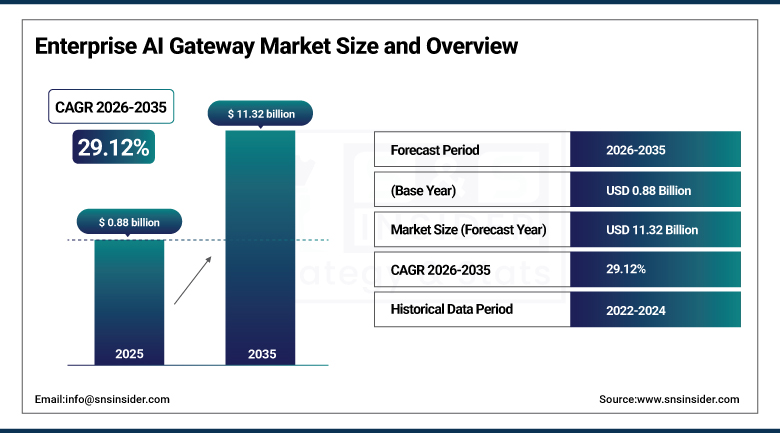
To Get more information Enterprise AI Gateway Market - Request Free Sample Report
Enterprise AI Gateway Market Trends
-
Growing adoption of cloud-native AI workloads is driving demand for enterprise AI gateway solutions that enable secure, scalable, and efficient management of AI applications across organizations.
-
Centralized AI traffic routing, observability, guardrails, and policy enforcement strengthen AI governance, security, and operational control.
-
Integration with AI models, cloud platforms, enterprise applications, and security tools improves visibility, interoperability, and compliance across multi-model environments.
-
AI governance, security controls, data protection, and usage monitoring help reduce risks associated with generative AI and large language model deployments
-
Cloud-based and hybrid deployments enable scalable, centralized management of AI workloads while optimizing performance, cost, and compliance across enterprise environments.
U.S. Enterprise AI Gateway Market Outlook
The U.S. Enterprise AI Gateway Market was valued at USD 0.32 Billion in 2025 and is expected to reach around USD 3.52 Billion by 2035, growing at a CAGR of 27.15% from 2026–2035.
There is a surge in the growth of the enterprise AI gateway market in the United States due to the rapid adoption of artificial intelligence, generative AI applications, and cloud-native AI workloads across enterprises. Organizations across industries are increasingly deploying enterprise AI gateway platforms to securely manage, route, and monitor AI interactions across multiple models and applications. These platforms help enforce AI governance policies, protect sensitive data, optimize AI usage and costs, provide observability into AI workloads, and ensure compliance with organizational and regulatory requirements. In addition, growing investments in responsible AI, multi-model AI strategies, AI governance frameworks, and secure enterprise AI deployments are further accelerating the growth of the enterprise AI gateway market in the United States.
Microsoft introduced AI Gateway capabilities within Microsoft Global Secure Access in the United States, enabling enterprises to centrally secure and govern generative AI applications, AI agents, and large language models (LLMs). The solution provides real-time prompt injection protection, network-level guardrails, policy enforcement, and centralized monitoring to help organizations securely deploy enterprise AI workloads across hybrid and multi-cloud environments.
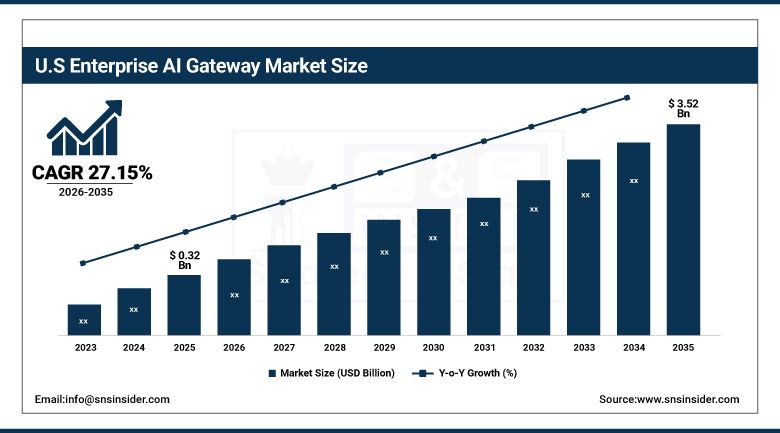
Enterprise AI Gateway Market Segment Analysis
-
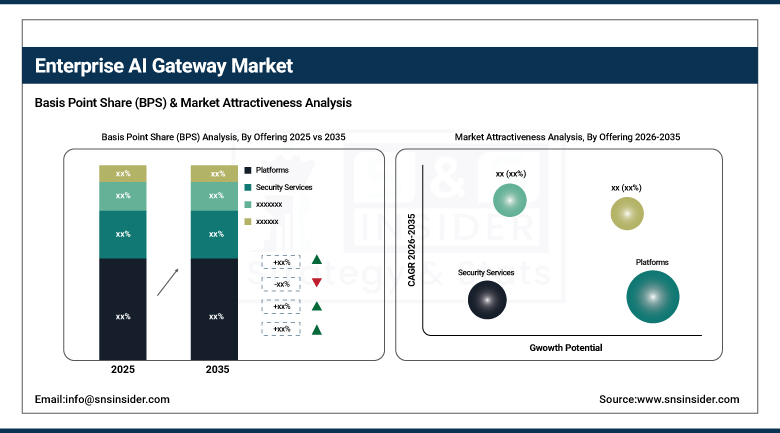
By Offering, platforms dominated the enterprise AI gateway market with an 81.40% share in 2025, while security services is projected to be the fastest-growing segment, registering a CAGR of 34.07% during 2026–2035.
-
By Deployment, cloud dominated the enterprise AI gateway market with a 67.80% share in 2025, while hybrid is projected to be the fastest-growing segment, registering a CAGR of 34.46% during 2026–2035.
-
By Gateway Type, LLM gateway dominated the enterprise AI gateway market with a 42.80% share in 2025, while agent gateway is projected to be the fastest-growing segment, registering a CAGR of 36.48% during 2026–2035.
-
By Organization Size, large enterprises dominated the enterprise AI gateway market with a 78.60% share in 2025, while small & medium enterprises (SMEs) are projected to be the fastest-growing segment, registering a CAGR of 33.77% during 2026–2035.
-
By Application, AI governance & compliance dominated the enterprise AI gateway market with a 28.40% share in 2025, while AI agent orchestration is projected to be the fastest-growing segment, registering a CAGR of 36.97% during 2026–2035.
-
By End-use Industry, IT & telecommunications dominated the enterprise AI gateway market with a 32.10% share in 2025, while healthcare & life sciences is projected to be the fastest-growing segment, registering a CAGR of 34.46% during 2026–2035.
By Offering, platforms dominated the enterprise AI gateway market, while security services is expected to grow fastest
In 2025, the Platforms sub-segment held the largest share of the enterprise AI gateway market due to the increasing adoption of enterprise AI gateway platforms that provide centralized management, secure routing, governance, and observability for AI models and applications. Organizations increasingly deployed platform-based solutions to manage multiple large language models (LLMs), enforce AI policies, protect sensitive data, optimize AI usage, and simplify integration across hybrid and multi-cloud environments.
The Security Services sub-segment is expected to be the fastest-growing during the forecast period due to the rising demand for implementation, integration, consulting, managed services, and continuous support for enterprise AI deployments. As organizations scale generative AI and agentic AI initiatives, they require specialized services to establish AI governance frameworks, configure security guardrails, ensure regulatory compliance, optimize AI performance, and manage increasingly complex multi-model AI environments.
By Application, AI governance & compliance dominated the enterprise AI gateway market, while ai agent orchestration is expected to grow fastest
According to Application, AI Governance & Compliance held the leading market share in the enterprise AI gateway market, whereas the AI Agent Orchestration segment is projected to have the highest growth rate during the forecast period. The AI Governance & Compliance segment was the largest in 2025 owing to the increasing need for centralized policy enforcement, secure AI access, regulatory compliance, data protection, and governance across enterprise AI applications, large language models (LLMs), and AI agents deployed in hybrid and multi-cloud environments.
The AI Agent Orchestration segment is expected to register the highest CAGR during the forecast period owing to the growing adoption of autonomous AI agents and multi-agent systems across enterprises. Organizations are increasingly investing in AI agent orchestration capabilities to coordinate AI workflows, manage interactions between multiple AI models and agents, optimize task execution, improve scalability, and ensure secure, efficient, and reliable operation of enterprise AI ecosystems.
By End-use Industry, it & telecommunications dominated the enterprise AI gateway market, while healthcare & life sciences is expected to grow fastest
As per End-use Industry, IT & Telecommunications accounted for the largest market share in the enterprise AI gateway market, while the Healthcare & Life Sciences segment is expected to exhibit the highest growth rate during the forecast period. The IT & Telecommunications segment dominated the market in 2025 due to the rapid adoption of generative AI, large language models (LLMs), AI-powered software development, cloud-native applications, and enterprise AI platforms. Organizations in this sector increasingly deployed enterprise AI gateways to securely route AI traffic, enforce governance policies, optimize AI performance, protect sensitive data, and manage AI workloads across hybrid and multi-cloud environments.
The Healthcare & Life Sciences segment is expected to witness the highest CAGR during the forecast period due to the increasing adoption of AI for clinical decision support, medical imaging, drug discovery, patient engagement, and healthcare operations. As healthcare organizations expand the use of generative AI and AI agents, demand for enterprise AI gateways is expected to rise to ensure secure AI access, regulatory compliance, data privacy, centralized governance, and seamless integration across diverse AI models and healthcare systems.
Regional Insights
|
Region |
Major Country |
Share within Region, 2025(%) |
|---|---|---|
|
North America |
United States |
87.40% |
|
Europe |
Germany |
24.80% |
|
Asia Pacific |
China |
42.90% |
|
Middle East & Africa |
Saudi Arabia |
30.80% |
|
Latin America |
Brazil |
39.70% |
North America Enterprise AI Gateway Market Insights
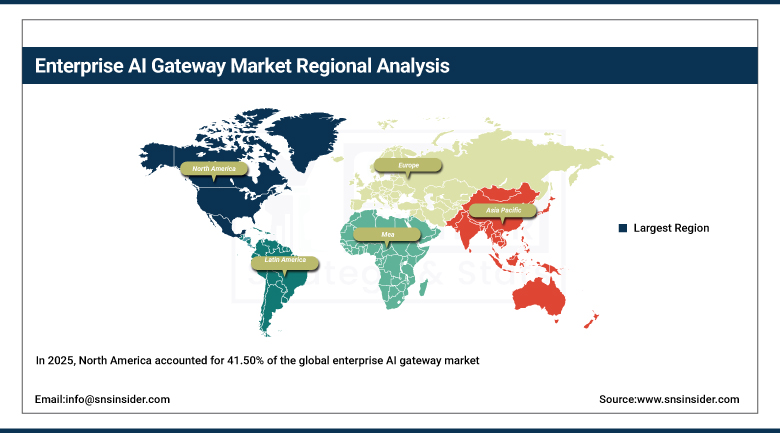
In 2025, North America accounted for 41.50% of the global enterprise AI gateway market, driven by the rapid adoption of artificial intelligence, generative AI applications, cloud-native AI infrastructure, and advanced enterprise digital transformation initiatives. Additionally, the United States represented 87.40% of the North America enterprise AI gateway market in 2025, supported by the presence of leading AI technology providers, hyperscale cloud companies, enterprise software vendors, and significant investments in responsible AI, AI governance, and secure AI deployment.
The growing adoption of large language models (LLMs), AI agents, multi-model AI environments, and cloud-based AI platforms is driving market growth across the region. Enterprises are increasingly deploying enterprise AI gateways to centrally manage AI traffic, enforce governance policies, secure AI interactions, protect sensitive data, optimize AI usage and costs, and provide observability across hybrid and multi-cloud environments. In addition, rising investments in AI governance frameworks, enterprise AI security, and scalable AI infrastructure are accelerating the adoption of enterprise AI gateway solutions across the United States and North America.
Get Customized Report as per Your Business Requirement - Enquiry Now
Europe Enterprise AI Gateway Market Insights
Europe remains a key region in the enterprise AI gateway market due to the increasing adoption of artificial intelligence, generative AI applications, cloud-native AI infrastructure, and stringent AI governance and data privacy regulations. Germany accounted for 24.80% of the Europe enterprise AI gateway market in 2025, supported by its strong industrial base, advanced digital transformation initiatives, and growing investments in enterprise AI, cloud computing, and secure AI deployment across critical industries.
The growth of the enterprise AI gateway market in Europe is driven by the rising adoption of AI-powered business applications, large language models (LLMs), AI agents, hybrid and multi-cloud environments, and enterprise AI governance frameworks. Furthermore, increasing demand for centralized AI traffic management, secure AI access, policy enforcement, observability, cost optimization, and compliance with evolving regulations is accelerating market adoption. Growing investments across manufacturing, BFSI, healthcare & life sciences, IT & telecommunications, retail, and public sector organizations are expected to support sustained market growth over the forecast period.
Asia Pacific Enterprise AI Gateway Market Insights
The Asia-Pacific enterprise AI gateway market is expected to register the highest CAGR 26.30% during the forecast period, driven by the rapid adoption of artificial intelligence, generative AI applications, cloud-native AI infrastructure, and expanding enterprise digital transformation initiatives. China accounted for 42.90% of the Asia-Pacific enterprise AI gateway market in 2025, supported by its large enterprise base, expanding AI ecosystem, significant investments in AI innovation, and growing deployment of AI across manufacturing, financial services, healthcare, and public sector organizations.
Growing adoption of large language models (LLMs), AI agents, AI-powered business applications, hybrid and multi-cloud environments, and enterprise AI platforms is creating significant growth opportunities across the region. Furthermore, increasing demand for centralized AI traffic management, secure AI access, governance policy enforcement, observability, cost optimization, and seamless integration across multiple AI models is expected to accelerate the adoption of enterprise AI gateway solutions throughout the forecast period.
Middle East & Africa and Latin America Enterprise AI Gateway Market Insights
The Middle East & Africa enterprise AI gateway market is growing steadily due to rising investments in artificial intelligence, cloud infrastructure, and enterprise digital transformation. Organizations are increasingly deploying enterprise AI gateway solutions to securely manage AI traffic, enforce governance policies, protect sensitive data, and optimize AI usage across cloud and hybrid environments. Saudi Arabia accounted for 30.80% of the regional market in 2025, supported by national AI strategies, expanding cloud infrastructure, and increasing adoption of enterprise AI across government and private sector organizations.
The Latin America enterprise AI gateway market is expanding with the growing adoption of enterprise AI, cloud computing, and digital transformation initiatives. Brazil led the regional market in 2025, accounting for 39.70% of the regional market, driven by investments in AI-powered business applications, cloud platforms, and enterprise AI modernization. Rising demand for centralized AI governance, secure AI access, AI traffic management, policy enforcement, observability, and cost optimization is expected to accelerate the adoption of enterprise AI gateway solutions across the region.
Growth Driver: Rising adoption of enterprise AI and AI governance accelerating enterprise AI gateway market growth
The increasing adoption of artificial intelligence, generative AI, large language models (LLMs), AI agents, and cloud-native AI workloads has emerged as a major driver of the enterprise AI gateway market. Organizations are increasingly deploying enterprise AI gateway solutions to centrally manage AI traffic, securely connect multiple AI models, enforce governance policies, protect sensitive data, and provide observability across cloud, on-premises, and hybrid environments. As enterprise AI deployments continue to expand, the need for secure, scalable, and policy-driven AI infrastructure is becoming increasingly critical.
The growing implementation of AI governance frameworks, rising demand for centralized AI access control, secure AI routing, policy enforcement, usage monitoring, cost optimization, and compliance with evolving AI regulations are expected to fuel the enterprise AI gateway market. Furthermore, increasing investments in responsible AI, enterprise AI platforms, cloud-native infrastructure, hybrid and multi-cloud environments, and multi-model AI ecosystems are projected to further accelerate market growth.
Restraints: High implementation costs, AI governance complexity, and integration challenges may restrain enterprise AI gateway market growth
High implementation costs and integration complexity continue to hinder growth in the enterprise AI gateway market. Deploying enterprise AI gateway platforms often requires significant investments in AI infrastructure, gateway platforms, cloud services, security controls, governance frameworks, and skilled AI and IT professionals, making adoption challenging for small and medium-sized enterprises (SMEs). Moreover, compatibility issues with legacy IT systems, diverse AI models, enterprise applications, and hybrid and multi-cloud environments can complicate deployment and increase implementation time.
Additionally, organizations face challenges in establishing consistent AI governance policies, meeting evolving regulatory requirements, and integrating enterprise AI gateways with existing identity and access management (IAM), API management, security, observability, and cloud platforms. Managing multiple AI models and providers, ensuring interoperability across enterprise AI ecosystems, protecting sensitive data, and maintaining consistent policy enforcement can also limit adoption. These factors are expected to restrain the growth of the enterprise AI gateway market during the forecast period.
Opportunities: Growing adoption of enterprise AI, AI governance, and responsible AI initiatives
The increasing adoption of enterprise AI, generative AI, large language models (LLMs), and AI agents presents significant growth opportunities for the enterprise AI gateway market. Organizations are increasingly deploying enterprise AI gateway platforms to centrally manage AI traffic, enforce governance policies, secure AI interactions, protect sensitive data, optimize AI usage, and provide observability across enterprise AI environments. Continuous advancements in AI orchestration, multi-model management, policy enforcement, and AI gateway technologies are further expanding the capabilities of enterprise AI gateway solutions.
In addition, rising investments in responsible AI, expanding adoption of hybrid and multi-cloud AI infrastructures, and increasing enterprise demand for secure and scalable AI deployments are creating new opportunities for market participants. Growing demand for unified AI gateway platforms across cloud and on-premises environments, increasing implementation of AI governance and regulatory compliance frameworks, and continuous innovation in AI traffic management, security guardrails, and AI observability technologies are expected to support the long-term growth of the enterprise AI gateway market.
Recent Developments
-
2026: Kong introduced Kong AI Gateway 2.0 with a dedicated runtime, unified management for AI models, MCP servers, and AI agents, enabling enterprises to strengthen AI governance, observability, and secure multi-model deployments across production environments.
-
2026: Microsoft expanded Azure API Management AI Gateway with a Unified Model API, enhanced token observability, MCP content safety, and agent-to-agent (A2A) support, helping enterprises securely manage and orchestrate AI models from multiple providers through a single gateway.
-
2026: Cloudflare enhanced AI Gateway by introducing a unified REST API for OpenAI-, Anthropic-, and Google-compatible models, allowing enterprises to simplify multi-model integration, improve interoperability, and streamline AI application development.
-
2026: Kong launched Agent Gateway within Kong AI Gateway, extending governance to LLM, MCP, and agent-to-agent (A2A) traffic from a unified control plane, enabling enterprises to secure and manage next-generation agentic AI workloads.
Enterprise AI Gateway Market Key Players are:
-
Microsoft Corporation
-
Google LLC
-
Amazon Web Services, Inc.
-
IBM Corporation
-
Kong Inc.
-
Solo.io, Inc.
-
Palo Alto Networks, Inc.
-
Cloudflare, Inc.
-
F5, Inc.
-
NGINX, Inc. (F5)
-
LangChain, Inc.
-
OpenAI, LLC
-
Anthropic PBC
-
Mistral AI SAS
-
Oracle Corporation
-
Red Hat, Inc.
-
MuleSoft LLC (Salesforce)
-
Tyk Technologies Ltd.
Enterprise AI Gateway Market Report Scope:
| Report Attributes | Details |
|---|---|
| Market Size in 2025 | USD 0.88 Billion |
| Market Size by 2035 | USD 11.32 Billion |
| CAGR | CAGR of 29.12% From 2026 to 2035 |
| Base Year | 2025 |
| Forecast Period | 2026-2035 |
| Historical Data | 2022-2024 |
| Report Scope & Coverage | Market Size, Segments Analysis, Competitive Landscape, Regional Analysis, DROC & SWOT Analysis, Forecast Outlook |
| Key Segments | • By Offering (Platforms, Security Services) • By Deployment (Cloud, On-premises, Hybrid) • By Gateway Type (LLM Gateway, Agent Gateway, MCP Gateway, Unified AI Gateway, API Gateway) • By Organization Size (Large Enterprises, Small & Medium Enterprises (SMEs)) • By Application (AI Governance & Compliance, AI Security & Access Control, Multi-LLM Routing & Load Balancing, API Management & Integration, AI Agent Orchestration) • By End-use Industry (BFSI, Healthcare & Life Sciences, IT & Telecommunications, Retail & E-commerce, Others) |
| Regional Analysis/Coverage | North America (US, Canada, Mexico), Europe (Eastern Europe [Poland, Romania, Hungary, Turkey, Rest of Eastern Europe] Western Europe] Germany, France, UK, Italy, Spain, Netherlands, Switzerland, Austria, Rest of Western Europe]), Asia Pacific (China, India, Japan, South Korea, Vietnam, Singapore, Australia, Rest of Asia Pacific), Middle East & Africa (Middle East [UAE, Egypt, Saudi Arabia, Qatar, Rest of Middle East], Africa [Nigeria, South Africa, Rest of Africa], Latin America (Brazil, Argentina, Colombia, Rest of Latin America) |
| Company Profiles | Microsoft Corporation, Google LLC, Amazon Web Services, Inc., IBM Corporation, Cisco Systems, Inc., Kong Inc., Solo.io, Inc., Palo Alto Networks, Inc., Cloudflare, Inc., F5, Inc., NGINX, Inc. (F5), Portkey AI, Inc., LangChain, Inc., OpenAI, LLC, Anthropic PBC, Mistral AI SAS, Oracle Corporation, Red Hat, Inc., MuleSoft LLC (Salesforce), Tyk Technologies Ltd. |
Frequently Asked Questions
The AI Inference Infrastructure Market is expected to grow at a CAGR of 29.12% from 2025 to 2035.
The Platforms segment dominated the enterprise AI gateway market in 2025 with an 81.40% share.
North America dominated the enterprise AI gateway market in 2025 with a 41.50% share.
