
Floating Production System Market Report Scope & Overview:
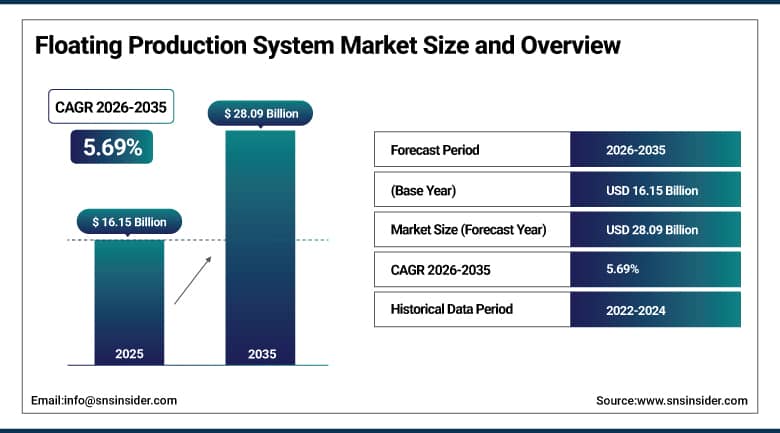
The Floating Production System Market size was valued at USD 16.15 Billion in 2025 and is projected to reach USD 28.09 Billion by 2035, expanding at a CAGR of 5.69% during the forecast period 2026–2035.
The market is expected to grow owing to the growth in exploration and production operations in more technically complex and deeper offshore reservoirs which require flexible production infrastructure for hydrocarbons. The increased investments in deep-water and ultra deep-water projects, offshore CAPEX by the national and international oil companies, as well as the increased interest in relocatable production facilities, will positively impact the demand for floating production systems in both mature and emerging offshore basins. Advancements in technology for floating hull, subsea integration, digital monitoring, and low carbon production will support future commercialization and operation efficiency in offshore energy projects.
The industry will experience an increase in the adoption of digital offshore production technologies, predictive maintenance solutions driven by artificial intelligence, cloud-based integrity management of assets, and remote real-time monitoring technologies to boost the uptime and cut down the operating costs. Automation, condition-based maintenance, advanced mooring systems, and emission reduction technologies are integrated in the floating production facilities to ensure maximum efficiency in production processes in line with environmental regulations. Expansions in offshore licensing rounds, continued investments in Brazilian pre-salt formations, Guyana projects, and West African offshore discoveries will provide favorable growth prospects for floating production systems during the forecast period.
To Get More Information On Floating Production System Market - Request Free Sample Report
Floating Production System Market Trends
-
Increasing deployment of FPSOs for deep-water and ultra-deep-water offshore developments.
-
Growing integration of AI-enabled predictive maintenance and digital offshore asset management platforms.
-
Rising investments in subsea tieback infrastructure supporting floating production facilities.
-
Expansion of offshore exploration activities across Brazil, Guyana, West Africa, and Southeast Asia.
-
Increasing adoption of low-emission power generation systems and carbon reduction technologies on floating production assets.
U.S. Floating Production System Market Size Outlook
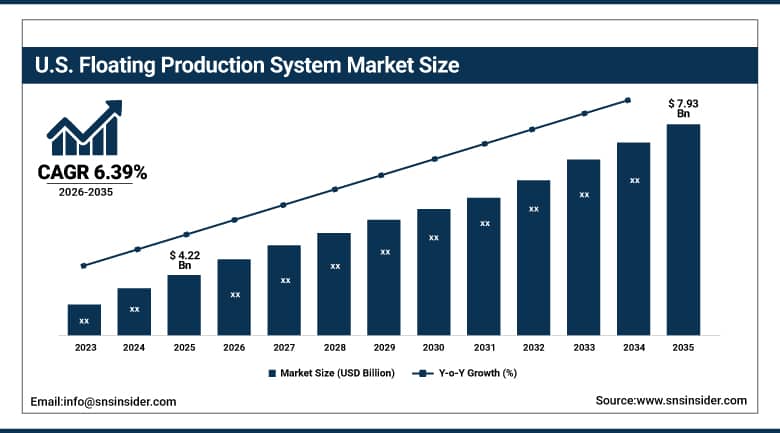
The U.S. Floating Production System Market was valued at USD 4.22 billion in 2025 and is expected to reach approximately USD 7.93 billion by 2035, expanding at a CAGR of 6.39% during 2026–2035.
The U.S. is expected to continue being the largest contributor to the North American market with ongoing investments in deep-water projects in the Gulf of Mexico, upgrading offshore oil and gas production facilities, and growing applications of modern floating production technologies. Digital twin technology implementation, artificial intelligence-powered production optimization and monitoring, and integrated subsea production are among the strategies that offshore operators use to achieve higher recovery rates and cut down downtime periods.
The government’s initiatives to support offshore lease activity and continuous investments from major energy firms will drive future growth in the market. In 2025, a number of operators have been intensifying their efforts in implementing intelligent offshore production monitoring solutions with real-time analysis and predictive maintenance features along with autonomous inspection and emissions monitoring capabilities.
Floating Production System Market Segment Analysis
-
By System Type, floating production storage and offloading (FPSO) dominated the market with 49.00% share in 2025, while spar platform are projected to witness the fastest growth with 7.08% CAGR during the forecast period.
-
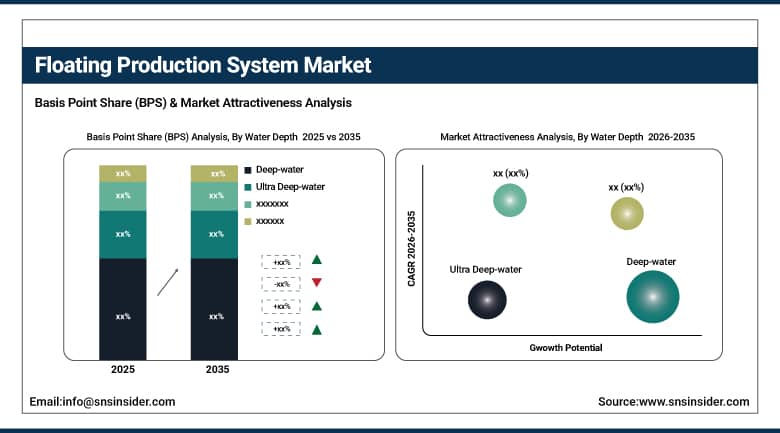
By Water Depth, deep-water dominated the market with 42.00% share in 2025, while ultra deep-water is projected to witness the fastest growth with 7.03% CAGR during the forecast period.
-
By Application, oil production dominated the market with 57.00% share in 2025, while offshore storage is projected to witness the fastest growth with 6.94% CAGR during the forecast period.
-
By End User, national oil companies dominated the market with 41.00% share in 2025, while offshore contractors are projected to witness the fastest growth with 7.64% CAGR during the forecast period.
By Water Depth, deep-water dominated, while ultra deep-water is the fastest-growing.
Deep-water is the largest market share segment in 2026 with 42.00% market share, which received significant investments in offshore developments including offshore areas in the Gulf of Mexico, pre-salt fields in Brazil, and West Africa. Developments in subsea production systems, dynamic positioning, reservoir surveillance technology, and floating production systems have helped to enhance the economics of deep-water projects. Both national and international oil companies will be emphasizing deep-water developments because of the large reserves, attractive production economics, and long operational life, thus ensuring continued strong demand for advanced floating production systems. Petrobras further expanded investments in deep-water pre-salt developments through increased capacity in floating production during 2025.
Ultra deep-water will see the fastest CAGR growth of 7.03% during 2026–2035 because of more offshore discoveries deeper than 1,500 meters, advanced drilling technology, and economics of ultra deep-water projects. Innovations in subsea processing equipment, large riser systems, AI-driven production optimization, and remotely monitored offshore platforms have made ultra deep-water developments economical and profitable. Increased exploratory activities in offshore Guyana, offshore Brazil, offshore U.S. Gulf of Mexico, and some African offshore basins have been further driving future growth. MODEC was developing next generation FPSOs suitable for deep-water and ultra deep-water offshore field developments with enhanced digital monitoring capability. Solutions, intelligent substations, and control platforms will drive adoption going forward.
By Application, oil production dominated, while offshore storage is the fastest-growing.
The oil production segment accounted for the highest revenue share in 2025, with a market share of 57.00%. A significant portion of this growth can be attributed to offshore crude oil production driven by deep water developments and investments in floating production infrastructure. Offshore operators are utilizing integrated production systems to optimize processes, including separation, storage, and exportation of crude oil, all while minimizing transportation expenses. The proliferation of offshore licensing rounds, augmented demand for energy resources, and enhanced economic viability of projects are propelling investment activity within offshore operators’ portfolios. Floating production infrastructure has been outfitted with various automation, digital monitoring, and predictive maintenance mechanisms to further bolster production capacity.
In terms of compound annual growth rates (CAGRs), the offshore storage segment is projected to register 6.94% market share, the swiftest increase throughout the entire forecast period. As noted earlier, the offshore production space is witnessing an ever-growing need for agile crude storage solutions designed to serve remote production zones as well as export operations. With more offshore development taking place without direct connections to pipelines, there’s been a corresponding surge in demand for floating storage infrastructural developments capable of harmonizing seamlessly with upstream production facilities. To ensure maximum utility and operational efficacy, offshore storage operators continue deploying sophisticated cargo management systems along with digital tracking technologies related specifically to storage units themselves.
By End User, national oil companies dominated, while offshore contractors fastest-growing.
In 2025, the national oil companies (NOCs) segment captured the highest market share of 41.00%. Significant offshore investments have been made by government supported energy producers such as those operating in Brazil, Middle East, Africa, and Asia Pacific. To bolster domestic energy security and raise hydrocarbons production, NOCs are making hefty investments on long life offshore assets which will ensure maximum hydrocarbons recovery from offshore reserves. The robust financial positions and huge exploration portfolios available among NOCs allow them to continue acquiring floating production system across the world’s offshore markets. For example, Petrobras awarded offshore developments contracts in 2025-2026 to develop its Floating Production Infrastructure for Brazilian Offshore Projects.
During the forecast period, the offshore contractors segment will register the highest CAGR of 7.64% globally. Growing demand for offshore EPC (Engineering, Procurement & Construction), Installation, and Operations contract from upstream oil & gas operators is driving this industry sector. To cut down upfront capex exposure while expediting the overall schedule of offshore projects, oil companies are partnering up increasingly with specialized offshore contractors who can provide complete solutions. With the growing popularity of lease and operate business model in the FPSO segments, backed up with integrated offshore service agreements and latest technology based digital management platform for offshore assets, offshore production contractor businesses are witnessing an unprecedented boom all over the globe.
Regional Analysis:
|
Region |
Major Country |
Share within Region, 2025 (%) |
|---|---|---|
|
North America |
United States |
90.00% |
|
Europe |
Germany |
19.00% |
|
Asia Pacific |
China |
17.00% |
|
Middle East & Africa |
UAE |
23.00% |
|
Latin America |
Brazil |
12.00% |
North America Floating Production System Market Insights
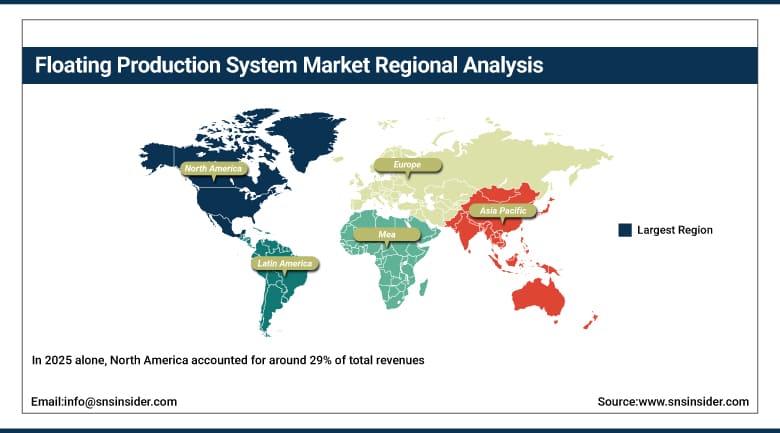
In 2025 alone, North America accounted for around 29% of total revenues from the global floating production system (FPS) market. Ongoing offshore development projects within countries such as the US Gulf of Mexico and a focus on developing deep-water production technologies have supported FPS investments throughout North America. The region’s leading role in offshore hydrocarbon extraction is reinforced by continued exploration activities led by some of the world’s largest energy firms focusing on legacy offshore sites. In response to industry needs, many FPS producers are now incorporating AI capabilities, deploying digital twins, implementing automation technologies, and adopting predictive maintenance tools designed to optimize productivity while reducing operational expenses.
As many offshore fields mature and are being redeveloped, FPS operators continue investing in infrastructure upgrades to connect new wellheads with existing processing facilities — driving consistent demand for advanced floating production systems in the region. Notably, Shell improved its offshore production intelligence by increasing the use of digital tools to monitor equipment and forecast maintenance requirements in its offshore areas of the Gulf of Mexico in 2026.
Get Customized Report as Per Your Business Requirement - Enquiry Now
Europe Floating Production System Market Insights
Europe is seeing continued investment in offshore production, particularly in Norway, the UK, and some North Sea projects. Companies are upgrading their floating production systems with better automation, ways to cut emissions, underwater power, and smart ways to manage their assets. The focus is on getting the most out of older offshore fields while reducing carbon pollution. This has led to more use of connected floating production systems that can run for a long time, be more reliable, and have a smaller environmental impact. Equinor, for example, kept investing in these digital offshore production tools and field improvement plans on the Norwegian Continental Shelf through 2025–2026.
Asia Pacific Floating Production System Market Insights
The Asia Pacific region is projected to witness the fastest growth with a CAGR of 7.58% over the forecast period owing to increasing offshore exploration activities, expansion of offshore natural gas developments, and high investment in deep-water production infrastructure in countries such as China, Malaysia, Australia, India, and Indonesia.
In addition, national oil companies and independent operators are augmenting their offshore capital expenditures for enhanced domestic energy security amid burgeoning regional energy demands. Continued adaptation of advanced subsea production systems, intelligent offshore monitoring platform solutions, AI-assisted production analytics tools, and automated inspection technologies are fostering improved operational efficiency, thereby enabling the commercialization of more sophisticated offshore developments. China National Offshore Oil Corporation (CNOOC) continues to expand its offshore production capacities via new deep-water development projects in 2026.
Middle East & Africa and Latin America Floating Production System Market Insights
Middle East & Africa region outlook will be boosted by the increase in offshore exploration campaigns as well as greater investment into offshore crude oil production operations, coupled with increased activity in deep-water fields development in the areas of Western Africa and the Middle East. In this scenario, governments and national oil companies have been investing into upgrading their offshore production capabilities based on digital assets management solutions as well as advanced floating production technology applications. Furthermore, the sustained offshore licensing activity along with higher level of offshore exploration expenditures and enhanced subsea engineering capabilities provide promising conditions for deploying Floating Production Systems (FPSO) units within several developing offshore basins around the world.
The Latin American segment will gain momentum due to its leader country, namely Brazil, which has remained active in offshore pre-salt fields developments, while offshore investments in Guyana’s territories and nearby offshore regions are also gaining ground. Moreover, both national and international oil companies persistently conclude big scale floating production deals to meet ever-growing crude oil output rates from ultra-deep water formations. At the same time, more widespread application of the latest generation FPSO structures that combine such modern technical features as carbon emission mitigation equipment installation, digital production optimizing systems integration, AI-based predictive maintenance algorithms and integrated subsea processing facilities shall assure the further progress of this industry sector over the entire forecast horizon.
Market Dynamics
Growth Drivers: Growing demand for energy globally and increased offshore hydrocarbon reserve discoveries.
In contrast to conventional fixed offshore platforms, floating production systems offer greater speed on field development timelines, reduced infrastructure cost components, and enhanced operating flexibility – key requirements for developing offshore fields at significant distances from land. Ongoing innovations in subsea production technology, dynamic positioning solutions, AI-enabled production optimization tools, and digital asset integrity management capabilities are all driving better project economics and operational dependability while maintaining high productivity levels. Ongoing expansion of offshore licensing rounds and growing capex spending by NOCs alongside increased sanctioning activity for new offshore projects augurs well for continued strong forward-looking prospects for this sector. Recently Petrobras approved several new offshore investment programs to enhance its existing floating production capacity across its Brazilian deep-water developments.
Restraints: High capital investments required to develop new projects and inherent complexities.
The development of all three types (FPSOs, TLPs, and Spar) involves complex engineering designs, access to specialist shipyards, sophisticated sub-sea infrastructure, and strict adherence to environmentally-friendly operations/safety standards – all leading to increased project costs. Furthermore, volatile crude oil prices coupled with interruptions along the global supply chains, inflationary pressures on key offshore construction inputs and limited availability of skilled labor are contributing factors that could hinder successful project execution and ultimately impact investment sentiment towards independent operators involved in smaller-scale offshore developments. In response, MODEC continues to implement its strategy of applying standardization principles to engineered solutions and adopting modular.
Opportunities: Growth through digital transformation and next-generation floating production systems.
Growing adoption of AI-enabled offshore operations, cloud based production analytics, digital twin technologies, autonomous inspection technologies, and predictive maintenance platforms continues to create substantial opportunity for floating production system providers as mature offshore basins (e.g., Gulf Of Mexico, North Sea, Brazil, West Africa) increase utilization of their floating production assets to extend field life and maximize hydrocarbons recoverable from existing infrastructure. Continued integration of intelligent subsea monitoring systems, robotics, advanced emissions management technologies, and remote asset management platforms will drive further improvements in production efficiency, lower operational expenditure and reduce environmental impact. Growing investment in carbon efficient offshore developments also should ensure continued commercialization of next generation floating production systems.
Recent Developments
-
2026: SBM Offshore secured financing and progressed multiple FPSO construction programs supporting offshore developments in South America while expanding deployment of digital asset integrity management and emissions reduction technologies.
-
2026: MODEC, Inc. advanced construction of next-generation FPSOs integrating AI-enabled equipment monitoring, predictive maintenance capabilities, and lower-carbon offshore production technologies for global offshore projects.
-
2025: BW Offshore announced continued progress on offshore production asset optimization and field development activities while strengthening its floating production portfolio through operational efficiency initiatives.
-
2025: Petrobras expanded investments across Brazil's offshore pre-salt developments through additional FPSO deployment programs supporting long-term crude oil production growth.
Floating Production System Companies are:
-
SBM Offshore N.V.
-
MODEC, Inc.
-
Yinson Holdings Berhad
-
Bumi Armada Berhad
-
Bluewater Energy Services B.V.
-
Petrobrás
-
Shell plc
-
Chevron Corporation
-
Exxon Mobil Corporation
-
Saipem S.p.A.
-
TechnipFMC plc
-
Mitsubishi Heavy Industries, Ltd.
-
Samsung Heavy Industries Co., Ltd.
-
Seatrium Limited
-
HD Hyundai Heavy Industries Co., Ltd.
-
Baker Hughes Company
-
SLB (Schlumberger Limited)
-
Wood plc
Floating Production System Market Report Scope:
| Report Attributes | Details |
|---|---|
| Market Size in 2025 | USD 16.15 Billion |
| Market Size by 2035 | USD 28.09 Billion |
| CAGR | CAGR of 5.69% From 2026 to 2035 |
| Base Year | 2025 |
| Forecast Period | 2026-2035 |
| Historical Data | 2022-2024 |
| Report Scope & Coverage | Market Size, Segments Analysis, Competitive Landscape, Regional Analysis, DROC & SWOT Analysis, Forecast Outlook |
| Key Segments | • By System Type (Floating Production Storage and Offloading (FPSO), Floating Storage and Offloading (FSO), Tension Leg Platform (TLP), Spar Platform, Others) • By Water Depth (Shallow Water, Deep-water, Ultra Deep-water) • By Application (Oil Production, Gas Production, Offshore Storage, Others) • By End User (National Oil Companies, International Oil Companies, Independent Operators, Offshore Contractors, Others) |
| Regional Analysis/Coverage | North America (US, Canada), Europe (Germany, UK, France, Italy, Spain, Russia, Poland, Rest of Europe), Asia Pacific (China, India, Japan, South Korea, Australia, ASEAN Countries, Rest of Asia Pacific), Middle East & Africa (UAE, Saudi Arabia, Qatar, South Africa, Rest of Middle East & Africa), Latin America (Brazil, Argentina, Mexico, Colombia, Rest of Latin America). |
| Company Profiles | SBM Offshore N.V., MODEC, Inc., BW Offshore Ltd., Yinson Holdings Berhad, Bumi Armada Berhad, Bluewater Energy Services B.V., Petrobrás, Shell plc, TotalEnergies SE, Chevron Corporation, Exxon Mobil Corporation, Saipem S.p.A., TechnipFMC plc, Mitsubishi Heavy Industries, Ltd., Samsung Heavy Industries Co., Ltd., Seatrium Limited, HD Hyundai Heavy Industries Co., Ltd., Baker Hughes Company, SLB (Schlumberger Limited), Wood plc |

Frequently Asked Questions
