
HVDC Transmission Market Report Scope & Overview:
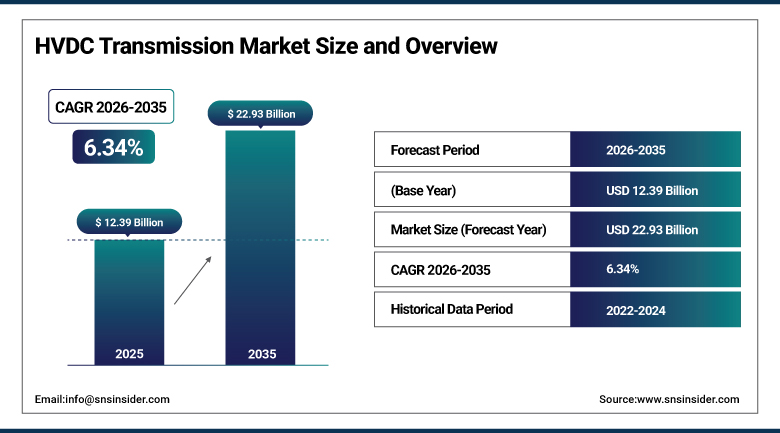
The HVDC Transmission Market was valued at USD 12.39 billion in 2025 and is expected to reach USD 22.93 billion by 2035, growing at a CAGR of 6.34% from 2026–2035.
The global High Voltage Direct Current (HVDC) Transmission Market is experiencing a strategic renaissance as the global energy transition fundamentally changes what power grids are required to do, transforming them from regionally self-contained networks of dispatchable generation into interconnected, internationally integrated systems that must efficiently transport large volumes of renewable energy from geographically remote generation sites to urban consumption centres across distances and environmental boundaries where conventional alternating current transmission technology is technically inefficient or physically impractical. HVDC transmission enables bulk electricity transfer at losses far below those of equivalent alternating current transmission over distances exceeding several hundred kilometres, maintains stable power flows across asynchronous grid boundaries that prevent direct AC interconnection between incompatible grid frequencies, and supports offshore wind energy transmission through subsea cable routes where AC reactive power losses become prohibitive beyond 50 to 80 kilometres. The global offshore wind industry's extraordinary expansion, with Europe deploying tens of gigawatts annually and Asia Pacific investing aggressively in offshore wind capacity, is creating the single largest near-term HVDC market driver as every major offshore wind project beyond 80 kilometres from shore requires HVDC cable technology for cost-effective power transmission to onshore grid connection points. Government grid modernisation investment programmes across Europe, North America, and Asia Pacific are simultaneously creating demand for HVDC technology in cross-border interconnection projects that improve renewable energy integration across national grid boundaries and in ultra-high-voltage transmission projects that transport solar and wind energy from resource-rich remote regions to population-dense demand centres thousands of kilometres away.
The HVDC Transmission Market's 6.34% CAGR from 2026 to 2035 reflects the structural demand certainty created by climate commitments requiring massive renewable energy deployment that physically cannot be integrated into national grids without HVDC infrastructure investment, combined with the growing recognition by governments and utilities that cross-border HVDC interconnections provide the grid flexibility and renewable energy balancing capability that makes 50 to 80% renewable electricity systems technically and economically viable. North America's expected fastest regional growth at 8.00% CAGR confirms that the U.S. IRA's renewable energy investment is progressively creating HVDC infrastructure demand alongside generation capacity expansion.
To Get more information HVDC Transmission Market - Request Free Sample Report
HVDC Transmission Market Trends
-
Accelerating deployment of Voltage Source Converter HVDC technology in offshore wind transmission applications, where VSC's ability to control active and reactive power independently, start up against a black grid without an active AC network, and operate in compact converter station configurations compatible with offshore platform installation provides decisive technical advantages over traditional Line Commutated Converter technology.
-
Growing development of multi-terminal HVDC networks and HVDC grids that connect multiple generation sources and consumption points within a single DC transmission system, enabling more flexible and resilient renewable energy integration than point-to-point HVDC links while progressively creating the foundation for future European Supergrid and Asian Power Grid interconnection visions.
-
Rising adoption of ultra-high voltage DC transmission at 800 kV and above in China and India for long-distance bulk power transmission from remote renewable resource zones to demand centres, where higher transmission voltage levels reduce per-megawatt transmission losses and enable economically viable transmission over distances of 2,000 to 3,000 kilometres.
-
Increasing localisation of HVDC technology manufacturing in major markets including China, India, and Brazil, where government industrial policy and project content requirements are compelling global HVDC equipment suppliers to establish local manufacturing facilities, transferring advanced power electronics technology to domestic industrial partners.
-
Growing integration of digital control and monitoring systems within HVDC converter stations, enabling real-time performance optimisation, predictive maintenance scheduling, and remote diagnostics that improve system availability and reduce operation and maintenance costs across large HVDC network portfolios.
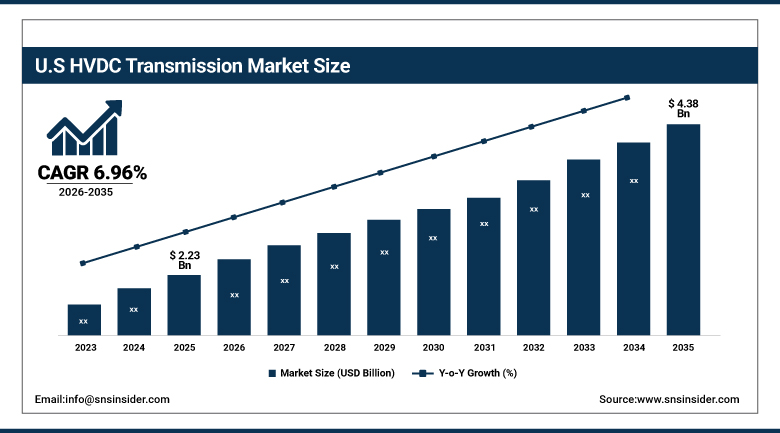
U.S. HVDC Transmission Market was valued at USD 2.23 billion in 2025 and is expected to reach USD 4.38 billion by 2035, growing at a CAGR of 6.96% during 2026–2035.
The United States represents a major and rapidly expanding HVDC Transmission Market, driven by the IRA's renewable energy investment incentives creating an extraordinary wind and solar build-out that is already straining existing AC transmission capacity in high-renewable states, the Biden and subsequent administrations' grid modernisation investment programmes targeting long-distance transmission interconnections, and growing recognition that renewable energy abundance in the nation's best wind and solar resource zones in the Great Plains and Southwest can only serve East and West Coast load centres through long-distance HVDC transmission infrastructure. The DOE's Liftoff Report on Long-Duration Storage and Transmission Buildout identified HVDC as essential infrastructure for the nation's clean energy future, while federal permitting reform efforts are progressively removing the regulatory barriers that have historically delayed large interstate transmission projects by a decade or more. The U.S. HVDC market is projected to grow at the fastest regional CAGR of 8.00%, reflecting the scale of the renewable energy transmission investment requirement created by IRA-stimulated clean energy deployment.
Rising localization of HVDC technology across the U.S. and the growing priority given to cross-border grid interconnections within the Inflation Reduction Act's clean energy framework are creating conditions where HVDC infrastructure investment is graduating from a niche technical application to a mainstream energy infrastructure priority receiving political and regulatory support comparable to the highway and pipeline investments of previous infrastructure investment eras. This transition from fringe to mainstream HVDC investment sustains the U.S. market's exceptional 6.96% CAGR through the 2026 to 2035 forecast period.
HVDC Transmission Market Segment Insights
-
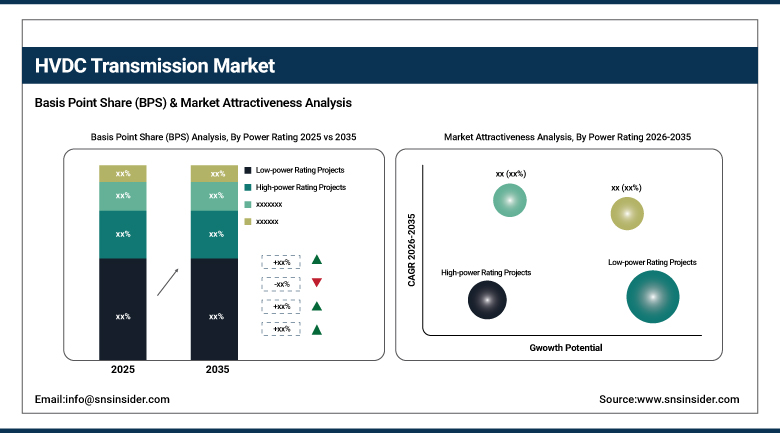
According to Power Rating, Low-power Rating Projects dominated with approximately 64% market share in 2025, driven by increasing demand for flexible and cost-effective transmission solutions in medium-scale renewable energy projects; High-power Rating Projects are expected to grow at the fastest CAGR of approximately 7.67% from 2026 to 2035 due to increased demand for transmitting bulk power over long distances.
-
In terms of Converter Technology, Line Commutated Converter dominated with approximately 67% market share in 2025, driven by its proven reliability in high-capacity, long-distance bulk power transmission; Voltage Source Converter is expected to grow at the fastest CAGR of approximately 7.81% from 2026 to 2035 driven by offshore wind integration requirements and urban underground transmission applications.
-
By Application, Long-Distance Bulk Power Transmission dominated in 2025 as the foundational HVDC application; Offshore Wind Integration is the fastest-growing application driven by the accelerating offshore wind capacity buildout across Europe, Asia Pacific, and the U.S. East Coast.
-
By End-User, Utilities dominated with the largest revenue share in 2025 as primary HVDC infrastructure investors; Renewable Power Plants are the fastest-growing end-user as offshore and onshore wind and solar project developers increasingly specify HVDC connections for projects requiring long-distance transmission.
HVDC Transmission Market Segment Analysis
By Power Rating: Low-power Rating Projects dominate, High-power Rating Projects grow fastest
Low-power Rating Projects retained the dominant position with approximately 64% of HVDC Transmission Market revenues in 2025, reflecting the commercial breadth of medium-scale HVDC applications including offshore wind farm HVDC cable connections in the 200 to 800 MW range, back-to-back converter stations for asynchronous grid interconnections at national borders, and medium-distance renewable energy transmission links that collectively represent the majority of project count and commissioned capacity in the global HVDC project pipeline. Low-power HVDC projects have benefited most from the maturation of VSC technology, which enables compact converter station configurations at moderate power levels that are economically viable across a wider range of project geographies and grid integration scenarios than the massive LCC converter stations required for ultra-high-power applications.
High-power Rating Projects are projected to grow at the fastest CAGR of approximately 7.67% through 2035, driven by the growing global investment in ultra-high-voltage DC transmission at 800 kV and above for bulk power transmission over distances of thousands of kilometres, and by the development of large-scale offshore wind cluster connection projects in the North Sea, U.S. Atlantic Coast, and Asia Pacific that aggregate hundreds of gigawatts of offshore wind capacity requiring high-power DC transmission infrastructure. China leads the global high-power HVDC project pipeline through its continued deployment of 800 kV and 1,100 kV ultra-high-voltage DC transmission lines connecting remote renewable energy zones in Xinjiang, Sichuan, and Yunnan to coastal load centres, while the EU's offshore wind expansion is creating a growing high-power offshore HVDC demand base as wind farms grow to 3 to 6 GW scale.
By Converter Technology: LCC dominates, VSC grows fastest
Line Commutated Converter technology retained the dominant position with approximately 67% of HVDC Transmission Market revenues in 2025, reflecting its 60-year commercial track record and engineering maturity in bulk power transmission applications where its high power capability at ultra-high voltages, excellent efficiency at rated load, and well-understood operational characteristics provide the reliability and cost-effectiveness that utilities and grid operators require for high-stakes infrastructure investments with design lives of 30 to 40 years. LCC technology is specified in the majority of ultra-high-voltage DC projects including China's 1,100 kV Changji to Guquan and India's 800 kV HVDC corridors, where the technology's ability to handle multi-gigawatt power transfer at the highest voltage levels makes it technically irreplaceable by current VSC alternatives. The large installed base of LCC HVDC equipment globally, comprising hundreds of converter stations worldwide, generates substantial recurring service, maintenance, and component replacement revenue that sustains the LCC segment's revenue leadership.
Voltage Source Converter is projected to grow at the fastest CAGR of approximately 7.81% through 2035, driven by its decisive technical advantages in offshore wind integration, urban underground HVDC cable applications, and multi-terminal HVDC grid development. VSC technology provides independent active and reactive power control capability that enables precise voltage support at both converter station ends without the reactive power compensation infrastructure that LCC systems require, black-start capability enabling island mode operation that is essential for offshore wind plant energisation before shore connection is established, and compact power electronics packaging that fits within the physical constraints of offshore platform topsides. The progressive cost reduction of advanced power semiconductor devices, including insulated gate bipolar transistors and silicon carbide power modules, is steadily improving VSC efficiency and reducing the cost premium of VSC over LCC at equivalent power ratings.
By Application: Long-Distance Transmission dominates, Offshore Wind Integration grows fastest
Long-Distance Bulk Power Transmission retained the dominant application position in 2025, encompassing the foundational HVDC application category where the technology's lower per-megawatt transmission losses at distances beyond 600 to 800 kilometres provide decisive economic advantages over AC alternatives. The global installed base of long-distance HVDC transmission lines, spanning thousands of kilometres of overhead HVDC lines connecting China's remote hydro, wind, and solar resources to coastal load centres, Brazil's Amazonian hydroelectric resources to southeastern cities, and India's renewable resource zones to industrial demand clusters, sustains the long-distance transmission segment's revenue leadership through the substantial project pipeline of new ultra-high-voltage DC lines under construction and in advanced planning stages.
Offshore Wind Integration is the fastest-growing HVDC application, driven by the extraordinary scale of offshore wind capacity being installed beyond 80 kilometres from shore across European waters, the U.S. Atlantic Coast, and Asia Pacific seas where HVDC cable technology is the only cost-effective power transmission medium. Europe's North Sea offshore wind expansion, targeting over 300 GW of cumulative capacity by 2050 under national and EU climate commitments, represents a pipeline of HVDC cable investment running into hundreds of billions of euros that will sustain offshore wind HVDC demand at exceptional levels through the forecast period. The progression from individual offshore wind farm HVDC connections to meshed North Sea offshore DC grids connecting multiple wind farms and multiple national grids will create the most technically sophisticated and commercially significant HVDC infrastructure development in history.
HVDC Transmission Market Regional Analysis
|
Region |
Major Country |
Share within Region (%) |
|---|---|---|
|
North America |
United States |
~75% |
|
Europe |
Germany |
~30% |
|
Asia Pacific |
China |
~56% |
|
Middle East & Africa |
Saudi Arabia |
~30% |
|
Latin America |
Brazil |
~54% |
Asia Pacific HVDC Transmission Market Insights
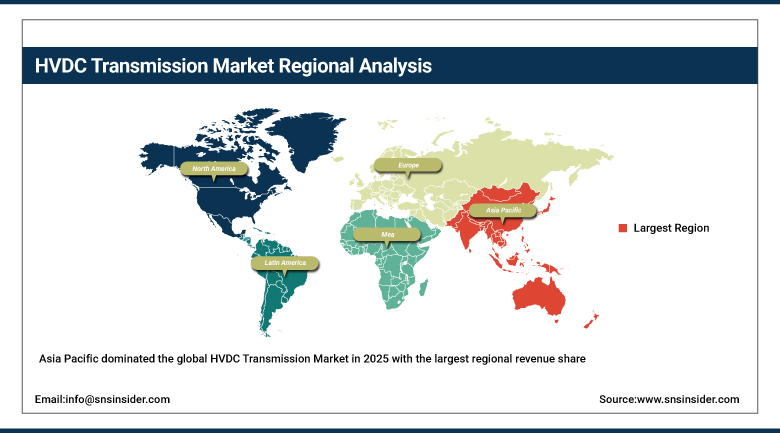
Asia Pacific dominated the global HVDC Transmission Market in 2025 with the largest regional revenue share, anchored by China's extraordinary pipeline of ultra-high-voltage DC transmission projects that represent the world's most ambitious national grid expansion programme, combined with India's growing HVDC corridor investment connecting renewable energy from the country's sunny and windy states to industrial load centres, Japan's offshore wind HVDC development, and South Korea's smart grid interconnection investment. China alone has installed more HVDC capacity than all other countries combined, with its 1,100 kV Changji to Guquan transmission project representing the world's highest voltage power transmission line and its ongoing deployment of new 800 kV lines sustaining Chinese HVDC demand at extraordinary levels.
Get Customized Report as per Your Business Requirement - Enquiry Now
Europe HVDC Transmission Market Insights
Europe is a major and technically sophisticated HVDC market, driven by the most active offshore wind development programme globally, the European Commission's Ten-Year Network Development Plan identifying dozens of cross-border HVDC interconnection projects as strategic infrastructure priorities, and the growing political and regulatory consensus around HVDC as essential infrastructure for European energy security and climate neutrality. Germany, Norway, the UK, and the Netherlands lead European HVDC investment, with the North Sea Wind Power Hub concept and various national offshore wind HVDC programmes representing a multi-decade investment pipeline. Leading HVDC technology suppliers ABB, Siemens, and GE Vernova are all headquartered or have major engineering centres in Europe, sustaining the continent's role as a global HVDC technology innovation centre.
North America HVDC Transmission Market Insights
North America is expected to register the fastest regional CAGR of 8.00% through 2035, driven by the IRA's renewable energy investment creating an extraordinary clean energy build-out that requires long-distance HVDC transmission to move wind energy from the Great Plains to Eastern cities and solar energy from the Southwest to the Pacific Northwest and Mountain West. The U.S. Department of Energy's grid modernisation investment programmes, including the Grid Resilience and Innovation Partnerships (GRIP) programme and the Building a Better Grid Initiative, are providing federal funding and policy support for long-distance HVDC transmission projects that had historically struggled to attract private financing due to long regulatory timelines and complex multi-state cost allocation arrangements.
Latin America and MEA HVDC Transmission Market Insights
Latin America and MEA are growing HVDC markets. Brazil leads Latin American revenues with approximately 54% of regional share through its long-established HVDC transmission infrastructure connecting Amazonian hydroelectric plants including Belo Monte and Itaipu to Southeast Brazil's industrial and population centres, representing one of the world's most extensive HVDC transmission networks operated by Eletrobras and its subsidiaries. MEA adoption is driven by Saudi Arabia's massive solar and wind energy investment under Vision 2030, South Africa's Renewable Independent Power Producer Programme creating HVDC-connected renewable projects, and Middle Eastern cross-border grid interconnection investment.
HVDC Transmission Market Growth Drivers:
-
Renewable energy integration imperatives and offshore wind development creating structural, policy-driven HVDC investment demand
The primary structural growth driver for the HVDC Transmission Market is the global commitment to decarbonising electricity generation that physically requires HVDC infrastructure investment to transport renewable energy efficiently from remote generation sites to consumption centres and to connect national grids across borders for renewable energy sharing that improves system resilience. The offshore wind industry's expansion beyond 80 kilometres from shore, where HVDC cable becomes economically mandatory, creates a direct proportional relationship between offshore wind deployment and HVDC cable market revenue that sustains exceptional growth in the offshore HVDC cable segment proportional to offshore wind capacity installation rates globally.
The rising localization of HVDC technology in major markets through domestic manufacturing partnerships and content requirements is simultaneously expanding the manufacturing capacity supporting global HVDC project delivery and creating national industrial capabilities that strengthen the technology ecosystem's ability to execute the extraordinary HVDC project pipeline that renewable energy targets require. This localization trend, combined with the renewable energy policy tailwinds in every major economy, confirms that the HVDC Transmission Market's structural demand growth is driven by policy and physical necessity rather than cyclical investment patterns, sustaining the market's 6.34% CAGR through the 2026 to 2035 forecast period.
HVDC Transmission Market Restraints
-
Very high project capital cost, complex regulatory approval timelines, and limited number of qualified HVDC equipment suppliers constraining project delivery capacity
A significant restraint on the HVDC Transmission Market is the extraordinary capital cost and lengthy delivery timeline of HVDC projects, where a typical point-to-point HVDC transmission link requires 5 to 10 years from initial planning through commissioning and total project costs ranging from hundreds of millions to several billion dollars that require complex multi-party financing structures and long-term power purchase agreements. The global HVDC equipment supply market is highly concentrated, with the majority of turnkey HVDC project capability concentrated among a handful of suppliers including Hitachi Energy, Siemens Energy, and GE Vernova, creating supply capacity constraints that can extend project timelines when multiple major HVDC projects compete for scarce engineering and manufacturing resources simultaneously.
HVDC Transmission Market Opportunities
-
Offshore HVDC grid development, multi-terminal HVDC network expansion, and energy storage integration with HVDC transmission
The development of meshed offshore HVDC grids in the North Sea and other offshore wind development zones, where multiple offshore wind farms and multiple national grids are connected within a single flexible DC network enabling optimal renewable energy routing and cross-border trading, represents the most technically ambitious and commercially significant long-term opportunity in the HVDC market. Multi-terminal HVDC network expansion on land, enabling multiple renewable energy sources and load centres to be served by integrated DC infrastructure rather than separate point-to-point links, progressively improves system economics and operational flexibility as DC breaker technology matures. The integration of utility-scale battery energy storage with HVDC converter stations, enabling HVDC links to provide storage and grid balancing services alongside power transmission, creates new revenue opportunities for HVDC infrastructure operators beyond simple transmission tariff income.
Recent Developments:
-
2025: Hitachi Energy received a major contract for the NeuConnect HVDC interconnector linking the UK and German electricity markets, representing one of Europe's most strategically important cross-border HVDC interconnection investments for renewable energy integration.
-
2025: Siemens Energy advanced the Suedlink HVDC project in Germany, a 700-kilometre underground HVDC cable connection transporting offshore wind energy from northern Germany to southern industrial load centres, representing the largest domestic HVDC infrastructure investment in German history.
-
2025: ABB (now Hitachi Energy) supplied converter transformer technology for China's latest 800 kV ultra-high-voltage DC transmission project connecting remote hydroelectric and wind resources to coastal provinces, continuing the longstanding supply partnership supporting China's HVDC expansion programme.
-
2025: GE Vernova expanded its HVDC technology portfolio with next-generation Modular Multilevel Converter systems targeting North Sea offshore wind hub connectivity projects, providing higher power density and improved efficiency relative to previous-generation VSC designs.
-
2025: Prysmian Group secured multiple contracts for high-voltage DC submarine cable supply for offshore wind farm connections in the U.S. Atlantic Coast and European North Sea, confirming the extraordinary commercial momentum of the HVDC cable segment driven by offshore wind deployment.
HVDC Transmission Market Key Players
-
Hitachi Energy Ltd. (ABB Power Grids)
-
Siemens Energy AG
-
GE Vernova Inc.
-
Prysmian SpA
-
Nexans SA
-
NKT AS
-
Mitsubishi Electric Corporation
-
General Cable Corporation
-
Toshiba Energy Systems and Solutions Corporation
-
State Grid Corporation of China
-
Alstom SA (GE Grid Solutions)
-
VISCAS Corporation
-
LS Cable and System Ltd.
-
Sumitomo Electric Industries Ltd.
-
Nari Technology Co. Ltd.
-
China XD Electric Co. Ltd.
-
Bharat Heavy Electricals Ltd.
-
C-EPRI Electric Power Engineering Co. Ltd.
-
Power Construction Corporation of China (PowerChina)
-
Eletrobras SA
| Report Attributes | Details |
|---|---|
| Market Size in 2025 | USD 12.39 Billion |
| Market Size by 2035 | USD 22.93 Billion |
| CAGR | CAGR of 6.34% From 2026 to 2035 |
| Base Year | 2025 |
| Forecast Period | 2026-2035 |
| Historical Data | 2022-2024 |
| Report Scope & Coverage | Market Size, Segments Analysis, Competitive Landscape, Regional Analysis, DROC & SWOT Analysis, Forecast Outlook |
| Key Segments | • By Power Rating (Low-power Rating Projects, High-power Rating Projects) • By Converter Technology (Line Commutated Converter, Voltage Source Converter) • By Transmission Type (Point-to-Point, Back-to-Back, Multi-Terminal) • By Application (Offshore Wind Integration, Cross-Border Interconnections, Long-Distance Bulk Power Transmission, Urban Underground Transmission, Others) • By End-User (Utilities, Renewable Power Plants, Industrial, Others) |
| Regional Analysis/Coverage | North America (US, Canada, Mexico), Europe (Eastern Europe [Poland, Romania, Hungary, Turkey, Rest of Eastern Europe] Western Europe] Germany, France, UK, Italy, Spain, Netherlands, Switzerland, Austria, Rest of Western Europe]), Asia Pacific (China, India, Japan, South Korea, Vietnam, Singapore, Australia, Rest of Asia Pacific), Middle East & Africa (Middle East [UAE, Egypt, Saudi Arabia, Qatar, Rest of Middle East], Africa [Nigeria, South Africa, Rest of Africa], Latin America (Brazil, Argentina, Colombia, Rest of Latin America) |
| Company Profiles | Hitachi Energy Ltd. (ABB Power Grids), Siemens Energy AG, GE Vernova Inc., Prysmian SpA, Nexans SA, NKT AS, Mitsubishi Electric Corporation, General Cable Corporation, Toshiba Energy Systems and Solutions Corporation, State Grid Corporation of China, Alstom SA (GE Grid Solutions), VISCAS Corporation, LS Cable and System Ltd., Sumitomo Electric Industries Ltd., Nari Technology Co. Ltd., China, XD Electric Co. Ltd., Bharat Heavy Electricals Ltd., C-EPRI Electric Power Engineering Co. Ltd., Power Construction Corporation of China (PowerChina), Eletrobras SA |

Frequently Asked Questions
The HVDC Transmission Market is expected to grow at a CAGR of 6.34% from 2026 to 2035.
The HVDC Transmission Market was valued at USD 12.39 billion in 2025.
The global renewable energy integration imperative creating physical demand for HVDC transmission to transport offshore wind and remote solar energy to urban consumption centres, combined with cross-border grid interconnection investment for renewable energy sharing, and government grid modernisation programmes in the U.S., Europe, China, and India allocating substantial capital to HVDC infrastructure development.
Low-power Rating Projects dominated with approximately 64% of market revenues in 2025, driven by increasing demand for flexible and cost-effective transmission solutions in medium-scale renewable energy projects, back-to-back converter stations for asynchronous grid interconnections, and offshore wind farm connections in the 200 to 800 MW range.
Asia Pacific dominated with the largest regional revenue share in 2025, anchored by China's extraordinary ultra-high-voltage DC transmission project pipeline representing the world's most extensive national HVDC infrastructure expansion programme, combined with India's growing HVDC corridor investment, Japan's offshore wind development, and South Korea's grid modernisation programme.
