
Hydrogen Sulfide Scavengers Market Report Scope and Overview:
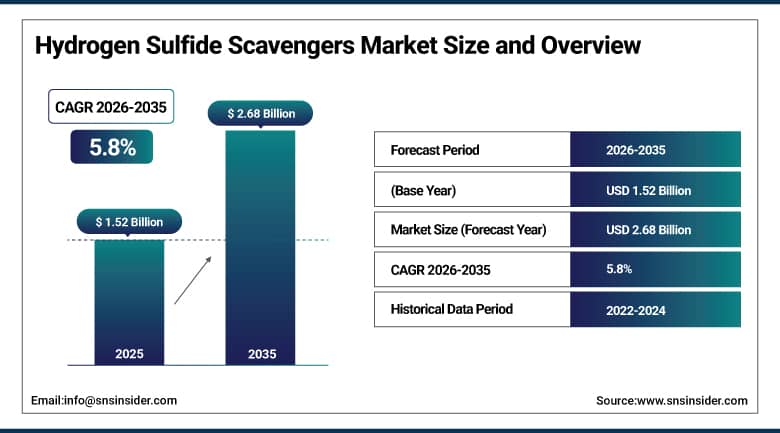
The Hydrogen Sulfide Scavengers Market was valued at USD 1.52 Billion in 2025 and is projected to reach USD 2.68 Billion by 2035, registering a CAGR of 5.8% from 2026 to 2035.
The Hydrogen Sulfide Scavengers Market is helping in enhancing safety and ensuring regulatory compliance by eliminating toxic H2S gas in oil and gas, wastewater, and biogas treatments. The characteristics that define the market include increase in exploration of sour gas, use of sustainable and eco-friendly scavenger chemistry, increase in the digitization of dosing and monitoring technologies, and adoption across up-, mid-, and down-stream processes in developed and emerging production regions.Significant momentum is being witnessed in triazine-based and non-triazine scavenger formulations, IoT-enabled dosing optimization and wastewater treatment applications, considering that operators, municipalities, and specialty chemical producers are directing sustained investment toward safer, more cost-effective H2S removal solutions that meet tightening occupational safety and environmental emission standards.
⮞SLB expanded its digital H2S monitoring and automated dosing optimization platform throughout 2025, integrating real-time hydrogen sulfide detection with its broader oilfield chemical management service portfolio across upstream operations.
To Get More Information On Hydrogen Sulfide Scavengers Market - Request Free Sample Report
Hydrogen Sulfide Scavengers Market Trends
-
Rising adoption of regenerative scavenger chemistries continues reducing chemical waste and improving cost efficiency across continuous oil and gas operations.
-
Growing digitalization of chemical dosing and real-time H2S monitoring systems continues optimizing scavenger consumption and reducing operational downtime.
-
Increasing sour gas exploration across mature and unconventional shale plays continues expanding baseline demand for high-capacity scavenger formulations.
-
Rising municipal and industrial wastewater treatment investment continues broadening scavenger application beyond traditional oil and gas end-markets.
-
Growing preference for eco-friendly, non-triazine scavenger formulations continues addressing tightening environmental discharge and disposal regulations.
U.S. Hydrogen Sulfide Scavengers Market Outlook
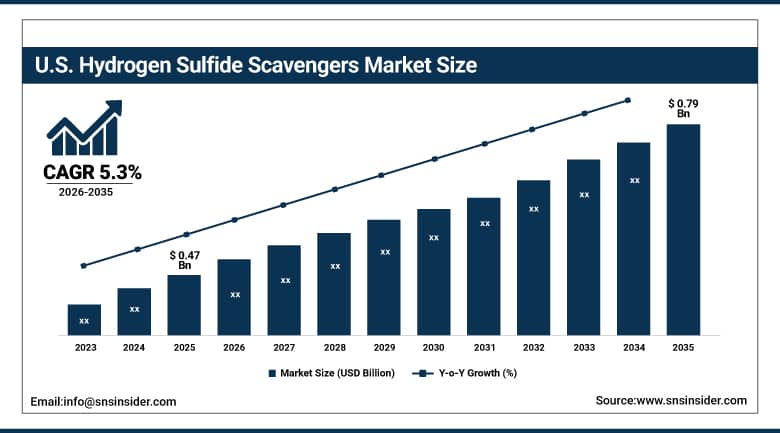
The U.S. Hydrogen Sulfide Scavengers Market was valued at approximately USD 0.47 Billion in 2025 and is projected to reach approximately USD 0.79 Billion by 2035, registering a CAGR of approximately 5.3% from 2026 to 2035.
The US demand is driven by the plentiful supply of sour gas within the Permian Basin, Marcellus Shale, and Gulf Coast refining areas, where the aging pipeline system and the rigorous safety regulations of the EPA and OSHA supported scavenger demand. Continued operator investment in high-capacity chemical scavengers and real-time monitoring systems reinforced the country's position as the largest single national market tracked in this report. Growing wastewater treatment investment and expanding biogas processing capacity added further layers of demand beyond the sector's traditional upstream oil and gas concentration, broadening the addressable customer base for scavenger suppliers nationwide.
⮞Baker Hughes signed a memorandum of understanding with Iraq-based Halfaya Gas Company in April 2024 to deploy gas flaring reduction and H2S treatment technology at the Bin Umar gas processing plant.
Hydrogen Sulfide Scavengers Market Segment Analysis
-
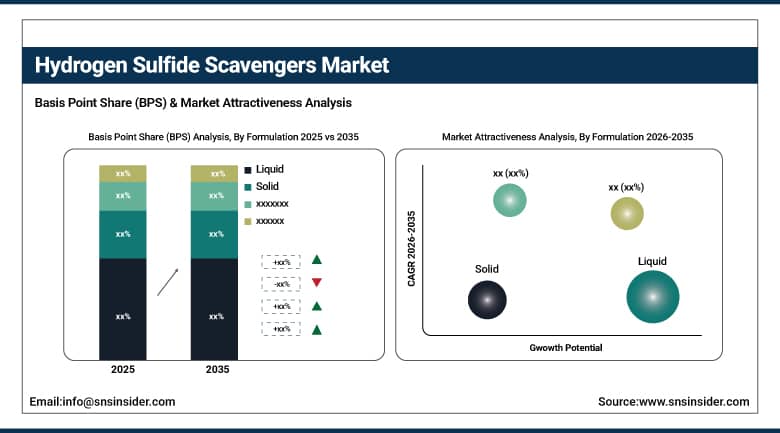
By Formulation, Liquid dominated the Hydrogen Sulfide Scavengers Market with a 61.00% share in 2025, while Solid is the fastest-growing formulation segment with a CAGR of 6.40% from 2026–2035.
-
By Product Type, Non-Regenerative Scavengers dominated the market with a 57.00% share in 2025, while Regenerative Scavengers are the fastest-growing product type segment with a CAGR of 7.10% from 2026–2035.
-
By Application, Oil & Gas dominated the market with a 64.00% share in 2025, while Wastewater Treatment is the fastest-growing application segment with a CAGR of 6.80% from 2026–2035.
-
By End-Use Industry, Upstream dominated the market with a 52.00% share in 2025, while Midstream is the fastest-growing end-use industry segment with a CAGR of 6.50% from 2026–2035.
By Formulation, Liquid Scavengers Lead the Hydrogen Sulfide Scavengers Market While Solid Scavengers Record the Fastest Growth
The Liquid Scavengers segment dominated the Hydrogen Sulfide Scavengers Market in 2025, supported by its versatility and ease of injection across oil and gas, petrochemical, and water treatment applications. Liquid formulations continue offering operators precise dosing control and rapid reaction kinetics with H2S, making them the preferred choice for continuous wellhead, pipeline, and processing facility treatment. Established supply chains and broad compatibility with existing chemical injection infrastructure across established producing regions reinforced liquid scavengers' leading formulation share throughout the forecast period.
The Solid Scavengers category is witnessing the highest growth rate in the Hydrogen Sulfide Scavengers Market due to increasing preference for scavenger types that are easy to carry, stock, and handle in remote or offshore locations where there is no specific liquid chemicals facility available. The use of solid scavenger types is preferred by companies running offshore rigs and remote pipelines due to the convenience of the former and the decreased chances of spillages when being transported. The future innovations in terms of increasing the reaction efficiency of solid scavengers will keep up with the growth of the segment.
⮞In July 2025, Baker Hughes published a field case study documenting the use of its PETROSWEET HSW24112 hydrogen sulfide scavenger to reduce H₂S concentrations in sales gas by 60%, helping an operator meet pipeline specifications and improve production economics.
By Product Type, Non-Regenerative Scavengers Dominate the Hydrogen Sulfide Scavengers Market While Regenerative Scavengers Emerge as the Fastest-Growing Product Type Segment
The Non-Regenerative Scavengers segment dominated the Hydrogen Sulfide Scavengers Market in 2025 owing to their proven single-use effectiveness in rapidly neutralizing H2S at the wellhead, in pipelines, and within storage tanks without requiring dedicated regeneration infrastructure. Formulations using triazines, which is by far the most commonly used non-regenerative chemistry today, have continued to reap benefits from years of performance records, widespread supplier presence, and easy-to-handle injection technology, thus making it a go-to option for companies facing uncertain levels of H2S. The preference for low-capital-investment treatments by small and medium-sized companies further consolidated the segment's top revenue contributor position.
The Regenerative Scavengers segment is the fastest growing within the Hydrogen Sulfide Scavengers Market, propelled by rising operator interest in reusable chemistries that generate less spent waste and lower disposal costs across continuous, high-volume processing operations. Increasing environmental pressure on the disposal of spent scavengers, together with increasingly stringent discharge controls for mature production regions, will continue to drive major players to regenerate systems in spite of their initial high investment cost. Chemical manufacturers that increase regeneration efficiency cycles should be able to maintain above-average growth rates in this sector over the forecast period.
⮞In May 2025, International Chemicals LLC, a subsidiary of SMC Global, launched AvanScav 1450, a triazine-free, amine-free hydrogen sulfide scavenger designed to reduce scaling, solid buildup, and equipment fouling in upstream and downstream oilfield operations.
By Application, Oil & Gas Dominates the Hydrogen Sulfide Scavengers Market While Wastewater Treatment Emerges as the Fastest-Growing Application Segment
The Oil & Gas segment dominated the Hydrogen Sulfide Scavengers Market in 2025, reflecting the industry's position as the largest single source of H2S generation across upstream production, midstream transport, and downstream refining operations. The sour gas reservoirs found in the Permian Basin, the Middle East, and Western Canada still require significant amounts of scavengers to ensure the safety of employees, avoid corrosion in pipelines, and meet the requirements for pipeline quality gas. The increase in the production of unconventional and offshore sour gas ensured the leadership of the oil and gas industry in the application share.
The Wastewater Treatment segment is the fastest growing within the Hydrogen Sulfide Scavengers Market, propelled by rising municipal and industrial investment in odor control and corrosion prevention across sewage collection and treatment infrastructure. Growing urbanization and aging wastewater infrastructure across both developed and emerging economies continue increasing H2S-related maintenance and safety concerns for municipal utilities. Rising adoption of scavenger-based treatment as a cost-effective alternative to full biological or chemical odor-control systems is expected to sustain this segment's above-average growth trajectory through the forecast period.
⮞In February 2025, Phoenix City Council approved a five-year contract, valued at up to USD 25 million, for chemicals, equipment, and services to control liquid-phase hydrogen sulfide, odors, and corrosion across designated locations in the city's wastewater collection system.
By End-Use Industry, Upstream Dominates the Hydrogen Sulfide Scavengers Market While Midstream Emerges as the Fastest-Growing End-Use Segment
The Upstream segment dominated the Hydrogen Sulfide Scavengers Market in 2025, as wellhead and production-site treatment remains the first and most critical point for neutralizing H2S before it enters gathering systems and processing facilities. Operators across sour gas-heavy basins continue prioritizing upstream scavenger injection to protect field personnel and prevent equipment corrosion at the earliest possible stage of the production process. Continued growth in unconventional drilling activity across sour gas-prone shale formations reinforced upstream's leading end-use revenue contribution throughout the forecast period.
The Midstream market is the highest growing market in the Hydrogen Sulfide Scavengers market due to increasing network of sour gas pipelines and increasing spending on infrastructure development in the gathering and transportation network in the newly explored unconventional plays. The midstream companies are using the scavenger technology at the compressor stations and gathering centers to ensure quality of gas in accordance with pipeline requirements and to avoid internal corrosion in long distance pipeline transportation network.
⮞In May 2026, Baker Hughes published a Permian Basin case study describing how its PETROSWEET hydrogen sulfide scavenger helped an operator reduce treatment costs across multiple contact-tower applications, demonstrating the commercial importance of optimizing gas-treatment chemical consumption.
Regional Insights
|
Region |
Major Country |
Share within Region, 2025 (%) |
|---|---|---|
|
North America |
United States |
78.00% |
|
Europe |
Germany |
28.00% |
|
Asia Pacific |
China |
52.00% |
|
Middle East and Africa |
UAE |
34.00% |
North America Hydrogen Sulfide Scavengers Market Insights
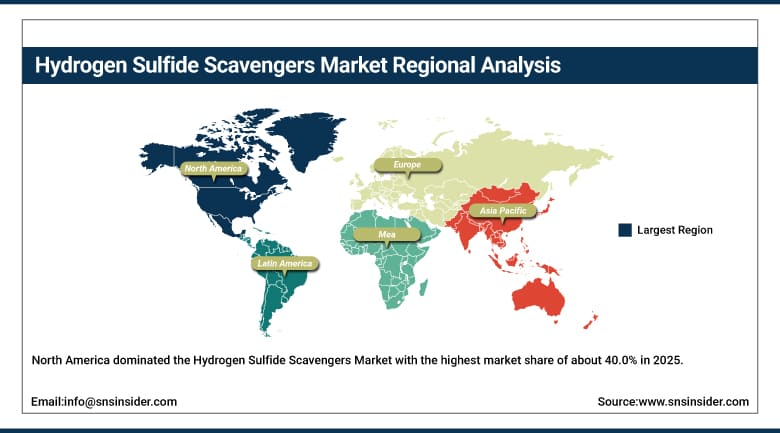
North America dominated the Hydrogen Sulfide Scavengers Market with the highest market share of about 40.0% in 2025. The region's mature sour gas production base, stringent EPA and OSHA safety mandates, and aging pipeline infrastructure requiring ongoing corrosion protection reinforced its leading position. Continued operator investment in high-capacity chemical scavengers and real-time monitoring systems across established producing basins kept regional demand well ahead of every other region tracked in this report.
The United States anchored by prolific sour gas output across the Permian Basin, Marcellus Shale, and Gulf Coast processing corridors. Canada's expanding oil sands and sour gas gathering operations added further regional demand, with continued regulatory emphasis on worker safety and emissions compliance keeping North America the largest addressable market for scavenger suppliers and service providers through the forecast period.
⮞In May 2025, International Chemicals LLC launched AvanScav 1450, a non-triazine hydrogen sulfide scavenger developed for oilfield operations, providing U.S. operators with an additional treatment option designed to reduce scaling, solids accumulation, and equipment fouling.
Get Customized Report as Per Your Business Requirement - Enquiry Now
Europe Hydrogen Sulfide Scavengers Market Insights
Europe had a significant portion of worldwide revenue, which was ensured through ongoing sour gas treatment in the North Sea, existing petrochemical production centers, and increasing investments in municipal wastewater treatment in line with the stringent discharge regulations of the European Union. Ongoing regulation regarding worker safety and emissions from industrialized nations maintained steady regional consumption of scavengers and green scavengers.
Germany led demand of European revenue, supported by its substantial petrochemical manufacturing base and continued investment in industrial wastewater treatment infrastructure. The United Kingdom and Norway contributed further demand tied to North Sea sour gas processing operations, and continued European Union emissions regulation is expected to keep regional demand for eco-friendly scavenger chemistries on a steady upward trajectory through the forecast period.
⮞In January 2025, DBI Gas- und Umwelttechnik reported research findings on combining iron-based oxides and natural zeolites to remove hydrogen sulfide and volatile methylsiloxanes from biogas, supporting the development of alternative gas-cleaning materials for renewable-energy applications.
Asia Pacific Hydrogen Sulfide Scavengers Market Insights
Asia Pacific is advancing at the fastest pace among all regions tracked in this report, registering a CAGR of 7.6% during the forecast period, driven by rapidly expanding sour gas exploration across China, India, and Southeast Asia alongside growing municipal wastewater treatment investment tied to accelerating urbanization. Continued government investment in domestic natural gas production capacity kept the region's growth trajectory well ahead of every other region tracked in this report.
China was the front-runner in the region, buoyed by considerable state funding for developing their own sour gas fields and building petrochemical processing plants. The other important players in this regard were India and the Southeast Asian countries, where growth in wastewater treatment plant investments due to urban population growth provided an additional boost.
MEA and Latin America Hydrogen Sulfide Scavengers Market Insights
The Middle East and Africa and Latin America both showed steady growth, driven by the Middle East's substantial sour gas reserves and Latin America's expanding offshore oil and gas development. As both regions continued prioritizing worker safety and pipeline integrity across sour gas-heavy production basins, scavenger chemistries proved a genuinely practical way to protect personnel and equipment from H2S-related corrosion and toxicity risks.
The UAE led Middle East and Africa demand of regional revenue, supported by the country's substantial sour gas reserves and continued investment in gas processing infrastructure. Saudi Arabia and Qatar contributed further demand through expanding sour gas field development. In Latin America, Brazil accounted for the largest share of regional revenue through continued offshore pre-salt sour gas development, anchoring regional demand for scavenger chemistries.
⮞In August 2025, Saudi Arabia's Scientific and Medical Equipment House announced a SAR 28.75 million contract with Saudi Aramco for restoration, treatment, repair, and insulation of the main sulfur pits at the Wasit Gas Plant, with a 36-month implementation period.
Growth Drivers: Rising Sour Gas Exploration and Tightening Safety Regulations
The industry is driven by rising sour gas exploration activity, growing adoption of regenerative and eco-friendly scavenger chemistries, increasing digitalization of chemical dosing and monitoring systems, and continued adoption across upstream, midstream, and downstream applications in mature and emerging producing regions. As unconventional and offshore sour gas development continues expanding, the need for reliable, cost-effective H2S neutralization keeps driving sustained operator investment in scavenger chemistries.
Tightening occupational safety and environmental emission regulations continue reinforcing this driver, as regulatory agencies worldwide impose stricter H2S exposure limits and discharge standards across oil and gas, wastewater treatment, and industrial processing facilities. Continued advancement of digital dosing optimization and real-time monitoring technology further supports this driver, and that combination of regulatory pressure and improving chemical efficiency is exactly what keeps demand climbing at a steady, sustained pace.
⮞In December 2025, Saudi Aramco commenced operations at its Tanajib Gas Plant, a major component of its gas-processing expansion strategy. The facility is expected to reach raw-gas processing capacity of 2.6 billion standard cubic feet per day in 2026, supporting increased gas-treatment requirements.
Restraints: Volatile Raw Material Pricing and Spent Scavenger Disposal Complexity
Volatile pricing of key raw materials used in triazine-based and non-triazine scavenger formulations continues posing a genuine restraint on stable market-wide margins, particularly for smaller specialty chemical producers without the purchasing scale that major oilfield service companies can leverage. That cost volatility has kept pricing pressure a persistent challenge across the competitive landscape, particularly during periods of broader petrochemical feedstock price fluctuation.
Spent scavenger disposal complexity continues posing a further restraint, as regulatory scrutiny of triazine-based reaction by-products and their environmental disposal requirements remains an ongoing, evolving compliance challenge across most producing jurisdictions. That complexity keeps some operators evaluating regenerative alternatives despite their higher upfront capital requirements, a trade-off that continues shaping purchasing decisions across environmentally sensitive operating regions.
Opportunities: Eco-Friendly Formulation Innovation and Wastewater Treatment Expansion
Development of eco-friendly, non-triazine scavenger formulations represents a genuinely significant opportunity, as this emerging chemistry category promises reduced environmental disposal complexity relative to conventional triazine-based products. Specialty chemical producers positioned early in commercially viable eco-friendly formulations stand to capture meaningful share as regulatory pressure on spent scavenger disposal continues intensifying across established producing regions.
Municipal and industrial wastewater treatment markets present a second large opportunity, as municipal and industrial players realize that scavenger treatment is an economical option compared to biological or chemical treatments for odor control. For chemical manufacturers that have demonstrated commercial success in wastewater treatment with existing formulations, there is an attractive market opportunity amid ongoing investments in infrastructure driven by urbanization.
⮞In March 2026, Salt Lake City’s Department of Public Utilities began construction of its 500 South Biofilter project to control sewer odors and hydrogen sulfide emissions. The system combines biological treatment with activated-carbon filtration to reduce odors and protect sewer infrastructure, creating a relevant example of expanding H₂S-control investment outside oil and gas.
Recent Developments
- 2026: Merichem Technologies reported successful Permian Basin field trials of its ECOTREAT® process, achieving more than 99% H₂S removal without generating solid waste.
- 2025: Clariant expanded its hydrogen sulfide scavenger production capacity to meet rising demand across Middle Eastern and North American sour gas markets, reinforcing its regional supply reliability.
Hydrogen Sulfide Scavengers Companies are:
-
SLB (Schlumberger Limited)
-
Baker Hughes Company
-
Halliburton Company
-
The Dow Chemical Company
-
Clariant AG
-
Ecolab Inc.
-
Veolia Environnement S.A.
-
Nouryon Chemicals Holding B.V.
-
The Lubrizol Corporation
-
Kemira Oyj
-
Solvay SA
-
Merichem Technologies
-
Innospec Inc.
-
Dorf Ketal Chemicals
-
Vink Chemicals GmbH & Co. KG
-
Newpoint Gas LLC
-
Q2 Technologies, LLC
-
Chevron Phillips Chemical Company LLC
Hydrogen Sulfide Scavengers Market Report Scope :
| Report Attributes | Details |
|---|---|
| Market Size in 2025 | USD 1.52 Billion |
| Market Size by 2035 | USD 2.68 Billion |
| CAGR | CAGR of 5.8% From 2026 to 2035 |
| Base Year | 2025 |
| Forecast Period | 2026-2035 |
| Historical Data | 2022-2024 |
| Report Scope & Coverage | Market Size, Segments Analysis, Competitive Landscape, Regional Analysis, DROC & SWOT Analysis, Forecast Outlook |
| Key Segments | • By Product Type (Regenerative Scavengers, Non-Regenerative Scavengers & Others) • By Formulation (Liquid, Solid & Gas) • By Application (Oil & Gas, Wastewater Treatment, Biogas Production & Others) • By End-Use Industry (Upstream, Midstream & Downstream) |
| Regional Analysis/Coverage | North America (US, Canada), Europe (Germany, UK, France, Italy, Spain, Russia, Poland, Rest of Europe), Asia Pacific (China, India, Japan, South Korea, Australia, ASEAN Countries, Rest of Asia Pacific), Middle East & Africa (UAE, Saudi Arabia, Qatar, South Africa, Rest of Middle East & Africa), Latin America (Brazil, Argentina, Mexico, Colombia, Rest of Latin America). |
| Company Profiles | SLB (Schlumberger Limited), Baker Hughes Company, Halliburton Company, BASF SE, The Dow Chemical Company, Clariant AG, Ecolab Inc., Veolia Environnement S.A., Nouryon Chemicals Holding B.V., The Lubrizol Corporation, Kemira Oyj, Solvay SA, Arkema Group, Merichem Technologies, Innospec Inc., Dorf Ketal Chemicals, Vink Chemicals GmbH & Co. KG, Newpoint Gas LLC, Q2 Technologies, LLC, Chevron Phillips Chemical Company LLC. |

Frequently Asked Questions
The Hydrogen Sulfide Scavengers Market is expected to grow at a CAGR of approximately 5.8% from 2026 to 2035, based on triangulated secondary research estimates.
The Hydrogen Sulfide Scavengers Market was valued at approximately USD 1.52 Billion in 2025, based on triangulation across multiple independent research sources.
The major growth factor is rising sour gas exploration activity, growing adoption of regenerative and eco-friendly scavenger chemistries, and tightening occupational safety and environmental regulations.
The Non-Regenerative Scavengers segment dominated the Hydrogen Sulfide Scavengers Market by product type, representing the largest share of revenue in 2025.
North America dominated the Hydrogen Sulfide Scavengers Market in 2025, holding an estimated 40.0% share of total global market revenue.
