
BMI Resins Market Report Scope & Overview:
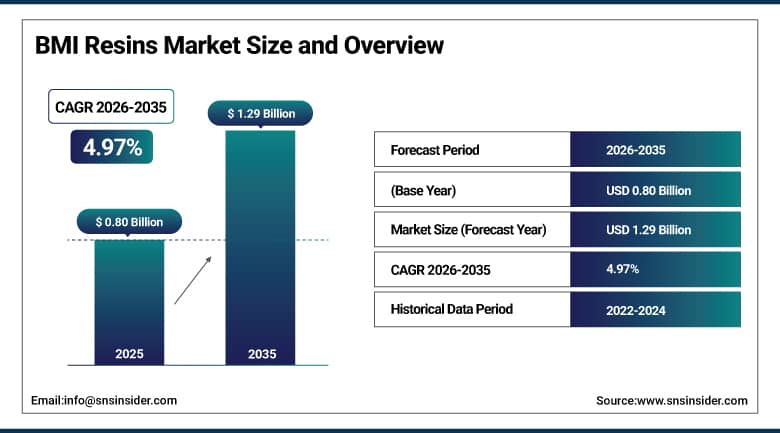
The BMI Resins Market was valued at USD 0.80 Billion in 2025 and is expected to reach USD 1.29 Billion by 2035, growing at a CAGR of 4.97% from 2026 to 2035.
The BMI Resins Market is growing strongly owing to the increasing output of commercial and military aerospace, increasing need for temperature resistance composites and technological advancements in the field of electronic packaging which needs superior thermal and dielectric properties. Bismaleimide (BMI) resins are thermoset addition type polyimides that have very high thermal stability up to 250°C, high mechanical strength and dielectric properties. Such properties enable them to be used as structural aircraft composites, engine parts, radomes and laminates for printed circuit boards that cannot be satisfied by ordinary epoxy systems. With commercial aerospace companies producing more airplanes to cater to increasing demand for flights worldwide and defense companies designing hypersonic and high-speed aircraft, the demand for BMI resins as prepregs, solutions and powders is on the rise.
⮞In 2026, Evonik Industries expanded its bismaleimide resin production capacity at its German facility to meet rising global aerospace composite demand, reinforcing its position as a leading BMI resin supplier to commercial and defense aircraft manufacturers
To Get More Information On BMI Resins Market - Request Free Sample Report
BMI Resins Market Trends
-
Rising adoption of BMI resin composites in next-generation hypersonic and high-speed aircraft is expanding demand for ultra-high-temperature materials.
-
Growing use of BMI resins in electronic packaging is supporting miniaturization trends in high-performance semiconductor applications.
-
Expanding commercial aerospace production rates are accelerating BMI prepreg composite consumption across structural aircraft components.
-
Increasing defense modernization spending is driving BMI resin adoption in military aircraft engine and airframe applications.
-
Strategic partnerships between resin manufacturers and aerospace OEMs are advancing next-generation bio-based BMI formulations.
U.S. BMI Resins Market Outlook
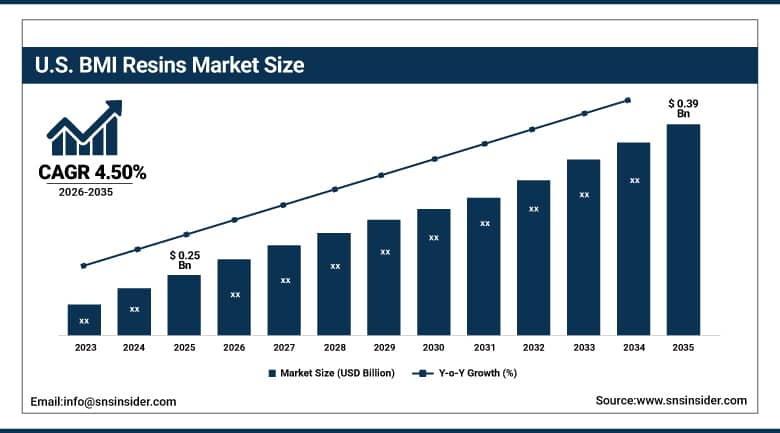
The U.S. BMI Resins Market was valued at approximately USD 0.25 Billion in 2025 and is projected to reach approximately USD 0.39 Billion by 2035, registering a CAGR of approximately 4.50% from 2026 to 2035.
The United States remains the single largest country market for BMI resins around the world due to its strong presence in commercial aerospace production, defense purchases, and advanced composites material R&D. The local aerospace producers and Tier-1 contractors remain increasingly active in using BMI resin-based composite materials for airframes, engine nacelles, and radomes as the rate of commercial aircraft production rises along with the introduction of next generation military aircraft needing materials with extremely high temperature capabilities. The ongoing DoD investments into hypersonic and advanced aircraft program development together with the rising demand from the local electronics industry for high-end semiconductor packaging materials keep fueling demand growth for BMI resins in the country.
⮞In 2025, Hexcel Corporation launched a new BMI prepreg system designed for improved processability in high-temperature aerospace structural applications, targeting commercial and defense aircraft manufacturers across North America.
BMI Resins Market Segment Analysis
-
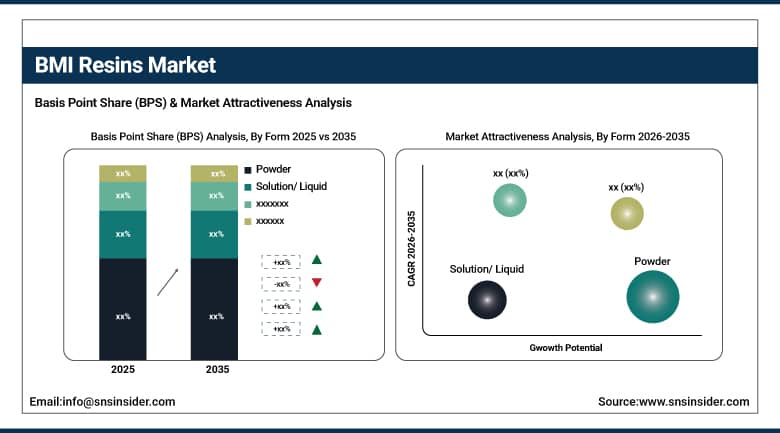
By Form, Powder dominated the BMI Resins Market with an estimated 58.40% share in 2025, while Solution/Liquid is the fastest-growing form segment with a CAGR of approximately 9.20% from 2026–2035.
-
By Temperature Grade, High-Temperature dominated the BMI Resins Market with a 71.30% share in 2025, while Standard is the fastest-growing temperature grade segment with a CAGR of 8.50% from 2026–2035.
-
By Application, Composites/Laminates dominated the BMI Resins Market with a 58.40% share in 2025, while Adhesives is the fastest-growing application segment with a CAGR of 8.60% from 2026–2035.
-
By End-Use Industry, Aerospace & Defense dominated the BMI Resins Market with a 64.70% share in 2025, while Electronics & Electrical is the fastest-growing end-use industry segment with a CAGR of 9.20% from 2026–2035.
By Form, Powder led while Solution/Liquid is the fastest-growing segment.
Powder BMI resins dominated the market in 2025 due to their excellent thermal stability, long shelf life, ease of handling, and suitability for high-performance composite manufacturing. Powder formulations enable precise processing and uniform resin distribution, supporting consistent material properties in aerospace, defense, automotive, and electronics applications. Their compatibility with advanced molding and impregnation techniques further strengthens adoption. Growing demand for lightweight, heat-resistant, and mechanically durable components, particularly in aerospace structures and high-temperature applications, continues to reinforce the segment’s leading market position.
Solution/Liquid BMI resins are projected to be the fastest-growing form segment due to their superior processing flexibility, easier application, and ability to achieve uniform resin dispersion across complex substrates. These formulations are increasingly preferred for advanced composites, coatings, adhesives, and electronic applications requiring precise wetting and impregnation. Rising adoption of lightweight materials in aerospace, automotive, and defense industries is creating additional demand. Technological advancements in liquid resin formulations, improved curing performance, and compatibility with automated manufacturing processes are further accelerating segment growth.
⮞In May 2026, Sumitomo Bakelite announced trial launches of its EME-L liquid encapsulant series for advanced semiconductor packages, targeting low warpage and high reliability in increasingly complex AI-driven packaging architectures.
By Temperature Grade, High-Temperature led while Standard is the fastest-growing segment.
The High-Temperature category held a market share of 71.30% of the BMI Resins Market in 2025. BMI resins for high temperatures with the ability to perform continuously beyond 250°C continue to be the leading type of temperature grade because of their critical importance in the manufacture of engine parts of airplanes, fast moving aerodynamic surfaces, and other uses that involve materials which can sustain themselves thermally, hence making the high-temperature grades the best choice for the toughest jobs in aerospace and defense industries where BMI resin’s inherent superiority over epoxy systems is important.
The Standard segment is anticipated to grow at the fastest rate during the forecast period 2026-2035, at a CAGR of 6.50%. Growing adoption of standard-grade BMI resins in electronics packaging and moderate-temperature industrial applications, where BMI's superior mechanical toughness and dielectric properties provide performance advantages over conventional thermosets without requiring the most extreme thermal specifications, is driving accelerated growth as manufacturers seek cost-effective BMI formulations for expanding non-aerospace applications.
⮞In March 2026, the UK's Defence Science and Technology Laboratory announced investment supporting Cross Manufacturing's pilot-scale production capability for ceramic matrix composites capable of withstanding temperatures above 1,000°C, advancing materials development for hypersonic and propulsion applications.
By Application, Composites/Laminates led while Adhesives is the fastest-growing segment.
The Composites/Laminates segment dominated the BMI Resins Market with a revenue share of 58.40% in 2025. Composite and laminate applications remain the leading category as BMI resins serve as the essential matrix material in high-performance structural composites used across aircraft primary and secondary structures, printed circuit board laminates, and radome components, reinforcing composites and laminates as the foundational application driving the majority of global BMI resin consumption across established aerospace and electronics manufacturing hubs.
The Adhesives segment is expected to register the fastest CAGR of 8.60% during the forecast period 2026-2035. Increased demand for high temperature resistant adhesives used in the aircraft industry in terms of manufacturing and repair purposes where BMI resins offer improved bond strength and thermal resistance when compared to regular epoxy based adhesives is causing rapid expansion of the market for this sector as BMI adhesives become specified by aerospace firms.
⮞In May 2025, NASA reviewed progress under its Hi-Rate Composite Aircraft Manufacturing project with partners from 22 organizations, evaluating manufacturing technologies intended to increase composite-aircraft production rates, reduce costs, and improve performance.
By End-Use Industry, Aerospace & Defense led while Electronics & Electrical is the fastest-growing segment.
The Aerospace & Defense segment dominated the BMI Resins Market with a revenue share of 64.70% in 2025. Aerospace and defense continue to be the dominant end-use application for BMI resins due to their superior thermal resistance, strength and flame resistance, which make them suitable for use in structural components of commercial and military airplanes, jet engine components, and radomes, thereby contributing to the persistent and valuable demand for them in the global aerospace industry.
The Electronics & Electrical segment is expected to witness the fastest CAGR of 9.20% during the forecast period 2026-2035. Increasing requirement for BMI resins in the manufacture of high performance printed circuit board laminates and semiconductor encapsulation due to the drive towards miniaturization and increased frequency operation that requires better thermal and dielectric properties is the factor propelling the fast growth of this sub-segment in electronics manufacturing which uses BMI based substrates.
⮞In April 2026, Kyocera announced commercialization of a multilayer ceramic-core substrate for advanced AI semiconductor packages, targeting high-density wiring and reduced package deformation as data-center processors and switch ASICs become more complex.
Regional Insights
|
Region |
Major Country |
Share within Region, 2025 (%) |
|---|---|---|
|
North America |
United States |
82.40% |
|
Europe |
France |
26.80% |
|
Asia Pacific |
China |
42.60% |
|
Middle East & Africa |
UAE |
24.50% |
|
Latin America |
Brazil |
33.20% |
North America BMI Resins Market Insights
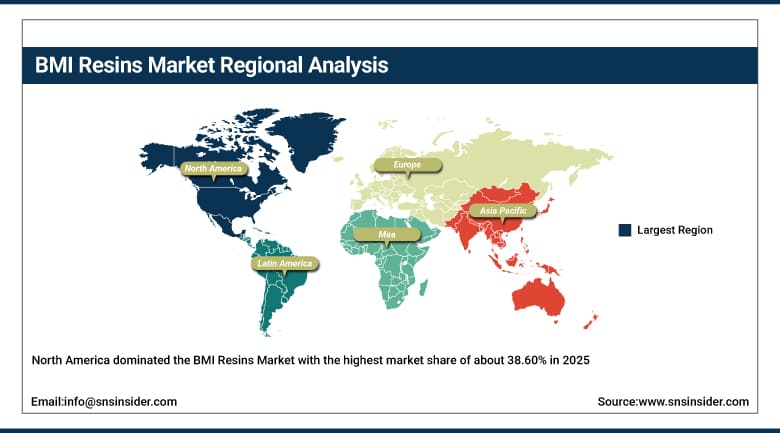
North America dominated the BMI Resins Market with the highest market share of about 38.60% in 2025, owing to the region's substantial commercial and military aerospace manufacturing base, extensive defense procurement programs, and leading position in advanced composite materials research and development. The region's mature aerospace supply chain and continued investment in next-generation aircraft and hypersonic defense programs continues to reinforce North America's position as the largest BMI resins market globally.
The US was the leading country within the North America BMI Resins Market in 2025 with a market share of 82.40% of the regional market, driven by its substantial commercial aerospace manufacturing base and extensive defense procurement programs. Canada is contributing to regional growth through its growing aerospace component manufacturing sector and expanding advanced composites research activity.
⮞In March 2025, GE Aerospace announced plans to invest nearly USD 1 billion in its U.S. factories and supply chain, including manufacturing expansions and facility upgrades intended to strengthen engine production, quality, and delivery capabilities.
Get Customized Report as Per Your Business Requirement - Enquiry Now
Asia Pacific BMI Resins Market Insights
The Asia Pacific BMI Resins Market is expected to witness the fastest growth rate during the forecast period 2026-2035, registering a CAGR of 8.80%. The market growth is driven by rapidly expanding commercial aerospace manufacturing capacity, growing domestic defense modernization programs, and increasing electronics manufacturing investment requiring high-performance packaging materials across the region's major and emerging manufacturing economies.
China is one of the main growth drivers in the Asia Pacific BMI Resins Market, owing to its expanding domestic commercial aircraft manufacturing program and growing defense modernization spending requiring advanced composite materials. Japan and South Korea, both hosting substantial electronics manufacturing and growing aerospace component production, are also contributing to regional growth through increasing BMI resin consumption across semiconductor packaging and aerospace applications.
⮞In February 2026, Beijing Jujia Machinery established a production base in China's Tianjin Economic-Technological Development Area with a planned investment of CNY 200 million, expanding manufacturing capabilities for aerospace components, aero-engine parts, and composite insulation materials.
Europe BMI Resins Market Insights
The Europe region was a major contributor to the BMI Resins Market in 2025, Supported by the presence of an extensive commercial aerospace and defense manufacturing sector that utilizes composite materials, growth within the region’s composite materials market is anticipated to continue through the forecast period due to further investment into new-generation aircraft and electronics manufacturing.
France is one of the major markets in Europe owing to its strong commercial aerospace manufacturing ecosystem and presence of major airframe production requiring extensive high-performance composite material consumption. Other countries such as Germany and the United Kingdom, home to established aerospace and defense manufacturers, are also contributing to regional market growth through continued BMI resin demand.
⮞In June 2026, the European Investment Bank committed a €3 billion financing framework to Airbus, including an initial €1 billion loan supporting long-term research and development across France, Germany, and Spain in commercial aviation, defence, and space.
Middle East & Africa and Latin America BMI Resins Market Insights
Middle East & Africa and Latin American regions are gradually expanding BMI resins adoption as aerospace and defense manufacturing capacity grows, supported by increasing regional aircraft maintenance infrastructure investment and growing government defense modernization spending across the regions' major economies.
Brazil is set to be a prominent Latin American market fueled by its substantial domestic aerospace manufacturing base and growing commercial aircraft production requiring advanced composite material consumption. The Middle East & Africa region has the UAE investing in aerospace maintenance and defense infrastructure, gradually increasing regional market activity as the country strengthens its position as a regional aerospace hub.
⮞In November 2025, Mohammed Bin Rashid Aerospace Hub signed an agreement with Atherion Aerospace to establish an advanced aerospace manufacturing facility at Dubai South, strengthening the UAE's industrial aviation ecosystem and its capacity for specialized aerospace production.
⮞In October 2026, Embraer and Saab completed the maiden flight of the first Gripen E fighter assembled in Brazil, demonstrating the country's expanding capability to manufacture, integrate, and test advanced military aircraft through domestic industrial participation and technology transfer.
Growth Drivers: Expanding aerospace production and hypersonic development driving market growth
The Continuous growth of aerospace manufacturing operations both on a commercial and military basis, together with increasing use of advanced hypersonic and high speed aircraft platform types that require materials with outstanding thermal performance characteristics, are some of the key factors stimulating the BMI Resins Market. The superior thermal stability, mechanical toughness and dielectric properties of BMI resins have been helping these materials maintain their importance in aerospace composite structures, engine parts and radomes where epoxy resins cannot suffice anymore.
Rising defense modernization spending supporting next-generation military aircraft and hypersonic weapons programs continues to expand demand for ultra-high-temperature BMI formulations. Growing electronics industry adoption of BMI resins for high-performance semiconductor packaging applications, combined with continued manufacturer investment in bio-based and sustainable BMI formulation development, is further supporting demand growth across the forecast period as BMI resin applications continue diversifying beyond traditional aerospace uses.
⮞In February 2026, Airbus reported 793 commercial aircraft deliveries for 2025 and a record year-end backlog of 8,754 aircraft, highlighting sustained aircraft-manufacturing demand and the production ramp-up facing the global aerospace supply chain.
Restraints: High production costs and processing complexity limiting market expansion
One of the most critical obstacles to market growth is the substantially higher cost of BMI resins compared with conventional epoxy resin systems, which limits their adoption to applications where the performance advantages justify the premium pricing, constraining broader market penetration across cost-sensitive industrial applications.
Moreover, the complex processing requirements associated with BMI resin curing, including extended cure cycles and precise temperature control, require specialized manufacturing equipment and technical expertise that raises production costs and limits the pool of qualified fabricators capable of processing BMI composite components. Besides, the cyclical nature of aerospace production, which represents the largest end-use market for BMI resins, creates demand volatility tied to commercial aircraft order cycles and defense budget allocations that can affect near-term market growth predictability.
Opportunities: Bio-based formulation innovation and electronics application expansion creating new growth avenues
The increasing development of bio-based and sustainable BMI resins is coupled with an increase in use of these resins in electronics industry, and thereby there exists significant scope for growth in BMI Resins Market. Aerospace and electronics companies looking to cut down their carbon footprint but still having high standards have started preferring next-generation BMI resins that offer sustainability along with high-temperature performance.
There is considerable potential for growth in hypersonic and advanced defense applications as military programs worldwide increasingly pursue high-speed platforms requiring ultra-high-temperature composite materials. The expansion of semiconductor packaging applications requiring superior dielectric and thermal management materials, coupled with continued commercial aerospace production growth across Asia-Pacific, will continue to drive incremental demand for BMI resins across the forecast period.
⮞In April 2026, TOKYO OHKA KOGYO announced the full-scale launch of the US-JOINT consortium, bringing together 12 Japanese and U.S. materials and equipment manufacturers at a new Silicon Valley research centre dedicated to developing next-generation semiconductor-packaging technologies.
Recent Developments
-
2025: Hexcel Corporation launched a new BMI prepreg system designed for improved processability in high-temperature aerospace structural applications.
-
2025: Huntsman Corporation expanded its bio-based BMI resin product line aimed at meeting growing sustainability demand across aerospace and defense customers.
-
2026: Evonik Industries expanded its bismaleimide resin production capacity at its German facility to meet rising global aerospace composite demand.
-
2026: Solvay introduced an upgraded high-toughness BMI resin formulation designed for improved damage tolerance in next-generation aircraft engine components.
BMI Resins Market Companies are:
-
Evonik Industries AG
-
Hexcel Corporation
-
Huntsman Corporation
-
Solvay S.A.
-
Renegade Materials Corporation (Teijin)
-
K.I. Chemicals (RBH Ltd)
-
Caplinq Corporation
-
Gurit Holding AG
-
Hexion Inc.
-
Honghu Shuangma Advanced Materials Technology Co., Ltd.
-
Qinyang Tianyi Chemical Co., Ltd.
-
Toray Advanced Composites
-
Designer Molecules Inc. (DIC Corporation)
-
Mitsubishi Chemical Corporation
-
SABIC
-
Envalior
-
Toho Tenax Co., Ltd.
-
Zhuzhou Times New Material Technology Co., Ltd.
BMI Resins Market Report Scope:
| Report Attributes | Details |
|---|---|
| Market Size in 2025 | USD 0.80 Billion |
| Market Size by 2035 | USD 1.29 Billion |
| CAGR | CAGR of 4.97% From 2026 to 2035 |
| Base Year | 2025 |
| Forecast Period | 2026-2035 |
| Historical Data | 2022-2024 |
| Report Scope & Coverage | Market Size, Segments Analysis, Competitive Landscape, Regional Analysis, DROC & SWOT Analysis, Forecast Outlook |
| Key Segments | • By Form (Prepreg, Solution/Liquid & Powder) • By Temperature Grade (High-Temperature, Standard) • By Application (Composites/Laminates, Adhesives, Coatings & Molding Compounds) • By End-Use Industry (Aerospace & Defense, Electronics & Electrical, Automotive & Others) |
| Regional Analysis/Coverage | North America (US, Canada), Europe (Germany, UK, France, Italy, Spain, Russia, Poland, Rest of Europe), Asia Pacific (China, India, Japan, South Korea, Australia, ASEAN Countries, Rest of Asia Pacific), Middle East & Africa (UAE, Saudi Arabia, Qatar, South Africa, Rest of Middle East & Africa), Latin America (Brazil, Argentina, Mexico, Colombia, Rest of Latin America). |
| Company Profiles | Evonik Industries AG, Hexcel Corporation, Huntsman Corporation, Solvay S.A., HOS-Technik GmbH, Renegade Materials Corporation (Teijin), K.I. Chemicals (RBH Ltd), Caplinq Corporation, Gurit Holding AG, Hexion Inc., Honghu Shuangma Advanced Materials Technology Co., Ltd., Qinyang Tianyi Chemical Co., Ltd., Toray Advanced Composites, Designer Molecules Inc. (DIC Corporation), Kaneka Corporation, Mitsubishi Chemical Corporation, SABIC, Envalior, Toho Tenax Co., Ltd., Zhuzhou Times New Material Technology Co., Ltd. |

Frequently Asked Questions
Key players include Evonik Industries AG, Hexcel Corporation, Huntsman Corporation, Solvay S.A., Gurit Holding AG, Toray Advanced Composites, Mitsubishi Chemical Corporation, and SABIC, among others.
Key opportunities include development of bio-based and sustainable BMI formulations, expansion into hypersonic and advanced defense applications, and growing adoption in semiconductor packaging and high-performance electronics.
Market growth is primarily driven by expanding commercial and military aerospace production, increasing demand for hypersonic and high-speed aircraft platforms requiring ultra-high-temperature materials, and rising electronics industry adoption for high-performance semiconductor packaging applications.
The Powder segment dominated the market, accounting for approximately 58.40% of the total share.
North America led the market in 2025 with approximately 38.60% share, supported by a substantial commercial and military aerospace manufacturing base, extensive defense procurement programs, and a leading position in advanced composite materials research and development.
