
Piezoelectric Materials Market Report Scope and Overview:
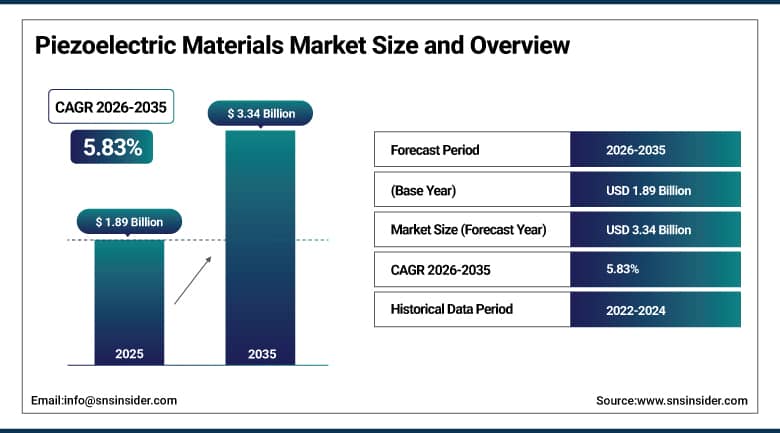
The Piezoelectric Materials Market was valued at USD 1.89 Billion in 2025 and is projected to reach approximately USD 3.34 Billion by 2035, registering a CAGR of 5.83% from 2026 to 2035.
The Piezoelectric Materials Market has been witnessing the adoption of precision sensing, actuation, and energy harvesting in electronics, automotive, and industrial systems through mechanical to electrical energy conversion. Key factors driving the market include increasing incorporation of piezoelectric sensors and actuators in advanced driver assistance and electric vehicles, increasing use of lead-free ceramic formulations, shrinking size of components used in consumer electronics products, and consistent adoption across automotive, medical, aerospace, and industrial automation sectors in developed and developing countries. There has been significant traction in energy harvesters, medical ultrasonic transducers, and microelectromechanical systems, taking into account the efforts by electronic component makers, automotive companies, and medical equipment makers to invest in small size and high-performance piezoelectric products.
⮞KYOCERA Corporation expanded its lead-free piezoelectric ceramic product line in 2025, targeting automotive sensor and industrial actuator manufacturers seeking to meet tightening RoHS environmental compliance requirements.
To Get More Information On Piezoelectric Materials Market - Request Free Sample Report
Piezoelectric Materials Market Trends
-
Rising integration of piezoelectric sensors and actuators in advanced driver-assistance systems continues expanding automotive-grade material demand.
-
Growing adoption of lead-free ceramic formulations continues addressing tightening RoHS and environmental compliance requirements across electronics manufacturing.
-
Increasing use of piezoelectric generators in energy-harvesting applications continues expanding demand beyond traditional sensing and actuation use-cases.
-
Rising miniaturization of consumer electronics components continues driving demand for thin-film and microelectromechanical piezoelectric materials.
-
Growing adoption of piezoelectric transducers in medical ultrasound and minimally invasive surgical devices continues expanding healthcare-sector demand.
U.S. Piezoelectric Materials Market Outlook
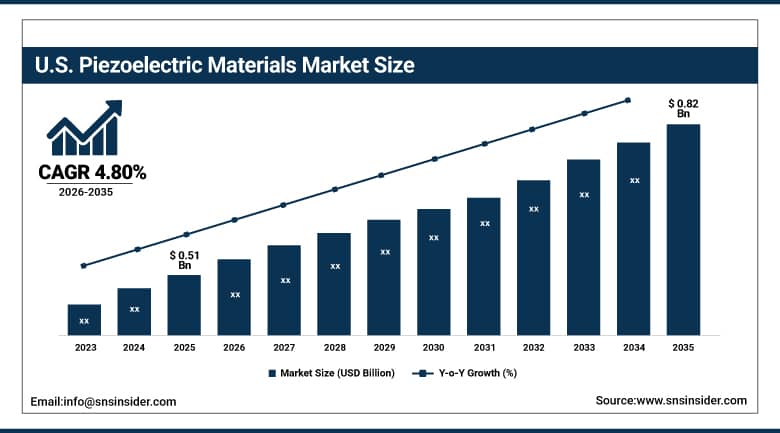
The U.S. Piezoelectric Materials Market was valued at approximately USD 0.51 Billion in 2025 and is projected to reach approximately USD 0.82 Billion by 2035, registering a CAGR of approximately 4.80% from 2026 to 2035.
Demand across the United States continued to be shaped by strong aerospace and defense sector adoption of piezoelectric sensors and transducers, expanding medical device manufacturing capacity, and growing automotive sector integration of piezoelectric components across advanced driver-assistance systems and electric vehicle platforms. Continued government and private-sector research funding directed toward advanced ceramics and microelectromechanical systems reinforced the country's position as a genuine innovation hub for next-generation piezoelectric material development. Growing industrial automation investment and expanding energy-harvesting application research added further layers of sustained demand beyond the sector's traditional aerospace and defense concentration, broadening the addressable customer base for material suppliers nationwide.
⮞L3Harris Technologies expanded its piezoelectric transducer manufacturing capacity in 2025, targeting SONAR, defense sensing, and undersea surveillance system programs requiring high-reliability piezoelectric ceramic components.
Piezoelectric Materials Market Segment Analysis
-
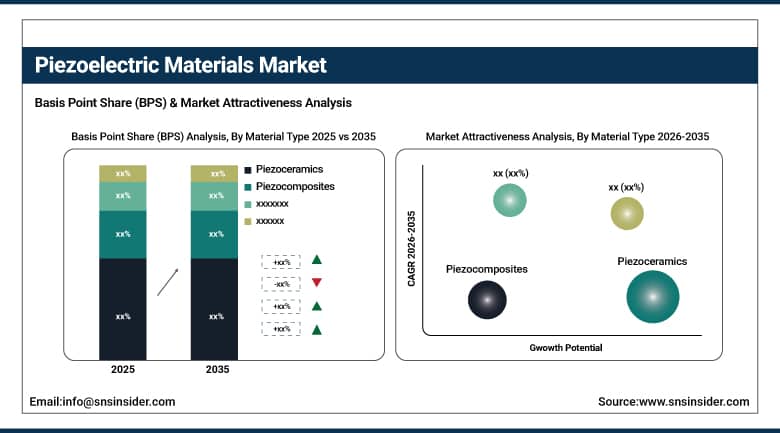
By Material Type, Piezoceramics dominated the Piezoelectric Materials Market with a 48.00% share in 2025, while Piezocomposites is the fastest-growing segment with a CAGR of 6.50% from 2026–2035.
-
By Product Form, Bulk dominated the market with a 40.00% share in 2025, while Thin Film is the fastest-growing segment with a CAGR of 7.20% from 2026–2035.
-
By Application, Actuators dominated the market with a 36.00% share in 2025, while Generators is the fastest-growing segment with a CAGR of 6.80% from 2026–2035.
-
By End-Use Industry, Automotive dominated the market with a 33.00% share in 2025, while Healthcare is the fastest-growing segment with a CAGR of 7.10% from 2026–2035.
By Material Type, Piezoceramics Dominate the Piezoelectric Materials Market While Piezocomposites Emerge as the Fastest-Growing Material Type Segment
The Piezoceramics segment dominated the Piezoelectric Materials Market in 2025 owing to its superior piezoelectric coefficients, high mechanical strength, and thermal stability across sensors, actuators, transducers, and medical ultrasound devices. Lead zirconate titanate-based ceramic formulations continue benefiting from decades of manufacturing process refinement, broad supplier availability, and proven field performance across demanding industrial and defense applications. continued preference by electronics manufacturers of the higher electromechanical coupling efficiency offered by ceramics when compared to the polymers also ensured that this market segment accounted for more revenue than others.
The Piezocomposites segment is the fastest growing within the Piezoelectric Materials Market, propelled by rising demand for materials that combine ceramic piezoelectric elements with polymer matrices to achieve improved flexibility, impact resistance, and acoustic matching relative to pure ceramics. Growing integration of composite piezoelectric materials in medical ultrasound transducers and structural health monitoring sensors continues driving above-average adoption across precision-engineering applications. Continued formulation innovation aimed at improving composite manufacturing scalability is expected to sustain this segment's above-average growth trajectory through the forecast period.
⮞In December 2025, Sumitomo Precision Products launched MEMS foundry services using lead-free potassium sodium niobate (KNN) piezoelectric thin films supplied by Sumitomo Chemical, expanding manufacturing options for environmentally compliant piezoelectric MEMS devices.
By Product Form, Bulk Materials Lead the Piezoelectric Materials Market While Thin Film Records the Fastest Growth
The Bulk segment dominated the Piezoelectric Materials Market in 2025, supported by its established manufacturing processes and broad applicability across actuators, motors, and larger-scale sensing and transducer applications. Bulk piezoelectric ceramics continue offering manufacturers proven mechanical durability and straightforward integration into existing device architectures across industrial and defense end-markets. Continued reliance on bulk material forms among established actuator and motor manufacturers reinforced this segment's leading revenue contribution throughout the forecast period.
The Thin Film segment is the fastest growing within the Piezoelectric Materials Market, driven by accelerating miniaturization of consumer electronics and microelectromechanical systems requiring precisely deposited, ultra-thin piezoelectric layers. Growing integration of thin-film piezoelectric materials in smartphone microphones, autofocus camera modules, and wearable sensors continues expanding this form segment's addressable applications. Continued advancement in thin-film deposition technology is expected to sustain this segment's above-average growth trajectory through the forecast period.
⮞In July 2026, I-PEX Piezo Solutions opened a new cleanroom in Fukuoka, Japan, to expand production capacity for its piezoelectric MEMS foundry business based on proprietary single-crystal PZT thin-film deposition technology.
By Application, Actuators Dominate the Piezoelectric Materials Market While Generators Emerge as the Fastest-Growing Application Segment
The Actuators segment dominated the Piezoelectric Materials Market in 2025, owing to its wide usage in precision positioning, fuel injection, and automation equipment that require fast and precise mechanical movements. The automotive fuel injector uses, in particular, have continued to contribute to the consumption of considerable amounts of actuator-grade piezoelectric materials owing to the superiority of its response rate compared to the response rate of a solenoid actuator. Growth in industrial automation equipment further cemented its position as the major application.
The Generators segment is the fastest growing within the Piezoelectric Materials Market, propelled by rising interest in energy-harvesting applications that convert ambient mechanical vibration into usable electrical power for low-power sensors and IoT devices. Growing research investment in self-powered wireless sensor networks and structural health monitoring systems continues expanding generator-application demand beyond niche research applications. Continued miniaturization of energy-harvesting circuitry is expected to sustain this segment's above-average growth trajectory through the forecast period.
⮞In August 2025, China's Awinic Electronics introduced its “Quiet Zone · Ice Core” piezoelectric micropump liquid-cooling driver solution, using piezoelectric ceramic vibrations to circulate coolant through microchannels in compact electronics and high-performance computing devices.
By End-Use Industry, Automotive Dominates the Piezoelectric Materials Market While Healthcare Emerges as the Fastest-Growing End-Use Segment
The Automotive segment dominated the Piezoelectric Materials Market in 2025, driven by rising integration of piezoelectric sensors and actuators across advanced driver-assistance systems, fuel injection systems and electric vehicle platforms. Increasing usage and production of ADAS features and EVs respectively ensured that automotive was the dominant end-use revenue generator over the course of the forecast period. The pre-established connections between piezoelectric material suppliers and automobile component makers added to the dominance of the segment.
The Healthcare segment is the fastest growing within the Piezoelectric Materials Market, driven by expanding use of piezoelectric transducers in medical ultrasound imaging, minimally invasive surgical tools, and drug delivery systems. Growing global healthcare infrastructure investment and rising demand for non-invasive diagnostic imaging technology continues expanding this end-use segment's addressable applications. Continued advancement in medical-grade piezoelectric material biocompatibility is expected to sustain this segment's above-average growth trajectory through the forecast period.
⮞In April 2026, U.S.-based Piezo Direct expanded its product portfolio with piezoelectric coaxial cable and PVDF film sensors designed for applications including medical devices, wearable technologies, aerospace systems, and industrial monitoring.
Regional Insights
|
Region |
Major Country |
Share within Region, 2025 (%) |
|---|---|---|
|
North America |
United States |
80.00% |
|
Europe |
Germany |
28.00% |
|
Asia Pacific |
China |
40.00% |
|
Middle East and Africa |
UAE |
32.00% |
|
Latin America |
Brazil |
46.00% |
North America Piezoelectric Materials Market Insights
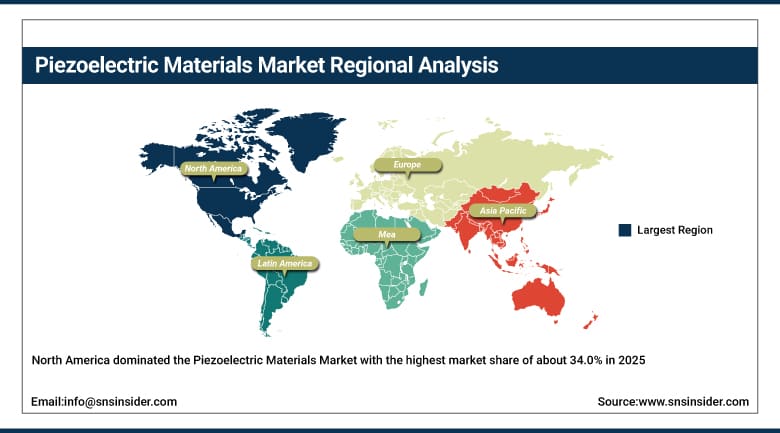
North America dominated the Piezoelectric Materials Market with the highest market share of about 34.0% in 2025, Strong aerospace and defense sector adoption, expanding medical device manufacturing capacity, and growing automotive sector integration of piezoelectric components across ADAS and electric vehicle platforms reinforced the region's leading position. Continued government and private-sector research funding directed toward advanced ceramics and microelectromechanical systems kept regional demand well ahead of every other region tracked in this report.
The United States anchored by extensive aerospace and defense procurement programs and expanding medical device manufacturing capacity. Canada's growing industrial automation and research institution activity added further regional demand, and continued innovation-driven investment is expected to keep North America the largest addressable market for piezoelectric material suppliers through the forecast period.
⮞In October 2025, U.S.-based Piezo Direct launched an e-commerce platform for standard piezoelectric components, enabling engineers, researchers, and product developers to purchase components directly for prototyping, testing, and production applications.
Get Customized Report as Per Your Business Requirement - Enquiry Now
Europe Piezoelectric Materials Market Insights
Europe held a meaningful share of global revenue, supported by strong automotive sector demand, established precision engineering and instrumentation manufacturing bases, and continued research institution investment in advanced ceramics. Continued regulatory emphasis on lead-free material adoption across the European Union reinforced steady regional demand for compliant piezoelectric ceramic formulations.
Germany led European demand of regional revenue, supported by its substantial automotive component manufacturing base and well-established precision engineering industry. France and Switzerland contributed further demand tied to aerospace and instrumentation manufacturing activity, and continued EU RoHS compliance emphasis is expected to keep regional demand for lead-free piezoelectric ceramics on a steady upward trajectory through the forecast period.
⮞In September 2025, the European Commission adopted Delegated Directive (EU) 2025/2363, extending specified RoHS exemptions for lead-containing ceramic and glass components, including piezoelectric devices, with revised expiry dates that affect compliance planning for material and component manufacturers.
Asia Pacific Piezoelectric Materials Market Insights
Asia Pacific is advancing at the fastest pace among all regions tracked in this report, registering a CAGR of 8.7% during the forecast period, driven by strong electronics manufacturing bases, rapid industrialization, and high demand from automotive, consumer electronics, telecom, and industrial automation sectors across China, Japan, South Korea, and India. Continued expansion of domestic electronics and automotive component manufacturing capacity kept the region's growth trajectory well ahead of every other region tracked in this report.
China led the region, supported by large-scale electronics manufacturing investment and expanding automotive component production capacity. Japan and South Korea contributed further growth through advanced precision electronics and automotive sensor manufacturing, reinforcing Asia Pacific's position as the fastest-growing piezoelectric materials market tracked in this report.
⮞In May 2025, STMicroelectronics expanded its Lab-in-Fab collaboration in Singapore with A*STAR's Institute of Microelectronics and ULVAC to advance piezoelectric MEMS technologies for personal electronics, medical devices, and other applications.
MEA and Latin America Piezoelectric Materials Market Insights
The Middle East and Africa and Latin America both showed steady growth, driven by expanding industrial automation investment, growing oil and gas sector sensor adoption, and rising automotive component manufacturing activity across both regions. As both regions continued investing in advanced manufacturing and infrastructure monitoring technology, piezoelectric materials proved a genuinely practical way to enable precision sensing and actuation across industrial applications.
The UAE led Middle East and Africa demand, with increased use of industrial automation and sensor technology within infrastructure monitoring systems. The increase in demand was supplemented by Saudi Arabia and South Africa, who made use of sensors within their oil and gas industry. Brazil in Latin America had the biggest share of the revenue because of the automotive parts industry.
⮞In June 2025, Brazilian instrumentation manufacturer ATCP Physical Engineering marked 25 years of developing and manufacturing power-ultrasound and material-characterization instruments, including equipment used to assess ultrasonic systems and medical transducers
Market Dynamics
Growth Drivers: Rising Automotive Sensor Integration and Miniaturization Demand
The industry is driven by rising integration of piezoelectric sensors and actuators in advanced driver-assistance systems and electric vehicles, growing adoption of lead-free ceramic formulations, increasing miniaturization of consumer electronics components, and continued adoption across automotive, healthcare, aerospace, and industrial automation applications. As vehicle electrification and ADAS feature adoption continue expanding globally, the need for reliable, high-performance piezoelectric sensing and actuation keeps driving sustained manufacturer investment.
Growing miniaturization of consumer electronics continues reinforcing this driver, as smartphone, wearable, and IoT device manufacturers increasingly require thin-film and microelectromechanical piezoelectric components capable of fitting within increasingly compact device architectures. Continued advancement of medical ultrasound and energy-harvesting technology further supports this driver, and that combination of automotive electrification and electronics miniaturization is exactly what keeps demand climbing at a steady, sustained pace.
⮞In June 2026, Niterra's NGK Ignition Parts introduced the Y1078PS pressure-sensor glow plug, integrating a piezoelectric sensor to measure cylinder combustion pressure in real time and support engine control and emissions compliance across compatible Volkswagen Group diesel vehicles.
Restraints: Raw Material Supply Constraints and Lead-Based Formulation Regulations
Supply constraints surrounding key raw materials used in piezoceramic production, including specialty zirconium and titanium compounds, continue posing a genuine restraint on stable market-wide margins, particularly for smaller specialty material producers without the purchasing scale that major electronics conglomerates can leverage. That supply volatility has kept pricing pressure a persistent challenge across the competitive landscape.
Tightening regulatory restrictions on lead-based piezoelectric ceramic formulations continue posing a further restraint, as manufacturers must invest substantial research and development resources into lead-free alternatives that historically have offered somewhat lower piezoelectric performance coefficients. That compliance transition keeps some manufacturers navigating a genuinely complex trade-off between environmental regulation and material performance requirements.
Opportunities: Lead-Free Formulation Innovation and Energy-Harvesting Application Expansion
Advancement of lead-free piezoelectric ceramic formulation technology represents a genuinely significant opportunity, as this emerging material category promises regulatory compliance without substantially compromising piezoelectric performance. Material producers positioned early in commercially viable lead-free formulations stand to capture meaningful share as RoHS and similar environmental regulations continue tightening across major electronics manufacturing regions.
Further development in energy generation and self-powered sensors will provide the second major opportunity, as the growth in the use of IoT devices will necessitate the need for low-energy sensing, thereby removing the requirement for battery changes. Manufacturers with already commercialized piezoelectric materials capable of producing electricity will benefit from the increase in wireless sensor networks.
⮞In June 2026, Spain-based Energiot secured €1.5 million in funding to advance self-powered wireless sensors for electricity-grid monitoring, using proprietary piezoelectric technology to harvest energy directly from power lines and reduce battery replacement and maintenance requirements.
Recent Developments:
- 2026: CEA-Leti expanded its lead-free piezoelectric technology portfolio using potassium sodium niobate (KNN) and aluminum scandium nitride (AlScN) for piezoMEMS, ultrasonic transducers, and optical MEMS applications.
- 2026: A multilayer KNN piezoceramic architecture increased the piezoelectric coefficient from 165 pC/N in bulk material to 1,568 pC/N while improving temperature stability, supporting advanced sensor applications.
- 2024: TDK Corporation expanded its PiezoNAS thin-film piezoelectric sensor portfolio, targeting smartphone camera autofocus and haptic feedback module manufacturers seeking further device miniaturization.
Piezoelectric Materials Key Players are:
-
KYOCERA Corporation
-
TDK Corporation
-
Murata Manufacturing Co., Ltd.
-
CTS Corporation
-
Morgan Advanced Materials plc
-
PI Ceramic GmbH (Physik Instrumente)
-
APC International, Ltd.
-
L3Harris Technologies, Inc.
-
Sparkler Ceramics Pvt. Ltd.
-
Piezo Kinetics, Inc.
-
Fuji Ceramics Corporation
-
PIEZO SYSTEMS, INC.
-
Parker Hannifin Corporation
-
Mide Technology Corporation
-
PiezoMotor Uppsala AB
-
Johnson Matthey PLC
-
Channel Industries, Inc.
-
Boston Piezo-Optics Inc.
Piezoelectric Materials Market Report Scope:
| Report Attributes | Details |
|---|---|
| Market Size in 2025 | USD 1.89 Billion |
| Market Size by 2035 | USD 3.34 Billion |
| CAGR | CAGR of 5.83% From 2026 to 2035 |
| Base Year | 2025 |
| Forecast Period | 2026-2035 |
| Historical Data | 2022-2024 |
| Report Scope & Coverage | Market Size, Segments Analysis, Competitive Landscape, Regional Analysis, DROC & SWOT Analysis, Forecast Outlook |
| Key Segments | • By Material Type (Piezoceramics, Piezopolymers, Piezocomposites & Others) • By Product Form (Bulk, Thin Film, Thick Film) • By Application (Actuators, Sensors, Motors, Generators, Transducers & Others) • By End-Use Industry (Automotive, Consumer Electronics, Healthcare, Aerospace & Defense, Industrial Automation & Others) |
| Regional Analysis/Coverage | North America (US, Canada), Europe (Germany, UK, France, Italy, Spain, Russia, Poland, Rest of Europe), Asia Pacific (China, India, Japan, South Korea, Australia, ASEAN Countries, Rest of Asia Pacific), Middle East & Africa (UAE, Saudi Arabia, Qatar, South Africa, Rest of Middle East & Africa), Latin America (Brazil, Argentina, Mexico, Colombia, Rest of Latin America). |
| Company Profiles | KYOCERA Corporation, TDK Corporation, Murata Manufacturing Co., Ltd., CTS Corporation, Morgan Advanced Materials plc, CeramTec GmbH, PI Ceramic GmbH (Physik Instrumente), APC International, Ltd., L3Harris Technologies, Inc., Sparkler Ceramics Pvt. Ltd., Piezo Kinetics, Inc., Fuji Ceramics Corporation, PIEZO SYSTEMS, INC., Parker Hannifin Corporation, STMicroelectronics N.V., Mide Technology Corporation, PiezoMotor Uppsala AB, Johnson Matthey PLC, Channel Industries, Inc., Boston Piezo-Optics Inc. |

Frequently Asked Questions
Key players include KYOCERA Corporation, TDK Corporation, Murata Manufacturing Co., Ltd., CTS Corporation, Morgan Advanced Materials plc, and CeramTec GmbH, among others.
Key opportunities include advancement in lead-free piezoelectric ceramic formulations and expansion of energy-harvesting applications for self-powered sensors and IoT devices.
Market growth is primarily driven by rising integration of piezoelectric sensors in advanced driver-assistance systems and electric vehicles, increasing miniaturization of consumer electronics, and growing adoption across automotive, healthcare, and industrial automation sectors.
The Piezoceramics segment dominated the market, accounting for approximately 48% of the total share.
North America led the market in 2025 with approximately 34.0% share, supported by strong aerospace and defense sector adoption, expanding medical device manufacturing, and growing automotive integration of piezoelectric components.
