
Industrial Decarbonization Market Report Scope & Overview:
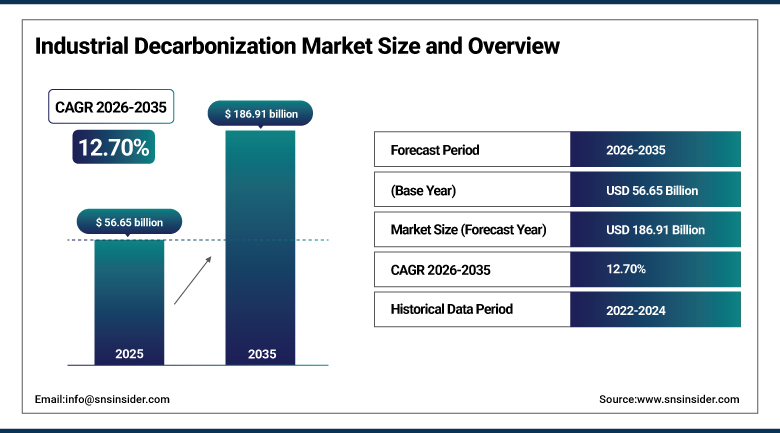
The Industrial Decarbonization Market size was valued at USD 56.65 Billion in 2025 and is expected to reach USD 186.91 Billion by 2035, growing at a CAGR of 12.70% from 2026–2035.
Some of the key drivers behind the development of the global industrial decarbonization market are the increasing use of AI, demand for energy efficiency and process optimization, growing interest in green hydrogen and industrial electrification, growing use of carbon capture, utilization, and storage (CCUS), and investments in low-carbon technology. The increasing requirement to cut down greenhouse gas emissions from energy intensive industries like steel, cement, chemical and manufacturing is driving the adoption of industrial decarbonization.
In addition to this, environmental regulations, carbon pricing, corporate sustainability initiatives, and renewable energy adoption are also accelerating investment in industrial decarbonization.
In July 2026, the European Commission advanced efforts to accelerate carbon capture and storage (CCS) deployment across Europe by bringing industry stakeholders together to identify practical solutions for scaling CO₂ capture, transport, and storage. The EU is targeting 50 million tonnes of annual CO₂ injection capacity in European geological storage sites by 2030, supporting the decarbonization and competitiveness of energy-intensive industries.
To Get more information Industrial Decarbonization Market - Request Free Sample Report
Industrial Decarbonization Market Trends
-
The increasing adoption of artificial intelligence (AI) and enterprise data analytics is driving the growth of the industrial decarbonization market.
-
Rising demand for energy efficiency, real-time emissions monitoring, and data-driven process optimization is accelerating the adoption of industrial decarbonization technologies.
-
Growing investments in renewable energy integration, green hydrogen, industrial electrification, and carbon capture, utilization and storage (CCUS) are supporting market expansion.
-
Increasing focus on reducing industrial greenhouse gas emissions, improving operational efficiency, and achieving corporate net-zero targets is strengthening demand for decarbonization solutions.
-
Expanding deployment of industrial decarbonization technologies across steel and iron, cement and concrete, automotive and transportation, energy and utility, chemicals, and other energy-intensive industries is further strengthening market demand.
The U.S. Industrial Decarbonization Market Size Outlook
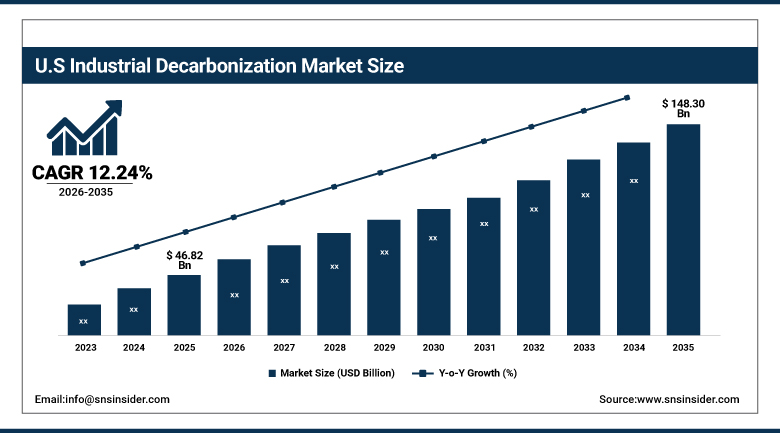
The U.S. Industrial Decarbonization Market was valued at USD 10.99 Billion in 2025 and is expected to reach around USD 31.11 Billion by 2035, growing at a CAGR of 10.98% from 2026–2035.
Adoption of artificial intelligence, generative artificial intelligence, and enterprise data analytics is expected to boost the industrial decarbonization market in the United States during the forecast period. The rise in the demand for contextualizing and making the industrial data easily available has been driving the adoption of digital solutions that would help make a connection between operational data available through equipment, sensors, energy management system, emissions monitoring, and cloud environment. The presence of major players in terms of technology providers, industrial companies, energy and utility players, and digital infrastructure along with rising investment in AI, automation, and data analytics solutions is expected to drive the market growth.
Apart from this, developments in AI-based process optimization, predictive maintenance, digital twins, emissions monitoring, energy management, and industrial data integration solutions are expected to propel the adoption of industrial decarbonization solutions. Investment in renewable energy, green hydrogen, industrial electrification, and carbon capture utilization and storage (CCUS) is opening up huge business opportunities. Rising emphasis on emission reduction, energy efficiency, industrial process optimization, operational resilience, and reaching net-zero goals by corporations is expected to boost the adoption of industrial decarbonization solutions in the United States during the forecast period.
In June 2026, the U.S. Department of Energy highlighted its ongoing Industrial Decarbonization Projects initiative, which supports the deployment of technologies designed to reduce emissions across U.S. industrial facilities. The initiative focuses on accelerating industrial decarbonization through investments in energy efficiency, electrification, carbon management, and other technologies needed to support the transition toward a net-zero economy.
Industrial Decarbonization Market Segment Analysis
-
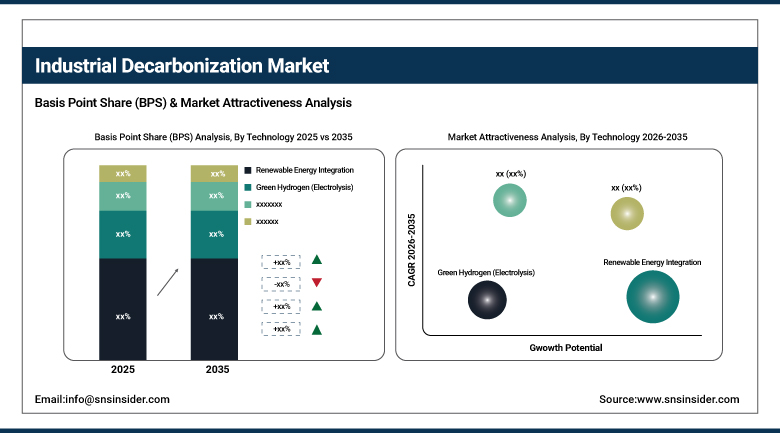
By Technology, renewable energy integration dominated the Industrial Decarbonization Market with a 30.30% share in 2025, while green hydrogen (electrolysis) is projected to be the fastest-growing segment, registering a 16.24% CAGR during 2025–2035.
-
By Service, consulting and advisory dominated the Industrial Decarbonization Market with a 22.14% share in 2025, while carbon removal and negative emissions is projected to be the fastest-growing segment, registering a 17.08% CAGR during 2025–2035.
-
By Strategy/Pillar, energy efficiency dominated the Industrial Decarbonization Market with a 45.16% share in 2025, while low-carbon feedstocks/fuels is projected to be the fastest-growing segment, registering a 17.62% CAGR during 2025–2035.
-
By End-User Industry, automotive and transportation dominated the Industrial Decarbonization Market with a 46.18% share in 2025, while energy and utility is projected to be the fastest-growing segment, registering a 17.05% CAGR during 2025–2035.
By Technology, renewable energy integration dominated the industrial decarbonization market, while green hydrogen (electrolysis) is expected to grow fastest.
Renewable Energy Integration had accounted for a market share of 30.30% in the Industrial Decarbonization Market in 2025 due to the growing implementation of renewable energy sources within energy intensive industrial applications. Renewable sources of energy such as solar and wind energy are being implemented within manufacturing plants to ensure that they rely less on fossil fuel energy and conventional sources of grid electricity while working towards reducing their emissions of greenhouse gases. Growing cost reductions in renewable energy technologies, stringent environmental policies, and commitment to achieving net-zero emissions by companies are some of the factors driving the segment.
Regarding the technology pathway, the fastest-growing segment in the industrial decarbonization market would be the green hydrogen (electrolysis) segment. Over the forecast period, the segment will post a 16.24% CAGR, owing to falling renewable energy prices, support from governments to develop hydrogen and technological innovations in the electrolyzers. Green hydrogen is being seen as an essential decarbonization route for hard-to-abate sectors such as steel, chemical, and cement sectors, wherein direct electrification could prove to be difficult.
By Strategy/Pillar, energy efficiency dominated the industrial decarbonization market, while low-carbon feedstocks/fuels are expected to grow fastest.
The energy efficiency segment had the leading share in the Industrial Decarbonization Market during 2025 due to its importance in being an economical way to decarbonize industrial energy usage and cut down on emissions. Energy-efficient equipment, process optimization, smart manufacturing, and artificial intelligence-based energy management tools are increasingly being employed by companies in the industry to lower their energy usage and cut costs. The feasibility of decarbonizing while cutting operating costs is one of the key drivers behind energy efficiency practices in energy-intensive sectors.
Low-carbon fuels/feedstocks is estimated to grow at the highest CAGR of 17.62% from 2025 to 2035. The growing need for alternative fuels that don't involve fossil sources is the main reason behind the expansion of the segment. These fuels and feedstocks can be used in high temperature processes and for applications that cannot yet be electrified. The adoption will be further spurred by government regulations, emissions reduction goals, waste-to-energy practices, and feedstock alternatives.
By End-User Industry, automotive and transportation dominated the industrial decarbonization market, while energy and utility are expected to grow fastest.
The Automotive & Transportation industry has taken the major market share in the Industrial Decarbonization Market in 2025 at 46.18% owing to growing investments in vehicle electrification, renewable energy, sustainable material production, and low carbon manufacturing. The automotive industry is increasingly emphasizing on the reduction of emissions throughout their supply chain including manufacturing, sourcing of materials, logistics, and even operations of the vehicles. More stringent emission standards along with corporate sustainability efforts are increasingly compelling the automotive firms to go for industrial decarbonization solutions.
Among all segments, Energy & Utility segment is estimated to witness the fastest growth rate during the forecast period at a CAGR of 17.05% during 2025 to 2035. This segment is gaining traction due to the importance of energy sector in making possible the industrial electrification as well as emission reduction in the generation of electricity. Increased investments in renewable energy generation, smart grids, energy storage, and low carbon electricity production is increasingly leading the transition away from fossil fuel based energy.
Regional Analysis
|
Region |
Major Country |
Share within Region, 2025(%) |
|---|---|---|
|
North America |
United States |
82.64% |
|
Europe |
Germany |
27.84% |
|
Asia Pacific |
China |
42.42% |
|
Middle East & Africa |
Saudi Arabia |
25.24% |
|
Latin America |
Brazil |
47.58% |
North America Industrial Decarbonization Market Insights
North America is one of the major regional markets for industrial decarbonization, supported by increasing adoption of renewable energy integration, green hydrogen, carbon capture, utilization and storage (CCUS), industrial electrification, and energy-efficiency technologies. The region benefits from its established industrial base and growing investments in low-carbon technologies aimed at reducing emissions from energy-intensive industries. North America is expected to experience continued expansion as industries increasingly adopt decarbonization solutions and transition toward cleaner production processes.
The United States held the leading position within the North American industrial decarbonization market in 2025. Its leadership is supported by its large industrial base, strong investments in clean energy and decarbonization technologies, and increasing adoption of renewable energy, green hydrogen, CCUS, industrial electrification, and energy-efficiency solutions. Canada is expected to experience faster growth than the United States during the forecast period, supported by increasing investments in clean energy, hydrogen, carbon management, and industrial decarbonization initiatives.
Get Customized Report as per Your Business Requirement - Enquiry Now
Europe Industrial Decarbonization Market Insights
Europe is a major industrial decarbonization market and is expected to experience the fastest regional growth during the forecast period. The region's expansion is supported by increasing adoption of renewable energy integration, green hydrogen, CCUS, industrial electrification, and energy-efficiency and process-optimization technologies. European industries are increasingly transitioning toward low-carbon production processes, while investments in clean industrial technologies are creating additional opportunities for decarbonization solutions across energy-intensive sectors.
The provided dataset does not include country-level figures for Europe. Therefore, a specific country such as Germany should not be identified as the leading country based on the supplied data.
Asia Pacific Industrial Decarbonization Market Insights
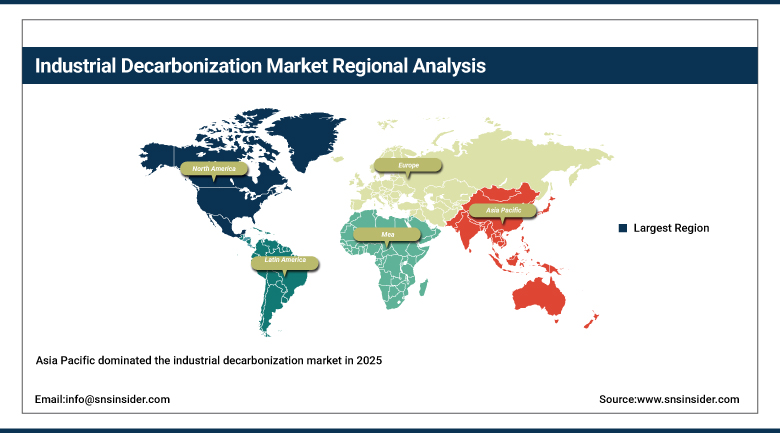
Asia Pacific dominated the industrial decarbonization market in 2025 and is expected to remain the largest regional market throughout the forecast period. The region's strong position is supported by its extensive industrial and manufacturing base, rising energy consumption, increasing renewable energy deployment, industrial electrification, green hydrogen development, CCUS adoption, and growing emphasis on energy efficiency and low-carbon manufacturing.
The region is expected to continue generating significant opportunities for industrial decarbonization as major economies increase investments in renewable energy, hydrogen technologies, carbon management, electrification, and energy-efficient industrial processes. However, the provided dataset does not include country-level figures for Asia Pacific, so China cannot be identified as the leading country based solely on the supplied data.
Middle East & Africa and Latin America Industrial Decarbonization Market Insights
The Middle East & Africa industrial decarbonization market is expected to witness strong growth during the forecast period, supported by increasing investments in renewable energy, green hydrogen, CCUS, energy efficiency, and low-carbon industrial infrastructure. The region's abundant solar and wind resources provide opportunities for clean energy and hydrogen development, while its large energy-intensive industries create substantial demand for decarbonization technologies.
Decarbonization opportunities are expected to increase across industries such as oil and gas, petrochemicals, metals, cement, and other energy-intensive sectors as companies invest in cleaner energy sources, carbon management, electrification, and energy-efficiency solutions. The supplied dataset does not provide country-level figures for this region, so Saudi Arabia cannot be identified as the leading country based solely on the provided data.
Latin America is expected to experience continued growth in industrial decarbonization, supported by its strong renewable energy potential, increasing industrial activity, and growing adoption of low-carbon technologies. The region offers opportunities for renewable electricity, green hydrogen, low-carbon fuels, carbon capture and removal, circular economy solutions, and energy-efficiency technologies.
The expansion of renewable energy infrastructure and increasing emphasis on sustainable industrial production are expected to support the adoption of decarbonization solutions across the region. However, the supplied dataset does not include country-level figures for Latin America, so Brazil cannot be identified as the leading country based solely on the provided data
Market Dynamic
Growth Driver: Rising investments in clean energy and low-carbon technologies driving industrial decarbonization market growth
Growing emphasis on decreasing the release of greenhouse gases from high-emission industries represents a key driver in the industrial decarbonization market. Countries around the world are adopting emission reduction targets and adopting renewable energy, industrial electrification, energy-efficient technology, green hydrogen, carbon capture and storage technology (CCS), and other low-carbon options. Growing pressure to decrease emissions from sectors such as cement, steel, chemicals, refining, mining, and manufacturing industry is driving adoption of industrial decarbonization technologies.
In addition to this, government incentives, carbon pricing mechanisms, clean energy policy initiatives, and net-zero commitments by companies are pushing industries to adopt emission reduction technologies. Availability of renewable electricity and advances in green hydrogen technology, carbon capture, industrial heat electrification, and energy management are providing impetus to market growth. Investments in clean industrial infrastructure in North America, Europe, and Asia Pacific are expected to be a significant growth driver for the industrial decarbonization market.
Restraint: High implementation costs and technological complexity may restrict industrial decarbonization market growth
Though there is no doubt that many advantages in terms of the environmental and operational aspects will be achieved through the decarbonization of industries, its high costs and complicated technology could become barriers in market development. Implementing decarbonization technologies implies a lot of investments into renewable energy generation technologies, electric power infrastructure, carbon capturing facilities, hydrogen production, energy-saving equipment, and other necessary infrastructure.
Besides, low-carbon technologies need to be integrated with existing industrial installations, which can be complicated due to the aged infrastructure, lack of access to renewable energy, absence of hydrogen and carbon infrastructure for transportation, difficulties in retrofits of the existing production capacity, and regional differences in clean energy, hydrogen, and carbon storage infrastructure. Furthermore, lack of standardized technologies, professionals, and infrastructure can also impede the introduction of decarbonization technologies in industries.
Opportunity: Growing investments in green hydrogen, carbon capture, and industrial electrification creating new growth opportunities
Increased investments in green hydrogen, carbon capture and storage, renewable energy sources, and industrial electrification have led to new opportunities for the industrial decarbonization market. Industries are increasingly looking at the use of low carbon sources as well as low carbon production methods in order to reduce carbon emissions without compromising on efficiency and competitiveness. The increased adoption of carbon capture utilization and storage (CCUS) solutions by hard-to-abate industries such as cement, steel, chemicals, and refineries is likely to present numerous opportunities for providers of technology.
In the same way, investments in green hydrogen and hydrogen-based industrial processes are helping achieve decarbonization in high-temperature industrial processes as well as heavy industries. Industrial electrification, renewable energy production, waste heat recovery, energy efficiency improvements, and digital energy management solutions have gained prominence. Moreover, government grants and tax breaks, carbon pricing, and net zero initiatives from corporations are helping industries make investments in decarbonization. Continued development of clean energy infrastructure in North America, Europe, and Asia Pacific regions will open up opportunities for industrial decarbonization technologies and solutions.
Recent Developments
-
2026: Siemens Energy AG advanced hydrogen technologies, including PEM electrolysis, hydrogen compression, and hydrogen-ready power generation, supporting scalable industrial decarbonization projects.
-
2026: ABB Ltd. expanded electrification, automation, energy-efficiency, hydrogen, and carbon capture solutions supporting industrial emissions reduction and clean-energy infrastructure development.
-
2026: GE Vernova Inc. advanced carbon capture, direct air capture, hydrogen combustion, and nuclear technologies targeting lower-carbon power and industrial applications.
-
2026: Honeywell International Inc. expanded carbon capture, energy efficiency, sustainable fuels, and process technologies supporting emissions reduction across energy-intensive industrial operations.
-
2026: Schneider Electric SE strengthened industrial decarbonization through electrification, energy management, automation, and digital technologies improving industrial efficiency and reducing emissions.
-
2026: Linde plc advanced hydrogen and carbon capture projects supporting industrial customers transitioning toward low-carbon production, cleaner energy, and reduced emissions.
Industrial Decarbonization Companies are:
-
Siemens Energy AG
-
ABB Ltd.
-
Honeywell International Inc.
-
Schneider Electric SE
-
Linde plc
-
Air Liquide S.A.
-
Air Products and Chemicals, Inc.
-
Emerson Electric Co.
-
Johnson Controls International plc
-
Cummins Inc.
-
Baker Hughes Company
-
Aker Solutions ASA
-
thyssenkrupp AG
-
Carbon Clean Solutions Limited
-
Climeworks AG
-
Plug Power Inc.
-
Nel ASA
-
McPhy Energy S.A.
Industrial Decarbonization Market Report Scope:
| Report Attributes | Details |
|---|---|
| Market Size in 2025 | USD 56.65 Billion |
| Market Size by 2035 | USD 186.91 Billion |
| CAGR | CAGR of 12.70% From 2026 to 2035 |
| Base Year | 2025 |
| Forecast Period | 2026-2035 |
| Historical Data | 2022-2024 |
| Report Scope & Coverage | Market Size, Segments Analysis, Competitive Landscape, Regional Analysis, DROC & SWOT Analysis, Forecast Outlook |
| Key Segments | • By Technology (Renewable Energy Integration, Green Hydrogen (Electrolysis), Carbon Capture, Utilization and Storage (CCUS), Industrial Electrification, Energy Efficiency and Process Optimization) • By Service (Consulting and Advisory, Carbon Removal and Negative Emissions, Waste Reduction and Circular Economy, Carbon Accounting and Emissions Management, Engineering and Implementation Services) • By Strategy/Pillar (Energy Efficiency, Low-Carbon Feedstocks/Fuels, Industrial Electrification, Circular Economy, Carbon Capture and Removal) • By End-User Industry (Automotive and Transportation, Energy and Utilities, Iron and Steel, Cement and Concrete) |
| Regional Analysis/Coverage | North America (US, Canada), Europe (Germany, UK, France, Italy, Spain, Russia, Poland, Rest of Europe), Asia Pacific (China, India, Japan, South Korea, Australia, ASEAN Countries, Rest of Asia Pacific), Middle East & Africa (UAE, Saudi Arabia, Qatar, South Africa, Rest of Middle East & Africa), Latin America (Brazil, Argentina, Mexico, Colombia, Rest of Latin America) |
| Company Profiles | ServiceNow, IBM Corporation, Atlassian Corporation Plc, PagerDuty Inc., Freshworks Inc., BMC Software, Inc., Ivanti Inc., HCL Technologies Limited, SolarWinds Corporation, Broadcom Inc., Splunk Inc., Datadog Inc., Dynatrace Inc., Elastic N.V., New Relic, Inc., ScienceLogic, Inc., BigPanda, Inc., Aisera Inc., Moveworks Inc., Resolve AI |
Frequently Asked Questions
The Industrial Decarbonization Market was valued at approximately USD 56.65 billion in 2025.
The market is driven by increasing investments in renewable energy, industrial electrification, green hydrogen, carbon capture and storage, energy efficiency, and other low-carbon technologies aimed at reducing industrial greenhouse gas emissions.
