
Masterbatch Market Report Scope & Overview:
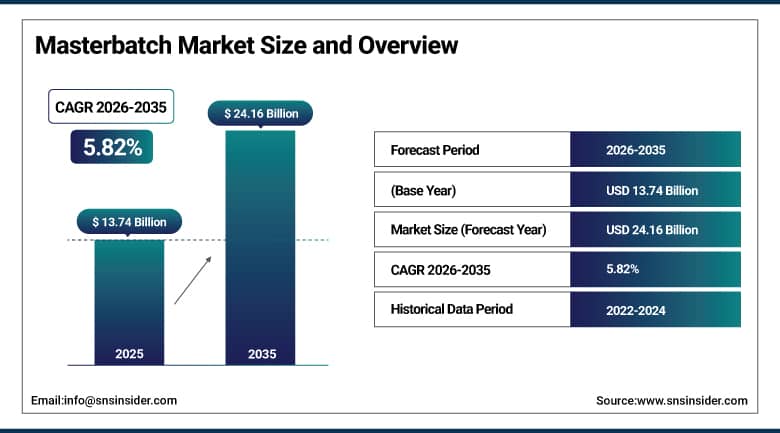
The Masterbatch Market was valued at USD 13.74 Billion in 2025 and is expected to reach USD 24.16 Billion by 2035, growing at a CAGR of 5.82% from 2026 to 2035.
The masterbatch industry is witnessing dynamic changes driven by factors like innovation and sustainability as well as the needs of the industry. The term masterbatch refers to a blend of colorants and additives which have been encapsulated within a carrier polymer resin, allowing easy mixing with base polymers during plastic manufacturing to provide an enhancement in terms of aesthetics and functionality. This product helps the users get benefits in terms of color consistency, UV resistance, durability, flame retardancy, and various other functionalities without coming into direct contact with the colorants and additives.
Replasblak is the name of a circular black masterbatch line that was launched in November 2023 by Cabot Corporation. The masterbatch line includes products that have between 40% and 100% recycled content attributed to them. It is supposed to help manufacturers of plastics in complying with environmental regulations such as REACH legislation in Europe and other equivalent legislations across the world. These regulations control the use of dangerous substances and provide openings for masterbatches business.
To Get More Information On Masterbatch Market - Request Free Sample Report
Masterbatch Market Trends
-
Circular economy initiatives are driving demand for recycled polymer-compatible masterbatches that support sustainable plastic production and recycled content targets.
-
Bio-based and biodegradable masterbatches are gaining adoption as compostable packaging and sustainable polymer applications expand globally.
-
Functional additive masterbatches are witnessing strong demand for antimicrobial, UV-stabilizing, antistatic, and barrier-enhancing applications.
-
Advanced masterbatch formulations for agricultural films are improving UV protection, anti-fog performance, and crop productivity.
-
High-performance dispersion technologies are enhancing color consistency, processing efficiency, and compatibility across diverse polymer manufacturing processes.
The U.S. Masterbatch Market Outlook
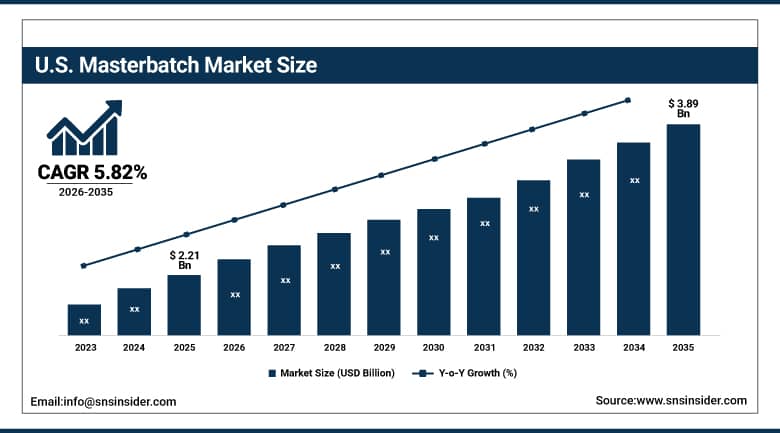
The U.S. Masterbatch Market was valued at approximately USD 2.21 Billion in 2025 and is expected to reach approximately USD 3.89 Billion by 2035, growing at a CAGR of approximately 5.82%.
There is a consistent growth trend in the USA, attributed to increasing use of high-performance plastics in packaging, auto, and other consumer goods. Key drivers include rising preference for sustainable and lightweight solutions in packaging. For instance, a leading company in the country, Avient Corporation, offers masterbatches that are sustainable and recyclable and have enhanced product properties. Also, there are contributions from industry associations, including American Chemistry Council, whose role is promoting the circular economy model and innovative plastics. As regulations continue to change and technologies improve, it is evident that the USA market is preparing itself to offer customized masterbatch solutions.
Penn Color Inc. commissioned an advanced manufacturing facility in April 2023 in the province of Rayong, Thailand as part of the company’s expansion plans for manufacturing capabilities where the main purpose of the expansion is to ensure the production of premium quality colorant and additive masterbatches to cater to the needs of the Asia Pacific region. This represents strategic planning by masterbatch manufacturers based in the U.S. for Asian production facilities.
Masterbatch Market Segment Analysis
-
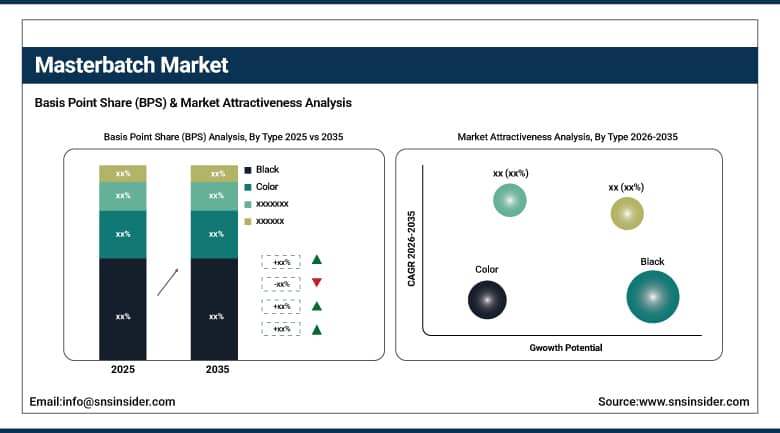
By Type, the black segment dominated the masterbatch market with approximately 31.8% share in 2025, while the color segment is the fastest growing.
-
By Carrier Polymer, the polypropylene segment dominated the masterbatch market with approximately 35.2% share in 2025, while the polyethylene segment is the fastest growing.
-
By Polymer Processing Technology, the extrusion segment dominated the masterbatch market with approximately 38.6% share in 2025, while the film processing segment is the fastest growing.
-
By End-use, the packaging segment dominated the masterbatch market with approximately 39.5% share in 2025, while the automotive and transportation segment is the fastest growing.
By Type, black dominates, color grows fastest
Black masterbatch retained the dominant type position in the masterbatch market in 2025. Black masterbatch production is an area of intensive development among U.S. companies such as RTP Company and Avient Corporation as performance-demanding industries such as automotive and packaging need pigmentation and functional improvements that add commercial value to the products rather than only coloring. American Chemistry Council highlights the significance of black masterbatch technology in making plastics easier to recycle by identifying and sorting plastics products. EPA recognizes the use of black masterbatch for light protection in agriculture films.
Color masterbatch is the fastest growing type because the increased need for improving the surface appearance of plastic components across automotive, building and construction, and consumer goods drives growth, with companies increasingly seeking tailored masterbatch solutions that offer color precision and brand consistency. A major element influencing demand for color masterbatches over the forecast period is the usage of color to distinguish products in competitive retail markets, where color masterbatches additionally offer customization options for producing goods with appealing visual appearance that support brand differentiation strategies across consumer-facing packaging and product categories.
By Carrier Polymer, polypropylene dominates, polyethylene grows fastest
Polypropylene maintained its position as the leader among carrier polymers, having about 35.2% share of the masterbatch market in 2025. Polypropylene is dominating as a carrier polymer because of its wide compatibility, good mechanical strength, and economic feasibility in industries such as automotive, packaging, and consumer goods. It also provides good electrical resistance and does not pose any stress cracking issues even under high temperatures and strong chemicals; hence, it can be used for rigid as well as flexible packaging applications. Non-polarity of polypropylene makes dispersion of dyes and stabilizers very easy, and it becomes best for creating custom-color masterbatches.
Polyethylene is the fastest growing carrier polymer because flexible packaging film applications, agricultural plasticulture practices, and consumer goods manufacturing collectively create above average demand growth for this versatile carrier category. The material's widespread use in low density and linear low-density forms for film extrusion applications, combined with growing agricultural film masterbatch demand for mulching, greenhouse, and drip irrigation applications, sustains polyethylene's above average growth trajectory relative to the broader carrier polymer category.
By End-use, packaging dominates, automotive grows fastest
Packaging has maintained its supremacy among the end use applications with a market share of around 39.5% in the masterbatch market in 2025. The supremacy of packaging has been maintained due to the high use of plastic materials in flexible as well as rigid forms in applications such as foods, beverages, pharmaceuticals, and e-commerce logistics. American companies such as Berry Global and Dow Inc. have been consistently growing the use of masterbatch materials for producing light weight and attractive packaging materials. Additives masterbatch, including anti-block, UV stabilizers, and antimicrobial masterbatch, is gaining traction in packaging materials for consumer safety and compliance with regulations.
Automotive and transportation is the fastest growing end-use sector because lightweighting initiatives across global vehicle manufacturing create structured demand for masterbatches that enable plastic components to replace heavier metal parts while maintaining required performance characteristics. Automotive interiors demand UV-stabilized black masterbatches for dashboard and trim components, while the growing electric vehicle production wave creates additional masterbatch demand for battery housing components, interior trim customization, and exterior body panel color matching that sustains above average automotive sector procurement growth.
Regional Analysis
|
Region |
Major Country |
Share within Region, 2025 (%) |
|---|---|---|
|
North America |
United States |
87.4% |
|
Europe |
Germany |
22.3% |
|
Asia Pacific |
China |
44.8% |
|
Middle East & Africa |
Saudi Arabia |
31.2% |
|
Latin America |
Brazil |
44.2% |
Asia Pacific Masterbatch Market Insights
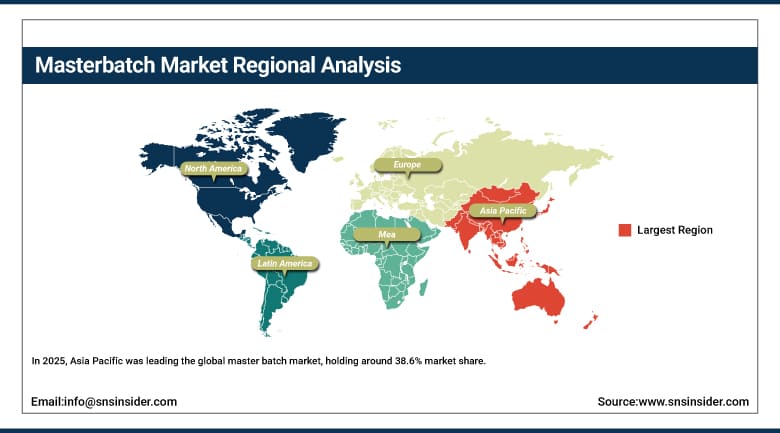
In 2025, Asia Pacific was leading the global master batch market, holding around 38.6% market share. This strong leadership was primarily due to high capacity of plastic production, fast growth of automotive and packaging industries, and availability of big polymer producers in the region. China held around 44.8% revenue of Asia Pacific market on the basis of high market share and fast industrialization of the region.
India represents the most commercially dynamic emerging market within Asia Pacific where the anticipated increase in demand for plastic packaging is expected to drive overall masterbatch product demand. Emerging economies like India present significant growth opportunities for market players, with increased infrastructural projects fostering heightened demand for the product, supported by government initiatives like Make in India and Smart City plans that elevate domestic demand throughout the forecast period.
Get Customized Report as Per Your Business Requirement - Enquiry Now
North America Masterbatch Market Insights
North America is a mature masterbatch market with steady growth, backed by technological advancements in masterbatch formulations and increasing demand for specialty additives and color concentrates. The United States accounts for approximately 87.4% of North American revenues through Avient Corporation, RTP Company, and Penn Color's commercial operations whose product innovation defines the regional technology standard.
Canada contributes complementary North American revenue through its packaging manufacturing sector's masterbatch procurement and the automotive parts supply industry's growing demand for performance-enhanced plastic components serving cross-border automotive assembly operations.
Europe Masterbatch Market Insights
Europe is a technically sophisticated masterbatch market where the European Union's REACH regulations, which restrict the use of hazardous chemicals, fuel a regulatory environment that drives demand for compliant, sustainable masterbatch formulations. Germany constitutes about 22.3 percent of European revenue generation with the help of a robust automotive and packaging manufacturing industry along with local manufacturing units of leading masterbatch manufacturers.
The UK, France, and Italy are other major secondary regions where packaging, automotive, and consumer goods manufacturing ensures regular demand generation. Switzerland-based Clariant and Greece-based Plastika Kritis ensure regional business supply of masterbatches in Europe.
MEA & Latin America Masterbatch Market Insights
The Saudi Arabia dominates the MEA region’s revenue contribution due to the increase in production of petrochemicals and plastics from its integrated polymer production. The United Arab Emirates and Egypt, on the other hand, contribute additional regional demand for masterbatch from their increasing packaging and plastic processing industries respectively.
Brazil leads Latin American revenues through its large packaging and automotive manufacturing sectors, whose combined plastic processing volume creates the region's most commercially significant masterbatch procurement base. Mexico's growing automotive parts manufacturing and Argentina's packaging sector collectively sustain regional market development through 2035.
Market Dynamics
Growth Drivers: Rising customization needs across manufacturing sectors
Many companies operating in various industries like packaging, automotive, construction, and consumer goods are looking for customized master batches that have precise colors, UV stability, fire retardant characteristics, and anti-static attributes. There is increasing tendency of the products being custom made which has resulted in increasing demand for value added master batch products which enable companies to retain brand identity while fulfilling functional requirements of their end customers. For example, UV resistant black masterbatches are required by automotive interior components, and FDA approved colors are required for food packaging products.
Plasticulture practices such as mulching, greenhouse films and drip irrigation have been adopted in the agriculture industry, especially in developing countries and semi-arid zones. The use of these films calls for the use of masterbatches that increase durability, offer protection against UV degradation, and minimize fog formation which may affect light transmission. There have been the development of masterbatches that are UV stabilized and anti-fog, which offer increased yield efficiency while enduring harsh environmental conditions.
Restraints: Environmental concerns over microplastic generation hampering market expansion
However, as far as there are mounting environmental issues regarding the pollution caused by plastics and their associated microplastics, the use of masterbatches is becoming difficult to accept, especially in environmentally sensitive areas such as North America and Europe. Masterbatches, especially those prepared using polyethylene or polypropylene carriers, play an important role in microplastic formation because the eventual plastic material can degrade or become part of the waste stream. With strict regulations for proper disposal of plastic wastes, it has become very difficult for conventional masterbatch suppliers to grow or obtain large contracts without any environmental guarantees.
The increase in demand for biodegradable products as well as liquid colorants is placing significant pressure on conventional masterbatch usage in a number of industries. The main advantage of using liquid colorants is their ability to change colors quickly, lower stock levels, and produce less waste during manufacture, compared to the traditional masterbatch pellets.
Opportunities: Growth in food, pharma, and smart agriculture applications
A valuable opportunity poised to grow significantly involves the food and beverage sector due to consumer preferences shifting toward processed and hygienic food products with increased health consciousness. In addition to this, the post-pandemic accelerated growth of pharmaceutical manufacturing, being a sector requiring high precision and contamination-free processing, favors specialty masterbatch trends suited to regulated packaging applications.
IoT and smart monitoring have begun opening fresh scope for differentiation and process optimization in both product and process, especially in developing economies where industrialization has just started to boom. Bio-based and biodegradable masterbatch innovations represent the most commercially significant near-term opportunity, as circular economy frameworks create regulatory and commercial motivation for sustainable formulation development across global producers.
Recent Developments:
-
2026: Avient Corporation expanded its sustainable masterbatch portfolio with recycled-content and bio-based color solutions designed for packaging and consumer goods applications.
-
2026: Clariant AG introduced advanced PFAS-free additive masterbatches that improve polymer performance while supporting evolving global sustainability and regulatory requirements.
-
2026: Ampacet Corporation launched new high-performance color and functional masterbatch solutions optimized for recyclable flexible packaging and mono-material plastic structures.
-
2026: Cabot Corporation expanded its conductive and specialty black masterbatch product portfolio to support growing demand from electric vehicles, electronics, and industrial plastic applications.
Masterbatch Market Key Players are:
-
Avient Corporation
-
Clariant AG
-
Cabot Corporation
-
Ampacet Corporation
-
Tosaf Group
-
RTP Company
-
Penn Color Inc.
-
Plastika Kritis S.A.
-
Plastiblends India Limited
-
Hubron International Ltd.
-
Heritage Plastics Inc.
-
Americhem Inc.
-
Polyplast Müller GmbH
-
Standridge Color Corporation
-
Gabriel-Chemie Group
-
PolyMaterials AG
-
Plastichem Sdn. Bhd.
-
LyondellBasell Industries N.V.
-
Techmer PM LLC
-
Uniform Color Company
Masterbatch Market Report Scope:
| Report Attributes | Details |
|---|---|
| Market Size in 2025 | USD 13.74 Billion |
| Market Size by 2035 | USD 24.16 Billion |
| CAGR | CAGR of 5.82% From 2026 to 2035 |
| Base Year | 2025 |
| Forecast Period | 2026-2035 |
| Historical Data | 2022-2024 |
| Report Scope & Coverage | Market Size, Segments Analysis, Competitive Landscape, Regional Analysis, DROC & SWOT Analysis, Forecast Outlook |
| Key Segments | • By Type (White, Black, Color, Additive, Filler, Others) • By Carrier Polymer (Polypropylene, Polyethylene, Polyvinyl Chloride, Polyethylene Terephthalate, Others) • By Polymer Processing Technology (Injection Molding, Blow Molding, Extrusion, Film Processing, Others) • By End-use (Packaging, Building and Construction, Consumer Goods, Automotive and Transportation, Agriculture, Others) |
| Regional Analysis/Coverage | North America (US, Canada), Europe (Germany, UK, France, Italy, Spain, Russia, Poland, Rest of Europe), Asia Pacific (China, India, Japan, South Korea, Australia, ASEAN Countries, Rest of Asia Pacific), Middle East & Africa (UAE, Saudi Arabia, Qatar, South Africa, Rest of Middle East & Africa), Latin America (Brazil, Argentina, Mexico, Colombia, Rest of Latin America). |
| Company Profiles | Avient Corporation, Clariant AG, Cabot Corporation, Ampacet Corporation, Tosaf Group, RTP Company, Penn Color Inc., Plastika Kritis S.A., Plastiblends India Limited, Hubron International Ltd., Heritage Plastics Inc., Americhem Inc., Polyplast Müller GmbH, Standridge Color Corporation, Gabriel-Chemie Group, PolyMaterials AG, Plastichem Sdn. Bhd., LyondellBasell Industries N.V., Techmer PM LLC, Uniform Color Company |
Frequently Asked Questions
The Masterbatch Market is expected to grow at a CAGR of 5.82% from 2026 to 2035.
Polypropylene dominated the Masterbatch Market with approximately 35.2% share in 2025.
Rising customization needs across packaging, automotive, and consumer goods manufacturing creating demand for specialty masterbatch formulations.
The Masterbatch Market was valued at USD 13.74 Billion in 2025.
Asia Pacific dominated the Masterbatch Market with approximately 38.6% share in 2025.
