
Medical Power Supply Market Report Scope & Overview:
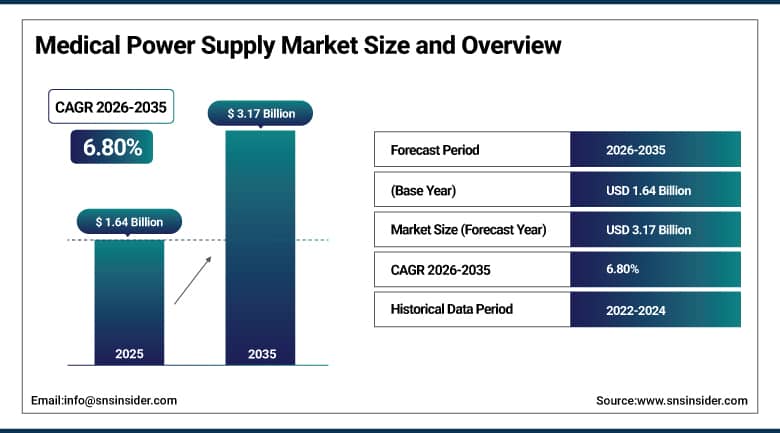
The Medical Power Supply Market was valued at USD 1.64 Billion in 2025 and is expected to reach USD 3.17 Billion by 2035, growing at a CAGR of 6.80% from 2026–2035.
Every piece of medical equipment in a hospital, from an MRI machine to a bedside patient monitor, needs power delivered in a way that's genuinely safe, stable, and compliant with medical device electrical safety standards, and that's a considerably more demanding requirement than powering ordinary consumer electronics. Medical power supplies are engineered specifically to meet those stringent isolation and leakage current requirements, and demand for them keeps climbing right alongside the broader expansion of diagnostic imaging, patient monitoring, and surgical equipment worldwide. As healthcare facilities keep investing in more sophisticated, power-hungry equipment, and as portable and home healthcare devices continue proliferating, the underlying power supply components remain a genuinely essential.
Rising global healthcare expenditure continues supporting capital investment in advanced diagnostic and therapeutic equipment, and every one of those investments requires a corresponding power supply engineered to meet strict medical-grade safety and reliability standards. That relationship between broader healthcare capital spending and medical power supply demand remains one of the more consistent structural drivers underpinning this market's steady growth trajectory.
Market Size and Forecast
-
Market Size in 2026E: USD 1.75 Billion
-
Market Size by 2035: USD 3.17 Billion
-
CAGR: 6.80% from 2026 to 2035
-
Fastest Growing Region: Asia Pacific
-
Largest Region: North America
To Get More Information On Medical Power Supply Market - Request Free Sample Report
Medical Power Supply Market Trends
-
Rising adoption of portable and home healthcare devices keeps increasing demand for compact, efficient medical-grade power supplies.
-
Growing emphasis on energy efficiency and reduced power consumption continues shaping new medical power supply design across the industry.
-
Increasing integration of digital health monitoring and connected medical devices keeps expanding the addressable market for reliable power components.
-
Manufacturers keep investing in modular, scalable power supply platforms capable of serving multiple equipment categories from a single design.
-
Tightening regulatory standards around electrical safety and isolation requirements continue shaping product development priorities industry-wide.
The U.S. Medical Power Supply Market Outlook
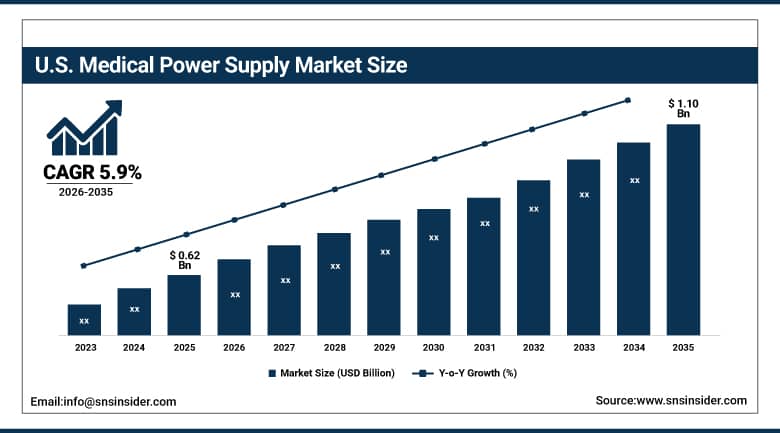
The U.S. Medical Power Supply Market was valued at approximately USD 0.62 Billion in 2025 and is expected to reach approximately USD 1.10 Billion by 2035, growing at a CAGR of approximately 5.9%.
The growth in the U.S. market is being fueled by constant investment in sophisticated imaging equipment, patient monitoring systems, and increasing demand for portable and at-home medical devices needing efficient power supply. With large numbers of medical device manufacturers based in the U.S., together with an established regulatory structure under the FDA for the electrical safety of medical devices, continuous market growth is being achieved. High capital expenditure in healthcare along with increased use of connected medical devices ensures that the U.S. remains the largest national market for medical power supplies in the world.
In September 2025, TDK-Lambda extended its offering for its CUS-M range of configurable medical and industrial power supplies, including increased wattages and more output combinations. Such an approach to growing their product offering is an example of how sensitive manufacturers of medical power supplies are to the changing power needs of the medical devices industry at large.
Medical Power Supply Market Segment Analysis
-
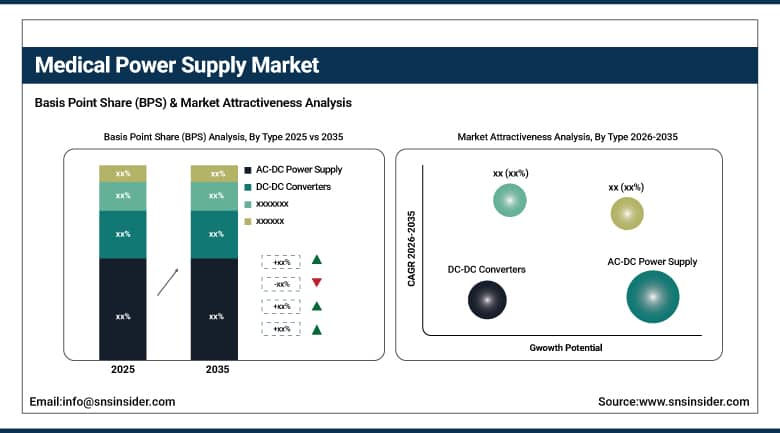
By Type, AC-DC power supply dominated the market with the largest revenue share in 2025, while DC-DC converters is the fastest growing segment.
-
By Output Power, the 100 to 500 watts segment dominated the market in 2025, while above 500 watts is the fastest growing segment.
-
By Application, diagnostic imaging dominated the market with the largest revenue share in 2025, while patient monitoring is the fastest growing segment.
-
By End User, hospitals dominated the market with the largest revenue share in 2025, while home healthcare is the fastest growing segment.
By Type, AC-DC power supplies dominate, DC-DC converters grow fastest
AC-DC power supplies dominated the medical power supply market in 2025, reflecting their essential role converting standard hospital mains electricity into the stable, regulated DC voltage that virtually every piece of medical equipment actually requires to operate safely. These power supplies form the foundational power conversion layer across imaging systems, patient monitors, and surgical equipment alike, and their broad applicability across nearly every medical device category keeps them the dominant product type by a comfortable margin, particularly given how tightly medical-grade AC-DC supplies must be engineered to meet isolation and leakage current safety standards.
DC-DC converters are the fastest-growing segment, driven by increasing use of battery-powered and portable medical devices that require efficient voltage conversion within an already-DC power architecture. As portable diagnostic devices, wearable monitors, and battery-operated surgical tools keep proliferating across both clinical and home healthcare settings, demand for compact, efficient DC-DC conversion components keeps climbing correspondingly. Manufacturers investing in smaller, more thermally efficient DC-DC converter designs stand to capture meaningful growth as portable medical device adoption continues accelerating industry-wide.
By Output Power, 100 to 500 watts dominates, above 500 watts grows fastest
The 100 to 500 watts output power segment dominated the market in 2025, reflecting the power requirements of a genuinely broad range of mid-sized medical equipment, including patient monitors, diagnostic devices, and smaller surgical tools that need meaningful but not extreme power delivery. This wattage range sits at something of a sweet spot for general hospital and clinical equipment, balancing sufficient power capacity against the compact form factor that most medical device manufacturers require, which keeps this segment firmly at the center of overall market demand across a wide variety of applications.
The above mentioned 500 watts range is the one that is experiencing the fastest growth due to the increase in demand for high-powered diagnostic imaging devices such as CT scanners, MRI machines and other large imaging devices that need much higher power input compared to standard clinical devices. Due to hospitals and diagnostic facilities investing in better diagnostic devices that need increased power input, there is an increasing need for high-powered medical power supplies and therefore a very promising future for this market segment.
By Application, diagnostic imaging dominates, patient monitoring grows fastest
Diagnostic imaging dominated the market by application in 2025, reflecting the substantial power requirements of CT, MRI, ultrasound, and X-ray systems, all of which depend on precisely engineered power supplies capable of delivering stable, high-capacity power without introducing electrical noise that could compromise image quality. As diagnostic imaging volume keeps climbing globally, driven by rising chronic disease prevalence and an aging population requiring more frequent diagnostic evaluation, demand for the power supply components underpinning this equipment category keeps growing correspondingly, reinforcing diagnostic imaging's position as the largest single application segment.
Patient monitoring is the fastest-growing application, driven by expanding use of continuous vital sign monitoring across hospital wards, intensive care units, and increasingly, home healthcare settings. As healthcare systems worldwide keep prioritizing earlier detection of patient deterioration through more comprehensive, continuous monitoring protocols, demand for the compact, reliable power supplies that keep these monitoring devices running continuously keeps expanding. That shift toward more pervasive, always-on patient monitoring is what's fueling this segment's above-average growth trajectory relative to the broader market.
By End User, hospitals dominate, home healthcare grows fastest
Hospitals dominated the market by end user in 2025, reflecting their position as the primary purchaser of diagnostic imaging, patient monitoring, and surgical equipment across virtually every healthcare system worldwide. Hospitals' sheer equipment volume, spanning multiple departments and dozens of individual devices, each requiring its own power supply component, keeps this end-user segment firmly at the top of overall market demand, and continued hospital capital investment in equipment upgrades and expansion keeps sustaining steady medical power supply demand from this channel specifically.
Home healthcare is the fastest-growing end-user segment, driven by the broader shift toward managing chronic disease and post-acute recovery outside traditional hospital settings. As more patients use home-based dialysis machines, oxygen concentrators, and remote monitoring devices, demand for compact, reliable, home-appropriate medical power supplies keeps climbing correspondingly. That shift toward decentralized, home-based care delivery is expected to keep this segment growing meaningfully faster than the broader medical power supply market throughout the forecast period.
Regional Analysis
|
Region |
Major Country |
Share within Region, 2025 (%) |
|---|---|---|
|
North America |
United States |
78.0% |
|
Europe |
Germany |
25.0% |
|
Asia Pacific |
China |
37.0% |
|
Latin America |
Brazil |
36.0% |
|
Middle East & Africa |
UAE |
26.0% |
North America Medical Power Supply Market Insights
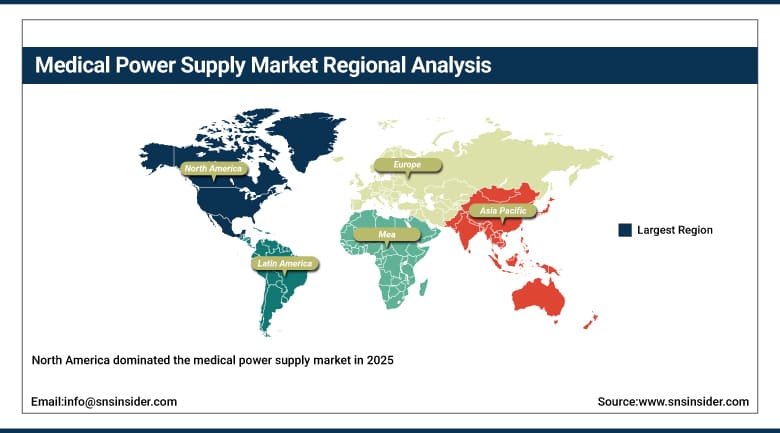
North America dominated the medical power supply market in 2025, supported by a well-established medical device manufacturing base, sustained healthcare capital expenditure, and a genuinely mature regulatory framework governing medical device electrical safety standards. Hospitals and diagnostic centers across the region continue investing in advanced imaging and patient monitoring equipment, each purchase requiring a corresponding medical-grade power supply engineered to meet stringent isolation and leakage current requirements. The U.S. constitutes the lion’s share of regional consumption due to the existence of numerous manufacturers of medical devices and power supply components in the area. Canada represents the lower portion of regional revenues.
Get Customized Report as Per Your Business Requirement - Enquiry Now
Europe Medical Power Supply Market Insights
Europe holds a significant share of the medical power supply market, supported by well-established healthcare infrastructure, stringent regulatory standards under the EU Medical Device Regulation, and a strong base of medical device manufacturers headquartered across the region. Germany, the UK, and France lead regional demand, supported by sophisticated hospital networks and continued investment in diagnostic and therapeutic equipment upgrades. That combination of regulatory rigor and manufacturing depth keeps Europe a technically sophisticated, if more measured, growth market relative to the faster-expanding economies across Asia Pacific, though sustained healthcare capital investment continues supporting steady regional growth throughout the forecast period.
Asia Pacific Medical Power Supply Market Insights
Asia Pacific is the fastest-growing region in the medical power supply market, driven by rapidly expanding healthcare infrastructure, rising medical device manufacturing activity, and growing government investment in hospital and diagnostic center capacity across the region's largest economies. China, Japan, and India are all seeing substantial growth in both domestic medical device manufacturing and healthcare facility construction, both of which directly translate into rising demand for medical power supply components. Growing local manufacturing capability, combined with expanding healthcare access initiatives across developing economies within the region, continues accelerating Asia Pacific's growth trajectory relative to every other market covered in this report.
MEA & Latin America Medical Power Supply Market Insights
The Middle East and Africa and Latin America are experiencing steady growth in medical power supply adoption, driven by expanding healthcare infrastructure investment, rising diagnostic imaging equipment deployment, and growing government initiatives aimed at improving healthcare access across both regions.
Within the Middle East, the countries that make the highest demands include the UAE and Saudi Arabia due to the construction and modernization of many hospitals through healthcare reforms. On the other hand, the leading demand in Latin America is represented by Brazil. Both regions remain smaller markets relative to North America, Europe, and Asia Pacific, though continued healthcare infrastructure investment is expected to support gradual, sustained market development through the forecast period.
Market Dynamics
Growth Drivers: Expanding diagnostic equipment deployment sustains demand
The continued global expansion of diagnostic imaging and therapeutic equipment deployment represents the principal driver behind medical power supply market growth. As healthcare systems worldwide keep investing in more sophisticated CT scanners, MRI systems, patient monitors, and surgical equipment to meet rising diagnostic and treatment demand, each new piece of equipment requires a corresponding power supply engineered to meet strict medical-grade safety and reliability standards. Rising chronic disease prevalence and an aging global population, both of which drive higher diagnostic imaging and monitoring volume, continue reinforcing this underlying equipment demand and, by extension, sustained medical power supply market growth.
Growing adoption of portable and home healthcare devices represents an equally significant growth driver, as more patients manage chronic conditions and post-acute recovery outside traditional hospital settings. The development of home health care has thus fueled a significant need for the development of miniaturized, efficient power supply components that are compatible with batteries and can reliably power home dialysis machines, oxygen concentrators, and remote patient monitoring devices. With the expansion of the adoption rate of home healthcare even in developing countries, there is an increasing demand for the special type of power supply components which enable these devices to function.
Restraints: Stringent certification requirements and design complexity constrain market entry
The genuinely stringent certification and regulatory compliance requirements governing medical device electrical safety represent a significant restraint on this market's broader competitive landscape. Medical power supplies must meet strict isolation, leakage current, and electromagnetic compatibility standards that differ meaningfully from standard industrial or consumer power supply requirements, and achieving these certifications requires substantial engineering investment and lengthy testing and approval timelines. This regulatory complexity raises the barrier to entry for smaller manufacturers and can delay new product introductions, ultimately concentrating market share among established suppliers with the resources to navigate these compliance requirements efficiently.
In addition, the custom nature of designing such power supplies and the requirement for unique and specific power supplies for specific applications of the medical equipment represents yet another constraint for wider scalability within this market segment. In contrast to standard industrial applications for power supplies, producers of medical equipment often need power supplies to be specially designed in accordance with certain electrical, thermal, and dimensional requirements for a particular piece of medical equipment, and hence, the possibility of achieving economies of scale through mass production by the manufacturer of power supplies is limited.
Opportunities: Miniaturization and energy efficiency advances unlock meaningful growth potential
Continued advancement in power supply miniaturization presents a substantial growth opportunity, particularly as medical device manufacturers keep pushing toward smaller, more portable equipment designs across diagnostic, monitoring, and surgical device categories. Power supply manufacturers capable of delivering genuinely compact, high-efficiency designs without compromising the safety and reliability standards medical applications demand stand to capture meaningful growth as device miniaturization continues accelerating across the broader medical device industry. This opportunity is particularly pronounced within the portable and home healthcare device categories, where form factor constraints are especially demanding.
Growing emphasis on energy efficiency and reduced power consumption presents a further meaningful opportunity, as healthcare facilities increasingly prioritize sustainability alongside traditional performance and safety considerations when selecting medical equipment and its underlying power supply components. Manufacturers investing in higher-efficiency power conversion designs, capable of reducing both energy consumption and heat generation, stand to differentiate themselves within an increasingly competitive market, particularly as hospital procurement decisions increasingly factor in total cost of ownership and environmental impact alongside upfront equipment cost and clinical performance considerations.
Recent Developments:
-
2024: In September 2024, Advanced Energy Industries launched a new CF-rated medical power supply series designed to meet stringent leakage current requirements for patient-connected medical equipment applications.
-
2025: In September 2025, TDK-Lambda expanded its CUS-M series of configurable medical and industrial power supplies, adding higher-wattage options and additional output configurations for increasingly power-dense equipment applications.
-
2025: In October 2025, TDK-Lambda launched the MU6 series, a compact, high-efficiency medical power supply platform designed to support next-generation portable and point-of-care diagnostic equipment.
Medical Power Supply Market key players are:
-
TDK-Lambda Corporation
-
Advanced Energy Industries, Inc.
-
XP Power Ltd.
-
CUI Inc. (Same Sky)
-
Mean Well Enterprises Co., Ltd.
-
Delta Electronics, Inc.
-
Bel Fuse Inc.
-
Murata Manufacturing Co., Ltd.
-
Artesyn Embedded Technologies
-
SL Power Electronics
-
Vicor Corporation
-
Cincon Electronics Co., Ltd.
-
Excelsys Technologies Ltd.
-
FRIWO AG
-
Powerbox International AB
-
RECOM Power GmbH
-
TRACO Electronic AG
-
Astrodyne TDI
-
GlobTek, Inc.
-
Cosel Co., Ltd.
Medical Power Supply Market Report Scope:
| Report Attributes | Details |
|---|---|
| Market Size in 2025 | USD 1.64 Billion |
| Market Size by 2035 | USD 3.17 Billion |
| CAGR | CAGR of 6.80% From 2026 to 2035 |
| Base Year | 2025 |
| Forecast Period | 2026-2035 |
| Historical Data | 2022-2024 |
| Report Scope & Coverage | Market Size, Segments Analysis, Competitive Landscape, Regional Analysis, DROC & SWOT Analysis, Forecast Outlook |
| Key Segments | • By Type (AC-DC Power Supply, DC-DC Converters, Battery Backup Systems, Others) • By Output Power (Below 100 Watts, 100 to 500 Watts, Above 500 Watts) • By Application (Diagnostic Imaging, Patient Monitoring, Surgical Equipment, Laboratory Equipment, Others) • By End User (Hospitals, Diagnostic Centers, Ambulatory Surgical Centers, Home Healthcare, Others) |
| Regional Analysis/Coverage | North America (US, Canada), Europe (Germany, UK, France, Italy, Spain, Russia, Poland, Rest of Europe), Asia Pacific (China, India, Japan, South Korea, Australia, ASEAN Countries, Rest of Asia Pacific), Middle East & Africa (UAE, Saudi Arabia, Qatar, South Africa, Rest of Middle East & Africa), Latin America (Brazil, Argentina, Mexico, Colombia, Rest of Latin America). |
| Company Profiles | TDK-Lambda Corporation, Advanced Energy Industries, Inc., XP Power Ltd., CUI Inc. (Same Sky), Mean Well Enterprises Co., Ltd., Delta Electronics, Inc., Bel Fuse Inc., Murata Manufacturing Co., Ltd., Artesyn Embedded Technologies, SL Power Electronics, Vicor Corporation, Cincon Electronics Co., Ltd., Excelsys Technologies Ltd., FRIWO AG, Powerbox International AB, RECOM Power GmbH, TRACO Electronic AG, Astrodyne TDI, GlobTek, Inc., Cosel Co., Ltd. |

Frequently Asked Questions
AC-DC Power Supply dominated the market in 2025.
Expanding diagnostic and therapeutic equipment deployment, combined with rising adoption of portable and home healthcare devices, are the major growth factors.
The Medical Power Supply Market was valued at USD 1.64 Billion in 2025.
The Medical Power Supply Market is expected to grow at a CAGR of 6.80% from 2026 to 2035.
