
Microphone Market Report Scope & Overview:
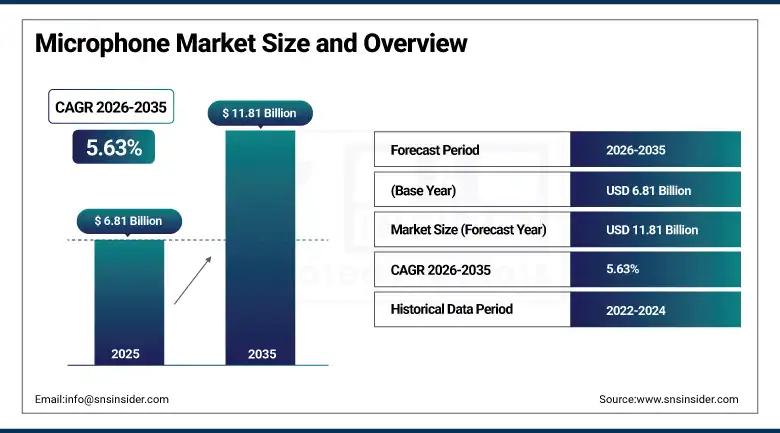
The Microphone Market was valued at USD 6.81 Billion in 2025 and is expected to reach USD 11.81 Billion by 2035, growing at a CAGR of 5.63% from 2026–2035.
The global microphone market is advancing across an extraordinarily diverse set of applications whose collective expansion reflects the growing role of high-quality audio capture in consumer electronics, automotive safety systems, industrial monitoring, telehealth, and voice-first computing interfaces. Microphone technology spans from millimetre-scale MEMS transducers embedded in smartphones, TWS earbuds, and IoT devices through professional condenser and dynamic microphones for broadcast and recording applications to industrial-grade piezoelectric sensors for machine monitoring and acoustic emission detection. Rising adoption of AI-powered voice assistants, noise-cancelling beamforming arrays in personal computing devices, and multi-microphone automotive hands-free systems collectively sustain above-average market growth. In 2023, consumer electronics contributed approximately 49% of global microphone revenues, with smartphone OEMs, wearable device manufacturers, and smart speaker producers representing the largest individual procurement categories.
In August 2025, AAC Technologies projected over 50% revenue growth in MEMS microphones driven by AI applications and launched a 2.0 mm × 1.5 mm MEMS microphone module among the smallest commercially available, enabling thinner true wireless stereo earbud designs without sacrificing acoustic performance. The launch demonstrated the commercial momentum of AI voice processing as a microphone demand driver, where the requirement for multiple high-SNR microphones per device to support accurate wake-word detection and noise-suppressed voice command capture is progressively increasing the average microphone count per consumer electronics product.
To Get more information On Microphone Market - Request Free Sample Report
Microphone Market Trends
-
AI-powered noise cancellation and beamforming array integration in laptops and smart speakers is increasing multi-microphone content per device.
-
Automotive in-cabin voice control systems requiring multi-microphone beamforming arrays are creating growing automotive MEMS microphone procurement per vehicle.
-
USB microphone adoption for podcasting, content creation, and remote work is driving above-average consumer standalone microphone segment growth.
-
Ultra-miniaturized MEMS microphone designs are enabling new hearing aid, hearable, and medical device applications requiring millimetre-scale transducers.
-
Industrial acoustic emission monitoring and machine health diagnostics are expanding microphone applications beyond audio capture into predictive maintenance contexts.
The U.S. Microphone Market Outlook
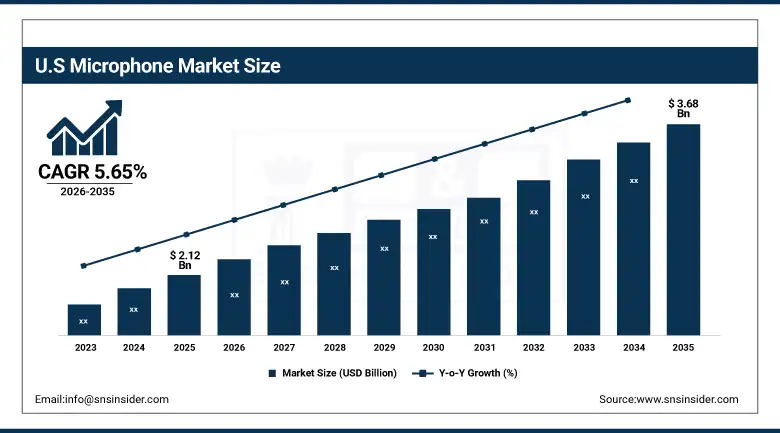
The U.S. Microphone Market was valued at approximately USD 2.12 Billion in 2025 and is expected to reach approximately USD 3.68 Billion by 2035, growing at a CAGR of approximately 5.65%.
The United States leads North American revenues through its concentration of consumer electronics OEM procurement, the world’s most active podcast and content creation economy whose creator-driven USB microphone adoption sustains premium standalone microphone segment growth, and substantial defense and aerospace microphone procurement for military communication and acoustic monitoring systems. Knowles Corporation and AAC Technologies’ U.S. operations sustain domestic MEMS microphone technology leadership. AI voice assistant infrastructure investment at Amazon, Apple, and Google creates engineering-driven microphone specification advancement that defines global performance standards for the consumer electronics supply chain.
In September 2024, Same Sky introduced new MEMS microphones featuring high signal-to-noise ratios of 62dBA and 64dBA with acoustic overload points of 123dB and 128dB SPL, targeting demanding TWS earbud, hearing aid, and professional headset applications whose performance requirements exceed conventional consumer MEMS specifications. The high-AOP specification addressed the growing market requirement for microphones that maintain linear response under the elevated sound pressure levels generated by in-ear or on-ear insertion without clipping, enabling accurate voice capture during loud environment use cases that standard MEMS microphones cannot handle without distortion.
Microphone Market Segment Analysis
-
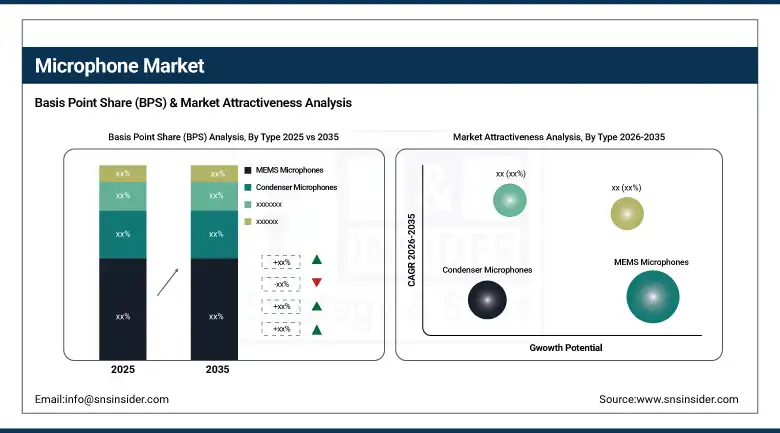
By Type, MEMS microphones segment dominated the microphone market with approximately 44.8% share in 2025, while the USB microphones segment is the fastest growing with a CAGR of approximately 8.7% driven by content creation and remote work adoption.
-
By Application, consumer electronics segment dominated the microphone market with approximately 49.0% share in 2025, while the industrial segment is the fastest growing with a CAGR of approximately 7.2% driven by machine monitoring and IoT deployment.
-
By End User, commercial segment dominated the microphone market with the largest share in 2025, while the professional segment is growing through content creator and broadcast media adoption of premium recording microphone systems.
By Type, MEMS microphones dominate, USB microphones grow fastest
MEMS microphones retained the dominant type position with approximately 44.8% of the microphone market in 2025. Their commercial primacy reflects the irreplaceable role of MEMS transducers as the de facto audio input component in smartphones, tablets, laptops, true wireless stereo earbuds, smart speakers, and IoT devices whose combined annual production volumes consume billions of MEMS microphone units. The technology’s combination of millimetre-scale dimensions, low power consumption enabling always-on voice detection, batch manufacturing cost efficiency through semiconductor wafer fabrication processes, and progressive SNR improvement creating measurable acoustic performance gains with each device generation sustains MEMS microphone specification dominance across the highest-volume consumer electronics applications. Knowles Corporation, AAC Technologies, and Goertek collectively supply the majority of global MEMS microphone volume to tier-1 smartphone and wearable OEMs.
USB microphones are growing fastest at approximately 8.7% CAGR because the global expansion of podcasting, video content creation, home recording, remote work, and online education has created a large and commercially significant standalone microphone category whose buyers prioritize audio quality, plug-and-play simplicity, and zero additional hardware requirements over the cost optimization that MEMS microphones serve in OEM applications. Each new podcast production, home studio setup, and professional video creator studio represents a USB microphone procurement event whose premium unit price and brand differentiation opportunities sustain above-average margin contribution for manufacturers competing in the content creator segment.
By Application, consumer electronics dominates, industrial grows fastest
Consumer electronics retained the dominant application position with approximately 49.0% of the microphone market in 2025, reflecting the foundational status of microphone technology as an essential component in the world’s highest-volume manufactured electronics categories. Each smartphone produced, each pair of TWS earbuds assembled, each laptop manufactured, and each smart speaker shipped contains multiple microphones whose per-device count is increasing with each AI voice processing generation that requires additional microphone array elements for improved beamforming, echo cancellation, and noise suppression performance. The smartphone market’s typical four to eight microphone count per flagship device, combined with annual smartphone production of approximately 1.4 billion units, creates the world’s largest single microphone consumption category.
Industrial applications are growing fastest at approximately 7.2% CAGR because the Industry 4.0 deployment of acoustic emission monitoring for machine health assessment, predictive maintenance in manufacturing and power generation, and environmental noise monitoring in regulatory compliance programmes creates growing demand for ruggedized microphones whose performance in harsh industrial environments differs substantially from consumer electronics specifications. Each new industrial IoT deployment that incorporates acoustic sensors for bearing fault detection, gear mesh monitoring, and pump cavitation identification adds microphone procurement to the sensor node hardware budget whose aggregate across manufacturing automation investment creates a commercially meaningful new application category.
Regional Analysis
|
Region |
Major Country |
Share within Region, 2025 (%) |
|---|---|---|
|
North America |
United States |
82.3% |
|
Europe |
Germany |
24.6% |
|
Asia Pacific |
China |
44.8% |
|
Middle East & Africa |
UAE |
22.8% |
|
Latin America |
Brazil |
43.8% |
North America Microphone Market Insights
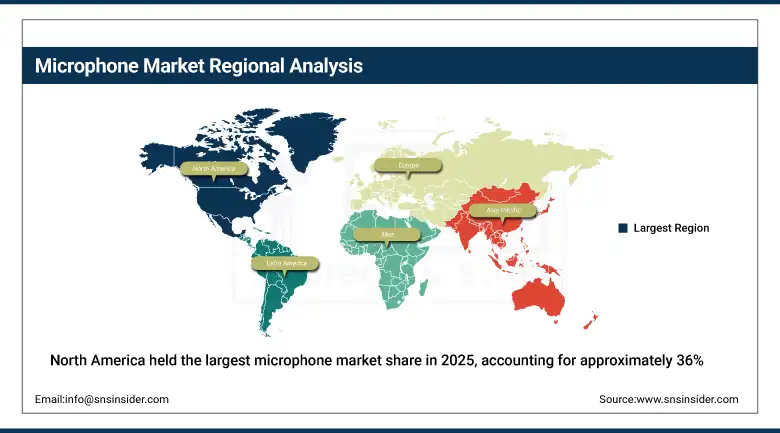
North America held the largest microphone market share in 2025, accounting for approximately 36% of total market revenue. This is driven by its concentration of consumer electronics ecosystem procurement, professional audio and broadcast industry demand, and the enterprise communication market’s investment in conferencing microphone arrays and telephony infrastructure. The United States accounts for approximately 82.3% of North American revenues through Apple’s iPhone microphone MEMS procurement specifications that define industry performance benchmarks, the professional recording industry’s premium condenser and dynamic microphone demand, and the podcast and content creator economy’s above-average USB microphone adoption rate.
Canada contributes supplementary North American revenues through its growing content creation economy, the broadcasting and media production industry’s professional microphone procurement, and the industrial sector’s acoustic monitoring adoption in oil sands, mining, and manufacturing operations whose harsh environmental requirements sustain demand for ruggedized microphone configurations not served by standard consumer electronics specifications.
Get Customized Report as per Your Business Requirement - Enquiry Now
Europe Microphone Market Insights
Europe is a technically sophisticated microphone market where premium professional audio brands including Sennheiser, Neumann, Beyerdynamic, and AKG sustain the world’s most commercially concentrated professional microphone manufacturing ecosystem alongside growing consumer electronics and automotive application procurement. Germany accounts for approximately 24.6% of European revenues through its concentration of professional audio manufacturing, the automotive industry’s multi-microphone voice control system procurement, and the industrial manufacturing sector’s acoustic emission monitoring investment.
The United Kingdom, Sweden, and Denmark contribute significant secondary European market revenues through their broadcasting and media production industries’ microphone procurement, the growing podcast and content creator economy in English-language European markets, and the telecommunications sector’s conferencing and collaboration system microphone adoption. European automotive OEMs’ MEMS microphone procurement for in-cabin noise cancellation and voice control creates a growing industrial application demand parallel to the consumer and professional audio segments.
Asia Pacific Microphone Market Insights
Asia Pacific is the fastest-growing regional microphone market, driven by the concentration of global consumer electronics manufacturing in China, South Korea, Taiwan, and Vietnam whose OEM production creates the world’s largest regional microphone consumption base, and the rapidly growing domestic consumer electronics markets across the region. China accounts for approximately 44.8% of Asia Pacific revenues through its dual role as the world’s largest consumer electronics manufacturing hub supplying global OEM demand and a rapidly expanding domestic consumer market for smartphones, TWS earbuds, and smart home devices.
South Korea’s Samsung and LG Electronics’ premium smartphone microphone specifications create high-value MEMS microphone procurement whose per-unit performance requirements sustain premium pricing from top-tier microphone suppliers. Japan’s professional audio heritage through Sony and Pioneer, India’s growing smartphone manufacturing ecosystem, and Southeast Asia’s expanding consumer electronics production base collectively sustain Asia Pacific’s dominant microphone consumption position and fastest-growing market trajectory.
MEA & Latin America Microphone Market Insights
The Middle East and Africa microphone market is growing through the UAE’s technology-forward consumer electronics adoption, media and entertainment sector procurement for broadcast and live event applications, and the growing podcast and content creation economy across Gulf Cooperation Council markets. Saudi Arabia contributes growing regional demand through its Vision 2030 media investment, entertainment sector expansion, and the growing adoption of voice-enabled smart home systems among its technology-oriented population.
Brazil leads Latin American revenues at approximately 43.8% through its large consumer electronics market, the growing content creator and streaming entertainment economy, and the media and broadcast sector’s professional microphone procurement. Mexico and Colombia are growing secondary markets whose expanding consumer electronics adoption, growing gaming and content creation communities, and enterprise communications sector create above-average microphone demand growth relative to regional GDP.
Market Dynamics
Growth Drivers: AI voice processing proliferation increasing multi-microphone array content per device and content creation economy expanding premium standalone microphone demand
The microphone market most structurally significant commercial growth driver is the AI voice processing revolution whose deployment in smartphones, smart speakers, laptops, and automotive systems is systematically increasing the microphone count per device as each additional microphone element improves beamforming directionality, echo cancellation quality, and noise suppression accuracy. Each generation of AI voice assistant whose wake-word detection accuracy improvement requires denser microphone arrays creates manufacturer specification requirements that multiply MEMS microphone procurement per device unit across billions of annual consumer electronics shipments. The content creator economy’s structural expansion, where podcast production, video content creation, live streaming, and online education collectively represent a growing commercial ecosystem whose participants invest in audio quality as a professional differentiator, sustains premium standalone microphone demand whose above-average unit value contributes above-proportionate revenue growth.
Restraints: Commoditization pressure on MEMS microphone pricing and raw material supply chain concentration creating margin and availability risks
The MEMS microphone market’s competitive intensity among Knowles Corporation, AAC Technologies, Goertek, and InvenSense whose combined market share approaches 80% creates pricing pressure that compresses margins on standard consumer electronics MEMS microphone specifications, limiting revenue growth from pure volume expansion below what unit count growth rates alone would suggest. Supply chain concentration of MEMS microphone wafer fabrication at a small number of semiconductor foundries creates single-point availability risk whose manifestation during semiconductor supply constraints can disrupt OEM production schedules across multiple consumer electronics product categories simultaneously. The challenge of differentiating premium microphone specifications from improving commodity alternatives creates pricing power erosion in market segments where good-enough performance is achievable from lower-cost suppliers.
Opportunities: Spatial audio microphone array innovation and medical-grade microphone applications creating premium commercial frontiers
Spatial audio capture using multi-microphone arrays whose signal processing enables three-dimensional sound field recording and reproduction represents the most commercially compelling innovation frontier for premium microphone applications in content creation, immersive media, and extended reality devices. Each spatial audio recording product, binaural microphone system, or ambisonic microphone array whose creative and technical differentiation sustains premium pricing creates a market tier whose revenue per unit substantially exceeds commodity MEMS microphone economics. Medical-grade microphone applications including implantable hearing aid receiver microphones, electrosurgical monitoring acoustic sensors, and stethoscope digital auscultation systems create a growing specialized application category whose regulatory approval barriers, performance specification requirements, and medical device pricing create margins that consumer electronics MEMS microphone applications cannot approach.
Recent Developments:
-
2025: AAC Technologies launched a 2.0 mm × 1.5 mm MEMS microphone module among the smallest commercially available for TWS earbud applications, enabling thinner device designs without acoustic performance compromise, and projected over 50% revenue growth in MEMS microphones driven by AI voice processing application adoption.
-
2024: Same Sky (formerly CUI Devices) introduced MEMS microphones with SNR of 62dBA and 64dBA and AOP of 123dB and 128dB SPL for demanding TWS earbud, hearing aid, and professional headset applications requiring accurate voice capture at elevated sound pressure levels.
-
2023: Knowles Corporation launched its SPH3827LR5H-1 MEMS microphone series incorporating SiSonic MEMS technology with enhanced acoustic overload point of 122dB SPL and bottom-port design optimized for automotive in-cabin voice control applications in noise-challenged environments.
Microphone Market Key Players are:
-
Knowles Corporation
-
AAC Technologies Holdings Inc.
-
Goertek Inc.
-
TDK Corporation (InvenSense)
-
Cirrus Logic Inc.
-
Analog Devices Inc.
-
STMicroelectronics NV
-
Same Sky (CUI Devices)
-
Vesper Technologies Inc.
-
Synaptics Incorporated
-
Sennheiser Electronic GmbH & Co. KG
-
Shure Incorporated
-
Audio-Technica Corporation
-
Neumann (Sennheiser Group)
-
Rode Microphones Pty Ltd.
-
Blue Microphones (Logitech)
-
RØDE Microphones
-
MXL Acoustics (Marshall Electronics)
-
AKG Acoustics GmbH (Samsung)
-
Beyerdynamic GmbH & Co. KG
Microphone Market Report Scope:
| Report Attributes | Details |
|---|---|
| Market Size in 2025 | USD 6.81 Billion |
| Market Size by 2035 | USD 11.81 Billion |
| CAGR | CAGR of 5.63% From 2026 to 2035 |
| Base Year | 2025 |
| Forecast Period | 2026-2035 |
| Historical Data | 2022-2024 |
| Report Scope & Coverage | Market Size, Segments Analysis, Competitive Landscape, Regional Analysis, DROC & SWOT Analysis, Forecast Outlook |
| Key Segments | • By Type (MEMS Microphones, Condenser Microphones, Dynamic Microphones, Ribbon Microphones, USB Microphones, Others) • By Application (Consumer Electronics, Automotive, Industrial, Healthcare, Media & Entertainment, IT & Telecommunications, Others) • By End User (Professional, Commercial, Personal) |
| Regional Analysis/Coverage | North America (US, Canada), Europe (Germany, UK, France, Italy, Spain, Russia, Poland, Rest of Europe), Asia Pacific (China, India, Japan, South Korea, Australia, ASEAN Countries, Rest of Asia Pacific), Middle East & Africa (UAE, Saudi Arabia, Qatar, South Africa, Rest of Middle East & Africa), Latin America (Brazil, Argentina, Mexico, Colombia, Rest of Latin America). |
| Company Profiles | Knowles Corporation, AAC Technologies Holdings Inc., Goertek Inc., TDK Corporation (InvenSense), Cirrus Logic Inc., Analog Devices Inc., STMicroelectronics NV, Same Sky (CUI Devices), Vesper Technologies Inc., Synaptics Incorporated, Sennheiser Electronic GmbH & Co. KG, Shure Incorporated, Audio-Technica Corporation, Neumann (Sennheiser Group), Rode Microphones Pty Ltd., Blue Microphones (Logitech), RØDE Microphones, MXL Acoustics (Marshall Electronics), AKG Acoustics GmbH (Samsung), and Beyerdynamic GmbH & Co. KG. |
Frequently Asked Questions
The Microphone Market is expected to grow at a CAGR of 5.63% from 2026 to 2035.
The Microphone Market was valued at USD 6.81 Billion in 2025.
AI voice processing proliferation increasing multi-microphone array content per consumer electronics device, the content creation economy expanding premium standalone microphone demand.
MEMS Microphones dominated the Microphone Market with approximately 44.8% share in 2025, while USB Microphones are the fastest growing with a CAGR of approximately 8.7%.
North America dominated the Microphone Market in 2025.
