
Smart Card Module Test Cell Market Report Scope & Overview:
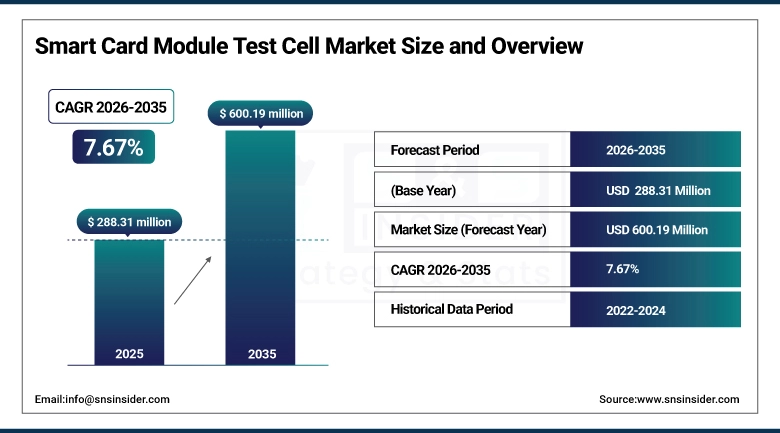
The Smart Card Module Test Cell Market size was valued at USD 288.31 Million in 2025 and is projected to reach USD 600.19 Billion by 2035, growing at a CAGR of 7.67% during 2026–2035.
The Smart Card Module Test Cell Market analysis report provides a detailed assessment of technology integration, application diversity, and regional leadership. Rising adoption in mobile devices, smartphones, and wearables, growing demand for secure payment systems, and expanding use by corporations and public organizations are driving robust market growth during 2026–2035.
In 2025, Smart Card Module test cell deployments rose by over 15%, with more than 25,000 units ordered by card manufacturers and semiconductor fabs.
To Get more information on Smart Card Module Test Cell Market - Request Free Sample Report
Smart Card Module Test Cell Market Trends:
-
Integration of Smart Card technology into mobile devices, smartphones, and wearables
-
Growing need for secure and efficient payment systems in banking, telecom and government ID Programs.
-
SIM/UICC modules hold the largest share around 43% reflecting telecom expansion and mobile connectivity needs.
-
Functional and protocol testing dominate, ensuring cards meet ISO/EVM standards and increasing emphasis on security validation to counter cyber threats and fraud.
-
Asia-Pacific leads growth due to large-scale telecom and banking card production. Europe follows closely, driven by strict compliance regulations and digital ID adoption.
-
Emerging markets (India, Africa, Latin America) show rising demand but slower infrastructure development.
-
Testing infrastructure is expanding in parallel with smart card adoption and governments and enterprises are investing in digital security initiatives, similar to clean transport incentives in other industries.
U.S. Smart Card Module test cell Insights:
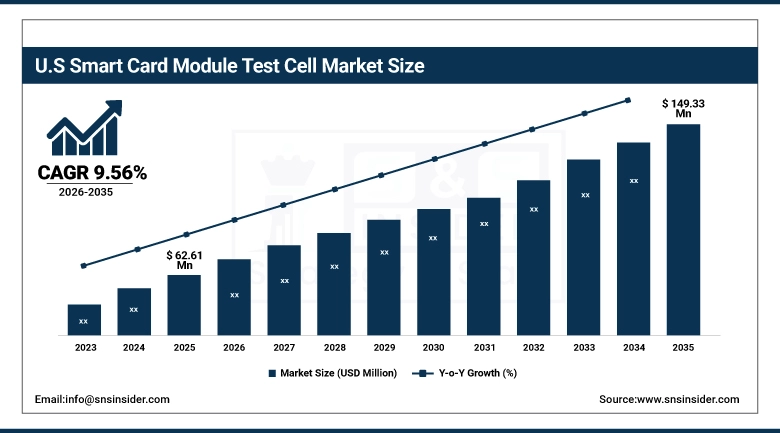
The U.S. Smart Card Module Test Cell Market has been valued at USD 62.61 Million in 2025 and is expected to reach USD 149.33 Million in 2035, growing at a CAGR of 9.56% from 2026 to 2035, driven by digital payments, telecom expansion, and government-backed security initiatives.
Smart Card Module Test Cell Market Growth Drivers:
-
Digital Payments Expansion driving demand for smart card module test cells.
The widespread acceptance of EMV Chip Cards and Contactless Payment Systems has significantly impacted the financial services industry. Financial institutions, fintech companies, and retailers are increasingly using smart cards to deliver secure transactions. This increased adoption necessitates the testing of card modules to verify their adherence to EMVCo and ISO specifications. Test cells are essential to verify the encryption, authentication, and interoperability of cards to ensure every card being issued can withstand fraudulent activity. With the increased adoption of digital wallets and tap-to-pay technology, the testing needs are increasing.
Over 25,000 test cell units were ordered in 2025, with a significant share dedicated to financial services testing, especially in North America and Asia‑Pacific.
Smart Card Module Test Cell Market Restraints:
-
High Initial Investment and Standardization Complexities driving barriers to smart card module test cell adoption.
The cost of deploying smart card technology is also high, considering that manufacturers need to invest in test cells, compliance, and integration into existing IT infrastructures. This is a major challenge for smaller manufacturers/integrators. In addition, smart card technology faces interoperability issues given the dynamic nature of standards (ISO, EMVCo, PCI DSS, telecom protocols, etc.). The need for constant upgrades of test cells is a challenge for manufacturers, which slows up the process of adoption and acts as a barrier to entry.
Smart Card Module Test Cell Market Opportunities:
-
Integration of AI and Automation in Testing accelerating efficiency in smart card module test cells.
The prospect of AI-based testing solution tools provides a significant opportunity to the smart card module test cell. This is due to the machine learning algorithms can be used to identify anomalies quickly, predict non-compliance issues, etc. This not only increases the efficiency of the testing procedure but also reduces the overall cost of the operation. This provides a significant prospect to the high-end testing cell, which can be adopted by both large-scale and mid-scale manufacturers.
In 2025, early adoption of AI enabled test cells reduced testing cycle times by around 30% in leading semiconductor fabs, while predictive analytics helped identify compliance issues before mass production.
Smart Card Module Test Cell Market Segments:
-
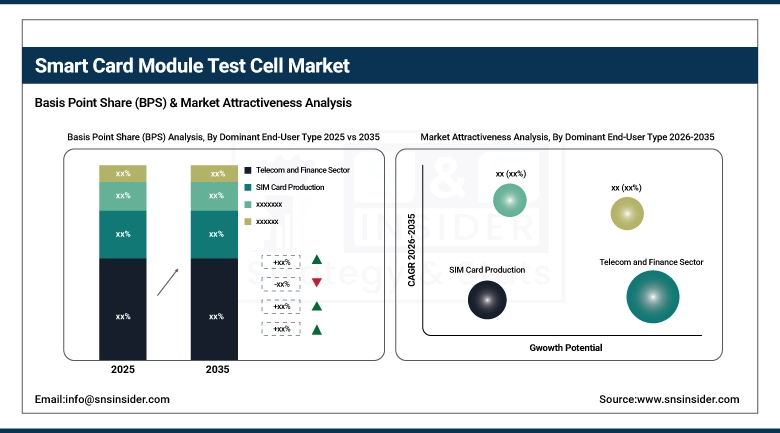
By End User, Telecom sector held the dominating market share of 34.25% in 2025, while Finance Sector are fastest growing with EMV chip adoption, contactless payments and mobile wallets with CAGR of 7.20% during 2026-2035.
-
By Application, Identification Function is dominating with market share of 32.71% and eID Function are projected to fastest growing at the CAGR of 8.22% during 2026–2035, supported by Aadhaar (India), eIDAS (Europe) and REAL ID (U.S.).
-
By Technology Trend, Contactless transactions and biometric smart cards have dominating market share of 30.45% in 2025 while eSIM/iSIM are the fastest growing with CAGR of 8.76% surpassed 1 billion devices, fuelled by IoT and 5G.
-
By Test Capability, dominated by Modern Test Cell segment with market share of 42.36% in 2025 while Electrical Defect Testing segment expected to grow at Fastest CAGR of 8.67% during forecast period.
Smart Card Module Test Cell Market Segments:
By Dominant End User, Telecom and Finance Sector Lead Growth:
The Telecom sector had the largest market share due to the large volume of SIM/UICC card production for 5G and IoT growth. The test requirements for the products also drive the demand for the products. The growing trend of eSIM/iSIM technology and the large-scale mobile connectivity initiatives are also expected to drive the growth in 2026-2035.
Finance sector is the fastest-growing sector, with EMV chip card, contactless, and mobile wallet payments requiring robust compliance. In 2025, over 25,000 test cell units were ordered globally, with strong adoption in the North America and Asia Pacific regions.
By High‑Growth Application, Identification Functions Dominate While eID Programs Surge:
Identification Function segment was dominant in the market with national ID cards, e-passports, and healthcare/border control projects. Increasing government initiatives for secure citizen identification and international compliance are also driving the segment. The segment is also expected to grow at a high rate with the expansion of digital identity frameworks.
eID Function was the fastest-growing segment in 2025, fuelled by initiatives such as Aadhaar, eIDAS, and REAL ID, reflecting rising reliance on secure identity ecosystems. Increasing government investments in digital identity frameworks and cross-border compliance are accelerating adoption.
By Key Technology Trends, Contactless & Biometric Dominate While eSIM/iSIM and Secure Elements Expand:
The dominant market segments of Contactless Transactions and Biometric Smart Card are expected to continue their hold over half of the card payments in 2025, which is likely to increase even more in the coming years through innovations in this area. The increasing demand for faster, secure, and convenient transaction methods is also boosting this market. Apart from this, developments in biometric technology and NFC are also increasing its reliability, which is resulting in its increased adoption in these areas.
Furthermore, it was also observed that the market segment of eSIM/iSIM is growing rapidly, with over 1 billion devices, owing to IoT and 5G technology. On the other hand, over 4 billion secure element devices are being shipped, which is a clear indication of its contribution to the market of digital identities and payment systems. It is expected that this trend will continue in the coming years, i.e., between 2026 and 2035.
By Test Capabilities, Advanced Quality Assurance Strengthens Adoption:
Modern Test Cells segment dominated the market share, emphasizing reel-to-reel handling, defect detection, and automated rejection to ensure throughput and compliance. Their adoption has led to significant improvements in efficiency, with leading manufacturers reporting around 25% defect reduction in 2025. Rising demand for advanced quality assurance and strict regulatory standards are expected to sustain strong growth during 2026–2035.
Electrical Defect Testing segment was observed to be the fastest-growing segment in 2025, with manufacturers witnessing a reduction of about 24% in the defect rate following the implementation of automated systems. The growth is also attributed to the need for quality assurance. The increasing regulatory needs for high-reliability modules are also projected to drive growth in 2026-2035.
Smart Card Module Test Cell Market Regional Analysis:
Asia-Pacific Smart Card Module Test Cell Market Analysis:
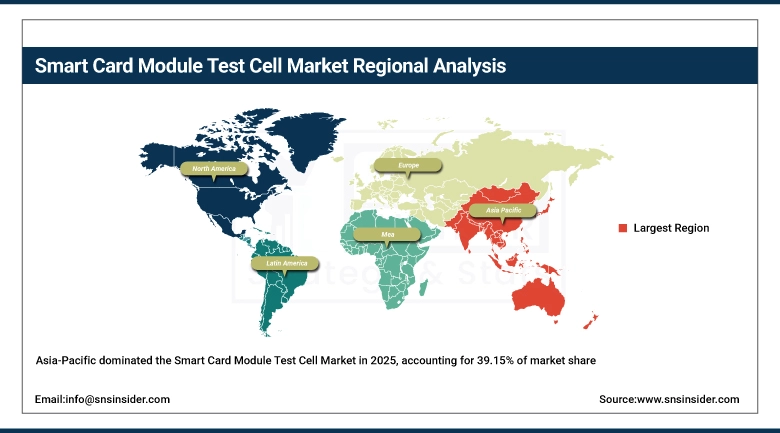
Asia-Pacific is the leader in the world market in terms of production market share. Asia-Pacific accounts for 39.15% of the market in 2025. China, India, and Southeast Asia are the leaders in telecom SIM/UICC card issuance. India’s Aadhaar-based identity and UPI payment systems create huge opportunities for compliance testing. Asia-Pacific is expected to remain the largest contributor in the market through 2035. The region is expected to witness high growth in terms of adoption of test cells.
Get Customized Report as per Your Business Requirement - Enquiry Now
China Smart Card Module Test Cell Market Analysis:
China is a critical driver of the smart card module test cell market, holding the highest market share in the Asia-Pacific region due to its massive subscriber base in telecom services, ID programs, and semiconductor manufacturing industry. The country is a leader in SIM/UICC card issuance and also has a high rate of adoption of eSIM/iSIM technology.
North America Smart Card Module Test Cell Market Analysis:
North America is a fastest-growing region with CAGR of 9.67%, The region is growing due to the widespread use of EMV chips and contactless transactions. The U.S. government’s efforts in securing identification programs and the development of fintech ecosystems have fueled the growth in the need for test cells. In 2025, North America maintains good market share. Investments by banks and telecom operators in the region are strong.
U.S. Smart Card Module Test Cell Market Analysis:
The U.S. represents the largest share market driven by strong adoption rates for EMV chip cards and a strong growth rate for contactless payments. Federal initiatives in REAL ID compliance and modernization of e-passports have fueled the need for secure testing solutions. The U.S. also benefits from high investments in semiconductor fabrication and secure elements.
Europe Smart Card Module Test Cell Market Analysis:
The European market is a high-compliance market that has strict regulations under GDPR, EMVCo, and eIDAS. This market is a hotbed for digital identity initiatives including e-passports and national ID cards. There is a high usage of contactless payments in this market, with over 60% being tap-to-pay transactions in 2025. This market is a key area for the implementation of a test cell, especially for card manufacturers and governments.
Germany Smart Card Module Test Cell Market Analysis:
Currently, Germany is a major hub for smart card module testing within Europe, with a strong focus on complying with the GDPR, EMVCo, and eIDAS regulations. The country's financial industry and the use of contactless payments, are major factors for the growth of smart card module tests. Germany, with its robust manufacturing capabilities, is expected to contribute significantly to the growth of the smart card module market till 2035.
Latin America Smart Card Module Test Cell Market Analysis:
The region of Latin America is an emerging market for smart card module test cells. The region is witnessing an increase in digital payment systems and government initiatives for ID projects. Countries such as Brazil and Mexico are increasing the adoption of EMV chip cards and ID projects. The only issue is cost sensitivity for test cells.
In 2025, Latin America contributed a smaller market but showed strong growth potential as financial inclusion programs expanded.
Middle East & Africa Smart Card Module Test Cell Market Analysis:
In Africa, the adoption is still in the early stages. The growth is largely due to the expansion of telecommunication services and mobile banking. Africa has been deploying SIM/UICC modules on a large scale in countries such as Nigeria, Kenya, and South Africa. This has created the need for basic test cell infrastructure. Government ID projects are slowly starting to materialize in Africa. However, the lack of infrastructure and the high costs involved are the major barriers. The Africa market in 2025 has long-term growth potential.
The Middle East market is more advanced compared to Africa, supported by strong investments in secure payment systems, telecom infrastructure, and national ID programs.
Smart Card Module Test Cell Market Competitive Landscape:
Thales Group is a leader in digital security and smart card technologies, offering advanced testing and compliance solutions for SIM cards, banking cards, and secure ID programs. The company emphasizes cybersecurity integration, biometric authentication, and contactless payment validation. Working closely with telecom operators and governments, Thales ensures secure module deployment across diverse applications. Its strong focus on innovation and compliance standards has positioned it as a trusted partner in the smart card ecosystem.
-
December 2025, Thales expanded its smart card testing portfolio by partnering with a major European telecom provider to validate 5G-ready SIM modules, strengthening its dominance in the telecom sector.
IDEMIA, headquartered in France, is a leading provider of identity technologies and smart card solutions, specializing in biometric-enabled payment cards, e-passports, and secure ID systems. Its test cell solutions are designed to meet EMVCo and ISO standards, ensuring fraud resistance and interoperability. IDEMIA plays a pivotal role in government-backed ID programs across Europe and Asia, while also driving innovation in secure payment technologies. The company’s expertise in biometrics and compliance makes it a key player.
-
November 2025, IDEMIA announced a collaboration with India’s Aadhaar program to supply secure test systems for national ID cards, expanding its footprint in Asia-Pacific.
Giesecke+Devrient, based in Germany, is a major provider of secure payment and telecom solutions, with strong expertise in eSIM/iSIM testing, secure element validation, and banking card compliance. The company is recognized for its innovation in embedded SIM technology, supporting IoT and 5G ecosystems. G+D’s solutions emphasize reliability, scalability, and regulatory compliance, making it a trusted partner for telecom operators and financial institutions. Its leadership in secure connectivity continues to shape the smart card testing market.
-
October 2025, G+D launched a new test cell platform designed for eSIM/iSIM modules, targeting IoT device manufacturers and telecom operators in Asia-Pacific and North America.
Smart Card Module Test Cell Market Players:
Some of the Smart Card Module Test Cell Market Companies are
-
Thales Group
-
IDEMIA
-
Giesecke+Devrient (G+D)
-
Watchdata
-
SPEA
-
NXP Semiconductors
-
Infineon Technologies
-
STMicroelectronics
-
Samsung Electronics
-
Microchip Technology
-
Sony Group Corporation
-
VALID
-
Eastcompeace Technology
-
JP Sistech
-
Jarltech
-
Advanced Card Systems
-
Micropross (NI/Emerson)
-
Datacon (ASMPT)
-
Cohu
-
Teradyne
-
Chroma ATE
-
Seica
| Report Attributes | Details |
|---|---|
| Market Size in 2025 | USD 288.31 Billion |
| Market Size by 2035 | USD 600.19 Billion |
| CAGR | CAGR of 7.67% From 2026 to 2035 |
| Base Year | 2025 |
| Forecast Period | 2026-2035 |
| Historical Data | 2022-2024 |
| Report Scope & Coverage | Market Size, Segments Analysis, Competitive Landscape, Regional Analysis, DROC & SWOT Analysis, Forecast Outlook |
| Key Segments | • By Dominant End-User: (telecom and Finance sector, SIM Card Production) • By High-Growth Application: (Identification, eID functions) • By Key Technology Trends: (Contactless & Biometric, eSIM/iSIM, Secure Elements) • By Test Capabilities: (full electrical defect testing, rejection of faulty) |
| Regional Analysis/Coverage | North America (US, Canada), Europe (Germany, UK, France, Italy, Spain, Russia, Poland, Rest of Europe), Asia Pacific (China, India, Japan, South Korea, Australia, ASEAN Countries, Rest of Asia Pacific), Middle East & Africa (UAE, Saudi Arabia, Qatar, South Africa, Rest of Middle East & Africa), Latin America (Brazil, Argentina, Mexico, Colombia, Rest of Latin America). |
| Company Profiles | SPEA, NXP Semiconductors, Infineon Technologies, STMicroelectronics, Samsung Electronics, Microchip Technology, Sony Group Corporation, IDEMIA, Giesecke+Devrient, Watchdata, VALID, Eastcompeace Technology, JP Sistech, Jarltech, CREATOR, Advanced Card Systems, Micropross (NI/Emerson), Datacon (ASMPT), Cohu, Advantest, Teradyne, Chroma ATE, Keysight Technologies, Seica, Rohde & Schwar, etc |
Frequently Asked Questions
Contactless & biometric authentication, eSIM/iSIM adoption, and secure elements are the most influential technology trends.
While Asia-Pacific remains dominant, North America is forecast to grow at 9.67% CAGR, driven by financial services, healthcare, and secure ID programs.
Asia-Pacific leads with 39.15% share, driven by its strong electronics manufacturing base and widespread adoption of smart cards in telecom and finance.
Rising demand for secure payment systems, government ID programs, telecom SIM card production, and biometric authentication are the primary growth drivers.
The overall market is projected to grow at a CAGR of 7.67%, with segments such as eSIM/iSIM and eID functions growing faster around 8%.
