
Private 5G Network Orchestration Market Report Scope & Overview:
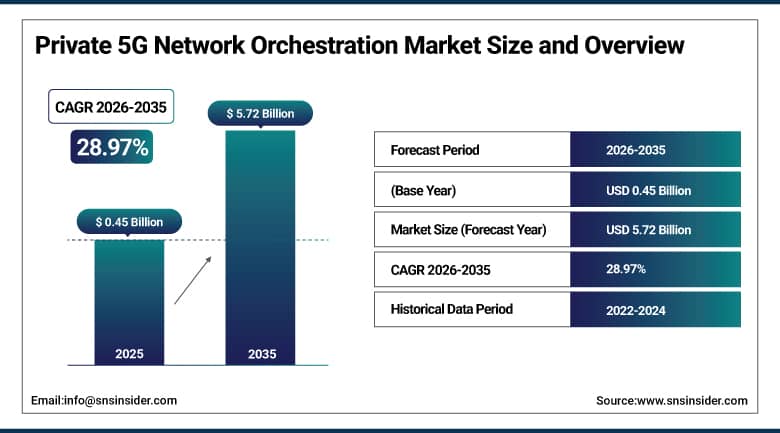
The Private 5G Network Orchestration Market was valued at USD 0.45 Billion in 2025 and is expected to reach USD 5.72 Billion by 2035, growing at a CAGR of 28.97% from 2026–2035.
The Private 5G Network Orchestration Market is experiencing strong growth due to increasing demand for secure, reliable, low-latency, and high-performance wireless connectivity across enterprise and industrial environments. The expansion of industrial automation, smart manufacturing, edge computing, Internet of Things (IoT), artificial intelligence, and mission-critical applications is driving demand for advanced network orchestration solutions. Private 5G orchestration platforms enable centralized provisioning, automated network management, resource allocation, network slicing, performance optimization, and policy control, improving network efficiency and operational flexibility. Companies are increasingly focusing on software-driven network automation, AI-enabled network optimization, multi-vendor management, and cloud-based and hybrid orchestration architectures to simplify private 5G deployment and lifecycle management.
In June 2026, the global private 5G orchestration platforms market is projected to grow by USD 873.31 million during 2025–2030 at a CAGR of 33.4%, driven by industrial automation, AI/ML-based network optimization, IoT expansion, centralized policy control, and the adoption of cloud-based and hybrid orchestration architectures.
To Get More Information On Private 5G Network Orchestration Market - Request Free Sample Report
Private 5G Network Orchestration Market Trends
-
Growing demand for secure, reliable, and low-latency connectivity is driving private 5G adoption across enterprises and industrial environments.
-
Rising deployment of AI, IoT, edge computing, and industrial automation is increasing demand for private 5G orchestration and network management solutions.
-
Increasing adoption of network automation, network slicing, and cloud-based architectures is supporting flexible and efficient private 5G network management.
-
Growing focus on network scalability, centralized management, security, and multi-vendor interoperability is creating opportunities for private 5G orchestration providers.
-
Advancements in AI-driven automation, network slicing, edge computing, and cloud-native architectures are improving network performance and supporting the adoption of private 5G orchestration solutions.
U.S. Private 5G Network Orchestration Market Outlook
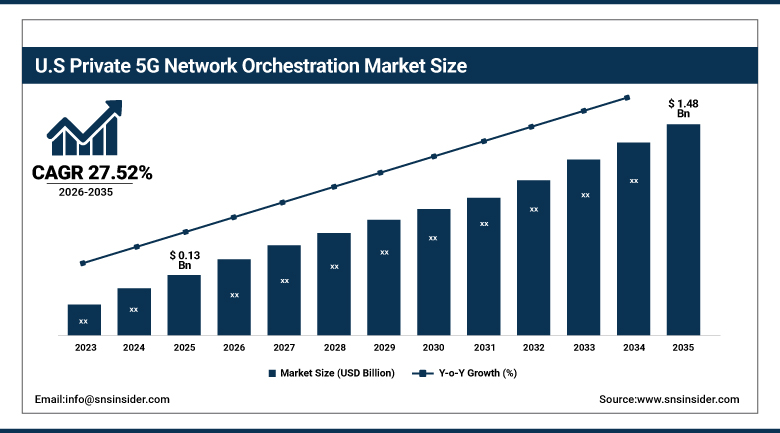
The U.S. Private 5G Network Orchestration Market was valued at USD 0.13 Billion in 2025 and is expected to reach around USD 1.48 Billion by 2035, growing at a CAGR of 27.52% from 2026–2035.
The U.S. Private 5G Network Orchestration Market is growing steadily due to rising demand for high-capacity, low-latency optical communication infrastructure. The expansion of artificial intelligence, hyperscale data centers, cloud computing, 5G networks, and high-performance computing is driving demand for terabit-scale data transmission. Investments in next-generation optical infrastructure and high-speed network upgrades are improving capacity, scalability, and efficiency. Growing hyperscale data centers, cloud services, telecom networks, and data center interconnect infrastructure are supporting market demand. Companies are focusing on coherent optical technology, DWDM, OTN, coherent pluggable optics, photonic integrated circuits, and higher data-rate solutions to enhance transmission efficiency and network flexibility. The adoption of 800G, 1.2T, 1.6T, and above-1.6T technologies is further supporting market growth in the U.S.
In April 2026, Siemens expanded its private 5G infrastructure to the United States, introducing a U.S.-specific CBRS-band radio unit to enable manufacturers to deploy private 5G networks on their own premises. The expansion supports industrial applications across manufacturing, pharmaceuticals, intralogistics, heavy industries, and other enterprise environments.
Private 5G Network Orchestration Market Segment Analysis
-
By Component, orchestration software dominated the private 5G network orchestration market with a 31.80% share in 2025, while network automation software is projected to be the fastest-growing segment, registering a 35.76% CAGR during 2026–2035.
-
By Deployment, on-premises dominated the private 5G network orchestration market with a 51.20% share in 2025, while cloud-based is projected to be the fastest-growing segment, registering a 33.65% CAGR during 2026–2035. The growing adoption of cloud-native orchestration, centralized management, and multi-site private 5G deployments is supporting demand for cloud-based platforms.
-
By Enterprise Size, large enterprises dominated the private 5G network orchestration market with a 72.60% share in 2025, while small & medium enterprises are projected to be the fastest-growing segment, registering a 33.83% CAGR during 2026–2035.
-
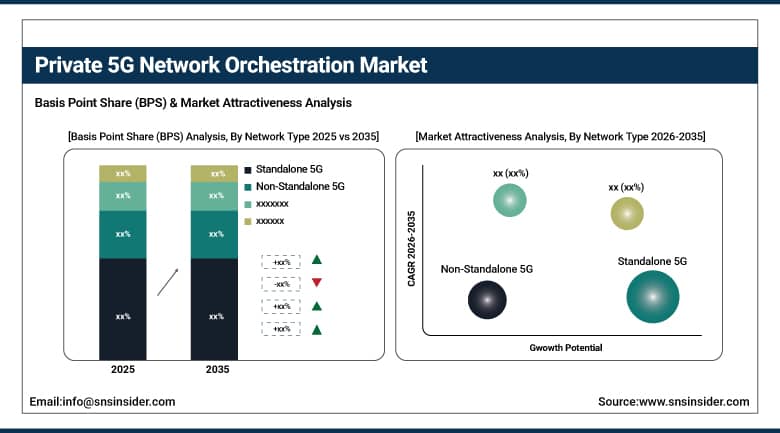
By Network Type, standalone 5G dominated the private 5G network orchestration market with a 62.50% share in 2025, while standalone 5G is also projected to be the fastest-growing segment, registering a 31.68% CAGR during 2026–2035. The expansion of cloud-native 5G standalone architectures is increasing demand for automated lifecycle management, provisioning, network slicing, and resource optimization.
-
By Application, network provisioning & configuration dominated the private 5G network orchestration market with a 27.50% share in 2025, while network slicing management is projected to be the fastest-growing segment, registering a 34.34% CAGR during 2026–2035
-
By Vertical, manufacturing & factories dominated the private 5G network orchestration market with a 31.50% share in 2025, while healthcare & hospitals is projected to be the fastest-growing segment, registering a 39.06% CAGR during 2026–2035.
By Network Type, standalone 5G dominated the private 5G network orchestration market in 2025 and is expected to remain the fastest-growing segment.
Standalone 5G held the leading position in the private 5G network orchestration market in 2025 because it provides enterprises with dedicated 5G core capabilities, greater control over network resources, and advanced support for network slicing, low-latency applications, and customized quality-of-service requirements. Standalone architectures are particularly suitable for industrial environments requiring reliable connectivity, local data processing, network customization, and advanced application support.
Standalone 5G is expected to maintain the fastest growth during the forecast period as enterprises increasingly adopt advanced private network architectures for Industry 4.0, connected machinery, autonomous systems, robotics, and mission-critical applications. The ability to combine 5G core functions, network slicing, edge computing, and automated lifecycle management is increasing the importance of standalone orchestration.
By Component, orchestration software dominated the private 5G network orchestration market in 2025, while network automation software is expected to be the fastest-growing segment.
Orchestration software held the leading position in the private 5G network orchestration market in 2025, supported by its critical role in coordinating network resources, provisioning services, managing configurations, and automating end-to-end private 5G operations. The increasing complexity of private 5G environments involving radio access, core networks, edge infrastructure, and multiple vendors is driving demand for centralized orchestration platforms.
Network automation software is expected to register the fastest growth during the forecast period. Increasing adoption of cloud-native network functions, zero-touch provisioning, AI-driven operations, and closed-loop automation is encouraging enterprises to automate network management activities. Automation can improve deployment speed, resource utilization, fault management, and service assurance while reducing operational complexity.
By Application, network provisioning & configuration dominated the private 5G network orchestration market in 2025, while network slicing management is expected to be the fastest-growing segment.
Network provisioning & configuration held the leading position in the private 5G network orchestration market in 2025, driven by the need to efficiently configure network resources, onboard devices, establish connectivity, and deploy private 5G services across enterprise locations. Private 5G environments involve multiple infrastructure layers, including radio access networks, 5G core functions, edge computing, and enterprise applications. Automated provisioning helps simplify deployment, reduce manual configuration requirements, and accelerate service activation.
Network slicing management is expected to register the fastest growth during the forecast period. Increasing requirements for differentiated connectivity, application-specific quality of service, resource isolation, and secure network environments are driving demand for automated slice management. Private 5G networks can support multiple applications through logically separated network slices, allowing enterprises to allocate resources according to specific operational requirements.
Regional Analysis
|
Region |
Major Country |
Share within Region, 2025(%) |
|---|---|---|
|
North America |
United States |
82.40% |
|
Europe |
Germany |
34.30% |
|
Asia Pacific |
China |
48.54% |
|
Middle East & Africa |
Saudi Arabia |
23.50% |
|
Latin America |
Brazil |
23.00% |
North America private 5G network orchestration market insights
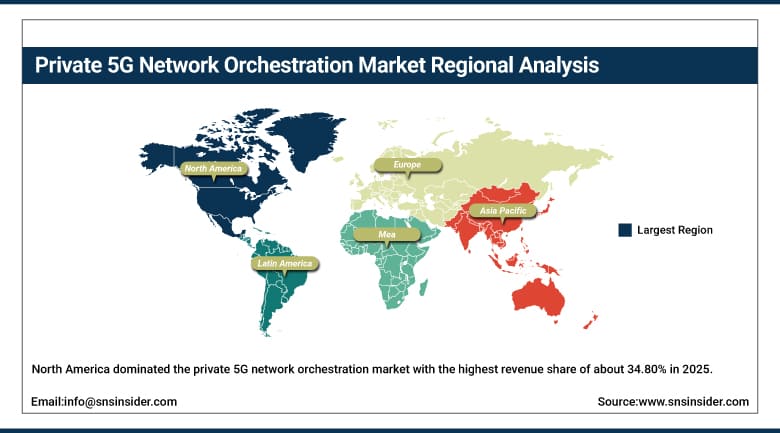
North America dominated the private 5G network orchestration market with the highest revenue share of about 34.80% in 2025, supported by its mature telecommunications infrastructure, strong enterprise technology ecosystem, and early adoption of private 5G solutions. The region benefits from established private-spectrum frameworks, particularly in the United States, alongside substantial investments in industrial automation, connected factories, logistics, healthcare, energy, and critical infrastructure. Enterprises increasingly require centralized orchestration to manage network provisioning, policy control, monitoring, security, and lifecycle operations across complex private 5G environments. The presence of major telecom operators, cloud providers, technology vendors, and system integrators further strengthens deployment capabilities. Growing integration of private 5G with edge computing, industrial IoT, artificial intelligence, and automation is also generating sustained demand for advanced orchestration platforms.
Get Customized Report as Per Your Business Requirement - Enquiry Now
Europe private 5G network orchestration market insights
The private 5G network orchestration market in Europe is expected to experience steady growth, supported by industrial digitalization, private wireless deployment, cloud adoption, and increasing requirements for secure and reliable enterprise connectivity. Germany is expected to remain an important country-level market because of its strong manufacturing base, Industry 4.0 initiatives, advanced industrial automation, and growing adoption of private 5G networks. Enterprises across automotive, machinery, logistics, energy, and healthcare are increasingly exploring private wireless networks to improve operational efficiency and support connected industrial applications. The growing complexity of these deployments is creating demand for orchestration platforms capable of coordinating network resources, managing policies, automating provisioning, and monitoring performance.
Asia-Pacific private 5G network orchestration market insights
Asia Pacific is expected to grow at the fastest CAGR of about 32.62% during 2026–2035, driven by rapid industrial digitalization, expanding smart-factory initiatives, and strong adoption of standalone 5G networks. China, Japan, South Korea, India, and Australia are investing heavily in private wireless infrastructure to support manufacturing, electronics, automotive, logistics, utilities, mining, and healthcare applications. The region’s large manufacturing base creates substantial demand for network automation, real-time monitoring, network slicing, provisioning, and lifecycle orchestration.
Government-backed 5G programs, enterprise spectrum initiatives, and Industry 4.0 policies are further accelerating deployments. Increasing adoption of robotics, industrial IoT, edge computing, artificial intelligence, and connected production systems is encouraging enterprises to move toward programmable and automated network environments. These factors are expected to make Asia Pacific the strongest growth engine for private 5G orchestration solutions.
Middle East & Africa and Latin America private 5G network orchestration market insights
The private 5G network orchestration market in the Middle East & Africa and Latin America is expected to witness consistent growth, supported by expanding telecommunications infrastructure, enterprise digital transformation, increasing 5G adoption, cloud deployment, and investments in industrial connectivity. In the Middle East, Saudi Arabia is expected to remain an important market because of its large-scale digital transformation programs, smart infrastructure development, industrial modernization, and investments in advanced telecommunications technologies.
In Latin America, Brazil is expected to remain a key country-level market because of its large industrial and telecommunications base, expanding enterprise connectivity, and growing interest in private wireless solutions. Manufacturing, mining, logistics, utilities, and large enterprise campuses are expected to generate increasing demand for private 5G deployments. As organizations in these regions move toward more complex private network environments, orchestration platforms will become increasingly important for provisioning, monitoring, policy management, network slicing, and lifecycle automation.
Growth Driver: Increasing demand for automated, low-latency, and intelligent network management is driving market growth
One of the key factors driving the growth of the global private 5G network orchestration market is the increasing deployment of private 5G networks across manufacturing, logistics, energy, healthcare, transportation, and enterprise environments. These networks require centralized orchestration to automate provisioning, configuration, monitoring, policy enforcement, resource allocation, and lifecycle management. The growing use of industrial IoT, robotics, autonomous systems, machine vision, and real-time operational applications is increasing the need for reliable and low-latency connectivity with consistent performance.
Restraint: High deployment costs and technological complexity can limit market adoption
The high cost and technical complexity associated with implementing private 5G orchestration environments can restrict adoption, particularly among small and medium-sized enterprises. Organizations may need to integrate orchestration platforms with 5G radio access networks, core networks, edge computing infrastructure, IoT devices, enterprise applications, security systems, and existing IT and operational technology environments. Multi-vendor interoperability can further increase implementation complexity because enterprises must coordinate equipment, software, APIs, policies, and network management systems from different technology providers. Skilled personnel are also required to configure, monitor, secure, and maintain sophisticated private 5G environments. In addition, enterprises may face challenges related to spectrum availability, network architecture selection, cybersecurity, data governance, and integration with legacy infrastructure.
Opportunity: Rapid expansion of industrial automation, edge computing, and network slicing creates new market opportunities
The rapid expansion of industrial automation, edge computing, and network slicing is creating significant opportunities for private 5G network orchestration solution providers. Manufacturers, ports, logistics operators, energy companies, healthcare organizations, and other enterprises are deploying private 5G to support connected machines, autonomous equipment, real-time monitoring, robotics, and mission-critical applications. These environments require orchestration capabilities that can dynamically allocate network resources, manage network slices, automate provisioning, and maintain application-specific performance requirements. The increasing adoption of standalone 5G is also creating opportunities for advanced lifecycle automation and multi-domain network management.
Recent Developments
-
2026: Celona Inc. expanded its private 5G orchestration capabilities with AI-driven network operations, centralized management, automated provisioning, policy control, and lifecycle management through Celona Orion.
-
2026: Nokia Corporation continued advancing private 5G network management and automation, supporting multi-vendor orchestration, network monitoring, and intelligent network operations.
-
2026: Telefonaktiebolaget Ericsson strengthened its private 5G portfolio with network management and automation capabilities supporting industrial and enterprise connectivity requirements.
-
2026: Huawei Technologies Co., Ltd. continued developing private 5G solutions focused on industrial automation, edge connectivity, network management, and intelligent operations.
-
2026: Cisco Systems, Inc. continued expanding its private 5G networking portfolio, supporting enterprise connectivity, security, network visibility, and integration with existing IT infrastructure.
Private 5G Network Orchestration Market Key Players are:
-
Ericsson
-
Nokia
-
Huawei Technologies Co., Ltd.
-
Samsung Electronics Co., Ltd.
-
NEC Corporation
-
ZTE Corporation
-
Hewlett Packard Enterprise
-
Mavenir
-
Netcracker Technology
-
Amdocs
-
Celona Inc.
-
JMA Wireless
-
Baicells Technologies
-
Airspan Networks
-
Rakuten Symphony
-
Fujitsu Limited
-
VMware by Broadcom
-
Parallel Wireless
Private 5G Network Orchestration Market Report Scope:
| Report Attributes | Details |
|---|---|
| Market Size in 2025 | USD 0.45 Billion |
| Market Size by 2035 | USD 5.72 Billion |
| CAGR | CAGR of 28.97% From 2026 to 2035 |
| Base Year | 2025 |
| Forecast Period | 2026-2035 |
| Historical Data | 2022-2024 |
| Report Scope & Coverage | Market Size, Segments Analysis, Competitive Landscape, Regional Analysis, DROC & SWOT Analysis, Forecast Outlook |
| Key Segments | • By Component (Orchestration Software, Network Management Software, Network Automation Software, Policy & Resource Management, Network Monitoring & Analytics, Services) • By Deployment (On-Premises, Cloud-Based, Hybrid) • By Enterprise Size (Small & Medium Enterprises, Large Enterprises) • By Network Type (Standalone 5G, Non-Standalone 5G) • By Application (Network Provisioning & Configuration, Network Slicing Management, Lifecycle Management, Performance Optimization, Multi-Vendor Network Management, Security & Policy Management) • By Vertical (Manufacturing & Factories, Energy & Utilities, Transportation & Logistics, Enterprises & Campus, Healthcare & Hospitals, Others) |
| Regional Analysis/Coverage | North America (US, Canada), Europe (Germany, UK, France, Italy, Spain, Russia, Poland, Rest of Europe), Asia Pacific (China, India, Japan, South Korea, Australia, ASEAN Countries, Rest of Asia Pacific), Middle East & Africa (UAE, Saudi Arabia, Qatar, South Africa, Rest of Middle East & Africa), Latin America (Brazil, Argentina, Mexico, Colombia, Rest of Latin America) |
| Company Profiles | Ericsson, Nokia, Huawei Technologies Co., Ltd., Cisco Systems, Inc., Samsung Electronics Co., Ltd., NEC Corporation, ZTE Corporation, Hewlett Packard Enterprise, Mavenir, Netcracker Technology, Amdocs, Celona Inc., JMA Wireless, Druid Software, Baicells Technologies, Airspan Networks, Rakuten Symphony, Fujitsu Limited, VMware by Broadcom, Parallel Wireless |

Frequently Asked Questions
Key players in the private 5G network orchestration market include Ericsson, Nokia Corporation, Huawei Technologies Co., Ltd., Cisco Systems, Inc., Samsung Electronics Co., Ltd., Hewlett Packard Enterprise, among others.
Key opportunities in the private 5G network orchestration market include industrial automation, edge computing, network slicing, IoT connectivity, cloud-native infrastructure, and AI-driven network operations.
The market is driven by growing private 5G adoption for industrial automation, IoT, and mission-critical operations. Enterprises increasingly need centralized platforms for network provisioning, optimization, security, and multi-vendor management.
The by Component dominated the private 5G network orchestration market, supported by increasing enterprise demand for centralized network provisioning, configuration, resource management, policy control, monitoring, and lifecycle automation.
North America dominated the private 5G network orchestration market in 2025, accounting for approximately 34.80% of the market, driven by early private 5G adoption and strong industrial automation investments.
