
Neurointerventional Devices Market Report Scope and Overview:
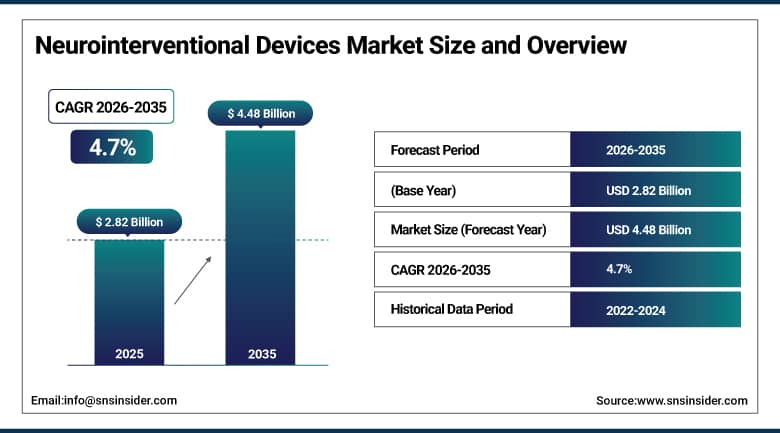
The Neurointerventional Devices Market was valued at USD 2.82 Billion in 2025 and is projected to reach USD 4.48 Billion by 2035, registering a CAGR of 4.7% from 2026 to 2035.
The global Neurointerventional Devices Market is transforming the treatment of acute stroke, intracranial aneurysms, and arteriovenous malformations by enabling minimally invasive, catheter-based procedures that restore blood flow and repair vascular abnormalities without open cranial surgery. The market is defined by the accelerating uptake of mechanical thrombectomy in large-vessel occlusion strokes, the enduring favorability of coiling approaches in aneurysms, and increasing application of artificial intelligence-driven imaging that enhances intervention accuracy. Notably, the deployment of novel stent retriever and artificial intelligence-guided cone-beam CT imaging technologies is being significantly accelerated by the ongoing commitment of hospitals and stroke centers to invest in cutting-edge neurointerventional solutions capable of reducing treatment timeframes.
GE HealthCare launched CleaRecon DL in May 2025, an AI-powered deep learning technology designed to enhance cone-beam CT imaging for neurointerventional procedures, receiving FDA clearance and CE marking for deployment on its Allia platform across hospitals in the United States and Europe.
To Get More Information On Neurointerventional Devices Market - Request Free Sample Report
Neurointerventional Devices Market Trends:
-
Rapid growth of mechanical thrombectomy continues expanding treatment options for large vessel occlusion stroke.
-
Continued clinical preference for coiling procedures continues sustaining demand for advanced embolization coil technology.
-
Growing integration of AI-powered cone-beam CT imaging continues improving procedural precision and diagnostic speed.
-
Rising domestic manufacturing capacity in China continues introducing cost-competitive neurointerventional device alternatives.
-
Expanding specialized stroke center networks continues improving time-to-treatment for acute neurovascular emergencies.
U.S. Neurointerventional Devices Market Outlook:
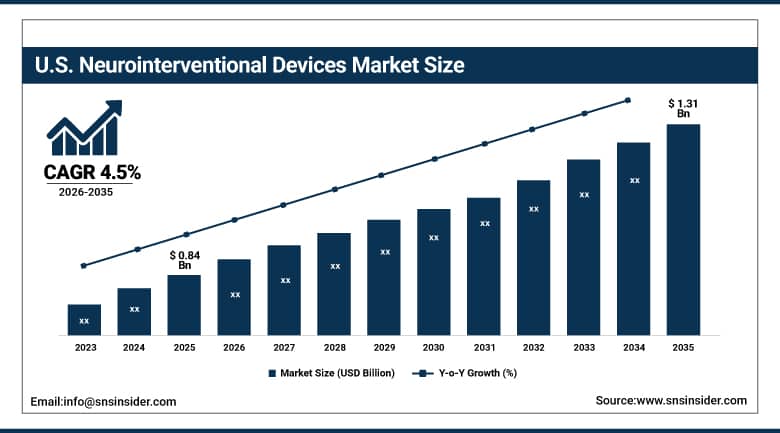
The U.S. Neurointerventional Devices Market was valued at approximately USD 0.84 Billion in 2025 and is projected to reach approximately USD 1.31 Billion by 2035, registering a CAGR of approximately 4.5% from 2026 to 2035.
Demand across the United States continued to be shaped by a dense concentration of leading stroke centers and academic neurosurgical programs, favorable FDA regulatory pathways for novel thrombectomy and embolization devices, and sustained investment in specialized stroke care infrastructure. Rising deployment of next-generation stent retrievers and AI-enhanced imaging platforms by leading academic medical centers continued reinforcing the country's position as both the largest and most clinically advanced neurointerventional devices market. Growing adoption across ambulatory surgical centers and specialty clinics added further layers of sustained domestic demand well beyond the technology's traditional hospital-based use case, with expanding aneurysm and AVM treatment programs increasingly relying on catheter-based neurointerventional technology.
Stryker Corporation continued expanding clinical adoption of its Trevo stent retriever system throughout the year, reinforcing its position among the leading mechanical thrombectomy platforms used by American stroke centers treating acute ischemic stroke patients.
Neurointerventional Devices Market Segment Analysis:
-
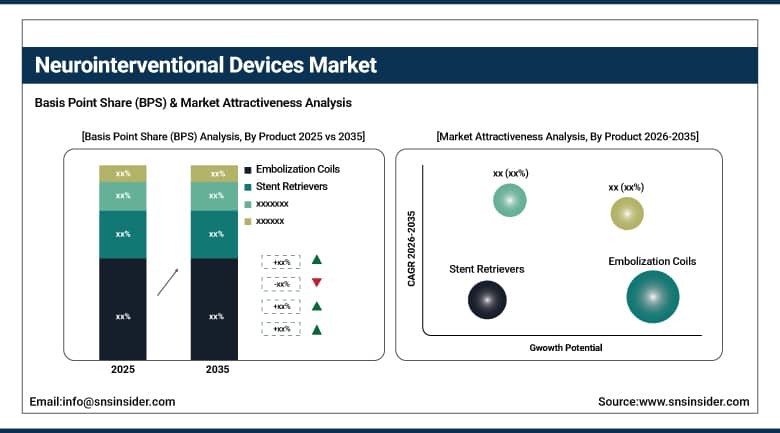
By Product, Embolization Coils segment dominated the Neurointerventional Devices Market in 2025 with 35.12% share; Stent Retrievers segment is the fastest growing segment.
-
By Application, Ischemic Stroke segment dominated the market in 2025 with 44.23% share; Intracranial Aneurysm segment is the fastest growing segment.
-
By Procedure Type, Coiling segment dominated the market in 2025 with 42.34% share; Thrombectomy segment is the fastest growing segment.
-
By End-User, Hospitals segment dominated the market in 2025; Ambulatory Surgical Centers segment is the fastest growing segment.
By Product: Embolization Coils Lead, Stent Retrievers Emerge as Fastest-Growing Segment
The Embolization Coils segment dominated the Neurointerventional Devices Market in 2025, driven by their established role as the primary treatment device for intracranial aneurysms and arteriovenous malformations, supported by decades of clinical evidence and extensive interventional neuroradiologist familiarity. Repeated procedure volumes across high-throughput neurovascular centers sustained steady demand for coil technology, while expanding aneurysm detection through improved diagnostic imaging kept treatment volumes elevated. Growing use of advanced detachable and bioactive coil designs reinforced coil revenues as the single largest contributor to total market spending throughout the base year.
The Stent Retrievers segment is the fastest growing in the Neurointerventional Devices Market owing to rapid expansion of mechanical thrombectomy as the standard-of-care treatment for large vessel occlusion ischemic stroke, supported by extensive clinical trial evidence demonstrating substantial functional outcome improvements. Growing expansion of thrombectomy-capable stroke centers and extended treatment time windows continues broadening the eligible patient population for stent retriever-based intervention. Rising competitive investment from Stryker, Medtronic, and Johnson & Johnson MedTech's Cerenovus business is accelerating stent retriever technology adoption across leading stroke centers worldwide.
By Application: Ischemic Stroke Dominates, Intracranial Aneurysm Gains Fastest Momentum
The Ischemic Stroke segment dominated the Neurointerventional Devices Market because ischemic stroke represents the most common acute neurovascular emergency worldwide, generating substantially higher procedure volumes than aneurysm or AVM treatment combined. Rising global stroke incidence among an aging population, combined with growing thrombectomy-capable stroke center availability, has sustained overwhelming procedure volume concentration in this application. Continued expansion of extended treatment time windows for mechanical thrombectomy reinforced this segment's dominant position throughout the base year.
The Intracranial Aneurysm segment is the fastest growing as improved diagnostic imaging continues detecting unruptured aneurysms earlier, expanding the eligible patient population for preventive coiling and flow-diversion treatment beyond emergency rupture cases. Rising clinical evidence supporting elective aneurysm treatment for high-risk unruptured aneurysms continues expanding this application's addressable patient base. Growing awareness campaigns and improved screening protocols are driving faster adoption across specialized neurovascular treatment centers worldwide.
By Procedure Type: Coiling Dominates, Thrombectomy Grows Fastest
The Coiling segment dominated the Neurointerventional Devices Market because endovascular coiling remains the preferred first-line treatment for the majority of intracranial aneurysms. It offers a well-established, minimally invasive alternative to open surgical clipping. Clinical studies validating coiling's safety and effectiveness profile, coupled with interventional neuroradiologist proficiency in the procedure, maintained coiling's dominance throughout the base year period. Ongoing innovations in coiling technology continued to support the procedure's dominant role in generating total market revenues.
The Thrombectomy segment is the fastest growing due to rapid expansion of mechanical thrombectomy as the standard-of-care intervention for large vessel occlusion ischemic stroke, a condition affecting a substantially larger patient population than aneurysm-related procedures. Rising global expansion of thrombectomy-capable stroke center networks continues broadening procedural access for eligible stroke patients. Growing extended treatment time window evidence is driving faster thrombectomy procedure volume growth across expanding stroke care networks worldwide.
By End-User: Hospitals Dominate, Ambulatory Surgical Centers Grow Fastest
The Hospitals segment dominated the Neurointerventional Devices Market due to their comprehensive neurointerventional and stroke care infrastructure, including advanced imaging, neurosurgical backup, and critical care capability required for treating acute neurovascular emergencies. Large academic and comprehensive stroke centers continue running the highest procedure volumes across thrombectomy and aneurysm treatment programs, sustaining consistent device demand. Continued investment in dedicated neurointerventional suites reinforced hospital-based segment dominance throughout the base year.
The Ambulatory Surgical Centers segment is expected to witness the fastest growth in the Neurointerventional Devices Market as select elective and lower-acuity neurointerventional procedures migrate toward outpatient settings supported by improving device safety profiles and shorter recovery protocols. Growing numbers of interventional neuroradiologists performing select elective aneurysm treatments increasingly rely on ambulatory surgical centers equipped with appropriate imaging to expand procedural capacity. Expanding ambulatory accreditation for select neurointerventional procedures continues attracting a broadening base of cost-conscious health systems.
Regional Analysis:
|
Region |
Major Country |
Share within Region, 2025 (%) |
|---|---|---|
|
North America |
United States |
78.09% |
|
Europe |
Germany |
21.60% |
|
Asia Pacific |
China |
26.80% |
|
Middle East and Africa |
Saudi Arabia |
22.80% |
|
Latin America |
Brazil |
32.20% |
North America Neurointerventional Devices Market Insights
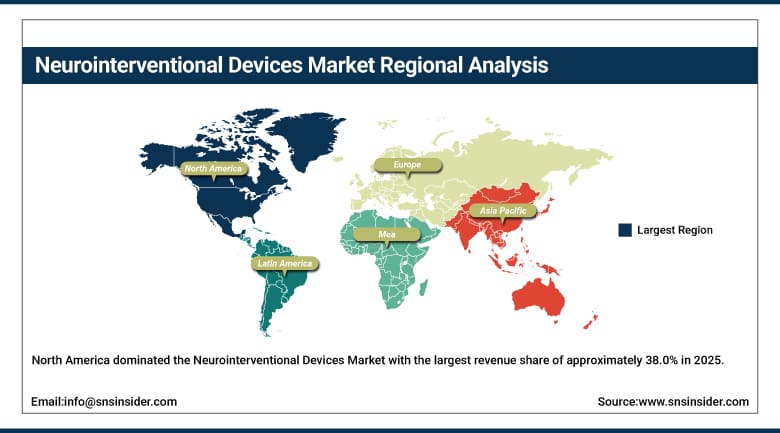
North America dominated the Neurointerventional Devices Market with the largest revenue share of approximately 38.0% in 2025. A dense concentration of leading stroke centers and academic neurosurgical programs, favorable FDA regulatory pathways for novel thrombectomy and embolization devices, and sustained investment in specialized stroke care infrastructure continued reinforcing this dominant regional position. A deep concentration of leading device manufacturers, academic medical centers, and interventional neuroradiology training programs headquartered across the continent gave regional clinicians early access to next-generation stent retriever, embolization coil, and AI-enhanced imaging technology well ahead of most other regions.
The United States accounted for approximately 78.09% of regional revenue, anchored by rapid thrombectomy-capable stroke center expansion, leading device manufacturer commercial presence, and extensive interventional neuroradiology training infrastructure. Canada added further demand through its own growing neurovascular treatment infrastructure and expanding public investment in comprehensive stroke care networks, and that combined strength kept the continent the largest addressable market for neurointerventional device vendors through the forecast period.
Get Customized Report as Per Your Business Requirement - Enquiry Now
Europe Neurointerventional Devices Market Insights
Europe held a meaningful share of global revenue, supported by rising stroke and aneurysm prevalence, expanding national reimbursement coverage for neurointerventional procedures, and continued growth of specialized stroke center networks across the region's major economies. Regulatory harmonization under the EU Medical Device Regulation and continued expansion of comprehensive stroke center certification programs continued lowering historically significant barriers to advanced neurointerventional technology adoption across the continent, while rising government healthcare modernization spending reinforced sustained regional demand.
Germany led demand at roughly 21.60% of European revenue, supported by its substantial hospital infrastructure and high per-capita stroke treatment procedure volumes among the region's largest economies. The UK and France contributed substantial additional demand through their own expanding stroke care and neurovascular treatment programs, and continued European investment in stroke center infrastructure should keep regional demand for neurointerventional devices climbing through the forecast period.
Asia Pacific Neurointerventional Devices Market Insights
The Asia Pacific is expected to register a CAGR of around 8.0% between 2026 and 2035, surpassing other geographic markets analyzed within this study. The region is characterized by increasing prevalence of cerebrovascular disease cases, especially strokes and aneurysms, increasing investments in neurological diagnostic testing, and growing government funding into stroke centers and neurology infrastructure in key Asia Pacific economies. The development of vast networks of hospitals with imaging capabilities continues fueling ongoing regional growth.
India leads country-level growth within the region at an estimated CAGR of 9.3%, driven by expanding neurodiagnostics and private hospital investment. China continues contributing substantial demand, supported by government health reforms expanding stroke care capacity and domestic manufacturers such as MicroPort and Wallaby Medical enhancing market penetration with cost-competitive devices. Japan's advanced neurointerventional infrastructure further reinforced the region's position as the fastest-growing market tracked in this report.
MEA and Latin America Neurointerventional Devices Market Insights
The Middle East and Africa and Latin America both showed steady growth, driven by expanding stroke care infrastructure, rising government investment in tertiary neurological care, and growing clinician training in neurointerventional procedures across both areas. As these markets continued building out modern stroke care infrastructure, neurointerventional devices proved a genuinely efficient way to expand advanced procedural capability without the decades-long buildout wealthier nations required, supporting faster access to time-critical neurovascular emergency treatment.
Saudi Arabia led Middle East and Africa demand, supported by the country's substantial healthcare investment under its national healthcare transformation programs. The UAE contributed further demand through its own expanding private hospital network and stroke care capability. In Latin America, Brazil accounted for the largest share of regional revenue, with growing stroke treatment adoption and academic neurointerventional training continuing to anchor regional demand for neurointerventional devices.
Market Dynamics:
Growth Drivers: Rising Stroke Prevalence and Expanding Thrombectomy Adoption
The industry is driven by rising global prevalence of stroke, intracranial aneurysms, and arteriovenous malformations among aging populations, growing adoption of mechanical thrombectomy for large vessel occlusion stroke, increasing preference for minimally invasive catheter-based procedures over open cranial surgery, and expanding integration of AI-powered imaging technology. As stroke center networks continue expanding treatment access, the need for reliable, catheter-delivered neurointerventional technology continues driving adoption of these devices across both established and rapidly developing healthcare markets worldwide.
Rising clinical evidence supporting extended treatment time windows for mechanical thrombectomy continues reinforcing this driver, as more stroke centers adopt thrombectomy-first protocols for eligible large vessel occlusion patients. Growing integration of AI-powered cone-beam CT imaging continues improving procedural precision and reducing diagnostic delay, and that combination of clinical validation and imaging innovation is exactly what keeps demand climbing at such a steady, sustained pace across leading academic and community stroke programs.
Restraints: High Device Costs and Shortage of Skilled Neurosurgeons
The substantial per-procedure cost of neurointerventional devices continues posing a genuine restraint on faster market-wide expansion, particularly across emerging healthcare systems and smaller community hospitals without the procedure volumes needed to justify premium device technology adoption. That cost profile has kept large-scale neurointerventional procedural capability concentrated among a comparatively small number of well-resourced academic and comprehensive stroke centers with sufficient patient volume to support dedicated infrastructure.
A persistent shortage of skilled interventional neuroradiologists and neurosurgeons trained in advanced catheter-based techniques continues posing a further restraint, as many regions lack sufficient specialist coverage to support round-the-clock emergency neurointerventional care. That skills gap keeps some healthcare systems reliant on transferring patients to distant comprehensive stroke centers rather than building local neurointerventional treatment capability, delaying time-critical intervention for patients in underserved areas.
Opportunities: AI-Powered Imaging Integration and Emerging Market Stroke Care Expansion
Rising investment in AI-powered imaging and procedural planning technology represents a genuinely significant opportunity, as stroke centers increasingly seek tools that improve diagnostic speed and procedural precision during time-critical neurovascular emergencies. Vendors positioned early in AI-enhanced imaging technology stand to capture meaningful share as this capability continues expanding from leading academic stroke centers into mainstream community hospital adoption across both developed and rapidly modernizing healthcare systems.
Closing stroke care infrastructure gaps across emerging markets offers a second substantial opportunity, as government initiatives aimed at expanding stroke treatment capacity continue creating fresh demand for accessible, cost-effective neurointerventional device infrastructure. Vendors with proven, affordable device platforms stand to capture meaningful share as developing economies increasingly view in-house neurointerventional capability as a genuinely practical way to reduce stroke-related disability and mortality at scale.
Recent Developments:
-
2024: Penumbra, Inc. continued advancing its Penumbra System aspiration thrombectomy technology, reinforcing its position in mechanical thrombectomy for large vessel occlusion stroke treatment.
-
2024: Johnson & Johnson MedTech's Cerenovus business continued expanding its EmboTrap stent retriever portfolio for acute ischemic stroke thrombectomy procedures.
-
2025: MicroPort Scientific Corporation and Wallaby Medical continued expanding domestic neurovascular device manufacturing capacity in China, supported by the country's centralized Volume-Based Procurement policy.
Neurointerventional Devices Market key players are:
-
Terumo Corporation
-
Penumbra, Inc.
-
Johnson & Johnson MedTech (Cerenovus)
-
MicroVention, Inc. (Terumo)
-
Abbott Laboratories
-
Cook Medical LLC
-
Asahi Intecc Co., Ltd.
-
MicroPort Scientific Corporation
-
W. L. Gore & Associates, Inc.
-
Wallaby Medical
-
Zylox-Tonbridge Medical Technology Co., Ltd.
-
Balt SA
-
phenox GmbH
-
Rapid Medical Ltd.
-
Imperative Care, Inc.
-
GE HealthCare Technologies Inc.
-
Siemens Healthineers AG
Neurointerventional Devices Market Report Scope:
| Report Attributes | Details |
|---|---|
| Market Size in 2025 | USD 2.82 Billion |
| Market Size by 2035 | USD 4.48 Billion |
| CAGR | CAGR of 4.7% From 2026 to 2035 |
| Base Year | 2025 |
| Forecast Period | 2026-2035 |
| Historical Data | 2022-2024 |
| Report Scope & Coverage | Market Size, Segments Analysis, Competitive Landscape, Regional Analysis, DROC & SWOT Analysis, Forecast Outlook |
| Key Segments | • By Product (Embolization Coils, Stent Retrievers, Neurovascular Stents, Microcatheters & Guidewires, Balloon Systems, Others) • By Application (Ischemic Stroke, Intracranial Aneurysm, Arteriovenous Malformation (AVM), Cerebral Hemorrhage, Others) • By Procedure Type (Coiling, Thrombectomy, Stenting, Others) • By End-User (Hospitals, Specialty Clinics, Ambulatory Surgical Centers) |
| Regional Analysis/Coverage | North America (US, Canada), Europe (Germany, UK, France, Italy, Spain, Russia, Poland, Rest of Europe), Asia Pacific (China, India, Japan, South Korea, Australia, ASEAN Countries, Rest of Asia Pacific), Middle East & Africa (UAE, Saudi Arabia, Qatar, South Africa, Rest of Middle East & Africa), Latin America (Brazil, Argentina, Mexico, Colombia, Rest of Latin America). |
| Company Profiles | Medtronic plc, Stryker Corporation, Boston Scientific Corporation, Terumo Corporation, Penumbra, Inc., Johnson & Johnson MedTech (Cerenovus), MicroVention, Inc. (Terumo), Abbott Laboratories, Cook Medical LLC, Asahi Intecc Co., Ltd., MicroPort Scientific Corporation, W. L. Gore & Associates, Inc., Wallaby Medical, Zylox-Tonbridge Medical Technology Co., Ltd., Balt SA, phenox GmbH, Rapid Medical Ltd., Imperative Care, Inc., GE HealthCare Technologies Inc., Siemens Healthineers AG |

Frequently Asked Questions
Key players include Medtronic, Stryker, Penumbra, Terumo, Boston Scientific, Johnson & Johnson MedTech, MicroPort, Abbott, and GE HealthCare.
Key opportunities include AI-powered imaging integration, expanding thrombectomy access, and emerging-market investments in stroke care infrastructure and neurovascular capabilities.
The market is driven by rising stroke prevalence, expanding mechanical thrombectomy adoption, minimally invasive procedures, and AI-powered imaging integration.
The Embolization Coils segment dominated the Neurointerventional Devices Market, accounting for approximately 35% market share.
North America dominated the Neurointerventional Devices Market in 2025 with a 38% share, driven by advanced stroke infrastructure and technology adoption.
