
Patient Warming Systems Market Report Scope & Overview:
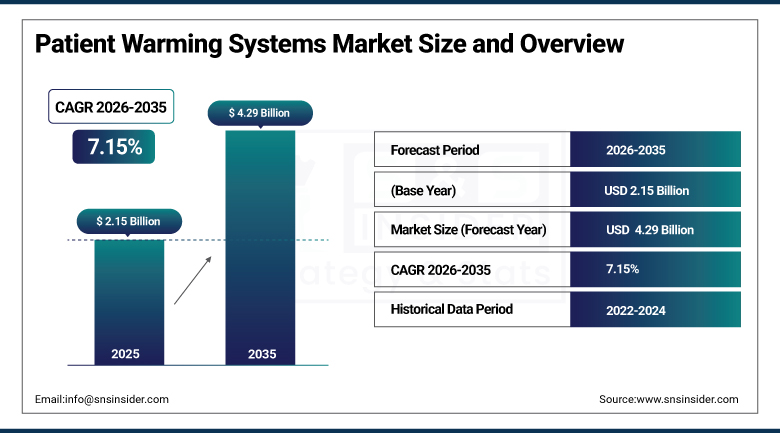
The Patient Warming Systems Market was valued at USD 2.15 Billion in 2025 and is expected to reach USD 4.29 Billion by 2035, growing at a CAGR of 7.15% from 2026-2035.
Patient Warming Systems Market will witness growth because of rising number of surgeries, increased adoption of perioperative normothermia, and development of the critical care industry in both developed as well as developing countries. Normal body temperature is being maintained throughout the surgical procedure and has become an important criterion in order to minimize the risk of infections at the surgical site, reduce the risk of bleeding, and improve healing process. Due to growing investments in the field of trauma care and emergency facilities and increase in number of surgeries required due to the aging population, there is high demand for forced air, conductive, and fluid warming systems.
In August 2025, QinFlow launched its Warrior AC Station, a next-generation blood and IV fluid warming platform built for operating rooms and intensive care units, capable of delivering warmed fluids within seconds through a shared consumable design spanning prehospital, OR, and ICU settings. The launch illustrates a broader shift in the market toward rapid, compact warming platforms that standardize consumables across the care continuum rather than relying on department-specific equipment, a development that is shortening replacement cycles and encouraging health systems to consolidate purchasing around fewer, more versatile suppliers.
To Get more information On Patient Warming Systems Market - Request Free Sample Report
Patient Warming Systems Market Trends
-
Rising surgical volumes and mandatory perioperative normothermia protocols are increasing adoption of forced-air and conductive warming systems in operating rooms.
-
Rapid-flow fluid and blood warmers capable of high infusion rates are becoming standard equipment in Level I trauma centers and EMS transport.
-
Sustainability-driven procurement reviews favoring reusable warming blankets are gradually shifting demand away from single-use forced-air disposables.
-
Growing NICU admissions and preterm birth rates are expanding demand for dedicated neonatal warming platforms.
-
Battery-powered and portable warming units are gaining traction in ambulatory surgical centers and field and military care settings.
-
Integration of automated temperature sensing and EMR connectivity is becoming a differentiator among hospital procurement committees.
U.S. Patient Warming Systems Market Outlook
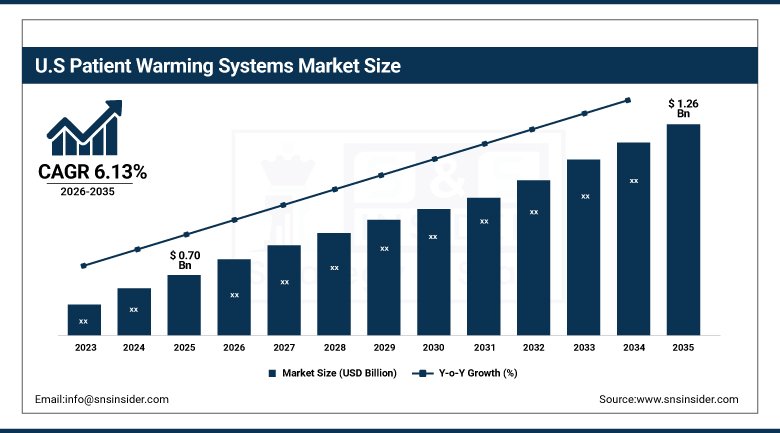
The U.S. Patient Warming Systems Market was valued at USD 0.70 Billion in 2025 and is expected to reach USD 1.26 Billion by 2035, growing at a CAGR of 6.13% from 2026-2035.
The U.S. Patient Warming Systems Market is still growing owing to the high volume of surgeries being performed in the country, the available reimbursement mechanisms for perioperative hypothermia prevention, and a large number of Level I and Level II trauma centers with strict temperature management protocols. The hospital systems are adopting forced-air and conductive warming solutions in their ERAS protocols, while the emergency services and military procurement are contributing to parallel demand for portable solutions for warming fluids and blood. The strength in manufacturing of the products in the region with major players being located in the United States contributes to product availability and innovation.
In April 2024, Solventum separated from 3M and became an independent New York Stock Exchange (NYSE)-listed healthcare organization, acquiring the Bair Hugger patient warming product line within its Medical Surgical business division. This spin-off has enabled the Bair Hugger brand to have its own corporate framework and capital deployment strategy entirely dedicated to healthcare, an approach that analysts expect will lead to faster refreshing of product lines in one of the most installed forced-air warming systems in the U.S. market.
Patient Warming Systems Market Segment Analysis
-
By Product Type, the Forced Air Warming Systems segment dominated the Patient Warming Systems Market with approximately 46.80% share in 2025, while the Fluid & Blood Warming Systems segment is the fastest growing with a CAGR of approximately 8.65%.
-
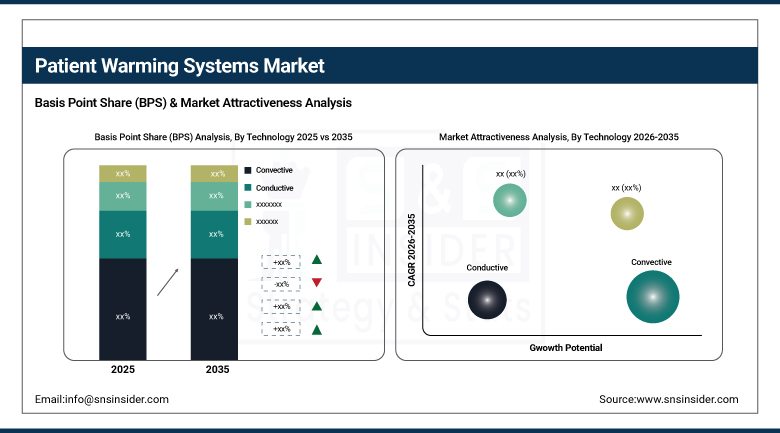
By Technology, the Convective segment dominated the Patient Warming Systems Market with approximately 47.90% share in 2025, while the Conductive segment is the fastest growing with a CAGR of approximately 8.20%.
-
By Application, the Perioperative Care segment dominated the Patient Warming Systems Market with approximately 48.60% share in 2025, while the Neonatal Care segment is the fastest growing with a CAGR of approximately 8.90%.
-
By End User, the Hospitals segment dominated the Patient Warming Systems Market with approximately 61.40% share in 2025, while the Ambulatory Surgical Centers segment is the fastest growing with a CAGR of approximately 9.15%.
By Product Type, Forced Air Warming Systems Dominates and Fluid & Blood Warming Systems Grows Fastest
The forced air warming systems have proven themselves as the best in the operating and PACU environments. The success of this system is attributed to its wide knowledge base among clinicians, ease of use and integration with conventional beds and tables in hospitals. It is for this reason that hospitals continue to opt for this system because it reduces training and easily integrates into the normal surgical protocol process. Blankets and gowns allow clinicians to personalize their use according to the particular surgical procedure involved. Years of evidence from literature support the effectiveness of this method in averting intraoperative hypothermia.
Fluid and blood warming systems are emerging as the fastest-growing category, driven by the demands of trauma care, massive transfusion protocols, and prehospital resuscitation, where rapid delivery of warmed fluid at high flow rates is critical to patient survival. This segment focuses on compact, cartridge-based designs that reduce setup time and support standardized consumables across emergency, operating room, and intensive care settings, closing the gap between civilian trauma centers and military-grade resuscitation equipment while positioning fluid warming as a strategic growth platform for device manufacturers.
By Technology, Convective Dominates and Conductive Grows Fastest
Convective technology is the dominant market technology because of its capability to deliver even heating without the need for ongoing adjustments since the body surface area covered by it does not need any form of direct contact for it to be effective. It works using filtered warm air which is circulated within a disposable blanket making it flexible to use in various positions during surgeries. Its clinical safety and consistent performance in long surgical operations has made it more popular among other methods.
Conductive technology is being regarded as the fast-growing category due to increased sustainability assessments, infection control assessments, and increased use of reusable fabric-gel technology as compared to disposable forced-air blankets. This trend is more visible in the health care organizations, which are trying to reduce their clinical waste. Another reason that is contributing to the demand for the conductive technology is that people have started to realize that the chances of contamination are low in the warming devices where there is no air flow, especially the laminar flow operating rooms.
By Application, Perioperative Care Dominates and Neonatal Care Grows Fastest
Perioperative care remains the largest application area, reflecting the sheer volume of surgical procedures performed annually and the clinical consensus that maintaining normothermia from the preoperative holding area through postoperative recovery materially reduces complication rates. Enhanced recovery after surgery protocols formally incorporate active warming as a mandatory step, embedding warming devices into standard surgical checklists across general, orthopedic, and cardiovascular procedures and sustaining consistent replacement and consumables demand.
Neonatal care is experiencing rapid growth owing to increasing numbers of babies born prematurely and advancements in neonatal intensive care capacity in both developed nations and developing economies. This drives up the need for precisely controlled radiant warmers and servo-controlled warming devices that are made specifically for vulnerable neonates. Neonatal warming has been gaining from increased focus on investing in health infrastructure in addition to policies requiring the stabilization of the baby’s body temperature immediately after birth.
By End User, Hospitals Dominate and Ambulatory Surgical Centers Grow Fastest
Hospitals account for the majority of demand given their high surgical throughput, broad case-mix complexity, and need to equip multiple operating rooms, recovery bays, and emergency departments simultaneously with warming technology. Large hospital systems typically standardize on a single vendor platform across facilities to simplify staff training, servicing, and consumables procurement, reinforcing incumbents with established institutional relationships and comprehensive service networks.
Ambulatory surgical centers are growing fastest as outpatient procedure volumes rise and payers continue shifting eligible surgical cases away from inpatient hospital settings toward lower-cost outpatient venues. This segment focuses on compact, easy-to-operate warming units that fit space-constrained facilities and support rapid patient turnover, and it benefits from the broader trend of same-day surgery expansion, making it an increasingly attractive channel for manufacturers targeting recurring consumables revenue.
Regional Analysis
|
Region |
Major Country |
Share within Region, 2025 (%) |
|
North America |
United States |
84.00% |
|
Europe |
Germany |
23.10% |
|
Asia Pacific |
China |
34.50% |
|
Middle East & Africa |
GCC Countries |
46.20% |
|
Latin America |
Brazil |
48.70% |
North America Patient Warming Systems Market Insights
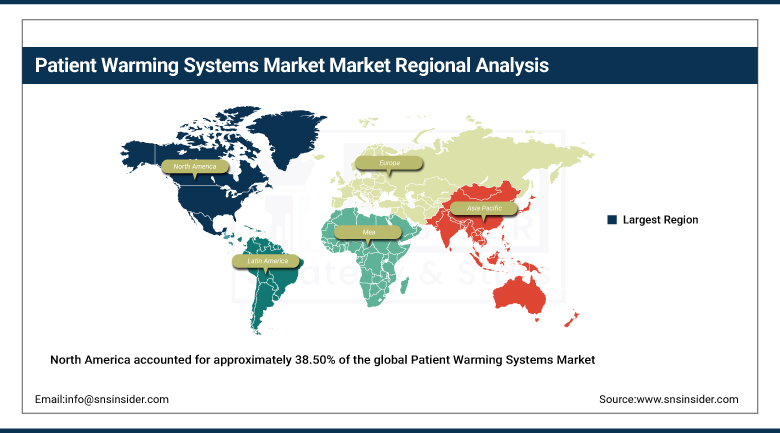
North America accounted for approximately 38.50% of the global Patient Warming Systems Market in 2025, the largest share of any region, supported by high surgical case volumes, comprehensive hospital accreditation standards, and reimbursement structures that recognize active warming as a standard-of-care intervention. The United States drives the substantial majority of regional demand, reflecting its large network of trauma centers, ambulatory surgical facilities, and academic medical centers that maintain rigorous perioperative temperature management protocols.
The contribution from Canada is relatively small but is rising steadily due to the provincial spending on healthcare to increase surgical capability and the upgrading of old warming devices. In the region, group purchasing continues to be consolidated while new national distribution deals that have been signed recently for blood and fluid warming devices indicate that the suppliers are able to make long-term contracts to protect their market share.
Get Customized Report as per Your Business Requirement - Enquiry Now
Europe Patient Warming Systems Market Insights
Europe represents the second-largest regional market, with Germany, the United Kingdom, and France accounting for the largest national contributions within the region. Demand is shaped by centralized procurement through national health systems, stringent medical device regulations under the EU Medical Device Regulation, and a growing emphasis on reusable, lower-waste warming technologies driven by hospital sustainability mandates.
Germany is leading the regional push for adoption by capitalizing on its expansive hospital base and early adopter of both conductive and resistive warming technologies. The United Kingdom’s National Health Service has started standardizing perioperative warming practices as part of their overall initiatives on enhancing recovery. Distribution deals in France and Benelux countries illustrate how companies are expanding their local footprint in order to counteract incumbent companies.
Asia Pacific Patient Warming Systems Market Insights
Asia Pacific is the fastest-growing regional market, projected to expand at a CAGR of approximately 8.35% between 2026 and 2035, driven by rising surgical volumes, expanding hospital bed capacity, and increasing government investment in maternal and neonatal care infrastructure across China and India. China represents the largest national market within the region, supported by rapid hospital construction and a growing base of domestic medical device manufacturers offering cost-competitive warming platforms.
A significant amount of growth in the region is coming from India and the larger Southeast Asia market due to the increasing number of surgeries performed by private hospital chains and insurance penetration among city dwellers. Japan is already an advanced market for technologies and is known for being an early adopter of precision-controlled temperature devices, while government initiatives in the region are bringing the warming technology to secondary and tertiary healthcare institutions.
MEA & Latin America Patient Warming Systems Market Insights
The Middle East & Africa region is led by the GCC countries, where large-scale hospital construction projects and government healthcare investment programs in Saudi Arabia and the United Arab Emirates are driving adoption of advanced perioperative warming equipment in newly commissioned surgical facilities. South Africa represents the largest contributor within the African portion of the region, supported by a comparatively developed private hospital network, while broader adoption across the rest of the region remains constrained by uneven healthcare infrastructure investment.
The dominant player within Latin America is Brazil due to the extensive presence of hospitals, both public and private, that generates more income than any other nation in the region through an increasing number of surgeries performed. In Mexico, it ranks as the second largest national market supported by the growth of private investments in the medical sector close to the United States border. Growth has been gradually increasing across other parts of Latin America through reforms made by health ministries.
Market Dynamics
Growth Drivers: Rising Surgical Volumes and Mandatory Normothermia Protocols
Growth in the Patient Warming Systems Market is fundamentally supported by the rising global volume of surgical procedures and the clinical consensus that maintaining patient normothermia throughout the perioperative period reduces complications, including surgical site infections, coagulopathy, and extended recovery times. Hospital accreditation bodies and enhanced recovery after surgery protocols increasingly mandate active warming as a checklist item rather than an optional intervention, embedding warming devices into standard surgical workflows across general, orthopedic, cardiovascular, and obstetric procedures.
The combined effects of an aging population around the world, the rising number of surgeries required by the patients and the increasing infrastructure for handling trauma and emergencies across developed and developing countries are leading to continued purchases of warming devices. Further, the rise in the capacity to handle newborn babies along with higher preterm births in various locations are also increasing the target market for temperature control devices.
Restraints: High Equipment and Consumables Costs Amid Budget Constraints
The relatively high upfront cost of advanced warming platforms, particularly precision-controlled fluid and blood warming systems, represents a meaningful barrier for smaller hospitals and facilities in cost-constrained healthcare systems. Recurring consumables spending on single-use blankets, disposable heat exchangers, and warming gowns adds to total cost of ownership, prompting some facilities to delay equipment upgrades or extend replacement cycles beyond manufacturer recommendations.
The complexities of regulatory compliance have increased the cost of developing products and introducing them into markets due to the need to adhere to different medical device regulations such as those under the EU Medical Device Regulation, among other stringent recyclability requirements that apply to disposables. There is also the growing threat of infection through air flow associated with forced air machines used in surgery, which has prompted some institutions to rethink the technologies they use.
Opportunities: Portable, Sustainable, and Connected Warming Platforms
The development of portable, battery-operated warming devices designed for prehospital, ambulatory surgical center, and military applications represents a significant opportunity, as care delivery continues to shift toward decentralized and outpatient settings. Manufacturers introducing compact, rapid-setup platforms with shared consumable designs across the care continuum are well positioned to capture share from facilities standardizing on fewer, more versatile suppliers.
Growing demands for sustainable hospitals are creating scope for conductive and resistive warming products that will create less waste of plastic materials than conventional air warming devices. On the other hand, increasing needs for connected and EMR integrated temperature management systems are creating scope for premium market development. Growing investments in healthcare facilities in Asia Pacific, Middle East, and Latin America regions are giving companies a large runway to expand their geographical presence beyond developed regions like North America and Europe.
Recent Developments:
-
2024: Inspiration Healthcare Group acquired Airon Corporation to strengthen its North American commercial presence and expand neonatal and patient warming product offerings beyond the UK.
-
2024: Gentherm partnered with US Med-Equip to expand Blanketrol System distribution across U.S. hospital rental markets, adding field service and maintenance support.
-
2024: Belmont Medical Technologies secured a national Premier Inc. agreement, expanding hospital access to its Rapid Infuser RI-2 blood and fluid warming system.
-
2025: Gentherm expanded its DUOMED distribution partnership into France, increasing availability of Astopad and Vytil warming products while strengthening European clinical support.
-
2026: Gentherm acquired Innovative Medical Equipment, adding ThermaZone technology and expanding its medical thermal management portfolio through broader hospital and clinical distribution channels.
Patient Warming Systems Market Key Players
-
Solventum Corporation (Bair Hugger)
-
Stryker Corporation
-
Medtronic plc
-
Gentherm Incorporated
-
Belmont Medical Technologies
-
Inspiration Healthcare Group plc
-
Quality In Flow Ltd. (QinFlow)
-
ICU Medical, Inc. (Smiths Medical)
-
Becton, Dickinson and Company
-
ZOLL Medical Corporation
-
Geratherm Medical AG
-
The 37Company
-
VitaHEAT Medical
-
Barkey GmbH & Co. KG
-
Inditherm plc
-
Avanos Medical, Inc.
-
Encompass Group, LLC
-
Cardinal Health, Inc.
-
GE HealthCare Technologies Inc.
-
Drägerwerk AG & Co. KGaA
Patient Warming Systems Market Report Scope:
| Report Attributes | Details |
|---|---|
| Market Size in 2025 | USD 2.15 Billion |
| Market Size by 2035 | USD 4.29 Billion |
| CAGR | CAGR of 7.15% From 2026 to 2035 |
| Base Year | 2025 |
| Forecast Period | 2026-2035 |
| Historical Data | 2022-2024 |
| Report Scope & Coverage | Market Size, Segments Analysis, Competitive Landscape, Regional Analysis, DROC & SWOT Analysis, Forecast Outlook |
| Key Segments | • By Product Type (Forced Air Warming Systems, Conductive/Resistive Warming Systems, Radiant Warmers, Fluid & Blood Warming Systems, Others) • By Technology (Convective, Conductive, Radiant, Fluid-Based, Intravascular) • By Application (Preoperative Care, Intraoperative Care, Postoperative Care, Neonatal Care, Emergency & Trauma Care, Critical/Acute Care) • By End User (Hospitals, Ambulatory Surgical Centers, Specialty Clinics, Nursing Homes & Home Care Settings) |
| Regional Analysis/Coverage | North America (US, Canada), Europe (Germany, UK, France, Italy, Spain, Russia, Poland, Rest of Europe), Asia Pacific (China, India, Japan, South Korea, Australia, ASEAN Countries, Rest of Asia Pacific), Middle East & Africa (UAE, Saudi Arabia, Qatar, South Africa, Rest of Middle East & Africa), Latin America (Brazil, Argentina, Mexico, Colombia, Rest of Latin America). |
| Company Profiles | Solventum Corporation (Bair Hugger), Stryker Corporation, Medtronic plc, Gentherm Incorporated, Belmont Medical Technologies, Inspiration Healthcare Group plc, Quality In Flow Ltd. (QinFlow), ICU Medical, Inc. (Smiths Medical), Becton, Dickinson and Company, ZOLL Medical Corporation, Geratherm Medical AG, The 37Company, VitaHEAT Medical, Barkey GmbH & Co. KG, Inditherm plc, Avanos Medical, Inc., Encompass Group, LLC, Cardinal Health, Inc., GE HealthCare Technologies Inc., Drägerwerk AG & Co. KGaA. |
Frequently Asked Questions
Leading companies include Solventum (Bair Hugger), Stryker, Medtronic, Gentherm, Belmont Medical Technologies, Inspiration Healthcare Group, QinFlow, ICU Medical, Becton Dickinson, and ZOLL Medical, among others.
Key opportunities include portable warming platforms, reusable conductive technologies, connected temperature monitoring, and geographic expansion across Asia Pacific, Middle East, and Latin America.
Growth is primarily driven by rising surgical volumes and the clinical mandate to maintain perioperative normothermia, which is now embedded in enhanced recovery after surgery protocols and hospital accreditation standards worldwide.
By Product Type, Forced Air Warming Systems dominates the market with approximately 46.80% share in 2025, supported by broad clinical familiarity and ease of integration into existing surgical workflows.
North America dominates the market with approximately 38.50% share in 2025, supported by high surgical volumes, established reimbursement frameworks, and a dense concentration of trauma centers.
