
PFAS-Free Barrier Coatings Market Report Scope & Overview:
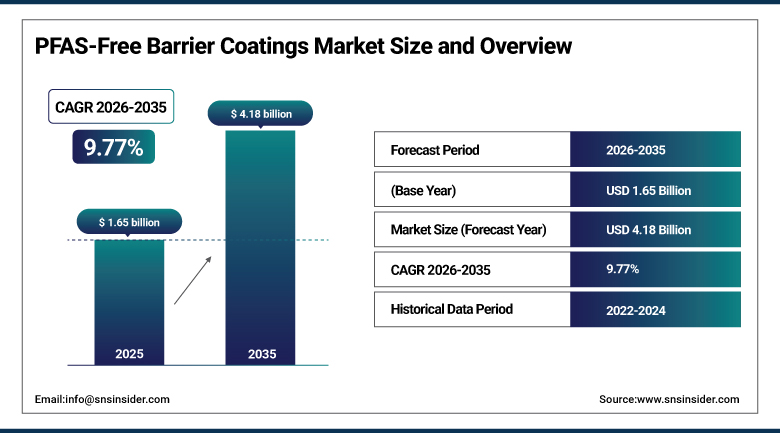
The PFAS-Free Barrier Coatings Market was valued at USD 1.65 billion in 2025 and is expected to reach USD 4.18 billion by 2035, growing at a CAGR of 9.77% from 2026–2035.
The PFAS-free barrier coating market is witnessing steady growth owing to the rising preference for sustainable, non-fluorinated coating products in packaging, textile, construction, and industrial applications. Rising regulations and bans on the use of PFAS are leading companies to use safe barrier coating products offering water, oil, grease, and chemical resistance without any fluorinated compounds.
Growing investments in high-performance coating technologies such as bio-based, silicone-based, and wax-based coatings have been enhancing the performance and efficiency of the barrier products. Companies are increasingly concentrating on the performance of the coatings, material compatibility, adhesion, efficiency, and environment-friendliness to satisfy the increasing sustainability demands. Increasing efforts towards PFAS reduction, sustainable packaging, circular economy, and green materials are also driving the technology development. Moreover, the increasing usage of advanced PFAS-free coatings in food packaging, textiles, construction, personal care, and industrial applications is boosting the market.
In March 2025, PlasmaLEXX introduced PlasmaGuard X, a fully PFAS-free dielectric barrier coating designed for high-protection applications including PCB assemblies, sensors, medical devices, and implants. The development highlights continued advances in thin, high-performance PFAS-free barrier coatings that can provide strong protection while helping manufacturers reduce reliance on fluorinated chemistries.
To Get more information PFAS-Free Barrier Coatings Market - Request Free Sample Report
PFAS-Free Barrier Coatings Market Trends
-
Growing adoption of PFAS-free materials is driving demand for sustainable barrier coatings across packaging, textiles, and industrial applications.
-
Increasing PFAS regulations are encouraging manufacturers to adopt safer, non-fluorinated coating alternatives.
-
Rising demand for sustainable packaging is supporting bio-based, silicone-based, and wax-based barrier coatings.
-
Growing focus on barrier performance, durability, recyclability, and coating efficiency is creating opportunities for manufacturers.
-
Advancements in coating chemistry and application technologies are improving PFAS-free coating performance and market adoption.
The U.S. PFAS-Free Barrier Coatings Market Outlook
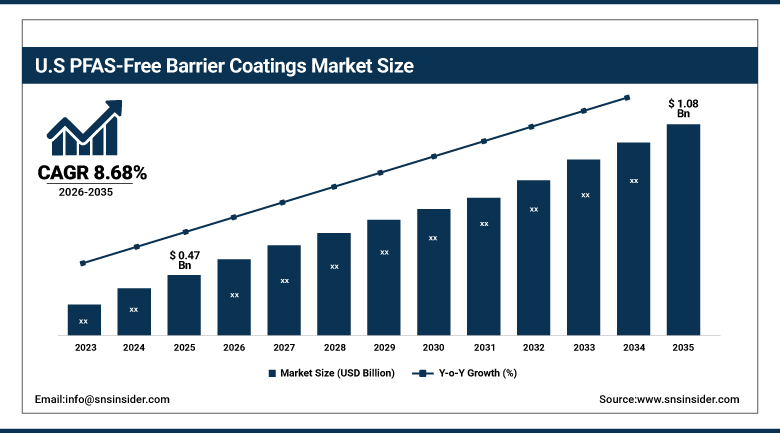
The U.S. PFAS-Free Barrier Coatings Market was valued at USD 0.47 Billion in 2025 and is expected to reach around USD 1.08 Billion by 2035, growing at a CAGR of 8.68% from 2026–2035.
The U.S. market for PFAS-free barrier coatings is growing steadily due to increasing demand for sustainable, non-fluorinated coating solutions across packaging, textiles, construction, and industrial applications. Growing regulatory scrutiny and restrictions on the use of per- and polyfluoroalkyl substances (PFAS) are encouraging manufacturers to transition toward safer barrier coating alternatives that provide water, oil, grease, and chemical resistance without relying on fluorinated chemistries. Increasing demand for environmentally responsible packaging and low-impact materials is further supporting market adoption.
Investments in bio-based polymers, silicone-based formulations, wax-based coatings, and other advanced barrier technologies are focused on improving coating performance, durability, recyclability, and processing efficiency. The expansion of sustainable manufacturing practices and growing preference for PFAS-free materials across end-use industries are expected to create further opportunities for coating manufacturers in the U.S. market.
In January 2025, Minnesota implemented restrictions on the sale of cookware containing PFAS, adding to the expanding U.S. regulatory push to reduce PFAS-containing products. The development is increasing pressure on manufacturers to develop and adopt alternative coating technologies, including ceramic, silicone-based, and other PFAS-free formulations, supporting demand for safer barrier coating solutions.
PFAS-Free Barrier Coatings Market Segment Analysis
-
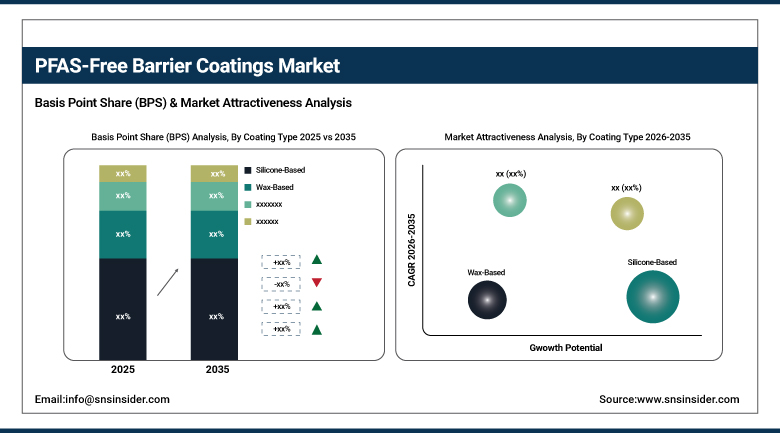
By Coating Type, silicone-based coatings dominated the PFAS-free barrier coatings market with a 46.00% share in 2025, while bio-based coatings are projected to be the fastest-growing segment, registering a 14.55% CAGR during 2026–2035.
-
By Substrate, textile dominated the PFAS-free barrier coatings market with a 34.00% share in 2025, while textile is projected to be the fastest-growing segment, registering a 11.00% CAGR during 2026–2035.
-
By Application, food packaging dominated the PFAS-free barrier coatings market with a 30.00% share in 2025, while industrial are projected to be the fastest-growing segment, registering a 13.49% CAGR during 2026–2035.
-
By Distribution Channel, direct sales dominated the PFAS-free barrier coatings market with a 50.00% share in 2025, while e-commerce is projected to be the fastest-growing segment, registering a 15.30% CAGR during 2026–2035.
-
By End-Use Industry, building & construction dominated the PFAS-free barrier coatings market with a 29.00% share in 2025, while electronics & electrical is projected to be the fastest-growing segment, registering a 15.29% CAGR during 2026–2035.
By Coating Type, silicone-based coatings dominated the PFAS-free barrier coatings market, while bio-based coatings are expected to grow fastest.
Silicone-based coatings held the dominant position due to their strong water, oil, and chemical resistance, along with their compatibility with multiple substrates and coating processes. Their ability to provide effective barrier performance without PFAS-containing chemistry has supported adoption across packaging, textiles, construction, and industrial applications. Continued improvements in silicone formulations are expected to enhance durability, adhesion, and processing efficiency.
Bio-based coatings are projected to grow fastest during 2026–2035, supported by increasing demand for renewable and environmentally responsible coating materials. Growing regulatory pressure on PFAS and sustainability requirements are encouraging manufacturers to develop bio-derived barrier formulations with improved moisture, grease, and oil resistance. Advancements in bio-based polymers and coating technologies are expected to accelerate adoption.
By Substrate, textile dominated the PFAS-free barrier coatings market, while textile is expected to grow fastest.
Textile held the dominant position due to extensive use of barrier and protective coatings for water, oil, stain, and chemical resistance in apparel and technical textile applications. Increasing restrictions on PFAS-based textile treatments are encouraging manufacturers to transition toward PFAS-free alternatives while maintaining functional performance. Demand for sustainable textile processing is further supporting the segment.
Textile is also projected to grow fastest as brands, textile manufacturers, and regulators increasingly emphasize PFAS-free and environmentally responsible treatments. Developments in silicone-based, bio-based, and other non-fluorinated coating technologies are improving durability, wash resistance, flexibility, and water repellency, supporting broader adoption across apparel, outdoor fabrics, and technical textiles.
By Application, food packaging dominated the PFAS-free barrier coatings market, while industrial applications are expected to grow fastest.
Food packaging accounted for the largest share due to strong demand for grease, oil, moisture, and water barriers in paper and other packaging materials. Increasing restrictions on PFAS in food-contact applications are accelerating the replacement of fluorinated coatings with PFAS-free alternatives. Manufacturers are focusing on maintaining barrier performance while improving recyclability and environmental compatibility.
Industrial applications are projected to grow fastest as manufacturers increasingly seek PFAS-free solutions for protective, corrosion-resistant, and functional coating applications. Advancements in coating formulations are improving chemical resistance, durability, adhesion, and thermal performance, creating opportunities across industrial manufacturing and processing environments.
Regional Insights
|
Region |
Major Country |
Share within Region, 2025(%) |
|---|---|---|
|
North America |
United States |
82.40% |
|
Europe |
Germany |
34.30% |
|
Asia Pacific |
China |
48.54% |
|
Middle East & Africa |
Saudi Arabia |
23.50% |
|
Latin America |
Brazil |
23.00% |
North America PFAS-Free Barrier Coatings Market Insights
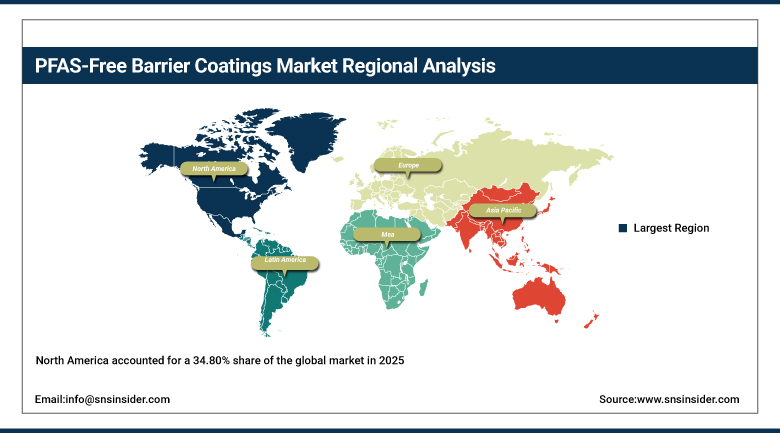
The North America PFAS-free barrier coatings market dominated the market, driven by increasing regulatory restrictions on PFAS, growing demand for sustainable coating solutions, and the transition toward non-fluorinated alternatives across packaging, textiles, construction, and industrial applications. North America accounted for a 34.80% share of the global market in 2025. Rising investments in advanced coating technologies are supporting the development of formulations that provide water, oil, grease, chemical, and moisture resistance while meeting evolving environmental requirements.
The United States is expected to dominate the North American market, supported by its large packaging, chemical, construction, electronics, and consumer goods industries. Growing regulatory attention toward PFAS-containing products, increasing adoption of sustainable materials, and investments in PFAS-free coating technologies are strengthening demand for alternative barrier solutions. Canada is also expected to contribute to regional growth through increasing sustainability initiatives and demand for environmentally responsible materials.
Get Customized Report as per Your Business Requirement - Enquiry Now
Europe PFAS-Free Barrier Coatings Market Insights
The Europe PFAS-free barrier coatings market is expected to experience steady growth over the forecast period, supported by stringent environmental regulations, increasing restrictions on PFAS-containing products, and growing demand for sustainable packaging and coating solutions. The region's emphasis on circular economy principles, recyclability, and environmentally responsible manufacturing is encouraging companies to develop and adopt non-fluorinated barrier coating technologies across packaging, textiles, construction, and industrial applications.
Germany is anticipated to remain a key national market in Europe due to its strong manufacturing base, advanced chemical and automotive industries, and growing focus on sustainable materials and environmentally responsible production. The United Kingdom, France, Italy, and other European countries are also contributing to regional demand as manufacturers increasingly transition toward PFAS-free coating formulations and sustainable barrier technologies.
Asia Pacific PFAS-Free Barrier Coatings Market Insights
The Asia Pacific PFAS-free barrier coatings market is expected to record the fastest growth during 2026–2035, registering a CAGR of 11.53%, supported by expanding manufacturing activities, increasing demand for sustainable packaging, rising textile production, and growing adoption of environmentally responsible coating technologies. Regulatory developments, increasing awareness of PFAS-related environmental concerns, and investments in advanced coating formulations are encouraging manufacturers across the region to transition toward PFAS-free alternatives.
China will remain a major market in Asia Pacific due to its large packaging, textile, electronics, construction, and manufacturing industries, as well as its extensive chemical and materials production capabilities. Japan and South Korea will continue to contribute significantly through their advanced electronics, automotive, packaging, and specialty materials industries. India is also expected to witness increasing demand as sustainable packaging, manufacturing capacity, and environmental compliance requirements expand.
Middle East & Africa and Latin America PFAS-Free Barrier Coatings Market Insights
The Middle East & Africa and Latin America PFAS-free barrier coatings markets are expected to grow steadily from 2026 to 2035, supported by expanding packaging, construction, consumer goods, industrial manufacturing, and textile applications. Increasing awareness of sustainable materials, evolving environmental standards, and growing demand for non-fluorinated coating technologies are creating opportunities for manufacturers across these regions.
Saudi Arabia is expected to remain an important market in the Middle East & Africa due to investments in construction, industrial development, packaging, and economic diversification initiatives. In Latin America, Brazil is expected to remain a key country-level market because of its large consumer goods, packaging, construction, agricultural, and industrial sectors. Other countries in both regions are also expected to contribute to market growth as manufacturers increasingly adopt sustainable and PFAS-free coating solutions.
Growth Driver: Increasing demand for sustainable and PFAS-free barrier solutions is driving market growth
One of the key drivers of the global PFAS-free barrier coatings market is the growing demand for sustainable, non-fluorinated coating solutions across packaging, textiles, construction, and industrial applications. Increasing regulatory scrutiny and restrictions on PFAS-containing products are encouraging manufacturers to replace conventional fluorinated coatings with safer alternatives that provide effective water, oil, grease, moisture, and chemical resistance.
In addition, growing demand for sustainable packaging, recyclable materials, and environmentally responsible manufacturing is accelerating the development of bio-based, silicone-based, wax-based, and other PFAS-free coating technologies. Investments in advanced coating formulations are focused on improving barrier performance, durability, adhesion, recyclability, and processing efficiency, further supporting market growth.
Restraint: Performance and durability challenges can limit market adoption
The performance gap between some PFAS-free alternatives and conventional fluorinated coatings can pose a challenge to market adoption. Certain applications require high levels of water, oil, grease, chemical, and thermal resistance, making it necessary for manufacturers to continuously improve PFAS-free formulations while maintaining cost competitiveness and processing efficiency.
Moreover, formulation compatibility, substrate adhesion, coating durability, and resistance to repeated exposure can vary depending on the application and material. The need for specialized formulations, testing, and production modifications can increase development costs, particularly for smaller manufacturers. These factors may slow the transition from conventional coatings to PFAS-free alternatives in performance-sensitive applications.
Opportunity: Growing regulatory restrictions and sustainable packaging demand create new market opportunities
Increasing regulatory restrictions on PFAS-containing materials present significant opportunities for manufacturers of PFAS-free barrier coatings. As companies across packaging, textiles, food-contact materials, construction, and industrial applications seek alternatives to fluorinated coatings, demand is increasing for technologies that can deliver comparable barrier performance without PFAS.
Further, the expansion of sustainable packaging, recyclable paper and cardboard products, and bio-based materials is creating opportunities for innovative coating formulations. Advances in bio-based polymers, silicone chemistry, wax-based formulations, and other non-fluorinated technologies can improve moisture, grease, oil, and chemical resistance. Increasing investments in sustainable manufacturing and circular-economy initiatives are expected to further support the development and adoption of advanced PFAS-free barrier coating solutions.
Recent Developments
-
April 2026: Valmet launched its PFAS-free Headbox Coating MX07 for paper-machine headboxes, providing durable dirt-repellent protection and surface cleanability while supporting the paper industry's transition toward PFAS-free technologies.
-
April 2026: Henkel launched Loctite AF 8810 and Loctite AF 8812, high-performance anti-fingerprint coatings formulated without PFAS or fluorine for automotive displays and touchscreens, supporting demand for non-fluorinated surface coating technologies.
-
May 2026: Stahl launched its Repura barrier coatings portfolio for paper-based packaging, offering protection against oil, grease, water, water vapor, and oxygen while supporting the transition toward more sustainable packaging structures.
-
May 2026: Plasmatreat and Fraunhofer IFAM expanded their collaboration to accelerate the industrial implementation of PFAS-free low-pressure plasma coating systems across industrial coating applications.
PFAS-Free Barrier Coatings Companies are:
-
Archroma
-
Michelman
-
Solenis
-
BASF
-
Stora Enso
-
Kemira
-
Xampla
-
Melodea
-
Flint Group
-
Stahl
-
Sun Chemical
-
Papkot
-
Covestro
-
AkzoNobel
-
The Sherwin-Williams Company
-
Nippon Paint Holdings
-
Kansai Paint Co., Ltd.
-
Jotun
PFAS-Free Barrier Coatings Market Report Scope:
| Report Attributes | Details |
|---|---|
| Market Size in 2025 | USD 1.65 Billion |
| Market Size by 2035 | USD 4.18 Billion |
| CAGR | CAGR of 9.77% From 2026 to 2035 |
| Base Year | 2025 |
| Forecast Period | 2026-2035 |
| Historical Data | 2022-2024 |
| Report Scope & Coverage | Market Size, Segments Analysis, Competitive Landscape, Regional Analysis, DROC & SWOT Analysis, Forecast Outlook |
| Key Segments | • By Coating Type (Silicone-Based, Wax-Based, Bio-Based, Others) • By Substrate (Textile, Paper & Cardboard, Metal, Concrete & Masonry, Others) • By Application (Textiles & Apparel, Food Packaging, Construction, Industrial, Personal Care, Others) • By Distribution Channel (Direct Sales, Distributors, E-Commerce) • By End-Use Industry (Building & Construction, Automotive & Transportation, Industrial Manufacturing, Healthcare, Consumer Goods, Electronics & Electrical, Aerospace & Defense, Others) |
| Regional Analysis/Coverage | North America (US, Canada), Europe (Germany, UK, France, Italy, Spain, Russia, Poland, Rest of Europe), Asia Pacific (China, India, Japan, South Korea, Australia, ASEAN Countries, Rest of Asia Pacific), Middle East & Africa (UAE, Saudi Arabia, Qatar, South Africa, Rest of Middle East & Africa), Latin America (Brazil, Argentina, Mexico, Colombia, Rest of Latin America) |
| Company Profiles | Archroma, Michelman, Solenis, BASF, Dow, Stora Enso, Kemira, Xampla, Melodea, Flint Group, Stahl, Sun Chemical, Papkot, Covestro, PPG Industries, AkzoNobel, The Sherwin-Williams Company, Nippon Paint Holdings, Kansai Paint Co., Ltd., Jotun |

Frequently Asked Questions
The PFAS-free barrier coatings market was valued at approximately USD 1.65 Billion in 2025.
The market is primarily driven by increasing regulatory restrictions on PFAS, growing demand for sustainable packaging, rising adoption of PFAS-free materials across textiles and industrial applications, and advancements in non-fluorinated barrier coating technologies.
Silicone-based coatings dominated the PFAS-free barrier coatings market in 2025, accounting for a 46.00% share
North America dominated the PFAS-free barrier coatings market in 2025, accounting for a 34.80% share
