
Secondary Refrigerants Market Report Scope and Overview:
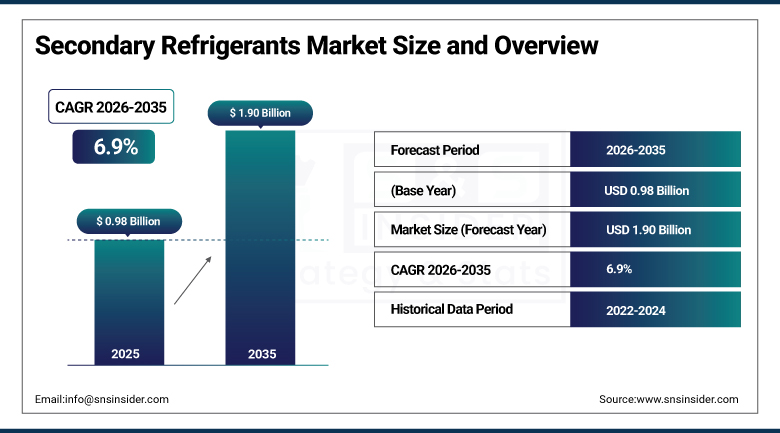
The Secondary Refrigerants Market was valued at USD 0.98 Billion in 2025 and is projected to reach USD 1.90 Billion by 2035, registering a CAGR of 6.9% from 2026 to 2035.
The Secondary Refrigerants Market is driving energy efficiency and regulatory compliance through the use of indirect heat transfer technology for reducing primary refrigerant charge and minimizing primary refrigerant leakage. The characteristics of the secondary refrigerants market include stringent regulation regarding the use of refrigerants with high global warming potential, increasing use of glycols and salt brine as heat transfer fluid, rising use of CO2 brines as an eco-friendly refrigerant alternative, and adoption of secondary refrigerants in commercial refrigeration, industrial refrigeration, heat pumps, and air conditioning segments within cold chain and building services industries. There is significant movement in district heating, heat pumps, and cold chain logistics due to the fact that food processing industry, pharmaceutical companies, and HVAC industry players have made substantial investments into safer refrigeration technologies.
Kemira continued expanding global distribution of its Freezium potassium formate secondary refrigerant fluid throughout 2025, supporting low-viscosity, non-corrosive heat transfer performance across industrial refrigeration and district cooling installations.
To Get more information On Secondary Refrigerants Market - Request Free Sample Report
Secondary Refrigerants Market Trends
-
Rising deployment of CO2 brines as a low-GWP alternative continues expanding adoption across supermarket and industrial refrigeration retrofit projects.
-
Growing heat pump installation across residential and district heating networks continues driving incremental demand for glycol and brine heat transfer fluids.
-
Tightening F-Gas and Kigali Amendment compliance requirements continue accelerating the shift from direct-expansion systems toward indirect secondary loop architectures.
-
Increasing cold chain logistics investment across emerging economies continues expanding baseline demand for stable, non-corrosive heat transfer fluids.
-
Rising adoption of smart dosing and fluid-monitoring systems continues improving secondary refrigerant lifecycle management and reducing replacement frequency.
U.S. Secondary Refrigerants Market Outlook
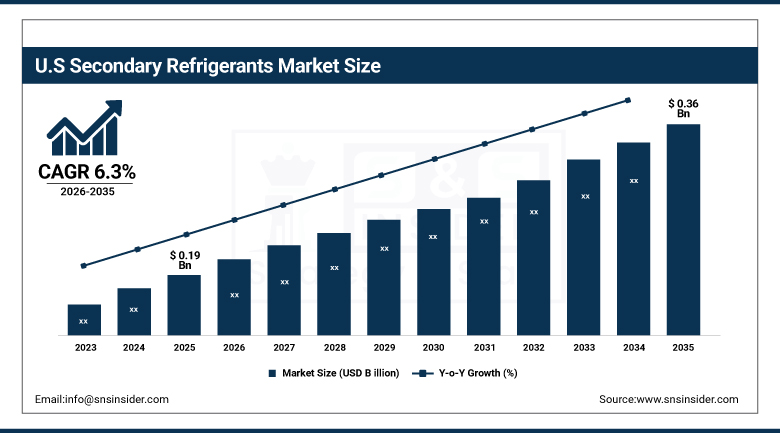
The U.S. Secondary Refrigerants Market was valued at approximately USD 0.19 Billion in 2025 and is projected to reach approximately USD 0.36 Billion by 2035, registering a CAGR of approximately 6.3% from 2026 to 2035.
Demand across the United States continued to be shaped by expanding cold chain infrastructure investment, rising commercial refrigeration retrofit activity tied to EPA AIM Act phasedown requirements for high-GWP refrigerants, and growing heat pump installation across both residential and light commercial buildings. Continued grocery and food distribution sector investment in indirect refrigeration architecture reinforced the country's position as the largest single national market tracked in this report. Growing pharmaceutical cold storage and data center liquid cooling investment added further layers of demand beyond the sector's traditional commercial refrigeration concentration, broadening the addressable customer base for fluid suppliers nationwide.
Chemours expanded its Freon secondary loop fluid portfolio in 2025, targeting supermarket and cold storage operators transitioning away from high-GWP direct-expansion refrigeration systems under EPA AIM Act phasedown requirements.
Secondary Refrigerants Market Segment Analysis
-
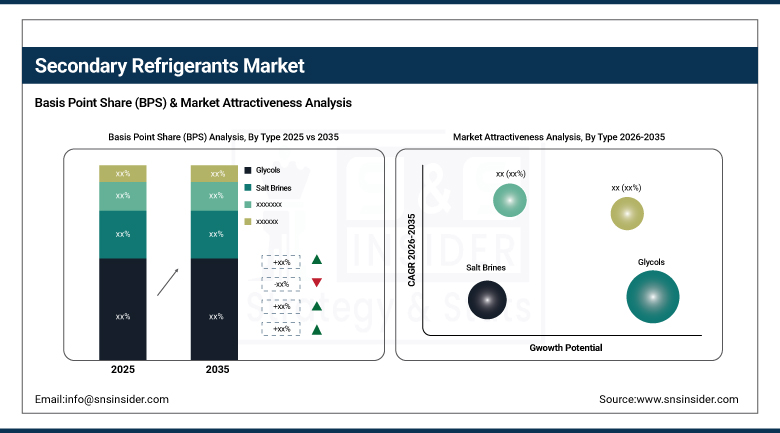
By Type, Glycols dominated the Secondary Refrigerants Market with a 44.00% share in 2025, while CO2 Brines is the fastest-growing type segment with a CAGR of 7.80% from 2026–2035.
-
By Application, Commercial Refrigeration dominated the market with a 38.00% share in 2025, while Heat Pumps is the fastest-growing application segment with a CAGR of 8.40% from 2026–2035.
-
By End-Use Industry, Food & Beverage dominated the market with a 41.00% share in 2025, while Chemical & Pharmaceutical is the fastest-growing end-use industry segment with a CAGR of 7.60% from 2026–2035.
By Type, Glycols Dominate the Secondary Refrigerants Market While CO2 Brines Emerge as the Fastest-Growing Type Segment
The Glycols segment dominated the Secondary Refrigerants Market in 2025 owing to its widespread use, low cost, and proven freeze-protection performance across commercial refrigeration, HVAC, and industrial cooling applications. Ethylene and propylene glycol-based fluids continue benefiting from established supply chains, broad chemical compatibility with existing piping and heat exchanger materials, and straightforward maintenance requirements that make them the default choice for operators retrofitting direct-expansion systems into indirect loop architectures. Continued availability from major chemical producers and well-understood handling protocols further reinforced glycols' leading revenue contribution within the overall type mix throughout the forecast period.
CO2 Brines has emerged as the leading growth contributor in the Secondary Refrigerants Market owing to increasing demand for natural refrigerants with low global warming potential among both regulations and consumers for the retrofit of refrigeration applications in supermarkets and industry. Transcritical CO2 refrigeration systems and increasing implementation of CO2 brines in these systems especially in European and increasingly in North American supermarkets is continuously driving the demand. Increasing stability and corrosion resistance of CO2 brine formulation is likely to continue supporting the high growth of this segment.
By Application, Commercial Refrigeration Leads the Secondary Refrigerants Market While Heat Pumps Record the Fastest Growth
The Commercial Refrigeration segment dominated the Secondary Refrigerants Market in 2025, anchored by widespread indirect refrigeration adoption across supermarkets, convenience stores, and cold storage warehouses seeking to minimize primary refrigerant charge and leakage liability. The increased investments by supermarket chains in centralized indirect refrigeration racks, which utilize secondary fluids for the distribution of the cooling effect through many cases from one compressor room, enhanced the market share of this segment in terms of revenue generation. The presence of the service network in matured markets for retrofits and servicing also contributed to its market leadership.
The Heat Pumps segment is the fastest growing within the Secondary Refrigerants Market, driven by accelerating residential and district heating electrification alongside growing government incentive programs supporting heat pump installation as a fossil fuel heating alternative. Secondary fluids will ensure that thermal energy can be transferred in the heat pumps by making use of building distribution systems while using very little amount of refrigerant inside the building. The favorable policies regarding building electrification expected from Europe and North America would continue this trend during the forecasted period.
By End-Use Industry, Food & Beverage Dominates the Secondary Refrigerants Market While Chemical & Pharmaceutical Emerges as the Fastest-Growing End-Use Segment
The Food & Beverage segment dominated the Secondary Refrigerants Market in 2025, resulting from the dependence of the industry on indirect refrigeration within processing plants, cold storage warehouses, and retail display systems, ensuring stringent product safety and quality requirements. The further development of cold chain logistics in both developed and developing countries, along with stricter food safety legislation, increased the revenues generated by this segment of the end-user market. The presence of well-established ties between fluid manufacturers and food industry refrigeration installers helped in maintaining its market dominance.
The Chemical & Pharmaceutical segment is the fastest growing within the Secondary Refrigerants Market, propelled by expanding biologics and vaccine cold storage capacity requiring precise, stable temperature control across manufacturing and distribution networks. Growing pharmaceutical cold chain investment, particularly for temperature-sensitive biologic drugs, continues driving demand for reliable, non-corrosive secondary fluids capable of maintaining tight temperature tolerances. Rising global biologics manufacturing capacity is expected to sustain this segment's above-average growth trajectory through the forecast period.
Regional Insights
|
Region |
Major Country |
Share within Region, 2025 (%) |
|---|---|---|
|
North America |
United States |
82.00% |
|
Europe |
Germany |
26.00% |
|
Asia Pacific |
China |
46.00% |
|
Middle East and Africa |
UAE |
35.00% |
|
Latin America |
Brazil |
39.2% |
North America Secondary Refrigerants Market Insights
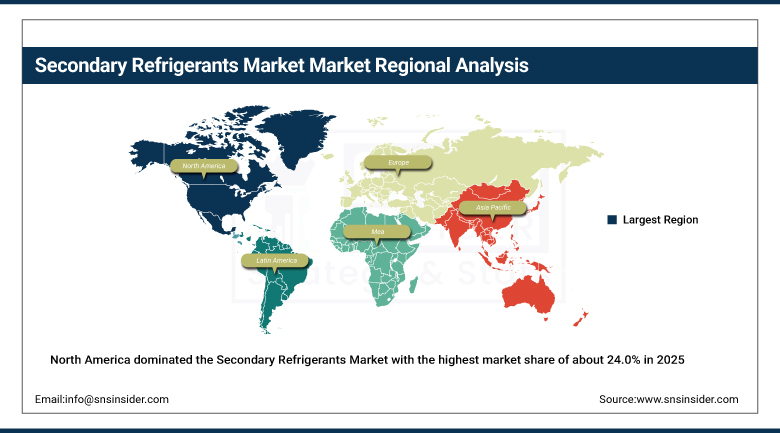
North America was also a mjor region in Secondary Refrigerants Market in 2025, Expanding cold chain infrastructure investment, EPA AIM Act phasedown requirements for high-GWP primary refrigerants, and growing heat pump installation across residential and commercial buildings reinforced steady regional demand. Continued grocery and pharmaceutical cold storage sector investment in indirect refrigeration architecture kept North America among the more mature, technology-forward markets tracked in this report.
The United States anchored by extensive commercial refrigeration retrofit activity and expanding pharmaceutical cold storage capacity. Canada's growing district heating and heat pump adoption added further regional demand, and continued regulatory emphasis on refrigerant charge minimization is expected to keep North America a steadily growing addressable market for secondary refrigerant suppliers through the forecast period.
Get Customized Report as per Your Business Requirement - Enquiry Now
Europe Secondary Refrigerants Market Insights
Europe held a meaningful share of global revenue, anchored by aggressive F-Gas Regulation enforcement and widespread adoption of transcritical CO2 refrigeration systems across supermarket chains. Continued district heating network expansion and heat pump adoption incentive programs across the European Union reinforced steady regional demand for both glycol-based and CO2 brine secondary refrigerant fluids.
Germany led European demand, supported by its substantial industrial refrigeration base and continued district heating network expansion. The United Kingdom and France contributed further demand tied to supermarket refrigeration retrofit and heat pump installation programs, and continued EU F-Gas enforcement is expected to keep regional demand for low-GWP secondary refrigerant fluids on a steady upward trajectory through the forecast period.
Asia Pacific Secondary Refrigerants Market Insights
Asia Pacific led the Secondary Refrigerants Market with the largest share of 50.0% in 2025 and is also advancing at the fastest pace among all regions tracked in this report, registering a CAGR of 7.8% during the forecast period. Rapid industrialization, expanding cold chain logistics infrastructure, and growing food processing capacity across China, India, and Japan reinforced the region's leading position and its above-average growth trajectory.
China led the region, Backed by massive investments in logistics and industrial refrigeration. Asia-Pacific's dominance was further supported by growth in India and Japan, driven by increasing cold storage investments for food processing and pharmaceuticals, making Asia-Pacific the largest as well as the fastest growing secondary refrigerants market covered in this report.
MEA and Latin America Secondary Refrigerants Market Insights
The Middle East and Africa and Latin America both showed steady growth, driven by expanding cold chain logistics investment tied to growing food and beverage sector activity and rising district cooling adoption across the Gulf region. As both regions continued prioritizing energy-efficient cooling solutions, secondary refrigerant fluids proved a genuinely practical way to reduce primary refrigerant charge across large-scale commercial cooling installations.
The UAE led Middle East and Africa demand, supported by the country's extensive district cooling infrastructure and continued investment in energy-efficient building services. Saudi Arabia and South Africa contributed further demand through expanding commercial refrigeration and cold storage capacity. In Latin America, Brazil accounted for the largest share of regional revenue through continued food and beverage cold chain expansion, anchoring regional demand for secondary refrigerant fluids.
Market Dynamics
Growth Drivers: Tightening Refrigerant Regulations and Expanding Cold Chain Infrastructure
The industry is driven by tightening regulations on high-global-warming-potential primary refrigerants, rising adoption of glycol and salt brine heat transfer fluids, growing deployment of CO2 brines as a low-GWP alternative, and continued adoption across commercial refrigeration, industrial refrigeration, heat pump, and air conditioning applications. As F-Gas Regulation and Kigali Amendment phasedown schedules tighten globally, the need for indirect refrigeration architectures that minimize primary refrigerant charge keeps driving sustained operator investment in secondary refrigerant fluids.
Expanding cold chain logistics infrastructure continues reinforcing this driver, as food processors, pharmaceutical manufacturers, and retail grocery chains increasingly invest in temperature-controlled storage and distribution capacity across both developed and emerging economies. Continued advancement of CO2 brine formulation stability and heat pump electrification incentive programs further supports this driver, and that combination of regulatory pressure and infrastructure expansion is exactly what keeps demand climbing at a steady, sustained pace.
Restraints: Volatile Feedstock Pricing and Retrofit Capital Costs
Volatile pricing of key petrochemical feedstocks used in glycol production continues posing a genuine restraint on stable market-wide margins, particularly for smaller fluid formulators without the purchasing scale that major chemical producers can leverage. That cost volatility has kept pricing pressure a persistent challenge across the competitive landscape, particularly during periods of broader ethylene and propylene glycol feedstock price fluctuation.
The substantial capital investment required to retrofit existing direct-expansion refrigeration systems into indirect secondary loop architectures continues posing a further restraint, as smaller commercial refrigeration operators often lack the capital budgets that large grocery and cold storage chains can commit. That cost profile has kept large-scale retrofit activity concentrated among a comparatively small number of well-resourced, often multinational retail and logistics operators.
Opportunities: CO2 Brine Innovation and Heat Pump Electrification Expansion
Advancement of CO2 brine formulation technology represents a genuinely significant opportunity, as this emerging fluid category promises substantially lower global-warming-potential relative to conventional glycol-based products. Fluid formulators positioned early in commercially viable CO2 brine solutions stand to capture meaningful share as transcritical CO2 refrigeration adoption continues expanding across supermarket and industrial cooling applications.
Expansion into heat pump and building electrification applications offers a second substantial opportunity, as governments increasingly incentivize heat pump installation as a fossil fuel heating alternative across residential and district heating networks. Fluid manufacturers with established and commercially-proven formulas for thermal conductivity will benefit from an increasing level of policy support aimed at building electrification through the forecast period.
Recent Developments:
- 2026: Linde announced advanced glycol-based formulations designed for high-efficiency centralized refrigeration loops, targeting improved thermal stability, system safety, and energy performance.
- 2024: Tazzetti expanded its range of pre-blended glycol and CO2 brine secondary refrigerant fluids, targeting European supermarket chains upgrading to transcritical CO2 refrigeration architecture under F-Gas Regulation compliance timelines.
Secondary Refrigerants Key Players are:
-
The Dow Chemical Company
-
BASF SE
-
Honeywell International Inc.
-
The Chemours Company
-
Eastman Chemical Company
-
Evonik Industries AG
-
The Lubrizol Corporation
-
Linde plc
-
Tazzetti S.p.A.
-
Temper Technology AB
-
Kemira Oyj
-
A-Gas International
-
Arkema S.A.
-
Sinochem Holdings Corporation Ltd.
-
MEGlobal
-
Univar Solutions Inc.
-
Orbia Advance Corporation, S.A.B. de C.V.
-
Secomak Ltd.
Secondary Refrigerants Market Report Scope:
| Report Attributes | Details |
|---|---|
| Market Size in 2025 | USD 0.98 Billion |
| Market Size by 2035 | USD 1.90 Billion |
| CAGR | CAGR of 6.9% From 2026 to 2035 |
| Base Year | 2025 |
| Forecast Period | 2026-2035 |
| Historical Data | 2022-2024 |
| Report Scope & Coverage | Market Size, Segments Analysis, Competitive Landscape, Regional Analysis, DROC & SWOT Analysis, Forecast Outlook |
| Key Segments | • By Type (Glycols, Salt Brines, CO2 Brines & Others) • By Application (Commercial Refrigeration, Industrial Refrigeration, Heat Pumps, Air Conditioning & Others) • By End-Use Industry (Food & Beverage, Chemical & Pharmaceutical, Oil & Gas, HVAC & Building Services & Others) |
| Regional Analysis/Coverage | North America (US, Canada), Europe (Germany, UK, France, Italy, Spain, Russia, Poland, Rest of Europe), Asia Pacific (China, India, Japan, South Korea, Australia, ASEAN Countries, Rest of Asia Pacific), Middle East & Africa (UAE, Saudi Arabia, Qatar, South Africa, Rest of Middle East & Africa), Latin America (Brazil, Argentina, Mexico, Colombia, Rest of Latin America). |
| Company Profiles | The Dow Chemical Company, BASF SE, Honeywell International Inc., The Chemours Company, Eastman Chemical Company, Clariant AG, Evonik Industries AG, The Lubrizol Corporation, Linde plc, Tazzetti S.p.A., Temper Technology AB, Kemira Oyj, A-Gas International, Arkema S.A., Sinochem Holdings Corporation Ltd., INEOS Group Holdings S.A., MEGlobal, Univar Solutions Inc., Orbia Advance Corporation, S.A.B. de C.V., Secomak Ltd. |

Frequently Asked Questions
