
Security Validation Platform Market Report Scope & Overview:
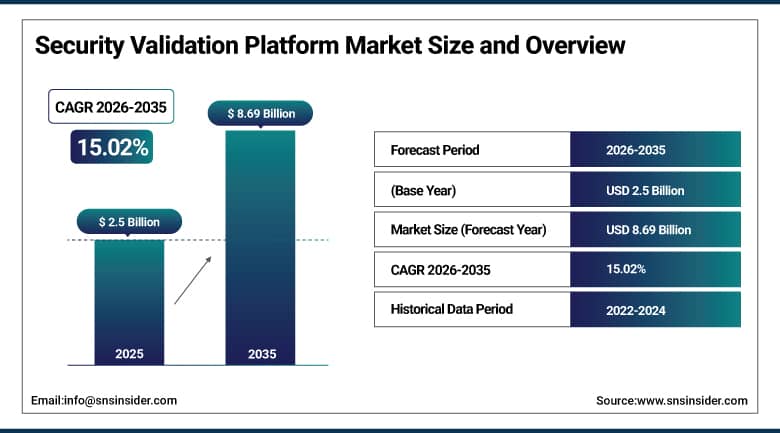
Security Validation Platform Market was valued at USD 2.5 Billion in 2025 and is expected to reach USD 8.69 Billion by 2035, growing at a CAGR of 15.02% from 2026–2035.
The major drivers fueling the expansion of the global security validation platform market are the increasing frequency and sophistication of cyberattacks, growing adoption of cloud computing and hybrid IT environments, rising regulatory compliance requirements, and the increasing need for continuous security posture assessment. Organizations are increasingly deploying security validation platforms to proactively identify vulnerabilities, validate the effectiveness of security controls, simulate real-world attack scenarios, and strengthen cyber resilience across on-premises, cloud, and hybrid infrastructures. Additionally, the integration of artificial intelligence (AI), machine learning (ML), automated breach and attack simulation (BAS), and continuous security validation capabilities is further supporting market growth.
In March 2025 Pentera expanded its automated security validation platform by strengthening AI-powered attack simulation, continuous exposure validation, and cloud security assessment capabilities following its Series D funding. These enhancements enable organizations to proactively identify exploitable vulnerabilities, validate the effectiveness of security controls, prioritize remediation efforts, and strengthen cyber resilience across hybrid and multi-cloud environments while improving operational efficiency.
Market Size and Forecast
-
Market Size 2026E: USD 2.47 Billion
-
Market Size 2035: USD 8.69Billion
-
CAGR: 15.02% from 2026 to 2035
-
Fastest Growing Region: Asia-Pacific
-
Largest Region: North America
To Get More Information On Security Validation Platform Market - Request Free Sample Report
Security Validation Platform Market Trends
-
Rising frequency of cyberattacks and ransomware incidents is driving demand for continuous security validation platforms.
-
Increasing adoption of cloud computing and hybrid IT environments is accelerating the need for automated security posture validation.
-
Security validation platforms improve threat detection, vulnerability assessment, compliance management, and cyber resilience across enterprise environments.
-
Advancements in artificial intelligence (AI), machine learning (ML), and automated breach and attack simulation (BAS) are driving innovation in security validation platforms.
-
Growing adoption across BFSI, IT and telecommunications, healthcare, government and defense, retail, and energy and utilities sectors is supporting sustained growth of the security validation platform market.
U.S. Security Validation Platform Market Outlook
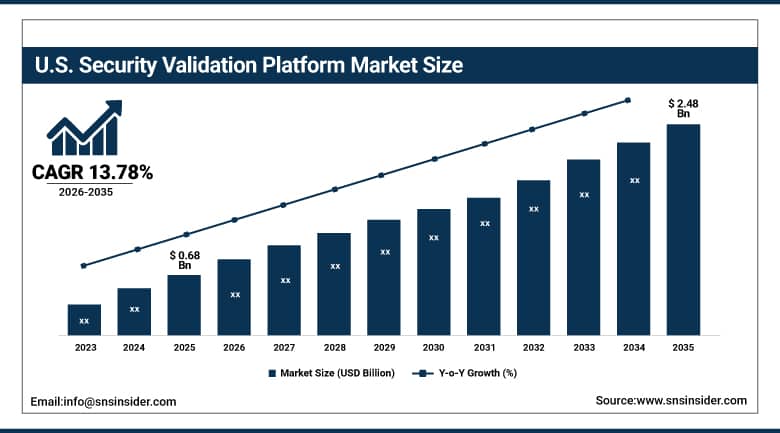
The U.S. Security Validation Platform Market was valued at USD 0.68 Billion in 2025 and is expected to reach around USD 2.48 Billion by 2035, growing at a CAGR of 13.78% from 2026–2035.
There is a surge in the growth of the security validation platform market in the United States due to the increasing frequency of cyberattacks, rapid adoption of cloud computing and hybrid IT environments, and rising demand for continuous security validation and proactive cyber risk management. Organizations across industries are increasingly implementing security validation platforms to assess the effectiveness of security controls, identify exploitable vulnerabilities, simulate real-world attack scenarios, and strengthen cyber resilience across on-premises, cloud, and hybrid infrastructures.
Additionally, the growing adoption of artificial intelligence (AI), machine learning (ML), automated breach and attack simulation (BAS), and zero-trust security frameworks, along with continued investments in cybersecurity modernization and regulatory compliance, are further accelerating the growth of the security validation platform market in the United States.
In February 2025, Cymulate introduced next-generation AI automation for its Exposure Validation Platform, adding AI-powered attack scenario generation, automated remediation, and enhanced threat exposure validation capabilities. The enhancements enable organizations to continuously validate security controls, identify exploitable attack paths, automate remediation workflows, and strengthen cyber resilience across on-premises, cloud, and hybrid environments while improving operational efficiency.
Security Validation Platform Market Size Segment Analysis
-
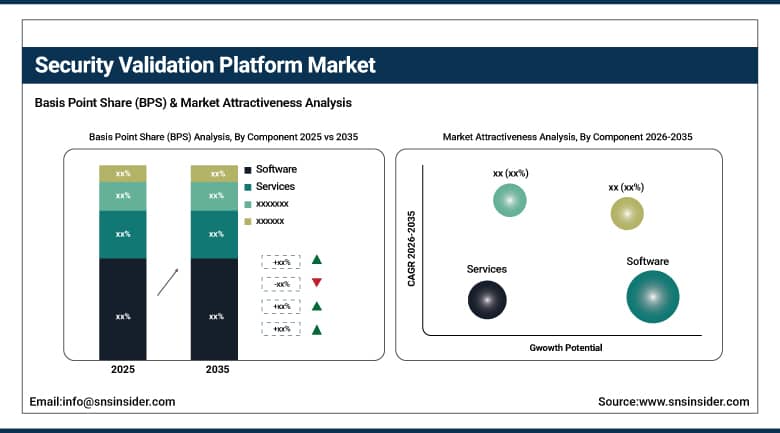
By Component, software dominated the security validation platform market with a 68.40% share in 2025, while services are projected to be the fastest-growing segment, registering a CAGR of 19.36% during 2025–2035.
-
By Deployment mode, cloud dominated the security validation platform market with a 59.80% share in 2025, while on-premises is projected to be the fastest-growing segment, registering a CAGR of 16.18% during 2025–2035.
-
By Organization size, large enterprises dominated the security validation platform market with a 63.30% share in 2025, while small and medium enterprises (SMEs) are projected to be the fastest-growing segment, registering a CAGR of 17.60% during 2025–2035.
-
By Application, network security dominated the security validation platform market with a 34.20% share in 2025, while cloud security is projected to be the fastest-growing segment, registering a CAGR of 18.67% during 2025–2035.
-
By End user, BFSI dominated the security validation platform market with a 24.80% share in 2025, while retail is projected to be the fastest-growing segment, registering a CAGR of 32.29% during 2025–2035.
By component, solutions dominated the security validation platform market, while services are expected to grow fastest
During 2025, the solutions sub-segment led the global security validation platform market owing to the increasing adoption of automated security validation, breach and attack simulation (BAS), continuous exposure management, and AI-powered threat validation platforms. Organizations increasingly invested in integrated security validation solutions to identify exploitable vulnerabilities, validate security controls, and strengthen cyber resilience across hybrid and multi-cloud environments.
The services sub-segment is expected to register the highest growth rate during the forecast period owing to the rising demand for consulting, implementation, integration, managed security, and training services. Growing cybersecurity complexity, increasing adoption of continuous security validation platforms, and the shortage of skilled cybersecurity professionals are expected to drive demand for professional and managed services.
By deployment model, public cloud dominated the security validation platform market, while hybrid cloud is expected to grow fastest
According to deployment model, the public cloud segment held the largest market share in the security validation platform market, whereas the hybrid cloud segment is projected to register the highest growth rate during the forecast period. The public cloud segment dominated in 2025 owing to the rapid adoption of cloud-native security platforms, lower deployment costs, scalability, and increasing enterprise migration to public cloud environments.
The hybrid cloud segment is expected to witness the highest CAGR during the forecast period owing to the growing adoption of hybrid IT environments, increasing multi-cloud strategies, and the need for unified security validation across on-premises and cloud infrastructure. Organizations are increasingly deploying hybrid cloud security validation solutions to improve visibility, ensure consistent security policies, and reduce cyber risks across distributed environments.
By end-user industry, BFSI dominated the security validation platform market, while healthcare is expected to grow fastest
As per end-user industry, BFSI accounted for the largest market share in the security validation platform market, while the healthcare segment is expected to exhibit the highest growth rate during the forecast period. The BFSI segment dominated the market in 2025 due to increasing cyber threats, stringent regulatory compliance requirements, widespread adoption of zero-trust security, and growing investments in continuous security validation to protect critical financial systems and sensitive customer data.
The healthcare segment is expected to witness the highest CAGR during the forecast period owing to the rapid digitalization of healthcare services, increasing adoption of connected medical devices and cloud-based healthcare platforms, and the growing frequency of ransomware and data breach incidents. Healthcare organizations are increasingly implementing security validation platforms to strengthen cyber resilience, protect patient information, and ensure compliance with healthcare data protection regulations.
Regional Insights
|
Region |
Major Country |
Share within Region, 2025(%) |
|---|---|---|
|
North America |
United States |
86.40% |
|
Europe |
Germany |
24.80% |
|
Asia Pacific |
China |
35.90% |
|
Middle East & Africa |
Saudi Arabia |
29.10% |
|
Latin America |
Brazil |
38.40% |
North America Security Validation Platform Market insights
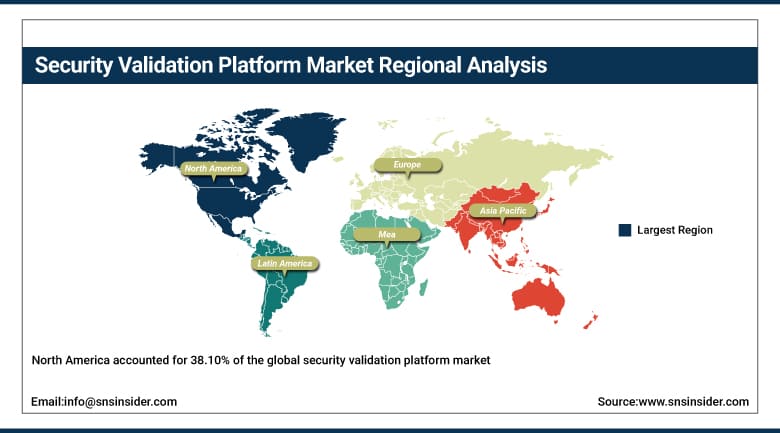
North America accounted for 38.10% of the global security validation platform market, driven by the increasing adoption of continuous security validation, exposure management, zero-trust security frameworks, and automated penetration testing across enterprises. Organizations are increasingly deploying security validation platforms to identify exploitable vulnerabilities, strengthen cyber resilience, improve security posture, and validate security controls across hybrid IT environments. Additionally, the United States represented 83.60% of the North America security validation platform market in 2025, supported by the presence of leading cybersecurity vendors, high enterprise cybersecurity spending, and widespread adoption of advanced security technologies.
The growing frequency of sophisticated cyberattacks, ransomware incidents, and regulatory compliance requirements continues to drive market growth across North America. Enterprises are increasingly investing in AI-powered threat validation, attack surface management, automated breach and attack simulation (BAS), and continuous security testing to strengthen cyber defenses. Furthermore, increasing investments in cloud security, digital transformation, and critical infrastructure protection are expected to further accelerate the growth of the security validation platform market across the United States and North America.
Get Customized Report as Per Your Business Requirement - Enquiry Now
Europe Security Validation Platform Market insights
Europe remains a significant market for the security validation platform market due to increasing cybersecurity investments, expanding digital transformation initiatives, and stringent data protection regulations. The United Kingdom accounted for 24.80% of the Europe security validation platform market in 2025, driven by its mature cybersecurity ecosystem, strong enterprise technology adoption, increasing cloud migration, and rising demand for continuous security validation solutions.
The growth of the security validation platform market in Europe is supported by increasing adoption of zero-trust architectures, security automation, vulnerability assessment, and regulatory compliance initiatives. Organizations are modernizing their cybersecurity strategies to proactively identify weaknesses, improve incident preparedness, and reduce cyber risk exposure. Continuous investments in AI-driven cybersecurity, cloud security, and threat intelligence are expected to support sustained market growth throughout the forecast period.
Asia Pacific Security Validation Platform Market insights
The Asia-Pacific security validation platform market is expected to register the highest CAGR during the forecast period, driven by rapid digitalization, increasing cyber threats, expanding cloud adoption, and rising enterprise cybersecurity spending. China accounted for 35.90% of the Asia-Pacific security validation platform market in 2025, supported by its large enterprise sector, expanding digital economy, increasing cloud infrastructure investments, and growing adoption of advanced cybersecurity technologies.
Growing demand for continuous security testing, automated penetration testing, breach and attack simulation, and cloud security validation is creating significant growth opportunities across the region. Furthermore, increasing adoption of AI, IoT, 5G, and hybrid cloud environments, along with rising investments in cybersecurity infrastructure and regulatory compliance, is expected to accelerate the growth of the security validation platform market throughout the forecast period.
Middle East & Africa and Latin America insights
The Middle East & Africa security validation platform market is growing steadily due to increasing cybersecurity awareness, rising cloud adoption, expanding digital transformation initiatives, and growing investments in critical infrastructure protection. The United Arab Emirates accounted for 29.10% of the regional market in 2025, supported by government-led cybersecurity programs, increasing enterprise cloud adoption, and continued investments in advanced digital infrastructure.
The Latin America security validation platform market is expanding due to increasing enterprise digitalization, growing cyberattack incidents, and rising investments in modern cybersecurity solutions. Brazil led the regional market in 2025, accounting for 38.40% of the regional market, driven by its large enterprise base, expanding cloud ecosystem, and increasing deployment of security validation and exposure management platforms. Growing demand for proactive cybersecurity, continuous security testing, regulatory compliance, and cloud security is expected to support market growth across the region during the forecast period.
Growth Driver: Increasing adoption of continuous security validation and exposure management accelerating security validation platform market growth
The increasing adoption of continuous security validation and exposure management has emerged as a major driver of the security validation platform market. Organizations are strengthening their cybersecurity strategies by continuously validating security controls, identifying exploitable vulnerabilities, and simulating real-world cyberattacks across cloud, on-premises, and hybrid IT environments. As cyber threats become more sophisticated, enterprises are increasingly deploying security validation platforms to improve cyber resilience, reduce attack surfaces, enhance threat detection capabilities, and ensure the effectiveness of existing security investments. The rapid adoption of zero-trust security models and cloud-native applications is further encouraging organizations to implement automated security validation solutions across distributed environments.
The growing adoption of breach and attack simulation (BAS), attack surface management (ASM), AI-powered threat validation, and automated penetration testing is expected to further fuel the security validation platform market. In addition, increasing investments in cybersecurity modernization, regulatory compliance, and enterprise risk management are projected to accelerate market growth throughout the forecast period.
Restraints: Integration complexity and shortage of cybersecurity expertise may restrain security validation platform market growth
Integration complexity and the shortage of skilled cybersecurity professionals continue to hinder growth in the security validation platform market. Many organizations operate complex legacy IT infrastructures that are difficult to integrate with modern security validation platforms, creating deployment challenges, higher implementation costs, and longer implementation timelines. Managing continuous security validation across multi-cloud, hybrid cloud, endpoint, network, and application environments also increases operational complexity for enterprises.
Additionally, organizations must address evolving cyber threats, regulatory compliance requirements, and data privacy standards while maintaining continuous monitoring and validation of security controls. The need for specialized cybersecurity expertise, ongoing platform management, and integration with existing security tools increases operational costs. These challenges are expected to restrain the growth of the security validation platform market during the forecast period.
Opportunities: Growing adoption of AI-driven cybersecurity and continuous threat validation
The rapid adoption of AI-driven cybersecurity solutions presents significant growth opportunities for the security validation platform market. Organizations are increasingly investing in artificial intelligence, machine learning, and security automation to proactively identify vulnerabilities, simulate attack scenarios, prioritize security risks, and improve incident response. The increasing adoption of cloud computing, digital transformation initiatives, and zero-trust architectures is creating additional demand for automated and continuous security validation platforms.
Furthermore, increasing investments in exposure management, extended detection and response (XDR), security operations centers (SOC), and cloud security platforms are expected to create new opportunities for market participants. Continuous innovation in AI-powered security validation, growing adoption of automated penetration testing, and expanding cybersecurity investments across both developed and emerging economies are expected to support the long-term growth of the security validation platform market.
Recent Developments
-
2026: Pentera expanded its Automated Security Validation Platform with enhanced AI-powered attack emulation and exposure validation capabilities, enabling organizations to continuously identify exploitable security gaps across hybrid and multi-cloud environments.
-
2026: XM Cyber introduced advanced exposure management capabilities that combine attack path analysis with continuous security validation, helping enterprises prioritize critical vulnerabilities and strengthen cyber resilience.
-
2025: Pentera launched new cloud security validation capabilities, allowing organizations to safely validate cloud configurations, identity security, and attack paths across AWS, Microsoft Azure, and Google Cloud environments.
-
2025: Picus Security enhanced its Security Validation Platform with AI-driven Breach and Attack Simulation (BAS) capabilities and expanded threat intelligence coverage to help organizations continuously validate the effectiveness of their security controls against evolving cyber threats.
Security Validation Platform Market Key Players
-
Pentera
-
Picus Security
-
XM Cyber
-
SafeBreach
-
Cymulate
-
Horizon3.ai
-
Mandiant (Google Cloud)
-
Qualys
-
Tenable
-
Rapid7
-
Microsoft
-
Palo Alto Networks
-
Cisco Systems, Inc.
-
IBM Corporation
-
Fortinet, Inc.
-
Check Point Software Technologies Ltd.
-
Trend Micro Incorporated
-
SentinelOne, Inc.
Security Validation Platform Market Report Scope:
| Report Attributes | Details |
|---|---|
| Market Size in 2025 | USD 2.5 Billion |
| Market Size by 2035 | USD 8.69 Billion |
| CAGR | CAGR of 15.02% From 2026 to 2035 |
| Base Year | 2025 |
| Forecast Period | 2026-2035 |
| Historical Data | 2022-2024 |
| Report Scope & Coverage | Market Size, Segments Analysis, Competitive Landscape, Regional Analysis, DROC & SWOT Analysis, Forecast Outlook |
| Key Segments | • By Component (Solutions, Services) • By Deployment Model (Public Cloud, Private Cloud, Hybrid Cloud) • By Enterprise Type (Single-Cloud Enterprises, Multi-Cloud Enterprises, Hybrid Cloud Enterprises) • By Organization Size (Large Enterprises, Small and Medium Enterprises (SMEs)) • By End-User Industry (BFSI, IT and Telecommunications, Healthcare, Retail, Manufacturing, Government, Others) |
| Regional Analysis/Coverage | North America (US, Canada, Mexico), Europe (Eastern Europe [Poland, Romania, Hungary, Turkey, Rest of Eastern Europe] Western Europe] Germany, France, UK, Italy, Spain, Netherlands, Switzerland, Austria, Rest of Western Europe]), Asia Pacific (China, India, Japan, South Korea, Vietnam, Singapore, Australia, Rest of Asia Pacific), Middle East & Africa (Middle East [UAE, Egypt, Saudi Arabia, Qatar, Rest of Middle East], Africa [Nigeria, South Africa, Rest of Africa], Latin America (Brazil, Argentina, Colombia, Rest of Latin America) |
| Company Profiles | Pentera, Picus Security, XM Cyber, SafeBreach, AttackIQ, Cymulate, Horizon3.ai, Mandiant (Google Cloud), Qualys, Tenable Holdings, Inc., Rapid7, Inc., Microsoft Corporation, Palo Alto Networks, Inc., CrowdStrike Holdings, Inc., Cisco Systems, Inc., IBM Corporation, Fortinet, Inc., Check Point Software Technologies Ltd., Trend Micro Incorporated, SentinelOne, Inc. |
Frequently Asked Questions
The security validation platform market was valued at USD 2.15 billion in 2025.
The market is driven by rising cyber threats and growing adoption of continuous security validation.
The software segment dominated the security validation platform market in 2025 with a 68.40% share.
North America dominated the security validation platform market in 2025 with a 38.10% share.
