
Bio Based Battery Market Report Scope & Overview:
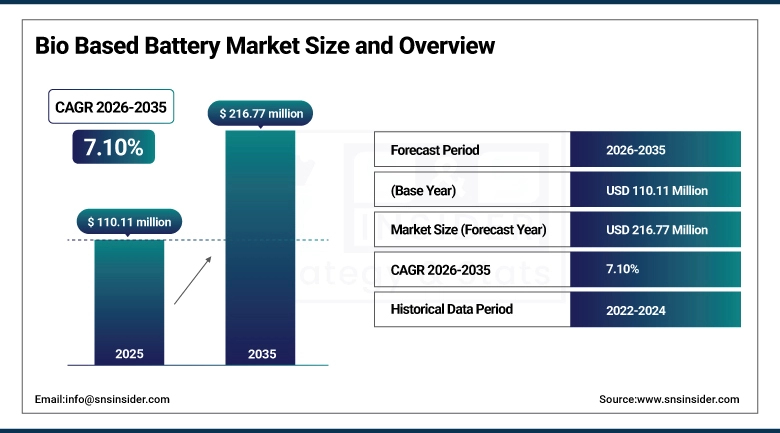
The Bio Based Battery Market was valued at USD 110.11 million in 2025 and is expected to reach USD 216.77 million by 2035, growing at a CAGR of 7.10% from 2026-2035.
The Bio Based Battery Market is being propelled by the need to have sustainable and environmentally friendly energy sources within different sectors. Environmental legislations, increase in usage of IoT technologies, and technological innovations in bio-materials are aiding the growth in the market. Moreover, investments in green energy technology and biodegradable batteries are further adding fuel to the growth trend in the market.
Research demonstrates that bio‑based battery designs can reduce environmental impacts by up to ~76–92% compared to conventional batteries by using biodegradable materials such as biological polymers and green membranes, highlighting strong R&D momentum toward sustainable energy storage.
Furthermore, the Ecodesign for Sustainable Products Regulation (Regulation (EU) 2024/1781), effective from 18 July 2024, provides a framework for designing products with sustainability and circular economy goals, including electronics and energy-related products, to minimize environmental impact throughout their lifecycle.
To Get more information on Bio Based Battery Market - Request Free Sample Report
Bio Based Battery Market Trends
-
Rising demand for sustainable and eco-friendly energy storage solutions is driving the bio-based battery market.
-
Growing adoption of renewable materials such as organic compounds, biomass-derived electrolytes, and biodegradable components is boosting market growth.
-
Expansion of applications in consumer electronics, medical devices, and wearable technologies is fueling deployment.
-
Increasing focus on reducing environmental impact and dependence on rare metals is shaping adoption trends.
-
Advancements in green chemistry, organic electrodes, and biodegradable battery technologies are enhancing performance and sustainability.
-
Rising investments in circular economy initiatives and clean energy innovation are supporting market expansion.
-
Collaborations between research institutions, battery manufacturers, and sustainability-focused organizations are accelerating innovation and global adoption.
U.S. Bio Based Battery Market Size Outlook:
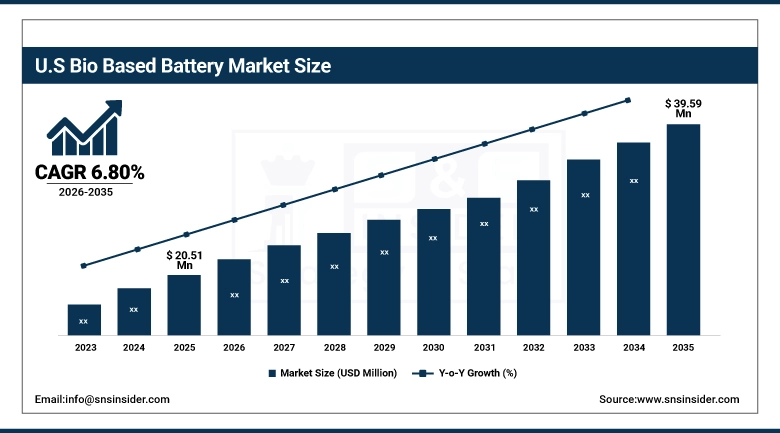
The U.S. Bio Based Battery Market was valued at USD 20.51 million in 2025 and is expected to reach USD 39.59 million by 2035, growing at a CAGR of 6.80% from 2026-2035. Growth of U.S. Bio Based Battery Market will be fueled by high investment in sustainable technology, increasing use of green electronics, and the need to lower carbon emissions. Development of bio-material technology and increasing usage of IoT devices will also facilitate market growth.
In line with these trends, the U.S. Department of Energy (DOE) announced a Notice of Funding Opportunity for up to USD 500 million to expand domestic battery materials manufacturing, critical mineral processing, and recycling, strengthening sustainable battery technologies across industries.
Bio Based Battery Market Growth Drivers:
-
Rising demand for sustainable and eco-friendly energy storage solutions is accelerating adoption of bio-based batteries across multiple industries globally
The rising concern for the environment along with stringent rules regarding carbon emissions is leading companies towards bio-based alternatives, thus promoting the application of bio-based batteries at a rapid rate. Bio-based batteries contain renewable raw materials and are biodegradable as opposed to traditional lithium-based batteries that create more pollution to the environment. Another factor contributing towards the growth of this sector is consumer and business awareness about green sources of energy. Governments all over the world are now trying to promote clean energy technology through different policies and incentives.
Bio Based Battery Market Restraints:
-
Limited energy density and performance constraints compared to conventional lithium-ion batteries are restricting large-scale adoption in high-power applications globally
Low energy density and low power capacity continue to be serious obstacles to the application of bio-batteries in high-performing devices like electric cars and energy storage systems. Bio-batteries tend not to provide stable and reliable energy outputs compared to lithium-ion batteries. This affects their ability to perform optimally in high-performance industries. Another factor that limits the use of bio-batteries is the gradual deterioration of their performance levels over time. While research efforts have been made to improve the performance levels of bio-batteries, achieving comparable performances to those of lithium-ion batteries is still an uphill task.
Bio Based Battery Market Opportunities:
-
Growing adoption of IoT devices and low-power electronics is creating strong demand for sustainable and biodegradable bio-based battery solutions globally
The rapid expansion of IoT-enabled gadgets and low-power electronics presents a huge opportunity for bio-based batteries. Such applications demand miniature, eco-friendly, and safe energy storage mechanisms; thus, bio-based batteries become the best option to consider. Their biodegradability and environmental-friendliness are features that make them perfect for use in such products. The growing adoption of sensors within sectors such as healthcare, agricultural, and smart city operations is fueling their demand further. With the proliferation of connected devices on the rise, the demand for bio-based batteries will only continue to grow.
Researchers at the University of Pennsylvania developed biodegradable zinc–air batteries for IoT applications, including precision agriculture sensors. Using biodegradable anodes, hydrogel electrolytes, and encapsulation, these batteries provide 7–340 days of sensor operation, offering practical, eco-friendly energy for distributed environmental monitoring without producing e‑waste.
Bio Based Battery Market Segment Highlights
-
By End User, Commercial dominated the Bio Based Battery Market with ~42% share in 2025; Industrial fastest growing (CAGR).
-
By Sales Channel, Dealer dominated the Bio Based Battery Market with ~44% share in 2025; Online fastest growing (CAGR).
-
By Application, Consumer Electronics dominated the Bio Based Battery Market with ~30% share in 2025; IoT Devices & Sensors fastest growing (CAGR).
-
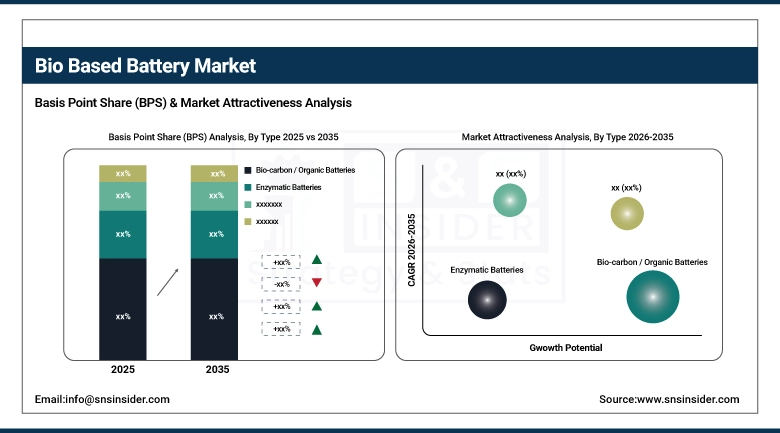
By Type, Bio-carbon / Organic Batteries dominated the Bio Based Battery Market with ~38% share in 2025; Enzymatic Batteries fastest growing (CAGR).
By Type, Bio-carbon / Organic Batteries segment dominates the Bio Based Battery Market, Enzymatic Batteries segment expected to grow fastest
Bio-Carbon / Organic Batteries segment had the largest share in the Bio Based Battery Market owing to its increased stability, efficiency, and scalability when compared with other types of bio-based batteries. The capability of these batteries to integrate well into traditional battery systems along with using renewable carbon materials has made them highly popular.
The Enzymatic Batteries segment is forecasted to have the fastest CAGR during the period between 2026 and 2035. This can be attributed to improvements in bio-catalyst technologies as well as increasing R&D activities focused on bio-electrochemistry. These batteries have several uses, especially in the medical field due to their sustainability and ability to power wearable devices.
By End User, Commercial segment dominates the Bio Based Battery Market, Industrial segment expected to grow fastest
The Commercial segment captured the largest revenue share in the Bio-Based Battery Market in 2025 owing to the high usage of such batteries in office buildings, retail centers, and service-oriented businesses that require sustainable sources of energy. Firms have been implementing eco-friendly innovations to fulfill regulatory mandates and sustainability objectives, and this trend has led to the widespread application of bio-based batteries in commercial setups worldwide.
The Industrial segment is anticipated to witness the fastest CAGR over the forecast period owing to the growing use of sustainable energy storage solutions in the manufacturing sector and other intensive processes. Increasing use of bio-based batteries for reducing carbon footprint and meeting environment-related norms have fueled the growth of this segment in the global market.
By Sales Channel, Dealer segment dominates the Bio Based Battery Market, Online segment expected to grow fastest
The dealers accounted for the largest revenue share in the Bio Based Battery Market in 2025 owing to efficient distribution channels and reliable business relations with corporate clients. Dealers offer technical assistance, bulk supplies, and tailor-made services that make them the ideal route for purchasing and implementing bio-based batteries on an extensive scale.
The online segment is estimated to record the highest CAGR from 2026-2035 due to rising digitization and consumer inclination towards convenient buying portals. In order to widen their customer base, manufacturers have been leveraging their online presence through increased e-commerce penetration and product comparison features.
By Application, Consumer Electronics segment dominates the Bio Based Battery Market, IoT Devices & Sensors segment expected to grow fastest
The Consumer Electronics segment held the leading position within the Bio Based Battery Market in terms of revenue in 2025 owing to the increased demand for environmentally friendly batteries in wearable devices, sensors, and small electronic products. Increasing consumer concerns towards sustainable products coupled with the rising uptake of green technology is fueling the adoption of bio-based batteries.
The IoT Devices & Sensors segment will witness the highest CAGR during 2026-2035 owing to the increasing deployment of connected products in smart homes, medical applications, and monitoring applications. The requirement for low energy consumption and biodegradability in batteries makes bio-based batteries apt for these applications. Increasing IoT installations around the world is driving the demand for these batteries.
Bio Based Battery Market Regional Analysis
Europe Bio Based Battery Market Insights
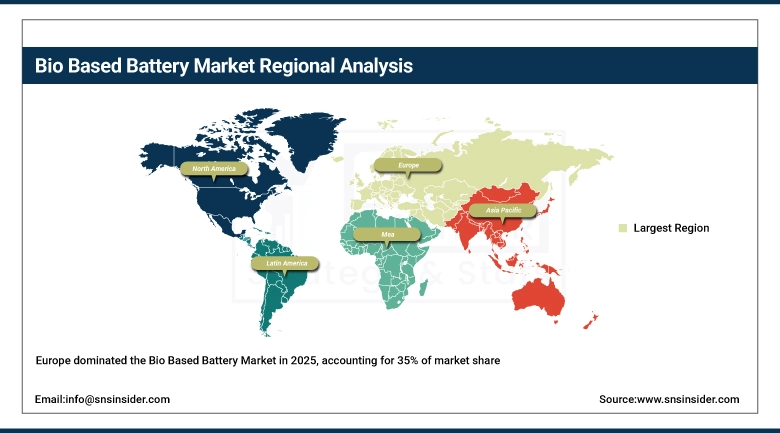
The European region accounted for the largest market share of about 35% in terms of revenues generated by the Bio Based Battery Market in 2025. This was owing to its favorable regulatory environment which favored sustainable development and promoted the concept of circular economies. There were huge investments made by the European region in renewable energy and biotechnology. This was coupled with presence of key companies and innovative research centers. In addition, adoption of green energy sources for power storage was increasing in Europe.
Get Customized Report as per Your Business Requirement - Enquiry Now
Asia Pacific Bio Based Battery Market Insights
The Asia-Pacific region is projected to record the highest CAGR of approximately 8.51% during the forecast period of 2026-2035 owing to factors such as rapid industrialization, rising adoption of renewable energy sources, and growing number of electronics production facilities. Sustainable technologies are being encouraged in the region by means of incentives and policies adopted by governments. With the increase in demand for affordable energy storage systems, the adoption of bio-based batteries is rapidly gaining momentum in the region.
North America Bio Based Battery Market Insights
North America is an important player in the Bio Based Battery Market owing to the rapid advancements in technology and their adoption of green energy solutions. Some key factors that favor the market in North America are the high investment in R&D and the presence of major innovative firms. The rising demand for environment-friendly products and emphasis on cutting down carbon emissions are driving market growth. Furthermore, government efforts towards green innovations and the increasing use of IoT products are boosting market growth.
Middle East & Africa and Latin America Bio Based Battery Market Insights
The Bio Based Battery Market is experiencing continuous growth in the Middle East & Africa and Latin America regions owing to the growing emphasis on renewable energy and sustainability programs. With governments promoting investments in environmentally friendly technologies to decrease dependency on non-renewable sources of energy, there has been an upsurge in the adoption of battery power in the agricultural sector and electronic gadgets.
Bio Based Battery Market Competitive Landscape:
CMBlu Energy
CMBlu Energy is an energy storage company located in Germany, which concentrates on the use of organic flow batteries. The company was established in 2014. Its main areas of concentration include safe and sustainable energy storage through the utilization of lignin-based materials. These materials are environmentally friendly since they do not contain lithium and metals. Such batteries can be applied for storing energy in the grid system.
-
2025: CMBlu Energy advanced commercialization of organic solid-flow batteries using lignin-based materials, emphasizing sustainable large-scale energy storage and reduced reliance on lithium, supporting grid applications with environmentally friendly, bio-derived chemistry innovations.
Ligna Energy
Established in 2017 and based out of Sweden, Ligna Energy is a company dedicated to the development of sustainable energy storage technologies utilizing biodegradable materials obtained from the forest industry. It primarily focuses on manufacturing printed supercapacitors intended for use in low-energy devices and Internet of Things systems. Ligna Energy aims at replacing conventional batteries in disposable electronics.
-
2025: Ligna Energy expanded production of bio-based supercapacitors using forest-derived materials, targeting IoT and low-power electronics, highlighting circular design, recyclability, and reduced environmental footprint in next-generation energy storage solutions.
BeFC
BeFC (Bioenzymatic Fuel Cells), founded in 2020 in France, specializes in developing unique paper-based biofuel cells utilizing enzymes. The firm offers an eco-friendly solution with regard to single-use power generation for use in diagnostic, smart packaging, and wearable products. The technology used is not only biodegradable but also does not contain any metals or harmful substances. BeFC leads in the field of coin cell battery replacement.
-
2024: BeFC scaled deployment of paper-based biofuel cells for single-use electronics, enabling compostable power sources for diagnostics and smart packaging, demonstrating practical commercialization of enzymatic bio-based battery technology in real-world applications.
Stora Enso
Established in 1998, with its headquarters in Finland, Stora Enso is one of the major producers of sustainable forest-based materials. The company serves the industries of packaging, biomaterials, wooden building, and paper products. Stora Enso is committed to research aimed at developing lignin-based sustainable materials that can serve as replacements for materials based on fossil sources in batteries and other forms of energy storage systems.
-
2024: Stora Enso continued development of lignin-based battery materials, focusing on replacing fossil-based components in energy storage systems, supporting sustainable battery innovation through renewable forestry-derived raw materials and circular economy initiatives.
Bio Based Battery Companies are:
-
BeFC
-
Bioo
-
Stora Enso
-
CarbonScape
-
CMBlu Energy
-
KEMIWATT
-
VoltStorage
-
Kiverdi
-
Nexeon
-
Indi Energy
-
Greenvolt Group
-
Hitachi High-Tech Corporation
-
Nanjing CBAK New Energy Technology
-
Panasonic Holdings Corporation
-
Samsung SDI
-
Sony Group Corporation
-
Northvolt
-
Saft
| Report Attributes | Details |
|---|---|
| Market Size in 2025 | USD 110.11 Million |
| Market Size by 2035 | USD 216.77 Million |
| CAGR | CAGR of 7.10% From 2026 to 2035 |
| Base Year | 2025 |
| Forecast Period | 2026-2035 |
| Historical Data | 2022-2024 |
| Report Scope & Coverage | Market Size, Segments Analysis, Competitive Landscape, Regional Analysis, DROC & SWOT Analysis, Forecast Outlook |
| Key Segments | • By Type (Enzymatic Batteries, Microbial Fuel Cells, Bio-carbon / Organic Batteries, Others) • By Application (Healthcare, Consumer Electronics, Electric Vehicles, Stationary Energy Storage, IoT Devices & Sensors, Others) • By Sales Channel (Online, Dealer, Retail) • By End User (Residential, Commercial, Industrial) |
| Regional Analysis/Coverage | North America (US, Canada), Europe (Germany, UK, France, Italy, Spain, Russia, Poland, Rest of Europe), Asia Pacific (China, India, Japan, South Korea, Australia, ASEAN Countries, Rest of Asia Pacific), Middle East & Africa (UAE, Saudi Arabia, Qatar, South Africa, Rest of Middle East & Africa), Latin America (Brazil, Argentina, Mexico, Colombia, Rest of Latin America). |
| Company Profiles | BeFC, Bioo, Bactery AB, Stora Enso, CarbonScape, CMBlu Energy, Ligna Energy, KEMIWATT, VoltStorage, Kiverdi, Nexeon, Indi Energy, Greenvolt Group, Hitachi High-Tech Corporation, Nanjing CBAK New Energy Technology, Panasonic Holdings Corporation, Samsung SDI, Sony Group Corporation, Northvolt, Saft. |

Frequently Asked Questions
Europe dominated the Bio Based Battery Market in 2025.
The Consumer electronics segment dominated the Bio Based Battery Market in 2025.
Rising demand for sustainable and eco-friendly energy storage solutions is accelerating adoption of bio-based batteries across multiple industries globally.
The Bio Based Battery Market was valued at USD 110.11 Million in 2025.
The Bio Based Battery Market is expected to grow at a CAGR of 7.10% from 2026 to 2035.
