
Speaker Driver Market Report Scope & Overview:
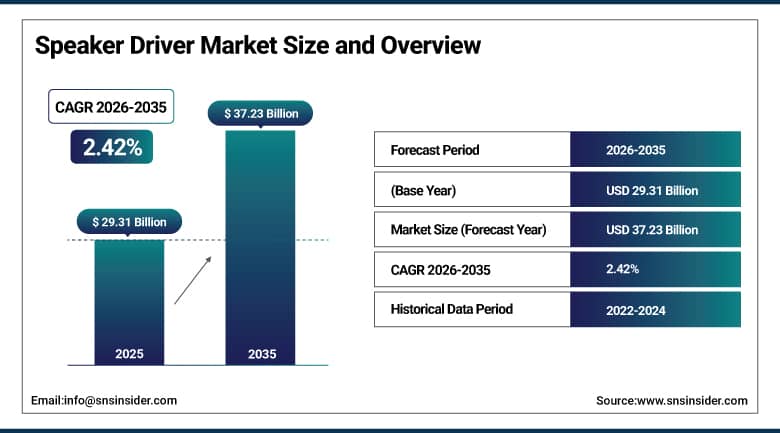
The Speaker Driver Market size was USD 29.31 Billion in 2025 and is expected to reach USD 37.23 Billion by 2035, growing at a CAGR of 2.42% from 2026–2035.
The market for speaker drivers is growing steadily because of the rising demand for quality sound reproduction in various consumer electronics devices, vehicles, professional sound systems, and smart gadgets. The innovations in materials sciences, acoustics, and digital signal processing help manufacturers create speaker drivers that offer better sound clarity, durability, efficiency, and performance. Sustainable design and energy efficiency are currently major areas of concern for many firms as they seek to reduce the carbon footprint of their products. In this way, manufacturers integrate low-energy designs, recyclable and eco-friendly materials in speaker drivers to comply with the changing regulations and customer demands. The industry can be defined by fast technological development as manufacturers try to improve the performance of audio devices while keeping costs down and ensuring the reliability of products.
The presence of global audio device manufacturers, including Sony, Panasonic, and Xiaomi, supports electronics product manufacturing across the region. China, Japan, and South Korea have a strong share of this growth, supported by widespread adoption of personal audio devices and a large consumer electronics market. Sony and Panasonic continue leading in high-fidelity driver design, while Xiaomi drives volume growth through affordable smart speaker products. The region's growing upper-middle class and rising disposable incomes also support premium audio product demand. These dynamics keep Asia Pacific the clear leader in global speaker driver production and revenue.
Market Size and Forecast:
-
Market Size in 2026E: USD 30.02 Billion
-
Market Size by 2035: USD 37.23 Billion
-
CAGR: 2.42% from 2026 to 2035
-
Fastest Growing Region: North America
-
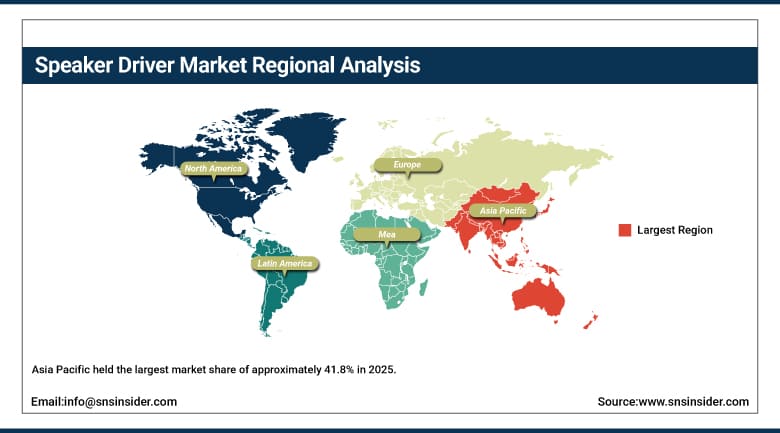
Largest Region: Asia Pacific
To Get More Information On Speaker Driver Market - Request Free Sample Report
Speaker Driver Market Trends:
-
Smart speaker adoption keeps expanding globally as voice assistant and smart home ecosystem penetration deepens.
-
True wireless stereo earbuds continue driving demand for miniaturized Below 20mm driver technology.
-
Planar magnetic drivers are gaining broader consumer adoption as production costs decline and audiophile interest grows.
-
Spatial audio and 3D sound technologies are creating fresh demand for advanced multi-driver speaker configurations.
-
Hearing aid integration with consumer earbuds is blurring the boundary between medical and consumer audio devices.
-
Sustainable materials and eco-friendly manufacturing approaches are becoming more prominent in speaker driver design.
U.S. Speaker Driver Market Outlook:
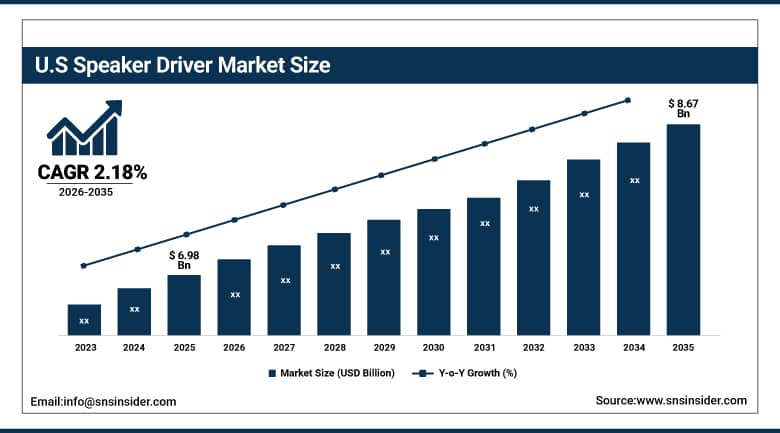
The U.S. Speaker Driver Market was valued at approximately USD 6.98 Billion in 2025 and is projected to reach USD 8.67 Billion by 2035, growing at a CAGR of 2.18% during 2026–2035.
The U.S. Speaker Driver Market can attribute its performance to North America's position as the fastest-growing region in the world. There is no figure for the size of the market in the U.S., but the U.S. can be considered a significant portion of the North American revenue. Demand in the U.S. and Canada is being driven by Amazon (Echo), Apple (HomePod), and Sonos smart speakers. Growing adoption of smart home ecosystem and rising integration of AI/voice assistant technology into audio devices is a major growth driver.
Bose Corporation acquired McIntosh Group in November 2024. This was the world-leading manufacturer of luxury high-performance audio. This merger will combine the renowned craft of McIntosh and the advanced audio technologies of Bose Corporation. Products of McIntosh are famous for their high-output amplifiers and premium speakers systems used all over the world by audiophiles. This move can help Bose Corporation become a serious competitor in the ultra-premium segment of the market. Other similar acquisitions may follow from other established manufacturers of audio devices who will try to diversify their product line to the premium tier.
Speaker Driver Market Segment Analysis:
-
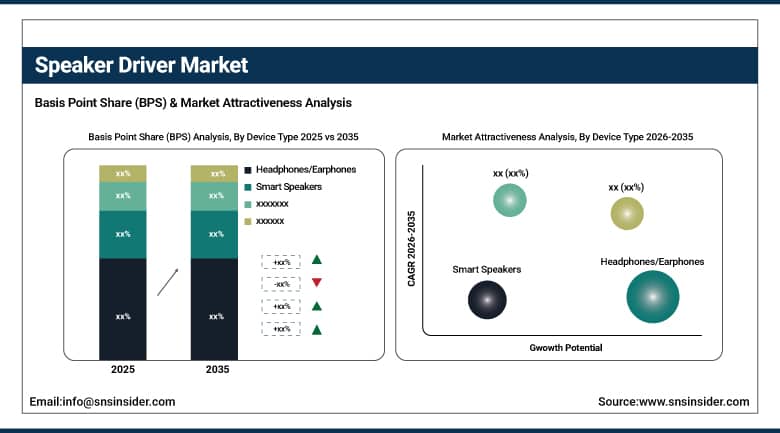
By Device Type, the headphones/earphones segment dominated the speaker driver market with approximately 31.5% share in 2025. The smart speakers segment is expected to register the fastest CAGR through the forecast period.
-
By Driver Type, the dynamic drivers segment dominated the speaker driver market with approximately 61.6% share in 2025. The planar magnetic segment is expected to register the fastest CAGR through the forecast period.
-
By Size, the 20–110 mm segment dominated the speaker driver market with approximately 46.7% share in 2025. The Below 20 mm segment is expected to register the fastest CAGR through the forecast period.
-
By Application, the consumer segment dominated the speaker driver market with approximately 61.3% share in 2025. The professional/enterprise segment is expected to register the fastest CAGR through the forecast period.
By Device Type, headphones/earphones dominate, smart speakers grow fastest
The segment of headphones and earphones was the leading device type segment with a market share of around 31.5%. Factors that fuel the segment include increased demand for small, comfortable personal audio equipment that offer superior sound quality. Development of wireless technology, noise cancellation, enhancement of Bluetooth, and higher battery life have contributed greatly to increase in usage. Preference among consumers for superior audio quality while mobile is the other factor contributing to continued strong demand. True wireless stereo earbuds have significantly contributed to the dominance of the segment recently.
Smart speakers are expected to exhibit the highest CAGR over the forecast period. Increase in adoption of smart home systems, voice assistants, and AI integration is the reason for the fast-growing market. The entry of smart speakers into consumer electronics is fast becoming common place with increasing numbers of consumers seeking connected and hands-free products. The major players responsible for mainstream adoption of smart speakers are Amazon Echo, Apple HomePod, and Google Nest. With increasing integration of voice interaction, the demand for smart speakers will only grow further.
By Driver Type, dynamic drivers dominate, planar magnetic grows fastest
Dynamic drivers accounted for approximately 61.6% of the speaker driver market in 2025. Their high usage in headphones, earphones, and portable speakers reflects their excellent sound quality at affordable price points. Dynamic drivers are the main choice for most consumer electronics due to their cost-effective performance profile. Progress in dynamic driver technology, including better bass extension and energy efficiency, further drives their market leadership. Balanced armature drivers represent a meaningful alternative segment, especially in hearing aids and in-ear monitor applications.
Planar magnetic drivers are expected to experience the fastest CAGR through the forecast period. They are revered for high-fidelity sound quality delivering both clarity and accuracy, making them popular in high-end headphones and audiophile markets. Consumer demand for advanced audio technologies is driving growing interest in planar magnetic options. Electrostatic drivers also represent a premium segment serving the ultra-high-fidelity end of the market. As audiophile and premium audio demand keeps growing, planar magnetic adoption should keep accelerating.
Regional Analysis:
|
Region |
Major Country |
Share within Region, 2025 (%) |
|---|---|---|
|
North America |
United States |
82.5% |
|
Europe |
Germany |
24.6% |
|
Asia Pacific |
China |
40.6% |
|
Middle East & Africa |
UAE |
22.8% |
|
Latin America |
Brazil |
43.8% |
Asia Pacific Speaker Driver Market Insights
Asia Pacific held the largest market share of approximately 41.8% in 2025. The presence of global audio device manufacturers, including Sony, Panasonic, and Xiaomi, makes consumer electronics product manufacturing a primary driver. China, Japan, and South Korea share strong growth, supported by widespread adoption of personal audio devices. The region's growing upper-middle class and high disposable income levels also boost premium audio product demand.
In China large-scale consumer electronics manufacturing and a massive domestic consumer market both keep reinforcing this regional leadership. As disposable incomes and consumer electronics spending keep rising, this leadership should continue.
Get Customized Report as Per Your Business Requirement - Enquiry Now
North America Speaker Driver Market Insights
North America is the fastest-growing region through the forecast period. Smart speakers and premium audio systems from Amazon, Apple, and Sonos are fueling strong demand in the U.S. and Canada. Growing smart home ecosystem penetration and increasing AI and voice assistant integration in audio products are key growth drivers.
The United States accounts for approximately 82.5% of North American revenue. Rising consumer adoption of premium wireless headphones, smart speakers, and professional audio solutions all contribute to this growth. North America's premium audio culture and professional entertainment market keep reinforcing this regional expansion.
Europe Speaker Driver Market Insights
Europe is a significant market for speaker drivers because of its rich audiophile culture and investment in professional audio. The market leader in the region is Germany, which is bolstered by high levels of consumer electronics consumption and professional audio production. Other regions such as France and the UK provide additional demand via their respective growing consumer and professional audio markets.
Germany contributes about 24.6% to the total revenue in Europe. Significant presence of quality speaker driver brands operating in the region, such as Sennheiser, Focal, and Elac, adds to the strength of the regional market.
MEA & Latin America Speaker Driver Market Insights
The UAE leads MEA revenue, growing consumer electronics adoption and rising middle-class spending on premium audio both support this position. Saudi Arabia is also expanding its consumer entertainment market as part of broader economic diversification.
Brazil leads Latin American revenue, growing smartphone penetration and rising demand for portable audio products drive regional demand. Mexico and Argentina contribute secondary demand through their own expanding consumer electronics markets.
Market Dynamics:
Growth Drivers: Rising consumer demand for premium audio solutions across all sectors
High demand from consumers for quality audio devices, such as headphones, earphones, and smart speakers, is the primary force driving the market. The innovations in wireless and noise-canceling technology continue to drive high demand among consumers. Increase in use of smart home systems and voice assistants drives demand. There is also increase in demand because mobile devices and tablets with better audio capabilities are coupled with developments in Bluetooth and Wi-Fi technologies.
Increasing adoption of audio devices in professional and enterprise environments, such as event sound systems and public areas, is yet another major growth driver. With continued adoption of smart home systems and voice assistants, this driver is expected to persist during the forecast period.
Restraints: Intense competition and rapid technological change challenging differentiation
The speaker driver industry is quite dynamic with fast changing technological advancement making differentiation difficult for the organizations. Consumers who have knowledge of technology rarely make compromises when it comes to sound quality and hence there is pressure on the OEMs to continue developing their products through Research and Development and making old models obsolete. Fast pace of change in the industry may result in shortened product life cycle and thus over supply.
Dependence on raw materials that are required to manufacture speaker drivers, rare earth elements among others makes the vendors susceptible to disruptions and shortages in production. Problems in the supply chain for specialty materials for the drivers' diaphragm and magnet are still evident.
Opportunities: Emerging markets and technological innovation creating new revenue streams
The computer-aided manufacturing process has made premium audio solutions affordable and thus created opportunities to enter high-end markets. The growing use of intelligent wearables and hearing aids creates additional income sources for speakers' drivers. There are many emerging markets that have growing incomes and an increasing share of smartphones users, so there are many growth opportunities.
The growing use of spatial audio and 3D sound technologies will encourage innovations and thus provide opportunities for the development of new drivers. There is also an opportunity created by the move of the hearing aid market towards OTC consumer products, where drivers can be used. With continued development of audio technology, this opportunity will only grow.
Recent Developments:
-
2024: Bose Corporation acquired McIntosh Group, the leader in luxury high-performance audio, enhancing its premium product offerings and combining McIntosh's craftsmanship with Bose's audio technologies.
-
2024: Apple launched updated AirPods Pro 2 with FDA-cleared hearing aid functionality, representing the first OTC hearing aid feature in true wireless earbuds and expanding speaker driver applications into regulated medical territory.
-
2024: Samsung Electronics launched Galaxy Buds3 Pro featuring advanced dynamic driver technology with enhanced AI-powered noise cancellation and spatial audio capabilities.
Speaker Driver Market Key Players are:
-
Bose Corporation
-
Harman International
-
Sony Corporation
-
Pioneer Corporation
-
Panasonic Corporation
-
Bang & Olufsen
-
Sennheiser Electronic
-
Yamaha Corporation
-
Focal-JMlab
-
Vifa
-
KEF
-
Klipsch
-
Bowers & Wilkins
-
Loewe
-
Elac
-
Audio-Technica Corporation
-
Anker Innovations Ltd.
-
Shure Incorporated
-
Denon Electronics
-
Creative Technology Ltd.
Speaker Driver Market Report Scope:
| Report Attributes | Details |
|---|---|
| Market Size in 2025 | USD 29.31 Billion |
| Market Size by 2035 | USD 37.23 Billion |
| CAGR | CAGR of 2.42% From 2026 to 2035 |
| Base Year | 2025 |
| Forecast Period | 2026-2035 |
| Historical Data | 2022-2024 |
| Report Scope & Coverage | Market Size, Segments Analysis, Competitive Landscape, Regional Analysis, DROC & SWOT Analysis, Forecast Outlook |
| Key Segments | • By Device Type (Headphones/Earphones, Hearing Aids, Smart Speakers, Mobile Phones/Tablets, Loudspeakers) • By Driver Type (Dynamic Drivers, Balanced Armature Drivers, Planar Magnetic, ElectroStatic, Others) • By Size (Below 20 mm, 20–110 mm, Others) • By Application (Consumer, Professional/Enterprise, Medical, Others) |
| Regional Analysis/Coverage | North America (US, Canada), Europe (Germany, UK, France, Italy, Spain, Russia, Poland, Rest of Europe), Asia Pacific (China, India, Japan, South Korea, Australia, ASEAN Countries, Rest of Asia Pacific), Middle East & Africa (UAE, Saudi Arabia, Qatar, South Africa, Rest of Middle East & Africa), Latin America (Brazil, Argentina, Mexico, Colombia, Rest of Latin America). |
| Company Profiles | Bose Corporation, Harman International, Sony Corporation, Pioneer Corporation, Panasonic Corporation, Bang & Olufsen, Sennheiser Electronic, Yamaha Corporation, Focal-JMlab, Vifa, KEF, Klipsch, Bowers & Wilkins, Loewe, Elac, Audio-Technica Corporation, Anker Innovations Ltd., Shure Incorporated, Denon Electronics, and Creative Technology Ltd. |
Frequently Asked Questions
The Speaker Driver Market is expected to grow at a CAGR of 2.42% from 2026 to 2035.
The Speaker Driver Market was valued at USD 29.31 Billion in 2025.
Rising consumer demand for premium wireless audio solutions and growing smart speaker and smart home adoption are the primary growth factors.
The Headphones/Earphones segment dominated with approximately 31.5% share in 2025.
Asia Pacific dominated the Speaker Driver Market with approximately 41.8% revenue share in 2025.
