
Stepper Motor Market Report Scope & Overview:
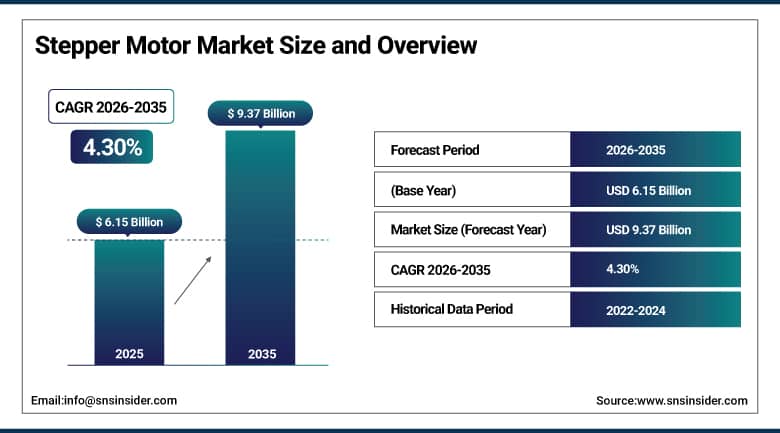
The Stepper Motor Market size was valued at USD 6.15 Billion in 2025 and is projected to reach USD 9.37 Billion by 2035, expanding at a CAGR of 4.30% during the forecast period 2026–2035.
Growth will be driven by the increased automation of the production process, increased capacity of semiconductors manufacturing, implementation of robotic systems, and increased demand for highly accurate multi-axis positioning. Hybrid stepper motors continue to be advantageous due to high positioning accuracy, torque, and simplicity of control. However, manufacturers continue to implement encoder, digital drives, and intelligent feedback in stepper motor systems, thus allowing open-loop architecture to be used in more demanding applications. The 2026 product activity of Mine be a Mitsumi shows how stepper motors are being transformed with the introduction of new encoder guidance and stepper motors and drivers' systems portfolio.
The market will also get a boost from the convergence of motion control with robotics, machine vision, connected manufacturing, and advanced production equipment. Semiconductor and electronics equipment manufacturers need compact motors for precise positioning of wafers, components, and tools, whereas medical and laboratory equipment requires controlled positioning for automated sample handling and diagnostics. Consequently, industrial purchasers are evaluating motors based on such parameters as torque, integration ability, thermal performance, controllability, noise, reliability, and efficiency.
To Get More Information On Stepper Motor Market - Request Free Sample Report
Stepper Motor Market Trends
-
Rising integration of stepper motors with automated manufacturing equipment.
-
Increasing deployment of motors in robotics and multi-axis positioning systems.
-
Growing demand for precision motion systems in semiconductor equipment.
-
Expansion of encoder-integrated and feedback-enabled stepper motor architectures.
-
Increasing development of compact, high-torque motors for space-constrained equipment.
U.S. Stepper Motor Market Size Outlook
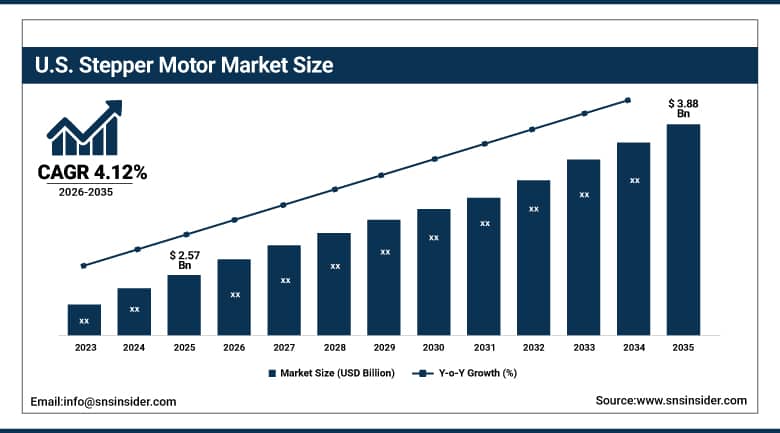
The U.S. Stepper Motor Market was valued at USD 2.57 billion in 2025 and is expected to reach approximately USD 3.88 billion by 2035, expanding at a CAGR of 4.12% during 2026–2035.
The U.S. marketplace is becoming increasingly driven by investment in semiconductor fabrication, industrial automation and robotics, thus giving rise to further opportunities for precision motion control components. Semiconductors and fabrication equipment require precise motion control in wafer handling, inspection, positioning, and processing operations, whereas robotics requires ever more compact and fast actuation. Recent innovations in the robotics industry in the United States show how important the development of resilient domestic supply chains for hardware is.
The competitive environment in the U.S. market is also driven by the need for motion control components offering value-added performance, rather than just commodities in the form of motors. The need for encoder support, closed-loop control, heat dissipation, low noise, and compatibility with industrial controls creates new opportunities for suppliers able to offer integrated solutions for motors, drivers, and feedback. Participation of Mine be a Mitsumi in CES 2026, where stepping motors along with geared motors, frameless BLDC motors and other precision motion control components were demonstrated, confirms this trend.
Stepper Motor Market Segment Analysis
-
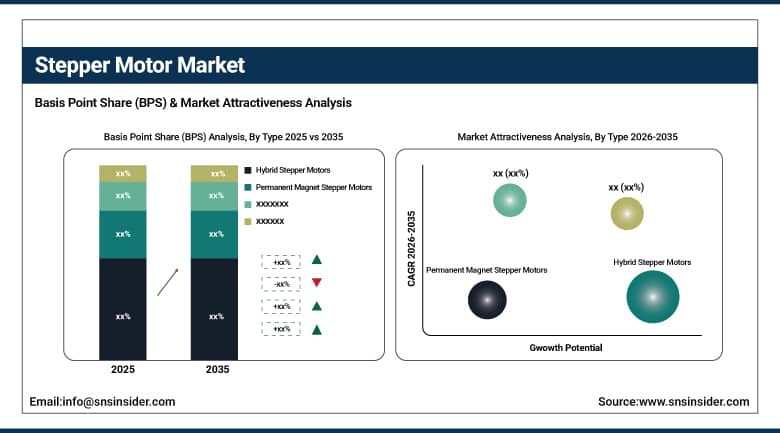
By Type, hybrid stepper motors dominated the market with 48.00% share in 2025, while permanent magnet stepper motors are projected to witness the fastest growth with 5.27% CAGR during the forecast period.
-
By Application, industrial automation & robotics dominated the market with 32.00% share in 2025, while semiconductor & electronics equipment is projected to witness the fastest growth with 5.71% CAGR during the forecast period.
-
By End-User Industry, industrial machinery & automation dominated the market with 31.00% share in 2025, while electronics & semiconductor is projected to witness the fastest growth with 5.99% CAGR during the forecast period.
By Type, hybrid stepper motors dominated, while permanent magnet stepper motors grows fastest.
The market share held by hybrid stepper motors stood at 48.00% in the year 2025. The dominance of this category is backed up by the factors such as high positioning accuracy, powerful holding torque, robust performance, and wide industrial application compatibility. This category adopts both permanent-magnet and variable-reluctance mechanisms to enable precise stepping motion of the manufacturing equipment, robots, medical devices, semiconductor machines, and office automation systems. They have established availability in a variety of standardized frames allowing machine makers to choose motors by matching their torque, speed, sizing and control requirements without extensive equipment modification.
Permanent magnet stepper motors are expected to display the highest CAGR of 5.27% during the period from 2026 to 2035. This segment is driven by the demand for small and affordable solutions that would allow for moderate torque, easy electronic control, and limited footprint. These qualities make permanent magnet motor architectures appropriate for use in compact automated devices, office equipment, instruments, and other applications of controlled incremental motion. It is anticipated that the expansion of this segment will be fueled by the increasing need for small-scale motion components as the equipment manufacturers attempt to downsize the equipment and incorporate automated functionality into the single machine.
By Application, industrial automation & robotics dominated, while semiconductor & electronics equipment grows fastest.
The industrial automation & robotics accounted for a share of 32.00% in 2025. Stepper motors find applications in automated positioning systems, robotics, machine tools, packaging machines, material handling systems, inspection systems, and multi-axis machines. The repeatability and simplicity of control involved in making incremental movements make stepper motors commercially lucrative for machine manufacturers who seek an effective trade-off between accuracy and cost of machines. There already exists a developed motor ecosystem involving motors, drives, controllers, and mechanics which facilitate their use not only in new installation projects but also in replacement projects. The application is experiencing the advantages of the ongoing shift towards connected and flexible manufacturing operations.
The forecasted compound annual growth rate (CAGR) in the application segment of semiconductors & electronics equipment is estimated at 5.71% during 2026-2035. Controlled movement in wafer handling, positioning, inspection, and aligning, testing and other manufacturing processes is required by semiconductor and electronics manufacturing equipment. With the rising level of equipment sophistication, the demand for repeatability, compactness, low vibration and reliable positioning increases. Such properties provide ample opportunities for stepper motors especially in those cases when designers do not want to utilize servo motors on all motion axes. Growth is fueled by capital investments in semiconductor and electronics manufacturing facilities.
By End-User Industry, industrial machinery & automation dominated, while electronics & semiconductor grows fastest.
The industrial machinery & automation segment held the highest share by end-user industries at 31.00%. Stepper motors continue to have significant deployment in industrial machinery since they offer controlled movement for production machines, automated production lines, packaging equipment, inspection stations, machine tools, and material handling equipment. The proven control technology and the availability and capability of stepper motors to work with programmable controllers help equipment manufacturers to automate individual machines without having to use expensive servo control technology on all machines within the production line. Increasing demand for motor systems that can be programmed as one single unit will be seen in equipment manufacturers.
The electronics & semiconductor industry is expected to see the highest growth rate over 2026–2035 at a CAGR of 5.99%. The growth is attributed to increasing demand for precise equipment used in semiconductor manufacturing, electronics assembly, electronics inspection, testing and automation of component handling. As production systems become more miniaturized and automated, it will necessitate precise positioning of motion components in small and compact equipment systems. This situation creates a favorable market condition for stepper motors that provide controlled movement and easy electronic configuration. Growth is also spurred by the increasing strategic importance of semiconductor and electronics manufacturing infrastructures. The developments above do not represent stepper motors revenues, but rather industry indicators in the electronics sector.
Regional Analysis:
|
Region |
Major Country |
Share within Region, 2025 (%) |
|---|---|---|
|
North America |
United States |
91.00% |
|
Europe |
Germany |
22.00% |
|
Asia Pacific |
China |
24.00% |
|
Middle East & Africa |
UAE |
4.00% |
|
Latin America |
Brazil |
4.00% |
North America Stepper Motor Market Insights
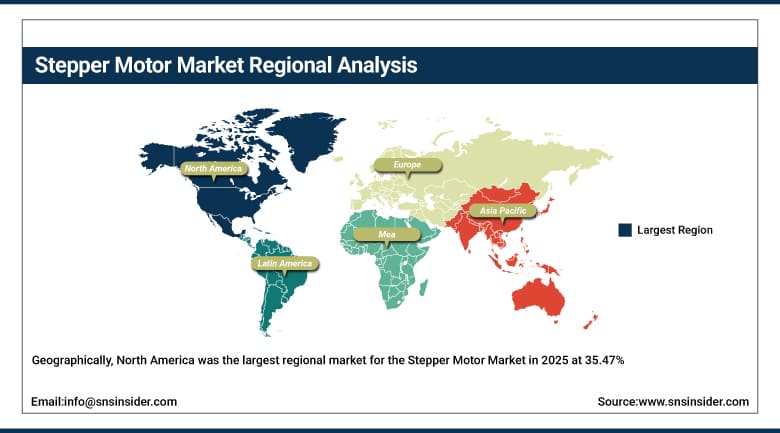
North America constituted the largest regional market share in terms of the Global Stepper Motor Market in 2025 with 46.00%. Regional dominance was ensured owing to the presence of advanced manufacturing, industrial automation, semiconductor equipment, medical devices, aerospace applications, and robotics research and development activities. Demand from precision machinery manufacturers and technology companies ensures a wide installed base of stepper motors and their drivers. The regional opportunities for the industry depend upon the increasing focus on advanced manufacturing and technology-based infrastructure investments.
MinebeaMitsumi's FY2026 presentation mentioned AI servers, humanoid robots, autonomous driving LiDAR, new mobility, commercial drones, and aircraft as key growth areas, indicating an increase in demand from precision electromechanical products by technology companies. The company is expected to generate consolidated sales of JPY 1.69 trillion in FY2027 owing to ongoing demand from data centers and core business growth. Such investments create opportunities for suppliers of motion control solutions through increasing automation.
Get Customized Report as Per Your Business Requirement - Enquiry Now
Europe Stepper Motor Market Insights
The Europe region can leverage the advantage of its advanced industrial base which includes automation, automotive, packaging, medical devices, electronics and precision engineering. There will be significant demands from manufacturers such as Germany, Italy, France and the UK, among others, who upgrade their production lines and increase machine productivity, thus requiring the use of components that can control movements. Stepper motors are still commercially viable in positioning axes where there is a need for controlled movement, reliable equipment and low-cost considerations.
The demands from the European market are further driven by the shift towards smarter and more flexible industrial production. More and more companies have started using sensors, digital controllers, robots and automatic inspections at production facilities, thus requiring motion components. With the focus shifting to efficient equipment and machine level automation, the suppliers are being encouraged to provide motors together with drivers and feedback solutions. This would favor companies which provide configurable motion components over component level motors, especially those supplying automation systems globally.
Asia Pacific Stepper Motor Market Insights
Asia Pacific constituted 24.00% of the global market share of the stepper motor market in 2025. The growth will be facilitated by the significant presence of electronics manufacturing, semiconductor manufacturing, industrial automation, robots, and machine manufacturing in China, Japan, South Korea, Taiwan, India, and Southeast Asia. The presence of many original equipment manufacturers (OEMs) and electronic supply chains ensures a large number of customers for precision motors needed in production and testing equipment.
This is further highlighted by continuing investments made in the production of semiconductors and electronics. In MinebeaMitsumi's financial year 2026 results, the Semiconductor & Electronics segment performed well and there were opportunities for growth arising from AI servers and other advanced technological applications. The company's motor product line addresses semiconductor manufacturing equipment, factory automation, robots, and medical equipment applications.
Middle East & Africa and Latin America Stepper Motor Market Insights
In the Middle East & Africa's cases, industrial diversification, production facilities' modernization, development of the healthcare infrastructure, automation of packaging, and investments in equipment are creating demand for the motion components. The Gulf economies are important in terms of automation-based projects, while the South African market and some other markets of the region have opportunities for application in manufacturing, laboratory equipment, and automatic machinery. Stepper motors could help in this situation due to their simple positioning capabilities in equipment where price and reliability matter in purchases. Industrial projects involve more machinery with digital control systems, robotics, laboratory automation, and inspection equipment, which creates extra demand for motion components.
Latin America’s market is focused on demands related to machinery for manufacturing, packaging, food and beverages processing, automotive production, electronics assembling and other manufacturing activities where automated positioning is needed. Brazil and Mexico are important industrial regions, while regional adoption is stimulated by modernization of manufacturing facilities and equipment replacement. Stepper motors provide an affordable way of increasing the machine capabilities that require exact increments of motion but not the whole system of servo drives along the line. The market in this region is still smaller compared to North America, Europe, and Asia Pacific.
Market Dynamics
Growth Drivers: Increase in industrial automation & precision motion control.
The adoption of industrial automation is a key driver for the Stepper Motor Market. Companies are employing automation in the form of machinery, robotic systems, packaging machines, inspection systems, and multi-axis motion control systems to improve productivity and decrease reliance on manual processes. Stepper motors continue to be a preferred choice since they offer incremental motion control, position ability, and simple integration with electronic controls. The cost efficiency of stepper motors against more advanced servo systems makes them suitable for use in applications that do not require highly dynamic performance. Hence, increased automation continues to drive demand for motors, drivers, actuators, and replacement parts.
Oriental Motor’s launch in July 2026 of its AZ Series DC-input, network-capable drives with Safe Torque Off (STO) is an example of this trend. The AZ Series drives are compatible with EtherCAT, EtherNet/IP, and PROFINET and incorporate safety features. Such technological advances make it commercially viable to use stepper-based systems for factory automation.
Restraints: Competition by servo motors and advanced motion control technology.
Servo motors present significant restraints for use of stepper motors in applications which need high speed, high acceleration, continuous torque, and advanced closed-loop control capability. Servo control systems tend to offer better dynamics and feedback control, hence becoming ideal control components in high-end applications where load changes rapidly. With continued development of automation devices, some of the automation equipment manufacturers may choose to replace the traditional open-loop stepper technology with servo control system. This forces stepper motor manufacturers to enhance torque capability, feedback capability, speed capability, and control capability while maintaining the traditional price advantage that supports the use of steppers. The boundary of competition between stepper motors and servo motors is becoming complicated with the integration of closed-loop capability.
Opportunities: Growing use of encoder-based and closed-loop stepper motor systems.
There is an obvious trend towards the adoption of stepper motors with embedded encoder system among other motor types. While an open-loop type motor can experience synchronization problems in case of high loading, an encoder-based motor will be able to sense a position difference and correct it through a controller. It is thus evident that closed-loop systems are a good choice for positioning applications that do not require all advantages of the servo system from the economic perspective. Thus, the growing interest in motors with both the properties of stepper motors and feedback systems. In October 2025, Oriental Motor started the production of flat PKP stepper motors with magnetic encoders, providing the integration of position feedback into compact motors.
Recent Developments
-
2026: Oriental Motor introduced AZ Series DC-input network-compatible drivers with built-in Safe Torque Off (STO), supporting EtherCAT, EtherNet/IP, and PROFINET. The development reduces external wiring and maintenance requirements for connected industrial automation.
-
2025: Oriental Motor expanded its PKP Series with flat-type stepper motors featuring magnetic encoders and resolutions up to 1,000 P/R. The compact design supports space-constrained equipment requiring enhanced position monitoring.
-
2025: Oriental Motor introduced a 13 mm frame-size PKP stepper motor, its smallest stepper motor lineup. The development addresses growing demand for miniaturized, space-efficient motion components in electronics, automation, and precision equipment.
-
2025: Oriental Motor introduced a planetary geared configuration for AZ Series hybrid step-servo motors, featuring zero-backlash gearing and 5:1 to 10:1 ratios. The solution supports higher-speed applications while maintaining compactness and positioning accuracy.
Stepper Motor Companies are:
-
MinebeaMitsumi Inc.
-
Oriental Motor Co., Ltd.
-
FAULHABER Group
-
MOONS' Industries
-
Johnson Electric Holdings Limited
-
Shinano Kenshi Co., Ltd.
-
Sanyo Denki Co., Ltd.
-
ElectroCraft, Inc.
-
Phytron GmbH
-
Nanotec Electronic GmbH & Co. KG
-
Leadshine Technology Co., Ltd.
-
Lin Engineering
-
Applied Motion Products, Inc.
-
Portescap
-
Haydon Kerk Pittman
-
JVL Industri Elektronik A/S
-
Trinamic Motion Control GmbH
-
Schneider Electric Motion
Stepper Motor Market Report Scope:
| Report Attributes | Details |
|---|---|
| Market Size in 2025 | USD 6.15 Billion |
| Market Size by 2035 | USD 9.37 Billion |
| CAGR | CAGR of 4.30% From 2026 to 2035 |
| Base Year | 2025 |
| Forecast Period | 2026-2035 |
| Historical Data | 2022-2024 |
| Report Scope & Coverage | Market Size, Segments Analysis, Competitive Landscape, Regional Analysis, DROC & SWOT Analysis, Forecast Outlook |
| Key Segments | • By Type (Hybrid Stepper Motors, Permanent Magnet Stepper Motors, Variable Reluctance Stepper Motors, Others) • By Application (Industrial Automation & Robotics, Semiconductor & Electronics Equipment, Medical & Laboratory Equipment, Automotive & Transportation, Consumer & Office Equipment) • By End-User Industry (Industrial Machinery & Automation, Electronics & Semiconductor, Healthcare & Life Sciences, Automotive, Others) |
| Regional Analysis/Coverage | North America (US, Canada), Europe (Germany, UK, France, Italy, Spain, Russia, Poland, Rest of Europe), Asia Pacific (China, India, Japan, South Korea, Australia, ASEAN Countries, Rest of Asia Pacific), Middle East & Africa (UAE, Saudi Arabia, Qatar, South Africa, Rest of Middle East & Africa), Latin America (Brazil, Argentina, Mexico, Colombia, Rest of Latin America). |
| Company Profiles | Nidec Corporation, MinebeaMitsumi Inc., Oriental Motor Co., Ltd., FAULHABER Group, MOONS' Industries, Johnson Electric Holdings Limited, Shinano Kenshi Co., Ltd., Tamagawa Seiki Co., Ltd., Sanyo Denki Co., Ltd., ElectroCraft, Inc., Phytron GmbH, Nanotec Electronic GmbH & Co. KG, Leadshine Technology Co., Ltd., Lin Engineering, Applied Motion Products, Inc., Portescap, Haydon Kerk Pittman, JVL Industri Elektronik A/S, Trinamic Motion Control GmbH, Schneider Electric Motion |
Frequently Asked Questions
The Stepper Motor Market was valued at USD 6.15 Billion in 2025, according to the ME-sheet estimates.
The Stepper Motor Market is projected to reach USD 9.37 Billion by 2035.
North America dominated the global Stepper Motor Market with a 46.00% share in 2025.
