
Styrene Butadiene Styrene Rubber Market Report Scope & Overview:
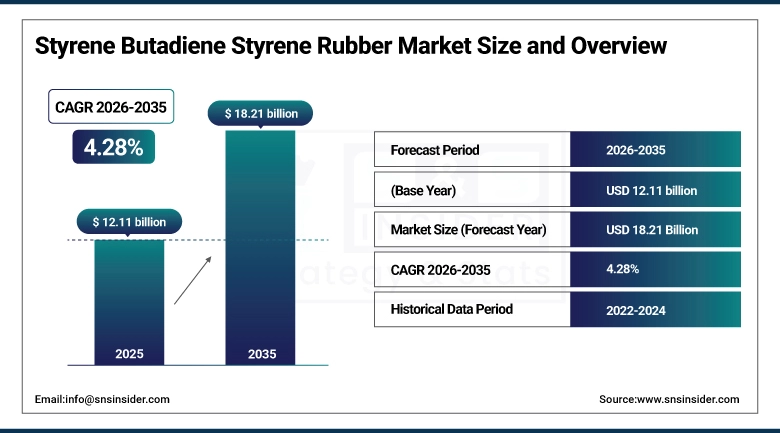
The Styrene Butadiene Styrene Rubber Market size is valued at USD 12.11 Billion in 2025 and is projected to reach USD 18.21 Billion by 2035, growing at a CAGR of 4.28% during the forecast period 2026–2035.
The Styrene Butadiene Styrene (SBS) Rubber Market report offers a thorough evaluation of market dynamics, innovations in products, and industrial applications. The increase in demand from the automotive and transport industry (tires, polymer modification), construction industry (asphalt modification, adhesives, sealants), footwear industry, and electrical & electronics industry are the key factors supporting the growth of the market from 2026 to 2035.
Global SBS rubber consumption exceeded 4.5 million metric tons in 2025, fuelled by infrastructure development, automotive production, and polymer blending applications.
To Get more information on Styrene Butadiene Styrene Rubber Market - Request Free Sample Report
Styrene Butadiene Styrene Rubber Market Trends:
-
Automotive & Transportation remains dominant, with SBS widely used in tires, polymer modification, and lightweight components.
-
Construction sector growth drives demand for asphalt modification, adhesives, and sealants in infrastructure projects.
-
Footwear manufacturing expansion in Asia-Pacific boosts SBS consumption in sports and casual shoes.
-
Electrical & electronics applications rising, especially wire and cable insulation, aligned with electrification and renewable energy growth.
-
Shift toward high-performance grades such as Hydrogenated SBS (SEBS) for better durability, heat resistance, and sustainability.
-
Sustainability and recycling initiatives push manufacturers toward greener SBS formulations and circular economy practices.
-
Processing innovations (extrusion, thermoplastic blending, masterbatch compounding) enable more efficient and customized SBS applications.
-
Volatility in raw material prices (styrene and butadiene) remains a challenge, influencing cost structures.
-
Strategic partnerships and capacity expansions among top producers (LG Chem, Kumho Petrochemical, INEOS, Kraton) strengthen market consolidation.
U.S. Styrene Butadiene Styrene Rubber Market Insights:
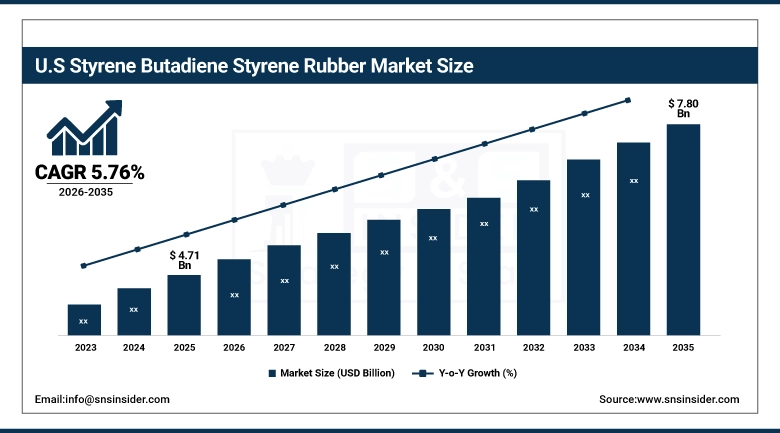
The U.S. Styrene Butadiene Styrene Rubber Market is projected to grow from USD 4.71 Billion in 2025 to USD 7.80 Billion by 2035, at a CAGR of 5.76%. The growth of the SBS rubber industry is influenced by high demand for the product in the automobile and transport sectors (tires and polymer modifications), construction sector (asphalt modifications, adhesives, and sealants), shoes manufacture and consumer goods, and electrical and electronic sectors (insulation of wire and cables).
Styrene Butadiene Styrene Rubber Market Growth Drivers:
-
Leading manufacturers and end‑use industries are increasingly investing in advanced SBS product types such as hydrogenated SBS (SEBS), blended grades to enhance durability, sustainability, and processing efficiency.
Demand growth from the automotive and transport sectors for high-performance tires and polymer modifications, growing usage from the construction sector via asphalt modifications, adhesives, and sealants, higher usage in footwear and consumer goods production, and greater adoption by the electrical and electronics industry for insulation of wires and cables. Improvements in extrusion, blending of thermoplastics, and injection molding processes, in addition to better performance and favorable environmental policies, are making the adoption process faster and stronger.
In 2025, over 60% of automotive and construction companies utilized advanced SBS grades to improve product performance and meet evolving sustainability standards.
Styrene Butadiene Styrene Rubber Market Restraints:
-
Volatility in raw material prices such as styrene and butadiene, which are closely tied to crude oil fluctuations.
The strict regulations that are placed for producing SBS and handling its waste create additional cost burdens for firms, especially in Europe and North America. Competition from synthetic rubbers and natural rubbers restricts the use of SBS. Technical difficulties related to recycling prevent its wider application in some cases. The industry’s reliance on automobiles and construction exposes it to cyclical volatility.
In 2025, More than 40% of SBS producers reported margin pressures due to rising feedstock costs and regulatory compliance requirements, constraining profitability and slowing expansion.
Styrene Butadiene Styrene Rubber Market Opportunities:
-
Growing development of advanced SBS grades, including hydrogenated SBS (SEBS) and blended formulations, presents significant opportunities for the Styrene Butadiene Styrene Rubber Market.
Increasingly, these high-performance materials are being used by automotive and transportation equipment makers for improved tire strength, better fuel economy, and greater safety. The construction industry is benefiting from the use of SBS in road construction, and adhesives and sealants. SBS is also finding application in the footwear and consumer goods industries due to its flexibility. Applications in electrical and electronics equipment, especially in wire and cable insulation, represent additional market opportunities. Innovations in production processes such as extrusion, thermoplastic mixing, and master batching, along with environmental awareness and government support, are helping in this regard.
In 2025, over 55% of automotive and construction firms integrated advanced SBS grades into their production processes to meet performance and sustainability targets.
Styrene Butadiene Styrene Rubber Market Segmentation Analysis:
-
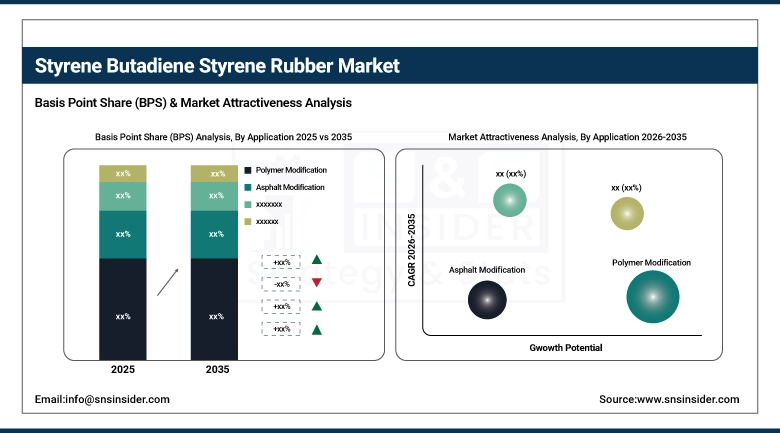
By Application, Polymer Modification held the largest market share of 18.97% in 2025, while Footwear Manufacturing are expected to grow at the fastest CAGR of 6.42% during 2026–2035.
-
By End-Use Industry, Automotive & Transportation dominated with 39.68% market share in 2025, whereas Electrical & Electronics are projected to record the fastest CAGR of 5.89% through 2026–2035.
-
By Product Type, Linear SBS accounted for the highest market share of 29.78% in 2025, while Hydrogenated SBS (SEBS) are expected to grow at the fastest CAGR of 5.58% during the forecast period.
-
By Form, Solid SBS dominated with a 38.95% share in 2025, while Masterbatch Form are anticipated to expand at the fastest CAGR of 6.66% through 2026–2035.
-
By Processing Method, Extrusion held the largest share of 32.55% in 2025, while Thermoplastic Blending are expected to grow at the fastest CAGR of 5.73% during the forecast period.
By Application, Polymer Modification Dominates While Footwear Manufacturing Grows Rapidly
The Polymer Modification segment dominates the Styrene Butadiene Styrene (SBS) rubber market due to its extensive use in enhancing the performance characteristics of plastics and bitumen. SBS is widely incorporated to improve flexibility, durability, impact resistance, and weatherability in various industrial and construction applications.
Footwear Manufacturing is the fastest-growing segment, driven by rising demand for lightweight, durable, and flexible materials in the footwear industry. SBS is increasingly used in shoe soles and components due to its superior elasticity, abrasion resistance, and cost-effectiveness compared to traditional rubber materials.
By End-Use Industry, Automotive & Transportation Dominates While Electrical & Electronics Grow Rapidly:
The Automotive & Transportation segment dominates the SBS rubber market due to its extensive use in manufacturing durable and flexible components such as tires, seals, gaskets, and interior parts. SBS is widely preferred for its excellent elasticity, impact resistance, and performance under varying temperature conditions, making it ideal for automotive applications.
Electrical & Electronics is the fastest-growing segment, driven by increasing demand for high-performance insulation and protective materials. SBS is gaining traction in wire and cable coatings, electronic components, and flexible insulation solutions due to its thermal stability and durability.
By Product Type, Linear SBS Dominates While Hydrogenated SBS (SEBS) Grow Rapidly:
The Linear SBS segment dominates the market due to its widespread use in adhesives, sealants, and asphalt modification applications. Its balanced properties, including flexibility, processability, and cost-effectiveness, make it a preferred choice across multiple industries.
Hydrogenated SBS (SEBS) is the fastest-growing segment, driven by increasing demand for high-performance and heat-resistant materials. SEBS offers superior weather resistance, UV stability, and enhanced durability compared to conventional SBS, making it suitable for advanced applications in automotive, healthcare, and electronics.
By Form, Solid SBS Dominates While Masterbatch Form Grow Rapidly:
The Solid SBS segment dominates the market due to its ease of handling, storage, and widespread use in bulk industrial applications such as asphalt modification and adhesive production. It is preferred by manufacturers for its stability during transportation and compatibility with large-scale processing systems.
Masterbatch Form is the fastest-growing segment, driven by increasing demand for customized material properties and enhanced processing efficiency. Masterbatch formulations allow precise control over additive dispersion, improving product consistency and performance.
By Processing Method, Extrusion Dominates While Thermoplastic Blending Grow Rapidly:
The Extrusion segment dominates the SBS market due to its widespread application in producing continuous profiles such as sheets, films, pipes, and insulation materials. The process offers high efficiency, scalability, and consistency, making it a preferred method across construction, automotive, and packaging industries.
Thermoplastic Blending is the fastest-growing segment, driven by increasing demand for customized material solutions with enhanced mechanical and thermal properties. This method enables manufacturers to tailor SBS properties for specific applications by combining it with other polymers and additives.
Styrene Butadiene Styrene Rubber Market Regional Analysis:
Asia-Pacific SBS Rubber Market Insights:
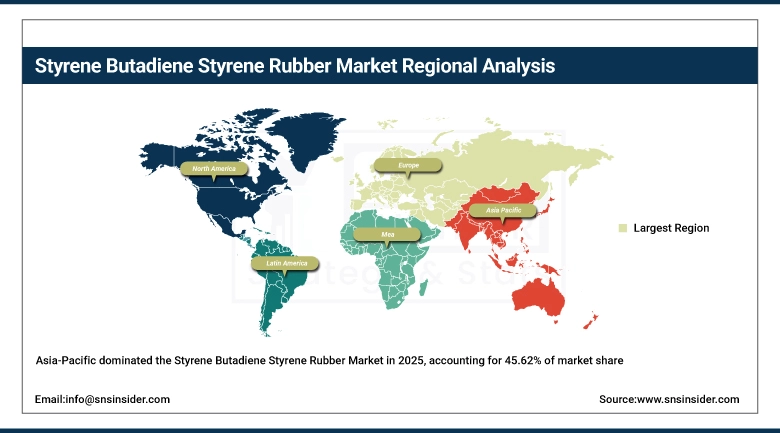
The Asia-Pacific region leads in the world’s SBS market, with a market share of 45.62% in 2025, and fastest-growing region in terms of CAGR, which stands at 5.02%, due to increased production of automobiles in countries such as China, India, and Japan. In addition to that, rapid development of infrastructure has helped boost growth rates. Increased demand for applications such as asphalt modification, adhesive production, and footwear manufacture drive the growth. Continuous investment in advanced grades of SBS which include SEBS helps to maintain the lead.
Get Customized Report as per Your Business Requirement - Enquiry Now
China SBS Rubber Market Insights:
China dominates the APAC region’s SBS market owing to its huge automobile industry, construction activities, and increased demand for polymer modification. Its emphasis on sustainability in infrastructure development and performance-oriented tires drives demand for SBS products. Chinese manufacturers such as Sinopec and TSRC are working hard to develop novel SEBS and specialty blends. Increased demand from the footwear sector and consumer goods provides additional impetus to SBS markets in China.
North America SBS Rubber Market Insights:
North America is an important participant in the market due to innovation in automotive and construction applications and industrial usage. In the region, the United States is dominant in terms of demand, while Canada makes use of construction and specialized industrial usage. The use of high-quality SBS for premium tire production and green construction initiatives aids the growth of the market. The region also benefits from strong R&D investments and technological advancements in polymer science, enabling the development of high‑performance SBS grades tailored for sustainability and next‑generation automotive applications.
U.S. SBS Rubber Market Insights:
The U.S. takes the leading position among the North American suppliers of SBS due to its well-developed automotive industry, construction, and production industry. The demand for SEBS in high-quality tires and as a modifier of polymers is growing owing to energy-saving measures and sustainable development. Innovations in technologies such as extrusion and thermoplastic compounding improve the effectiveness of SBS products. The US remains a place where innovations in SBS applications emerge.
Europe SBS Rubber Market Insights:
The European SBS market is impacted by sustainability policies, eco-construction practices, and the requirement for high-performing tires. Leading countries in adopting this technology include Germany, France, and Italy, while SEBS shows promise in luxury automobile applications. Infrastructure adhesive and sealant use is an additional factor driving growth in this market. The European region is considered a leader in setting policies, which push SBS manufacturers toward greener products.
Germany SBS Rubber Market Insights:
Germany is the biggest consumer of SBS rubber in Europe, owing to its prominence in automotive production and advanced construction industry. The usage of SEBS as a tire and modifier material for polymers is increasing due to stringent environmental sustainability norms set by the EU. Other industrial uses such as in hoses, belts, and adhesives also contribute to the growing demand for the product.
Latin America SBS Rubber Market Insights:
The Latin American market for SBS is growing on the strength of improvements in infrastructure, construction adhesives, and increasing auto demand in Brazil and Mexico. The production of shoes also plays an important role, especially in Brazil. The use of SBS in asphalt modifications and in industrial applications is also becoming more prevalent as economies develop. Latin America is considered increasingly to be an emerging market for SBS.
Middle East & Africa SBS Rubber Market Insights:
Middle East and Africa’s market growth of SBS is due to infrastructure developments, industrial manufacturing, and increased demand for automobiles from emerging markets. Asphalt modification is one of the key applications of SBS, while industrial products such as hoses and gaskets are other drivers of growth. The adoption rate of SBS is much lower when compared with other developed regions such as APAC and Europe, however, it is progressing rapidly.
Styrene Butadiene Styrene Rubber Market Competitive Landscape:
LG Chem
LG Chem is a leading South Korean chemical company with a significant role in the SBS rubber market, producing high‑performance thermoplastic elastomers used in asphalt modification, adhesives, footwear, and polymer blending. The company emphasizes sustainability and innovation, with strong R&D capabilities and supply chain reach. LG Chem’s SBS portfolio focuses on recyclability, multiple processing methods, and advanced mechanical properties, supporting its competitive positioning in automotive and construction industries.
-
In March 2025, LG Chem showcased innovative SBS solutions and sustainability strategies at Tire Technology Expo 2025 in Hannover, Germany, highlighting high‑functional synthetic rubber products designed to meet environmental demands.
Kumho Petrochemical
Kumho Petrochemical is a South Korean petrochemical giant and the world’s largest producer of synthetic rubber, including SBS and advanced grades such as SSBR and NdBR. The company plays a critical role in supplying high‑quality elastomers to the tire and automotive industries. Kumho emphasizes sustainability, investing in bio‑based raw material supply chains and CO₂ conversion technologies. Its broad portfolio spans synthetic rubbers, resins, specialty chemicals, and nanocarbon materials, reinforcing its leadership in industrial innovation.
-
In February 2025, Kumho Petrochemical signed an MOU with SK geo centric and Tongsuh Petrochemical to establish a sustainable bio raw material supply chain, strengthening its eco‑friendly SBS production initiatives.
INEOS Styrolution
INEOS Styrolution is a German‑based subsidiary of INEOS and a leader in styrenics, including SBS and related specialty polymers. The company serves diverse industries such as automotive, electronics, construction, healthcare, and packaging, with a strong focus on sustainable ECO products. INEOS Styrolution leverages its global footprint and advanced R&D to deliver high‑performance styrenics solutions, positioning itself as a key innovator in recycled and specialty SBS materials. Its emphasis on circular economy practices and customer‑centric innovation further strengthens its role as a strategic partner for industries seeking sustainable polymer solutions.
-
In September 2025, INEOS Styrolution achieved its first commercial delivery of recycled polystyrene, expanding its sustainable product portfolio and reinforcing its commitment to circular economy practices in styrenics.
Styrene Butadiene Styrene Rubber Market Key Players:
Some of the Styrene Butadiene Styrene Rubber Market Companies are:
-
LG Chem
-
Kumho Petrochemical
-
INEOS Styrolution
-
Kraton Corporation
-
Dynasol Group
-
LCY Chemical
-
Sinopec
-
TSRC Corporation
-
Versalis (ENI)
-
Asahi Kasei Corporation
-
JSR Corporation
-
Zeon Corporation
-
Trinseo
-
Chi Mei Corporation
-
Lanxess AG
-
Sibur
-
Reliance Industries Limited
-
Dow Chemical Company
-
ExxonMobil Chemical
-
Saudi Basic Industries Corporation (SABIC)
| Report Attributes | Details |
|---|---|
| Market Size in 2025 | USD 12.11 Billion |
| Market Size by 2035 | USD 18.21 Billion |
| CAGR | CAGR of 4.28% From 2026 to 2035 |
| Base Year | 2025 |
| Forecast Period | 2026-2035 |
| Historical Data | 2022-2024 |
| Report Scope & Coverage | Market Size, Segments Analysis, Competitive Landscape, Regional Analysis, DROC & SWOT Analysis, Forecast Outlook |
| Key Segments | • By Application (Polymer Modification, Asphalt Modification, Adhesives & Sealants, Footwear Manufacturing, Wire & Cable Insulation, Others), • By End-Use Industry (Automotive & Transportation, Electrical & Electronics, Construction, Footwear & Consumer Goods, Industrial Manufacturing, Others), • By Product Type (Linear SBS, Hydrogenated SBS (SEBS), Radial SBS, Star-Structured SBS, Blended SBS Grades, Others), • By Form (Solid SBS, Masterbatch Form, Liquid SBS, Pellet Form, Powder Form, Others), • By Processing Method (Extrusion, Thermoplastic Blending, Injection Molding, Blow Molding, Compression Molding, Others) |
| Regional Analysis/Coverage | North America (US, Canada), Europe (Germany, UK, France, Italy, Spain, Russia, Poland, Rest of Europe), Asia Pacific (China, India, Japan, South Korea, Australia, ASEAN Countries, Rest of Asia Pacific), Middle East & Africa (UAE, Saudi Arabia, Qatar, South Africa, Rest of Middle East & Africa), Latin America (Brazil, Argentina, Mexico, Colombia, Rest of Latin America). |
| Company Profiles | LG Chem, Kumho Petrochemical, INEOS Styrolution, Kraton Corporation, Dynasol Group, LCY Chemical, Sinopec, TSRC Corporation, Versalis (ENI), Asahi Kasei Corporation, JSR Corporation, Zeon Corporation, Trinseo, Chi Mei Corporation, Lanxess AG, Sibur, Reliance Industries Limited, Dow Chemical Company, ExxonMobil Chemical, Saudi Basic Industries Corporation (SABIC). |

Frequently Asked Questions
Asia-Pacific dominated with a 45.62% share in 2025, while it is also the fastest-growing region, expected to expand at a CAGR of 5.02% during 2026–2035.
Linear SBS dominated with a 29.78% share in 2025, while Hydrogenated SBS (SEBS) Antibodies are projected to grow at the fastest CAGR of 5.58% during 2026–2035.
Growth in the SBS rubber market is driven by rising demand in automotive & transportation (especially tires and polymer modification), expanding use in construction (asphalt modification, adhesives, sealants).
The market is valued at USD 12.11 Billion in 2025 and is projected to reach USD 18.21 Billion by 2035.
The Styrene Butadiene Styrene Rubber Market is projected to grow at a CAGR of 4.28% during 2026–2035.
