
Inorganic Salts Market Report Scope & Overview:
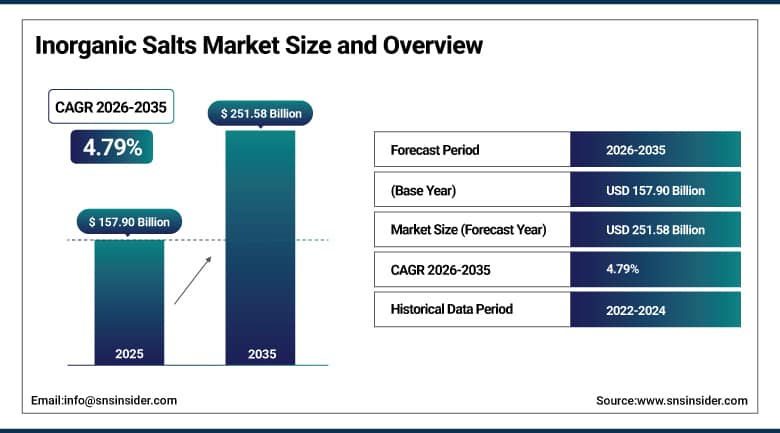
The Inorganic Salts Market was valued at USD 157.90 billion in 2025 and is expected to reach USD 251.58 billion by 2035, growing at a CAGR of 4.79% from 2026–2035.
The inorganic salts market is witnessing steady growth in the global market due to rising industrial applications and increasing demand from agriculture sectors. Growing utilization of inorganic salts in chemical manufacturing, water treatment, pharmaceuticals, and food processing industries is supporting market expansion. The increasing adoption of specialty salts for industrial processing and fertilizer production is significantly boosting product demand. Rising investments in wastewater treatment facilities and industrial infrastructure development are accelerating market growth globally. The growing requirement for high-purity salts in healthcare and laboratory applications is further contributing to industry expansion.
The market for inorganic salts continues to experience growth due to increased demand in fertilizers and chemicals. It is worth noting that based on DCPC figures, inorganic chemical production has grown from 978 to 1197 thousand MT (2021-2025) with a better trade balance. As per the information provided by FAO, global fertilizers consumption stands at about 185 million tonnes.
Market Size and Forecast
-
Market Size 2026E: USD 165.15 Billion
-
Market Size 2035: USD 251.58 Billion
-
CAGR (2026 - 2035): 4.79%
-
Fastest Growing Region: Asia Pacific
-
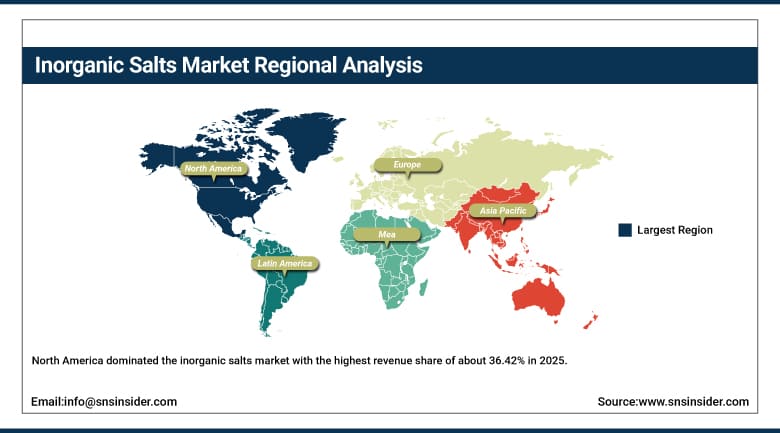
Largest Region: North America
To Get More Information On Inorganic Salts Market - Request Free Sample Report
Inorganic Salts Market Trends
-
-
Increasing demand for high-purity inorganic salts is driving adoption across pharmaceutical and water treatment industries globally. This is improving product quality and regulatory compliance standards.
-
Rising electric vehicle battery production is accelerating demand for lithium carbonate and nickel sulfate worldwide. This is strengthening inorganic salt manufacturing and processing activities rapidly.
-
Growing focus on sustainable chemical production is encouraging adoption of energy-efficient refining technologies across industries globally. This is supporting emission reduction and environmentally responsible manufacturing practices.
-
Increasing use of inorganic salts in agriculture is improving fertilizer efficiency and enhancing crop productivity consistently. This is supporting modern farming practices and global food demand growth.
-
Expansion of digital chemical distribution platforms is improving procurement efficiency for industrial buyers across multiple regions. This is strengthening online chemical trade and supply chain accessibility globally.
-
U.S. Inorganic Salts Market Size Outlook.
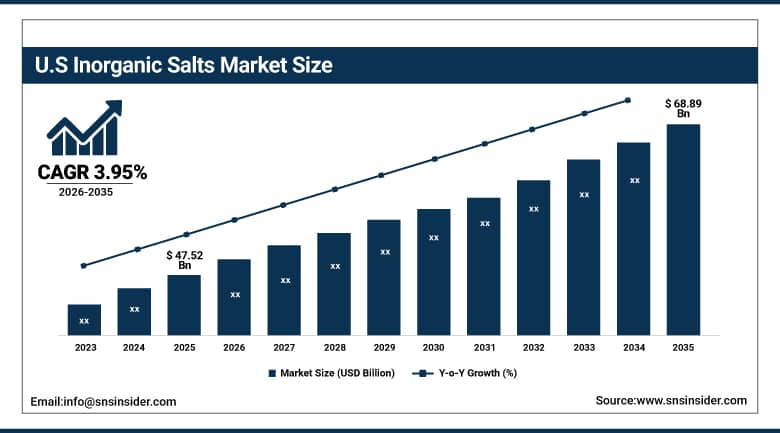
The U.S. Inorganic Salts Market was valued at USD 47.52 billion in 2025 and is expected to reach around USD 68.89 billion by 2035, growing at a CAGR of 3.95% from 2026–2035.
The U.S. inorganic salts market is growing steadily due to rising industrialization and increasing chemical manufacturing activities across multiple sectors. Demand is strongly supported by extensive usage in agriculture, pharmaceuticals, water treatment, food processing, and construction applications nationwide. Increasing focus on industrial productivity, chemical processing efficiency, and environmental safety regulations is further strengthening product consumption consistently. The presence of advanced manufacturing infrastructure and strong investments in specialty chemical production is also supporting long-term market expansion across the country.
The Inorganic Salt Market is growing owing to robust U.S. chemical production and need for water treatment. As per EPA's Chemical Data Reporting, inorganic compounds such as sodium chloride and sodium hydroxide are some of the largest volumes producing chemicals in the U.S. BASF and Merck KGaA are extending their range of high purity salts for electronics and pharmaceuticals applications.
Inorganic Salts Market Segment Analysis
-
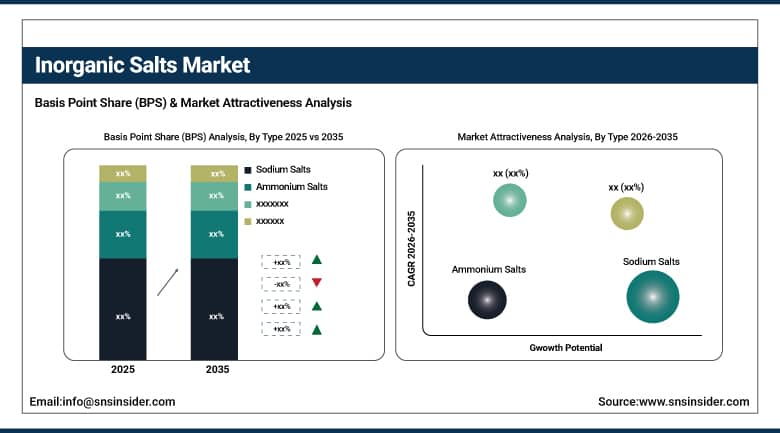
By Type, sodium salts dominated the inorganic salts market with 34.82% share in 2025; while ammonium salts are the fastest growing segment with CAGR of 7.93% during 2026 to 2035.
-
By Application, agriculture dominated the inorganic salts market with 36.74% share in 2025; while pharmaceuticals are the fastest growing segment with CAGR of 8.49% during 2026 to 2035.
-
By Form, solid (powder, crystals, granules) dominated the inorganic salts market with 61.85% share in 2025; while liquid solutions are the fastest growing segment with CAGR of 6.99% during 2026 to 2035.
By Type, sodium salts dominated the inorganic salts market, while ammonium salts are the fastest growing segment.
Sodium Salts Segment was leading the inorganic salts market by having the dominated share in terms of revenue generation in 2025. The dominance of the sodium salts segment can be credited to its wide usage in industries like chemicals, foods, water purification, and detergents all around the world. Sodium salts are more popular due to being cost-effective, highly chemically stable, and easy to source on an industrial scale. Additionally, increasing demands from the agriculture and pharmaceutical industry will keep pushing the usage levels forward.
Ammonium Salts Segment is projected to have the fastest CAGR between 2026 and 2035. The growth in the ammonium salts market can be attributed to the growing usage of nitrogen-based fertilizers and increased demands for productivity enhancement in the agricultural sector in developing countries. Ammonium salts are becoming more popular in manufacturing explosives, pharmaceuticals, textiles, and industrial chemicals. Increased funding towards agriculture and the growing need for food security worldwide is also driving the adoption.
By Application, agriculture dominated the inorganic salts market, while pharmaceuticals are the fastest growing segment.
Agriculture segment led the inorganic salts market by generating the dominated revenue share in 2025 because of widespread applications in fertilizers as well as for improving the nutrient content of the soil in various parts of the world. As the demand for agriculture products is increasing, along with that the need for higher yields and productivity from the land has risen, leading to the increased use of salts in agriculture. High use of salt-based micronutrients in agricultural crops helps enhance their quality as well as increase soil fertility.
Pharmaceutical segment is anticipated to exhibit the fastest CAGR during 2026-2035 due to the growing demand for inorganic salts of high purity level in the production and manufacturing process. Increased pharmaceutical production activities along with the rapid development in the health care industry has boosted the adoption rate of these salts for specialized applications significantly. Innovations in technology related to the purifying of such compounds for use have gained importance in the pharmaceutical industry.
By Form, solid (powder, crystals, granules) dominated the inorganic salts market, while liquid solutions are the fastest growing segment.
Solid (powder, crystals, granules) segment dominated the inorganic salts market in 2025 due to strong industrial usage across chemical manufacturing, agriculture, and construction applications globally. These forms offer easy handling, long shelf life, and cost-effective bulk transportation advantages. High stability and wide availability make them preferred in fertilizers, detergents, and industrial processing. Large scale production and storage efficiency further strengthen their dominant position in global markets consistently.
Liquid solutions segment is expected to grow at the fastest CAGR from 2026 to 2035 due to increasing demand in water treatment, pharmaceuticals, and chemical dosing applications globally. Liquid form enables easier mixing, faster reaction rates, and automated industrial usage. Growing adoption in continuous processing industries and precision chemical applications is accelerating demand. Expansion of municipal water treatment systems and rising use in healthcare formulations further support strong future growth globally.
Regional Analysis
|
Region |
Major Country |
Share within Region, 2025(%) |
|---|---|---|
|
North America |
United States |
82.64% |
|
Europe |
Germany |
26.17% |
|
Asia Pacific |
China |
29.74% |
|
Middle East & Africa |
UAE |
5.83% |
|
Latin America |
Brazil |
3.58% |
North America Inorganic Salts Market Insights.
North America dominated the inorganic salts market with the highest revenue share of about 36.42% in 2025 due to strong industrial manufacturing and advanced chemical processing infrastructure. The region benefits from high demand across agriculture, pharmaceuticals, water treatment, food processing, and construction industries consistently. Widespread availability of industrial raw materials and strong presence of major chemical manufacturers further supports steady market expansion across the United States and Canada. Rising investments in specialty chemicals and industrial production technologies are accelerating inorganic salts consumption across multiple end use sectors.
Inorganic salt demand in North America is driven by robust inorganic salt production. Compass Minerals has estimated their total salt sales at about 10,450-10,900 thousand tons. Tariff-free shipments to the United States are made under the USMCA agreement. The United States uses about 39 million tons of salt per year according to the Department of Energy (DOE).
Get Customized Report as Per Your Business Requirement - Enquiry Now
Europe Inorganic Salts Market Insights.
Europe region has emerged as one of the key regions contributing to the demand in the inorganic salts market owing to stringent regulatory norms and advanced standards in chemical production in diverse industry sectors. Some of the countries in this region that are covered under Europe include Germany, France, and UK. These regions have observed a rising trend regarding the use of inorganic salts in various applications like the pharmaceuticals sector, food & beverages industry, and water treatment industry. Growth in demands is being driven by factors such as environmental regulations, along with rising demands for improved industrial efficiencies.
Europe comprises around 26.17% of the global market for inorganic salts, owing to Germany, France, and the UK, which have significant applications of inorganic salts in the chemical and pharmaceutical industries. BASF SE manufactures pure nitrogen salts in Germany, whereas Solvay is involved in producing industrial salts. Germany holds a major share within Europe due to strong chemical manufacturing and pharmaceutical production infrastructure, supporting high consumption of inorganic salts across industrial applications.
Asia Pacific Inorganic Salts Market Insights.
Asia Pacific holds a market share of about 6.23% in 2025 and is expected to grow at the fastest CAGR due to rapid industrialization and expanding manufacturing activities. Rapid urbanization expanding infrastructure development and strong chemical production growth in China, Japan, South Korea, and Southeast Asia are driving product demand. Increasing government initiatives supporting domestic manufacturing and industrial development are further supporting adoption. Strong presence of regional chemical manufacturers is improving affordability and product accessibility across the region.
Asia Pacific leads the inorganic salts market, driven by large-scale chemical production and strong downstream demand from fertilizers, pharmaceuticals, and industrial processing. The region accounted for about 27.88% share of the global inorganic salts market in 2025, supported by expanding chemical manufacturing and export capacity. China is the key production hub under national chemical industry development policies. Regional output remains stable at 1.8 million tons for salts of inorganic acids (2024), reflecting steady industrial growth.
Middle East & Africa and Latin America Inorganic Salts Market Insights.
Middle East and Africa and Latin America regions are anticipated to witness an increase in market share during 2025 because of the expansion of industries as well as infrastructure development activities within the aforementioned regions. Countries like UAE, Saudi Arabia, South Africa, Brazil, and Mexico have recorded a surge in the demand for chemicals from various industries including agricultural industry, chemical manufacturing industry, mining industry, and water treatment industry. The government initiatives in terms of industrial diversification, infrastructure, and manufacturing expansion are also anticipated to drive market growth within the aforementioned regions.
According to the Food and Agriculture Organization, global inorganic fertilizer consumption stood at around 190 Mt in 2023 with robust consumption levels recorded in regions with developing countries. The USGS reveals that there are vigorous data collection and reporting for active minerals in MEA and Latin American regions.
Market Dynamics
Growth Drivers: Expansion Of Water Treatment and Environmental Applications Driving Steady Consumption Growth Globally
Increased awareness about the need for safe drinking water and environmental protection is leading to an increased use of inorganic salts in various treatment processes. The use of inorganic salts in purification, water softening, and other chemical balancing processes has been rising at both the industrial and municipal levels. Environmental laws are forcing businesses to adopt efficient chemical treatment methods in their waste water disposal and emissions control systems. Increased population and urbanization are exerting pressure on water management systems around the world. There is ongoing investment in advanced water management technologies that are helping boost demand over time.
Expansion of water treatment and environmental protection policies is driving steady inorganic salts demand globally. The U.S. EPA highlights rising use of salts like sodium chloride and sodium carbonate in coagulation, pH control, and disinfection, with increasing freshwater salinization raising treatment needs. USGS reports higher dissolved solids levels in rivers due to urban and industrial discharge, reinforcing long-term consumption growth in water purification systems.
Restraints: Environmental Regulations and Waste Disposal Challenges Restricting Large Scale Industrial Expansion
Strict environmental regulations concerning the production of chemicals and disposing of waste material are hindering further growth in the inorganic salt manufacturing sector. Effluent generated from the manufacturing process is subject to sophisticated methods for treating the waste water, adding to the cost burden. Waste by-products from the manufacturing process present operational challenges in large production units. Governments in various parts of the world are enforcing strict laws on emissions. This results in higher costs to comply with environmental regulations. Small firms have challenges complying with these regulations owing to high costs involved.
Opportunities: Rising Adoption in Pharmaceutical and Healthcare Applications Creating Strong Growth Potential Globally
The increasing use of inorganic salts of high purity in drug formulation is creating tremendous growth opportunities all around the globe. Growing demand in terms of drug manufacture, scientific research, and medical chemistry application due to stringent quality standards is fueling up the growth rate of the market. Growth in healthcare systems along with healthcare expenditure is promoting consumption in hospitals as well as research centers. Advanced formulations of drugs are adding value to the consumption of specialty salts. Emerging nations are making heavy investments in healthcare facilities and drug manufacture capacities.
The increasing use of inorganic salts in pharmaceuticals and healthcare is pushing the global market demand as inorganic salts are key components of IV fluids, electrolyte solutions, and drug formulations. About 52 percent of medicines require the use of inorganic salts.
Recent Developments
• 2026: K+S reported strong Q1 results driven by higher potash and salt sales volumes, with EBITDA significantly above expectations due to improved agricultural demand and cost optimization in inorganic salt operations.
• 2026: Solvay advanced its carbon-neutral soda ash plant project in NEOM, targeting large-scale sustainable sodium carbonate production using seawater brine processing.
• 2025: ICL reported increased bromine and potash output supported by modernized Dead Sea operations and improved efficiency in mineral extraction systems.
• 2025: Solvay announced a breakthrough soda ash production process targeting 50% lower CO₂ emissions and reduced limestone consumption, advancing its carbon neutrality roadmap.
• 2024: Evonik expanded specialty inorganic chemistry solutions including catalysts and phosphate-based salts used in healthcare and industrial applications.
Inorganic Salts Market Key Players are:
-
BASF SE
-
Merck KGaA
-
Compass Minerals
-
K+S Aktiengesellschaft
-
Ciner Group
-
Solvay S.A.
-
ICL Group Ltd.
-
Mosaic Company
-
Nouryon
-
LANXESS AG
-
Occidental Petroleum Corporation
-
Eastman Chemical Company
-
Arkema S.A.
-
Sumitomo Chemical Co., Ltd.
-
AGC Inc.
-
Thermo Fisher Scientific Inc.
-
Lhoist Group
-
Brenntag SE
-
Wacker Chemie AG
-
Evonik Industries AG
Inorganic Salts Market Report Scope:
| Report Attributes | Details |
|---|---|
| Market Size in 2025 | USD 157.90 Billion |
| Market Size by 2035 | USD 251.58 Billion |
| CAGR | CAGR of 4.79% From 2026 to 2035 |
| Base Year | 2025 |
| Forecast Period | 2026-2035 |
| Historical Data | 2022-2024 |
| Report Scope & Coverage | Market Size, Segments Analysis, Competitive Landscape, Regional Analysis, DROC & SWOT Analysis, Forecast Outlook |
| Key Segments | • By Type (Sodium Salts, Magnesium Salts, Calcium Salts, Potassium Salts, Ammonium Salts, Others) • By Application (Agriculture, Pharmaceuticals, Cement, Rubber Processing, Food, Others) • By End-Use Industry (Chemical Manufacturing, Water Treatment, Construction, Healthcare & Pharmaceuticals, Food & Beverage, Textile Industry, Agriculture, Others) |
| Regional Analysis/Coverage | North America (US, Canada), Europe (Germany, UK, France, Italy, Spain, Russia, Poland, Rest of Europe), Asia Pacific (China, India, Japan, South Korea, Australia, ASEAN Countries, Rest of Asia Pacific), Middle East & Africa (UAE, Saudi Arabia, Qatar, South Africa, Rest of Middle East & Africa), Latin America (Brazil, Argentina, Mexico, Colombia, Rest of Latin America). |
| Company Profiles | BASF SE, Merck KGaA, Compass Minerals, K+S Aktiengesellschaft, Ciner Group, Solvay S.A., ICL Group Ltd., Mosaic Company, Nouryon, LANXESS AG, Occidental Petroleum Corporation, Eastman Chemical Company, Arkema S.A., Sumitomo Chemical Co., Ltd., AGC Inc., Thermo Fisher Scientific Inc., Lhoist Group, Brenntag SE, Wacker Chemie AG, Evonik Industries AG |
Frequently Asked Questions
The inorganic salts market was valued at USD 157.90 billion in 2025.
Rising demand from agriculture and chemical manufacturing, increasing use in water treatment and pharmaceuticals, growing adoption of high-purity salts, and expansion of industrial infrastructure are driving market growth globally.
The Sodium Salts segment dominated the market in 2025 due to its wide industrial use, cost-effectiveness, stability, and strong demand across major industries.
North America dominated the market in 2025 due to strong industrial infrastructure, high chemical demand, and widespread use across key end-use industries.
Get in Touch
