
Sugar-Based Excipients Market Report Scope & Overview:
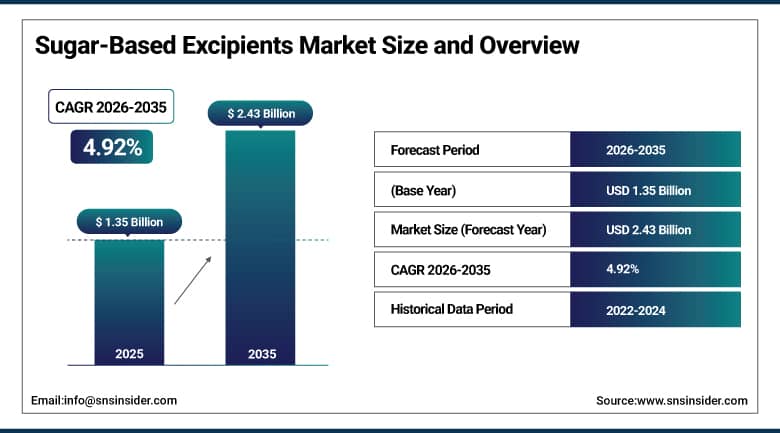
The Sugar-Based Excipients Market was valued at USD 1.35 Billion in 2025 and is expected to reach USD 2.43 Billion by 2035, growing at a CAGR of 4.92% from 2026–2035.
The global sugar-based excipients market is advancing at a steady and commercially broad-based pace. Sugar-based excipients are functional ingredients derived from natural or chemically modified sugar compounds used in pharmaceutical, food, and nutraceutical formulations to provide bulking, binding, taste masking, solubility enhancement, and stability functions. The market is primarily driven by increasing demand for orally disintegrating tablets and liquid formulations whose patient compliance and paediatric and geriatric medication acceptability requirements create structural demand for sugar excipients’ taste masking, sweetening, and quick dissolution capabilities.
In 2024, Roquette Group launched a new grade of pharmaceutical-quality mannitol specifically designed for direct compression of orally disintegrating tablets, offering improved flowability, compressibility, and mouth-feel characteristics compared to standard mannitol grades. The innovation addresses the growing ODT market’s formulation challenge of achieving rapid disintegration combined with pleasant mouth feel and adequate tablet hardness, whose simultaneous requirement demands excipient engineering that standard direct compression fillers cannot satisfy without optimised mannitol grades.
Market Size and Forecast
-
Market Size in 2026E: USD 1.42 Billion
-
Market Size by 2035: USD 2.43 Billion
-
CAGR: 4.92% from 2026 to 2035
-
Fastest Growing Region: Asia Pacific
-
Largest Region: North America
To Get More Information On Sugar-Based Excipients Market - Request Free Sample Report
Sugar-Based Excipients Market Trends
-
Orally disintegrating tablet adoption is increasing as patients prefer formulations that dissolve quickly without water, driving demand for sugar alcohol excipients with superior taste and dissolution properties
-
Sugar alcohol excipients are gaining popularity in pharmaceutical formulations for diabetic patients due to their low glycaemic impact and suitability for blood glucose management
-
Direct compression sugar technologies are improving tablet manufacturing efficiency by simplifying production processes and reducing processing time and operational costs
-
Co-processed excipients combining sugar alcohols with multiple functional ingredients are helping pharmaceutical manufacturers streamline formulation development and production
-
Regulatory support for sugar-based excipients is strengthening as global approvals and safety validations encourage their wider adoption across pharmaceutical and food applications
U.S. Sugar-Based Excipients Market Outlook
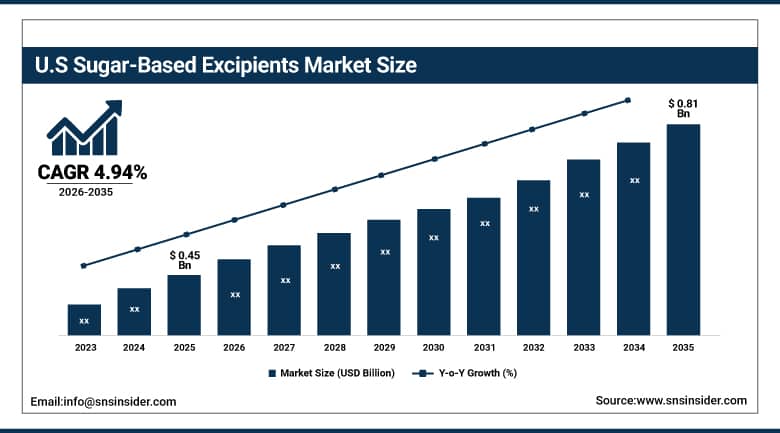
The U.S. Sugar-Based Excipients Market was valued at approximately USD 0.45 Billion in 2025 and is expected to reach approximately USD 0.81 Billion by 2035, growing at a CAGR of approximately 4.94%.
The U.S. is the most commercially sophisticated sugar-based excipients market within North America’s dominant revenue position. Roquette’s U.S. operations, Cargill’s pharmaceutical excipient business, Ingredion’s specialty starch and sugar portfolio, and DFE Pharma’s lactose excipient supply collectively define the domestic supply landscape. The FDA’s well-developed pharmaceutical excipient regulatory framework, the pharmaceutical industry’s ODT and liquid formulation investment, and the nutraceutical industry’s sugar excipient procurement collectively sustain consistent commercial demand. The aging U.S. population’s growing need for easy-to-swallow formulations creates structural demand for ODT and liquid dosage forms whose sugar excipient requirement compounds with demographic growth.
Cargill launched its optimised pharmaceutical-grade dextrose monohydrate excipient line in 2024, offering improved compressibility and lower hygroscopicity for tablet direct compression applications. The product development targets tablet manufacturers seeking to improve process efficiency through direct compression without wet granulation, reducing manufacturing cycle time, energy consumption, and equipment capital requirements while maintaining tablet hardness and dissolution specification compliance.
Sugar-Based Excipients Market Segment Analysis
-
By Product Type, the Actual Sugars segment dominated the Sugar-Based Excipients Market with 48.21% share in 2025, while the Sugar Alcohols segment is the fastest growing segment.
-
By Form, the Powders & Granules segment dominated the Sugar-Based Excipients Market with approximately 42% share in 2025, while the Direct Compression Sugars segment is the fastest growing segment.
-
By Functionality, the Fillers & Diluents segment dominated the Sugar-Based Excipients Market with approximately 36% share in 2025, while the Binders segment is the fastest growing segment.
-
By Pharmaceutical Application, the Tablets segment dominated the Sugar-Based Excipients Market with approximately 44% share in 2025, while the Orally Disintegrating Tablets (ODT) segment is the fastest growing segment.
-
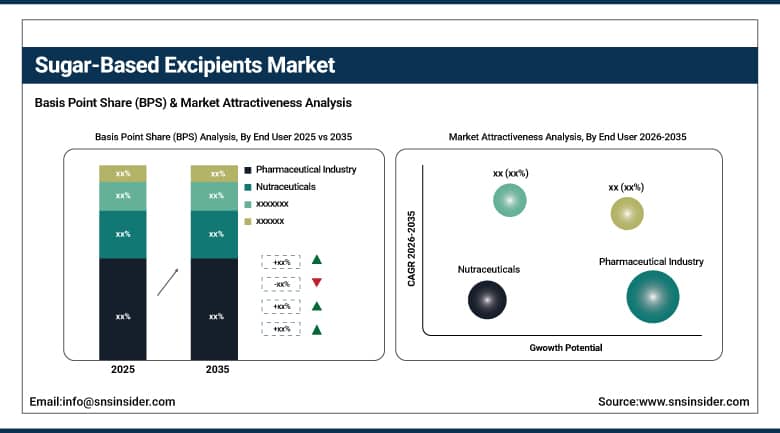
By End User, the Pharmaceutical Industry segment dominated the Sugar-Based Excipients Market with approximately 62% share in 2025, while the Nutraceuticals segment is the fastest growing segment.
By End User, pharmaceutical dominates, nutraceuticals grow fastest
The pharmaceutical industry retained the dominant end-user position with approximately 62% of the sugar-based excipients market in 2025. The pharmaceutical industry’s universal requirement for excipients in solid and liquid dosage form manufacturing creates structured, consistent, and quality-specification-driven procurement that sustains commercial relationships whose value and continuity substantially exceed food and nutraceutical industry procurement. Pharmaceutical GMP manufacturing’s excipient qualification requirements and batch-to-batch consistency specifications create institutional procurement relationships whose switching cost sustains long-duration supplier partnerships.
Nutraceuticals is the fastest-growing end user because the extraordinary commercial momentum of dietary supplement, functional food, and health product innovation is creating growing excipient demand from product developers whose formulation complexity is progressively approaching pharmaceutical standards. Each new nutraceutical product in gummy, chewable tablet, or liquid form creates sugar excipient procurement whose regulatory flexibility relative to pharmaceutical applications enables faster innovation cycles that sustain above-average product launch volume.
By Product Type, actual sugars dominate, sugar alcohols grow fastest
Actual sugars retained the dominant product type position with 48.21% of the sugar-based excipients market in 2025. Their commercial primacy reflects decades of established use in pharmaceutical tablet coating, syrup formulation, and confectionery production whose regulatory acceptance, supply chain infrastructure, and formulator familiarity create a commercially entrenched position. Sucrose’s superior taste masking capability for bitter active pharmaceutical ingredients, lactose’s long-established status as the most widely used pharmaceutical excipient in tablet formulation, and dextrose’s role in parenteral nutrition and intravenous formulations collectively sustain actual sugar’s aggregate market leadership across diverse application categories.
Sugar alcohols are the fastest-growing product type because mannitol, sorbitol, and xylitol’s combination of low glycaemic index, pleasant sweetness, and functional pharmaceutical properties creates commercial advantage in applications where actual sugars’ caloric content and blood glucose impact create formulation limitations. The ODT market’s systematic specification of mannitol as the preferred filler-disintegrant combination, combined with the diabetic patient population’s medication formulation requirement, creates structured sugar alcohol procurement growth that sustains above-average segment expansion relative to actual sugar alternatives.
By Functionality, fillers dominate, binders grow fastest
Fillers and diluents retained the dominant functionality position with approximately 36% of the sugar-based excipients market in 2025. The universal requirement for tablet and capsule filling to therapeutic dose presentation creates filler demand across all solid dosage form manufacturing whose aggregate volume defines the largest single functionality category. Lactose, dextrose, mannitol, and sorbitol each serve as primary fillers in specific dosage form contexts whose combined market presence sustains filler functionality’s commercial dominance. Each tablet manufactured creates filler procurement that compounds with global pharmaceutical production volume growth.
Binders are the fastest-growing functionality because the pharmaceutical industry’s progression toward complex formulations including modified-release tablets, mini-tablets, and multi-particulate systems creates binding requirement sophistication that standard filler-only approaches cannot satisfy. Sucrose and sorbitol solution’s role as binders in wet granulation, combined with hydroxypropyl cellulose’s replacement by sugar-based alternatives in cost-sensitive generic formulations, creates binder procurement growth whose rate exceeds the stable filler category’s expansion.
By Pharmaceutical Application, tablets dominate, ODTs grow fastest
Tablets retained the dominant pharmaceutical application position with approximately 44% of the sugar-based excipients market in 2025. The tablet dosage form’s position as the most widely manufactured and prescribed pharmaceutical form globally creates sugar excipient demand that compounds with pharmaceutical production volume. Each tablet press batch creates filler, binder, and coating sugar excipient consumption whose aggregate across global pharmaceutical manufacturing creates the commercial base that sustains tablet application’s market leadership. Lactose and microcrystalline cellulose’s co-dominance as standard tablet excipients reflects the formulation knowledge base accumulated over decades of tablet development whose sugar excipient component sustains consistent procurement.
Orally disintegrating tablets are the fastest-growing pharmaceutical application because the patient compliance and medication adherence improvement that ODTs provide for paediatric, geriatric, and dysphagia patient populations creates structured demand for the mannitol and sugar alcohol excipient combinations that ODT formulation requires. Each new drug product whose patient population’s swallowing difficulty creates a clinical case for ODT reformulation creates a new sugar excipient procurement requirement whose aggregate across the growing ODT pharmaceutical pipeline sustains above-average application segment growth.
Regional Analysis:
|
Region |
Major Country |
Share within Region, 2025 (%) |
|---|---|---|
|
North America |
United States |
87.4% |
|
Europe |
Germany |
22.3% |
|
Asia Pacific |
China |
44.8% |
|
Middle East & Africa |
UAE |
38.4% |
|
Latin America |
Brazil |
44.2% |
North America Sugar-Based Excipients Market Insights
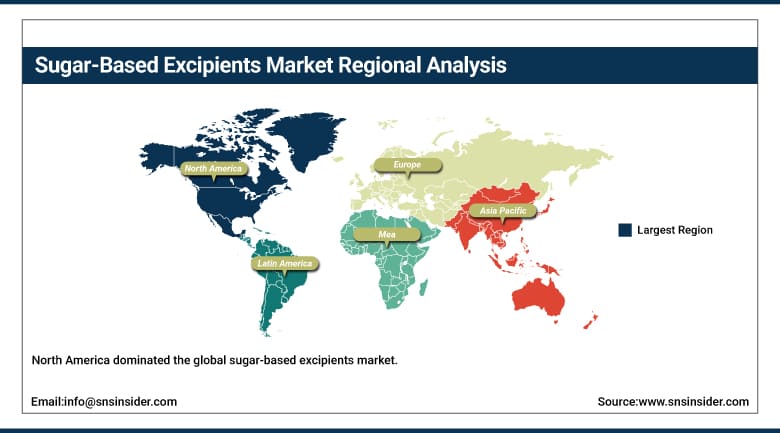
North America dominated the global sugar-based excipients market in 2023 as the region with the most advanced pharmaceutical manufacturing industry. The United States accounts for approximately 87.4% of North American revenues through its pharmaceutical industry’s extensive excipient procurement, Roquette’s and Cargill’s commercial presence, and the nutraceutical industry’s above-average market development whose combined demand creates the most commercially sophisticated sugar excipient market globally.
Canada contributes approximately 12.6% of North American revenues through its pharmaceutical manufacturing sector’s excipient procurement, the nutraceutical industry’s growing product development, and the food and beverage industry’s natural ingredient demand that creates consistent sugar excipient commercial activity.
Get Customized Report as Per Your Business Requirement - Enquiry Now
Europe Sugar-Based Excipients Market Insights
Europe is a technically sophisticated sugar-based excipients market where the pharmaceutical industry’s advanced formulation capability, DFE Pharma’s German headquarters, Roquette Frères’ French operations, and BASF’s excipient business create a complete supply ecosystem. Germany accounts for approximately 22.3% of European revenues through its pharmaceutical manufacturing leadership, the chemical industry’s excipient development, and the food and nutraceutical industry’s above-average natural ingredient specification.
The United Kingdom, France, and the Netherlands are significant secondary markets where the pharmaceutical contract manufacturing sector’s excipient procurement, the nutraceutical industry’s innovation, and the food industry’s natural sugar excipient adoption create consistent commercial demand.
Asia Pacific Sugar-Based Excipients Market Insights
Asia Pacific is the fastest-growing regional sugar-based excipients market, driven by the pharmaceutical industry’s extraordinary expansion in India and China, the food industry’s natural ingredient demand, and the nutraceutical sector’s growing commercial development. China accounts for approximately 44.8% of Asia Pacific revenues through its pharmaceutical manufacturing scale, the food industry’s above-average sugar excipient consumption, and the growing nutraceutical market’s product development investment.
India represents the most commercially dynamic emerging market within Asia Pacific where the generic pharmaceutical industry’s extraordinary production scale creates consistent bulk sugar excipient procurement, and the growing domestic nutraceutical market creates new commercial demand channels beyond the established pharmaceutical procurement base.
MEA & Latin America Sugar-Based Excipients Market Insights
UAE leads MEA revenues at approximately 38.4% through its pharmaceutical manufacturing investment, the advanced hospital sector’s medication procurement, and the growing food and nutraceutical industry’s natural excipient demand. Brazil leads Latin American revenues at approximately 44.2% through its large pharmaceutical industry’s excipient procurement, the food industry’s above-average sugar application, and the growing nutraceutical market’s ingredient demand.
Saudi Arabia’s pharmaceutical manufacturing investment and South Africa’s generic pharmaceutical sector create significant MEA secondary markets whose excipient procurement sustains regional market development.
Market Dynamics:
Growth Drivers: ODT adoption and patient-centric formulation demand creating structured sugar excipient procurement
Orally disintegrating tablet adoption is the sugar-based excipients market’s most commercially dynamic growth driver. The pharmaceutical industry’s recognition that patient compliance determines therapeutic outcome has created systematic investment in formulations whose ease of administration improves medication adherence across paediatric, geriatric, and dysphagia patient populations. Each drug whose patient population compliance benefit justifies ODT reformulation creates new mannitol and sugar alcohol excipient procurement whose aggregate across the growing ODT pipeline sustains market expansion. The WHO’s Model List of Essential Medicines’ progressive inclusion of ODT formulations creates developing market procurement motivation that compounds with the commercial pharmaceutical market’s ODT adoption.
The aging global population’s growing preference for liquid and easily dissolved medications whose swallowing difficulty creates product selection motivation is simultaneously creating liquid formulation sugar excipient demand that compounds with demographic growth. Each percentage point increase in the proportion of global population over 65 creates growing demand for patient-friendly formulations whose sugar excipient requirement compounds with pharmaceutical industry investment in geriatric-appropriate dosage forms.
Restraints: Regulatory scrutiny of artificial sweeteners and lactose intolerance limiting broad adoption
Regulatory scrutiny of artificial sweeteners including saccharin, aspartame, and cyclamate creates consumer safety concern that progressive regulatory review may restrict or require label disclosure in pharmaceutical and food applications. Each regulatory action against a specific sweetener creates reformulation requirements whose excipient substitution creates development cost and timeline that pharmaceutical manufacturers prefer to avoid through alternative natural sugar excipient specification.
Lactose intolerance’s approximately 68% global prevalence creates a significant patient population for whom lactose-containing pharmaceutical formulations create gastrointestinal adverse effects whose occurrence limits lactose’s commercial acceptance in new pharmaceutical formulation development. Each pharmaceutical product development programme whose target patient population includes substantial lactose intolerant representation creates specification motivation for lactose-free alternative excipients.
Opportunities: Sugar alcohol ODT market and nutraceutical natural ingredient demand
Sugar alcohol ODT excipient market represents the most commercially premium near-term opportunity for mannitol and sorbitol producers whose ODT formulation specification creates demand at above-commodity pricing. Each new drug product approved in ODT formulation creates a defined mannitol procurement requirement whose long product lifecycle sustains multi-decade excipient supply relationships. Roquette’s 2024 ODT-optimised mannitol grade launch demonstrates the commercial investment logic of premium ODT-specific excipient development.
Nutraceutical natural ingredient demand represents the most commercially dynamic growth channel for sugar-based excipients whose natural origin and consumer-friendly image create specification preference in the nutraceutical industry’s label-conscious product development. Each consumer trend toward clean-label formulations creates structured demand for sugar excipients’ natural positioning whose regulatory acceptance and consumer familiarity create competitive advantage over synthetic alternatives.
Recent Developments:
-
2024: Roquette Group launched a new pharmaceutical-quality mannitol grade specifically designed for direct compression of orally disintegrating tablets in 2024, offering improved flowability, compressibility, and mouth-feel characteristics to support the growing ODT formulation market.
-
2024: Cargill launched its optimised pharmaceutical-grade dextrose monohydrate excipient line in 2024, offering improved compressibility and lower hygroscopicity for tablet direct compression applications targeting manufacturers seeking to eliminate wet granulation processing steps.
-
2023: DFE Pharma introduced a new co-processed lactose-mannitol excipient blend in 2023 for enhanced ODT and chewable tablet formulation, combining lactose’s binding properties with mannitol’s rapid dissolution and pleasant taste to create a dual-functional excipient reducing formulation component count.
Sugar-Based Excipients Market Key Players
-
Roquette Frères
-
DFE Pharma GmbH
-
Cargill Incorporated
-
BASF SE
-
Ingredion Incorporated
-
Tate & Lyle PLC
-
Pfanstiehl Inc.
-
Merck KGaA (MilliporeSigma)
-
Colorcon Inc.
-
Ashland Inc.
-
SPI Pharma
-
Penford (Ingredion)
-
Südzucker AG
-
Associated British Foods PLC
-
Kerry Group
-
Beneo GmbH
-
Fraken Biochem Co., Ltd.
-
Grain Processing Corporation
-
Archer Daniels Midland
-
Hunan Hengguang Chemical Technology
Sugar-Based Excipients Market Report Scope:
| Report Attributes | Details |
|---|---|
| Market Size in 2025 | USD 1.35 Billion |
| Market Size by 2035 | USD 2.43 Billion |
| CAGR | CAGR of 4.92% From 2026 to 2035 |
| Base Year | 2025 |
| Forecast Period | 2026-2035 |
| Historical Data | 2022-2024 |
| Report Scope & Coverage | Market Size, Segments Analysis, Competitive Landscape, Regional Analysis, DROC & SWOT Analysis, Forecast Outlook |
| Key Segments | • by Product Type (Actual Sugars/Sucrose/Glucose/Lactose/Dextrose, Sugar Alcohols/Mannitol/Sorbitol/Xylitol, Artificial Sweeteners) • by Form (Powders & Granules, Direct Compression Sugars, Crystals, Syrups) • by Functionality (Fillers & Diluents, Binders, Sweeteners & Flavouring Agents, Disintegrants, Stabilisers, Others) • by Pharmaceutical Application (Tablets, Capsules, Oral Liquids, Injectables, Orally Disintegrating Tablets, Others) • by End User (Pharmaceutical Industry, Food & Beverage Industry, Nutraceuticals, Cosmetics) |
| Regional Analysis/Coverage | North America (US, Canada, Mexico), Europe (Eastern Europe [Poland, Romania, Hungary, Turkey, Rest of Eastern Europe] Western Europe] Germany, France, UK, Italy, Spain, Netherlands, Switzerland, Austria, Rest of Western Europe]), Asia Pacific (China, India, Japan, South Korea, Vietnam, Singapore, Australia, Rest of Asia Pacific), Middle East & Africa (Middle East [UAE, Egypt, Saudi Arabia, Qatar, Rest of Middle East], Africa [Nigeria, South Africa, Rest of Africa], Latin America (Brazil, Argentina, Colombia, Rest of Latin America) |
| Company Profiles | Roquette Frères, DFE Pharma GmbH, Cargill Incorporated, BASF SE, Ingredion Incorporated, Tate & Lyle PLC, Pfanstiehl Inc., Merck KGaA (MilliporeSigma), Colorcon Inc., Ashland Inc., SPI Pharma, Penford (Ingredion), Südzucker AG, Associated British Foods PLC, Kerry Group, Beneo GmbH, Fraken Biochem Co., Ltd., Grain Processing Corporation, Archer Daniels Midland, Hunan Hengguang Chemical Technology |
Frequently Asked Questions
The Sugar-Based Excipients Market is expected to grow at a CAGR of 4.92% from 2026 to 2035.
The Sugar-Based Excipients Market was valued at USD 1.35 Billion in 2025.
Increasing demand for orally disintegrating tablets and liquid formulations requiring sugar excipients for taste masking, sweetening, and quick dissolution capability, and the aging population’s growing need for patient-friendly dosage forms.
Actual Sugars dominated the Sugar-Based Excipients Market with 48.21% share in 2025, while Sugar Alcohols is the fastest growing segment.
North America dominated the Sugar-Based Excipients Market in 2023, with the United States accounting for approximately 87.4% of North American revenues.
