
Wireless Medical Technologies Market Report Scope & Overview:
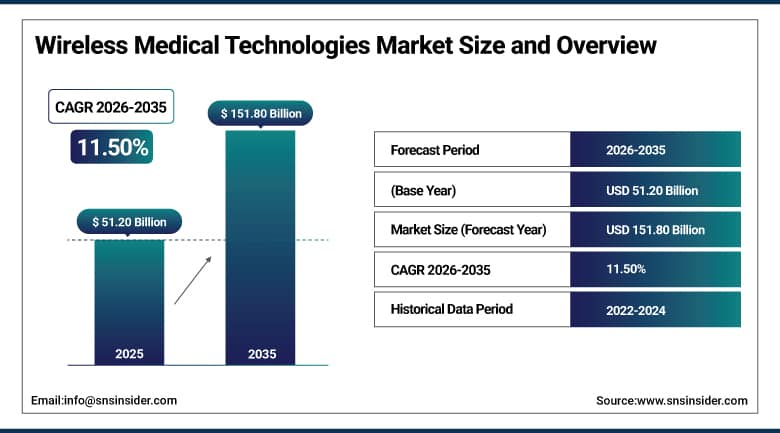
The Wireless Medical Technologies Market was valued at USD 51.20 Billion in 2025 and is expected to reach USD 151.80 Billion by 2035, growing at a CAGR of 11.50% from 2026 to 2035.
The Wireless Medical Technologies Market experiences constant growth due to digitalization in health care services, implementation of telemedicine and remote patient monitoring, and development of new low-power wireless standards providing security and real-time transfer of health-related data. Wireless medical technologies encompass a broad spectrum of inter-connected devices used for diagnostics, monitoring, and therapy using the architecture of WWAN, WPAN, WiMAX, and WBAN. That allows healthcare organizations, insurance companies, and patients to exchange medical information irrespective of geographical location, thus, reducing the number of hospital readmissions and delivering proactive value-based medicine.
Medtronic became the recipient of the 2025 MedTech Breakthrough Award with its HealthCast intelligent patient monitoring system.
To Get More Information On Wireless Medical Technologies Market - Request Free Sample Report
Wireless Medical Technologies Market Trends:
-
Rapid integration of 5G connectivity is enabling ultra-low latency remote surgery and continuous wearable monitoring across hospital networks.
-
Growing use of AI-driven diagnostic software embedded in wireless ultrasound and imaging devices is accelerating point-of-care adoption.
-
Rising adoption of eSIM-enabled medical alert and monitoring devices is improving connectivity reliability across diverse care settings.
-
Expanding telehealth reimbursement policies are increasing provider investment in wireless remote patient monitoring platforms.
-
Increasing convergence of wearable sensors with cloud-based health data platforms is strengthening chronic disease management ecosystems.
U.S. Wireless Medical Technologies Market Outlook:
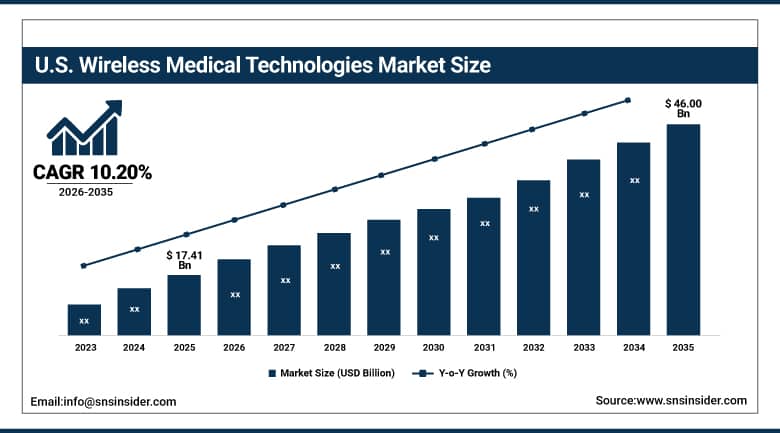
The U.S. Wireless Medical Technologies Market was valued at USD 17.41 Billion in 2025 and is projected to reach USD 46.00 Billion by 2035, growing at a CAGR of 10.20% during 2026–2035.
There is an ongoing expansion of wireless monitoring and diagnostics platforms among top device manufacturers and hospital systems in the country. The reason behind this development is that there is already a developed infrastructure of electronic health records, good reimbursement for remote patient monitoring services, and patients' preference for connected and home monitoring of their chronic disease. In addition to Wi-Fi 6E and private 5G networks becoming more available within the hospitals' campuses, as well as additional cybersecurity spending to secure connected medical devices, there is an increasing demand for more sophisticated wireless monitoring and alerting systems. In order to compete with rapidly developing foreign competitors, domestic companies invest a lot into developing AI-powered diagnostic applications for wireless devices.
In February 2024, KORE and Medical Guardian launched a medical alert device using eSIM technology in order to solve the problem of the cellular signal and decrease healthcare disparities throughout the US due to electronic carrier switching.
Wireless Medical Technologies Market Segment Analysis:
-
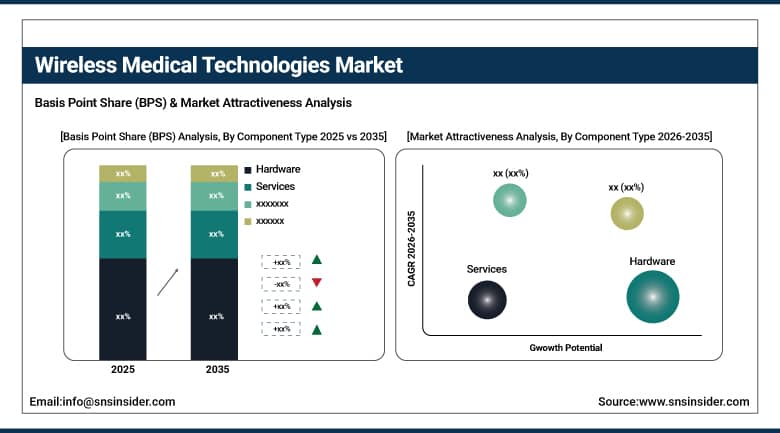
By Component Type, Hardware dominated the Wireless Medical Technologies Market with a 45.20% share in 2025, while Services is the fastest-growing component segment with a CAGR of 13.50% from 2026–2035.
-
By Technology, Wireless Body Area Network (WBAN) dominated the Wireless Medical Technologies Market with a 35.00% share in 2025, while Wireless Personal Area Network (WPAN) is the fastest-growing technology segment with a CAGR of 13.60% from 2026–2035.
-
By Application, Patient-specific dominated the Wireless Medical Technologies Market with a 50.10% share in 2025, while Provider-specific is the fastest-growing application segment with a CAGR of 12.70% from 2026–2035.
-
By End User, Provider dominated the Wireless Medical Technologies Market with a 55.30% share in 2025, while Payers is the fastest-growing end-user segment with a CAGR of 13.90% from 2026–2035.
By Component Type, Hardware dominated the Wireless Medical Technologies Market, while Services is the fastest-growing segment.
The Hardware segment held 45.20% of the share in the Wireless Medical Technologies Market in 2025 and has continuously maintained its dominance as the critical physical component of connected healthcare. The Hardware category includes wireless sensors, monitoring patches, transmitters, and gateways required for clinical data acquisition and transmission in real-time. This dominance is attributed to the strong market pull of connected diagnostic devices, wireless infusion pumps, and remote monitoring hardware devices within hospitals and home healthcare settings. Hospitals and other health facilities are opting for wireless devices as compared to their wired counterparts to minimize infections and improve patient mobility and scalability of devices within hospital networks.
The Services Segment will register the highest growth rate of 13.50% during 2026-2035. The key factor that is expected to trigger high growth in this market is increasing requirement of system integration, networking, and consultancy services for implementation of wireless technology solutions in healthcare organizations. With hospitals and clinics looking to use vendors to provide integration services between wireless healthcare infrastructure and existing electronic health records system, the services segment is expected to grow at an above average pace. In addition, increasing complexity in cybersecurity compliance, devices lifecycle management, and multi vendor networking optimization is creating the need for services.
By Technology, Wireless Body Area Network (WBAN) dominated the Market, while Wireless Personal Area Network (WPAN) is the fastest-growing segment.
Wireless Body Area Network (WBAN) sub-segment has taken the lead in the Wireless Medical Technologies market, having grabbed a significant share of 35.00%. The wireless body area network is the leading technology category because of its system of sensors worn directly on the body that monitor the critical parameters such as heart rate, ECG, blood pressure, and glucose, transmitting the data in real-time from wherever the patient is situated. The rising global prevalence of diseases like cardiovascular ailments and diabetes has spurred continuous implementation of WBANs in hospitals, at-home care, and ambulatory monitoring. The WBAN based continuous glucose monitoring and cardiac patches are essential devices for clinicians dealing with high-risk patients away from hospitals.
The WPAN segment will be witnessing the highest CAGR at around 13.60% during the forecast period 2026-2035. The growth of the segment will be driven by the increased use of wearable devices equipped with Bluetooth and an increased number of applications for home care enabled through easy device-to-device pairing along with power-efficient communication technology. The advancements in the area of Zigbee along with other short-range protocol technologies will boost the growth of the segment significantly, especially in the rapidly growing digital health sector of Asia Pacific and North America.
By Application, Patient-specific dominated the Wireless Medical Technologies Market, while Provider-specific is the fastest-growing segment.
The Patient-specific segment was the leader of the Wireless Medical Technologies Market with a 50.10% revenue share in 2025. This segment remains the largest since wearable devices and personalized health monitors are popular and can monitor users' health 24/7. Patients with conditions like diabetes, cardiovascular diseases, and respiratory problems prefer using such solutions, and the increasing demand for personalized care and instant information about one's health will drive the growth of this segment. That is why manufacturers pay more attention to developing convenient and user-friendly applications and devices for patients, just like they do in the consumer electronics sector.
At the same time, the Provider-specific segment will have the highest CAGR of 12.70% during 2026-2035. The rapid adoption of IoT in hospitals and their expansion of clinical networks will lead to the development of provider-specific segments at an above-average pace. Healthcare organizations need wireless platforms that can connect all diagnostic equipment and devices like infusion pumps and patient monitors in one hospital network. Adding advanced analytics to wireless technologies used by hospitals will positively affect clinical decision-making, which means that hospitals will be encouraged to invest in this technology.
By End User, Provider dominated the Wireless Medical Technologies Market, while Payers is the fastest-growing segment.
The Provider Segment was the dominating one in the Wireless Medical Technologies Market, accounting for 55.30% of revenues in 2025. Providers will continue to be the leading end-users as the rapid uptake in hospitals, clinics, and care centers owing to the need for efficient and timely monitoring as well as integration of healthcare information management system will continue. The demand for the improved workflow, less paperwork, and coordination of care will push providers to invest more in wireless diagnostic and monitoring technologies.
The Payer Segment is anticipated to grow at the highest CAGR of 13.90% during the forecast period of 2026-2035. The growing interest of insurers in the cost-saving and preventive healthcare will drive the fast growth of the segment, as wireless technologies can help reduce hospital admissions, provide precise risk assessment, and promote value-based reimbursement system. The increased adoption by payers of the connected health technology platforms to monitor the patients and prove quality care metrics will further foster cooperation of insurers and wireless technology vendors.
Regional Analysis:
|
Region |
Major Country |
Share within Region, 2025 (%) |
|
North America |
United States |
87.00% |
|
Europe |
Germany |
24.00% |
|
Asia Pacific |
China |
38.00% |
|
Middle East & Africa |
UAE |
23.00% |
|
Latin America |
Brazil |
35.00% |
North America Wireless Medical Technologies Market Insights
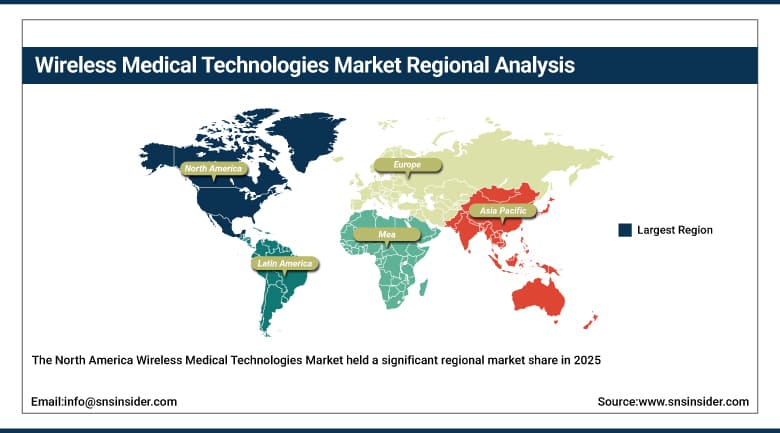
The North America Wireless Medical Technologies Market held a significant regional market share in 2025 owing to the region's advanced digital health infrastructure, widespread use of electronic health records, and early adoption of innovative wireless medical devices across hospitals and outpatient care networks. Hospitals and clinics across the region are increasingly deploying wireless monitoring tools, wearable sensors, and mobile health platforms to improve chronic disease management, strengthen care coordination, and support home-based treatment models, supported by advancing AI, cloud computing, and 5G connectivity that enable faster data transmission and seamless device interoperability across clinical settings.
The US was the leading country within the North America Wireless Medical Technologies Market in 2025 with a market share of 87.00% of the regional market, driven by extensive domestic hospital wireless network deployments, favorable telehealth and remote patient monitoring reimbursement policies, and rising consumer acceptance of connected diagnostic and wearable devices. Canada is contributing to regional growth through expanding public healthcare investment in digital health infrastructure and growing deployment of enterprise-grade wireless connectivity across major hospital networks.
Get Customized Report as Per Your Business Requirement - Enquiry Now
Europe Wireless Medical Technologies Market Insights
The Europe region was a major contributor to the Wireless Medical Technologies Market in 2025, expected to register steady growth for connected diagnostic and remote monitoring solutions during the forecast period. This is attributed to the region's aging population, high chronic disease prevalence, and rising demand for home-based care, supported by favorable regulatory frameworks and funding programs promoting data security, device integration, and cross-border health information exchange across national health systems.
Germany is one of the major markets in Europe owing to its strong hospital-based digital health infrastructure and presence of leading medical technology manufacturers serving both domestic and international customers. Other countries such as the United Kingdom, France, and Italy, home to established telemedicine platforms and growing private healthcare networks, are also contributing to market growth through expanding remote monitoring deployments and rising physician adoption of wireless diagnostic tools across cardiology, neurology, and diabetes care.
Asia Pacific Wireless Medical Technologies Market Insights
The Asia Pacific Wireless Medical Technologies Market is expected to witness the fastest growth rate during the forecast period 2026-2035, registering a CAGR of 13.80%. The market growth is driven by rapid digital transformation, expanding healthcare infrastructure, widespread smartphone penetration, and improved 4G-5G connectivity that enable seamless integration of wireless solutions across both clinical and home-care settings, supported by growing government initiatives promoting electronic health records and AI-enabled diagnostics.
China is one of the main growth drivers in the Asia Pacific Wireless Medical Technologies Market, owing to its massive patient population and rapidly expanding domestic medical device manufacturing capability supporting both local and export-oriented hospital customers. India, Japan, and South Korea are also contributing to regional growth through accelerating investment in smart hospitals, telemedicine platforms, and remote patient monitoring systems, fueled by rising chronic disease incidence and a growing elderly population.
Middle East & Africa and Latin America Wireless Medical Technologies Market Insights
Middle East & Africa and Latin American regions are gradually expanding wireless medical technology adoption as tertiary hospital investment grows across both regions, supported by increasing government healthcare modernization initiatives and growing deployment of telehealth and remote monitoring infrastructure across major metropolitan referral centers.
Brazil is set to be a prominent Latin American market fueled by its expanding private hospital network and growing patient awareness of connected home-monitoring alternatives to frequent in-person visits. The Middle East & Africa region has the UAE and Saudi Arabia investing in advanced digital health infrastructure that is gradually increasing demand for wireless diagnostic and monitoring systems across their expanding hospital and specialty care networks.
Market Dynamics:
Growth Drivers: Rising healthcare digitalization and telemedicine adoption driving market growth
The Wireless Medical Technologies Market is driven by the rise in healthcare digitization and the growing use of telemedicine, remote patient monitoring, and virtual care solutions. Digital health endeavors, funded by governments and designed to extend the reach of virtual care for underserved communities, drive adoption of wireless medical devices and remote monitoring solutions. It helps increase healthcare access while reducing pressure on traditional care facilities, particularly in such fields as chronic conditions management, postoperative care, and geriatric care.
Advancements in low power wireless networks, wearable sensors, and health data platforms powered by cloud computing fuel the growth of the market as well. Healthcare providers become increasingly dependent on wireless devices that help monitor patients' vital signs, glucose, and heart rate in real time. Introduction of 5G technology into healthcare systems significantly increases the speed of transferring images from the devices in question and enhances remote diagnostics. Moreover, the development of mobile health apps ecosystem and IoT technologies increases the accuracy and scalability of remote monitoring.
Restraints: Cybersecurity risk and high interoperability costs limiting market expansion
One of the primary obstacles faced by the market has its origins in the cybersecurity and data protection issues associated with wireless transmission and storage of confidential data about patients. Connected medical equipment generates the ever-increasing area open to attacks from hackers, and healthcare organizations and manufacturers of such equipment have to spend enormous amounts of money on data encryption and continuous monitoring of security.
Moreover, the expensive process of product development and implementation of the necessary degree of interoperability remains one of the key reasons behind poor market growth. Indeed, the manufacturers have to incorporate into their devices different technologies – sensors, wireless communications, cloud computing and cybersecurity – each of which adds to the complexity of development. The smooth functioning of connected devices within existing hospital IT infrastructure requires lots of programming and tests.
Opportunities: 5G-enabled mHealth and AI-driven diagnostics creating new growth avenues
Advancements in 5G-enabled mHealth and AI-driven diagnostics present significant growth opportunities for the Wireless Medical Technologies Market. The integration of 5G significantly enhances mobile health capabilities through ultra-low latency, high bandwidth, and reliable data transmission, allowing clinicians to access real-time patient information with unprecedented accuracy and supporting advanced applications such as remote surgeries, continuous wearable monitoring, and high-quality teleconsultations across both urban and rural settings.
With AI-powered diagnosis, huge amounts of data generated by imaging, sensors, and other clinical information sources can be analyzed to help identify deviations from normality as well as predict disease progression. In combination with 5G technology, they allow instant transmission of results to healthcare professionals who need to deliver appropriate, personalized treatment in a timely manner. Moreover, the integration of 5G technology and AI is helping in the proliferation of smart hospitals, triage automation, and predictive maintenance of connected medical devices.
Recent Developments:
-
May 2025: Medtronic received the 2025 MedTech Breakthrough Award for 'Best Overall Medical Device Solution' for its HealthCast intelligent patient monitoring system, recognizing its commitment to advancing clinician support and connected patient care.
-
April 2024: GE HealthCare launched its Caption AI software on the Vscan Air SL wireless handheld ultrasound system, providing AI-driven guidance and automated ejection fraction calculation for point-of-care cardiac imaging.
-
February 2024: KORE and Medical Guardian collaborated on the launch of a medical alert device utilizing eSIM technology, designed to overcome cell signal challenges and enable electronic switching of service carriers for continuous connectivity.
-
March 2023: Cherish and AT&T launched Cherish Serenity, an in-home sensing device using patented radar technology to monitor the health of aging adults across multiple rooms without additional wearable equipment.
-
June 2022: GE Healthcare launched Portrait Mobile, a wireless patient monitoring system featuring patient-worn wireless sensors that communicate with a mobile monitor to help clinicians detect patient deterioration.
Wireless Medical Technologies Market Key Players are:
-
Cisco Systems, Inc.
-
McKesson Corporation
-
Oracle Corporation
-
Samsung Electronics Co., Ltd.
-
Siemens Healthineers AG
-
Johnson & Johnson MedTech
-
Dexcom, Inc.
-
Fitbit (Google LLC)
-
Omron Healthcare, Inc.
-
Masimo Corporation
-
Baxter International Inc.
-
Abbott Laboratories
-
ResMed Inc.
-
Boston Scientific Corporation
-
Honeywell International Inc.
-
Zebra Technologies Corporation
-
iRhythm Technologies, Inc.
Wireless Medical Technologies Market Report Scope:
| Report Attributes | Details |
|---|---|
| Market Size in 2025 | USD 51.20 Billion |
| Market Size by 2035 | USD 151.80 Billion |
| CAGR | CAGR of 11.50% From 2026 to 2035 |
| Base Year | 2025 |
| Forecast Period | 2026-2035 |
| Historical Data | 2022-2024 |
| Report Scope & Coverage | Market Size, Segments Analysis, Competitive Landscape, Regional Analysis, DROC & SWOT Analysis, Forecast Outlook |
| Key Segments | • By Technology (Wireless Wide Area Network (WWAN), Wireless Personal Area Network (WPAN), Worldwide Interoperability for Microwave Access (WiMAX), Wireless Body Area Network (WBAN)) • By Component Type (Software, Hardware, Services) • By Application (Patient-specific, Provider-specific) • By End User (Provider, Payers, Patients) |
| Regional Analysis/Coverage | North America (US, Canada), Europe (Germany, UK, France, Italy, Spain, Russia, Poland, Rest of Europe), Asia Pacific (China, India, Japan, South Korea, Australia, ASEAN Countries, Rest of Asia Pacific), Middle East & Africa (UAE, Saudi Arabia, Qatar, South Africa, Rest of Middle East & Africa), Latin America (Brazil, Argentina, Mexico, Colombia, Rest of Latin America). |
| Company Profiles | Koninklijke Philips N.V., Medtronic plc, GE HealthCare Technologies Inc., Cisco Systems, Inc., McKesson Corporation, Oracle Corporation, Samsung Electronics Co., Ltd., Siemens Healthineers AG, Johnson & Johnson MedTech, Dexcom, Inc., Fitbit (Google LLC), Omron Healthcare, Inc., Masimo Corporation, Baxter International Inc., Abbott Laboratories, ResMed Inc., Boston Scientific Corporation, Honeywell International Inc., Zebra Technologies Corporation, iRhythm Technologies, Inc. |

Frequently Asked Questions
Key players include Koninklijke Philips, Medtronic, GE HealthCare, Cisco Systems, Siemens Healthineers, Abbott Laboratories, Dexcom, and Masimo.
Key opportunities include 5G-enabled mHealth, AI-driven diagnostics, smart hospitals, remote patient monitoring, and connected healthcare infrastructure.
Market growth is driven by healthcare digitalization, telemedicine adoption, remote monitoring demand, wireless connectivity advancements, and wearable technology integration.
The Wireless Body Area Network (WBAN) segment dominated the market, accounting for approximately 35.00% share in 2025.
North America dominated the Wireless Medical Technologies Market in 2025, supported by advanced digital infrastructure, EHR adoption, and wireless device utilization.
