
Lung Cancer Liquid Biopsy Market Report Scope and Overview:
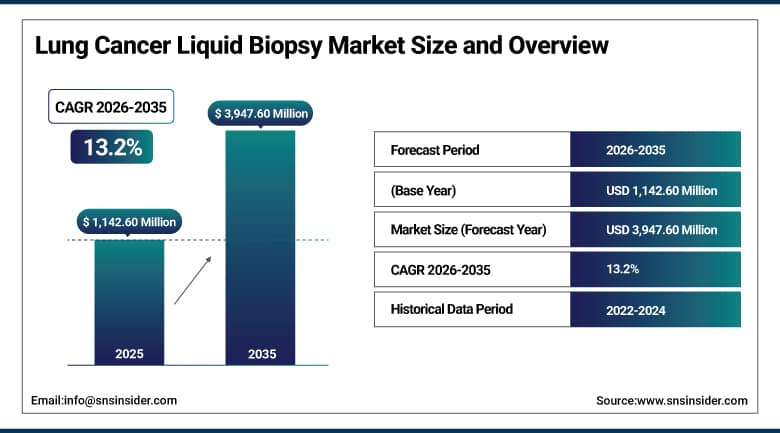
The Lung Cancer Liquid Biopsy Market was valued at USD 1,142.60 Million in 2025 and is projected to reach USD 3,947.60 Million by 2035, registering a CAGR of 13.2% from 2026 to 2035.
The Lung Cancer Liquid Biopsy Market is transforming lung cancer diagnosis and management by enabling minimally invasive detection of tumor-derived genetic mutations directly from a patient blood sample, eliminating the need for risky tissue biopsy in many clinical scenarios. The market is marked by increasing government regulatory bodies' approval of liquid biopsy approaches for blood-based genomic analysis, widespread healthcare payer reimbursement coverage across major health care systems, and increasing pharmaceutical industry interest in the use of liquid biopsy methods to monitor molecular responses in targeted therapy and immunotherapy regimens. Significant growth is occurring in areas of minimal residual disease surveillance testing, next generation sequencing panel implementation, and fragmentomics test development.
The NHS became the first health system in the world to introduce a nationwide liquid biopsy blood test for cancer patients throughout 2025, enabling faster access to targeted therapy for lung and breast cancer patients nationwide.
To Get More Information On Lung Cancer Liquid Biopsy Market - Request Free Sample Report
Lung Cancer Liquid Biopsy Market Trends:
-
Rising regulatory and clinical guideline endorsement continues normalizing blood-based genomic profiling as standard of care for advanced lung cancer.
-
Growing minimal residual disease surveillance testing continues expanding post-surgical monitoring adoption among oncology treatment centers.
-
Expanding fragmentomics and methylation-based assay development continues lowering sequencing costs while maintaining diagnostic accuracy.
-
Increasing pharmaceutical demand for circulating tumor DNA endpoints continues embedding liquid biopsy into clinical trial drug registration pathways.
-
Rising hospital laboratory in-sourcing of testing capability continues shifting volume away from independent reference laboratories over time.
-
Growing academic-industry collaboration continues accelerating validation of novel biomarker panels for earlier-stage lung cancer detection.
U.S. Lung Cancer Liquid Biopsy Market Outlook:
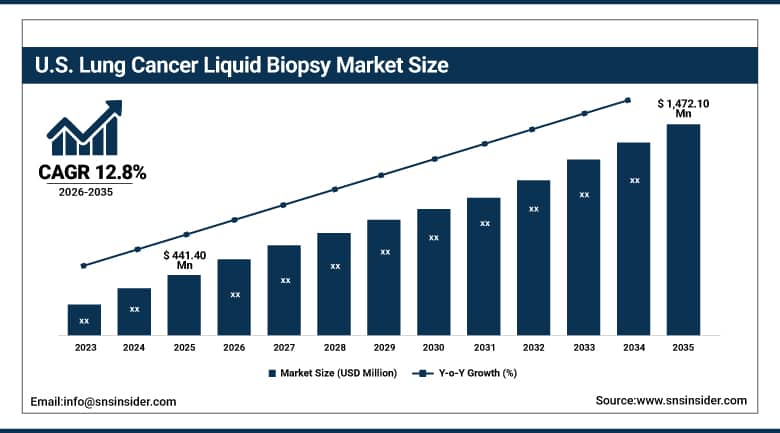
The U.S. Lung Cancer Liquid Biopsy Market was valued at approximately USD 441.40 Million in 2025 and is projected to reach approximately USD 1,472.10 Million by 2035, registering a CAGR of approximately 12.8% from 2026 to 2035.
United States demand continued owing to medicare reimbursement decisions establishing national payment floors for major liquid biopsy assays, a dense concentration of leading testing vendors headquartered domestically, and active FDA engagement with analytic validity standards for minimal residual disease assays. Rising lung cancer incidence, combined with growing physician and patient preference for blood-based testing over repeat tissue biopsy, continued reinforcing the country's position as both the largest and most commercially advanced market for lung cancer liquid biopsy technology. Expanding pharmaceutical trial integration and growing hospital laboratory investment in onsite sequencing infrastructure added further layers of sustained domestic demand nationwide.
The Centers for Medicare & Medicaid Services placed Guardant360 CDx and FoundationOne Liquid CDx on its Advanced Diagnostic Laboratory Test list throughout 2025, establishing national reimbursement price floors that strengthened commercial payer alignment for lung cancer liquid biopsy testing nationwide.
Lung Cancer Liquid Biopsy Market Segment Analysis:
-
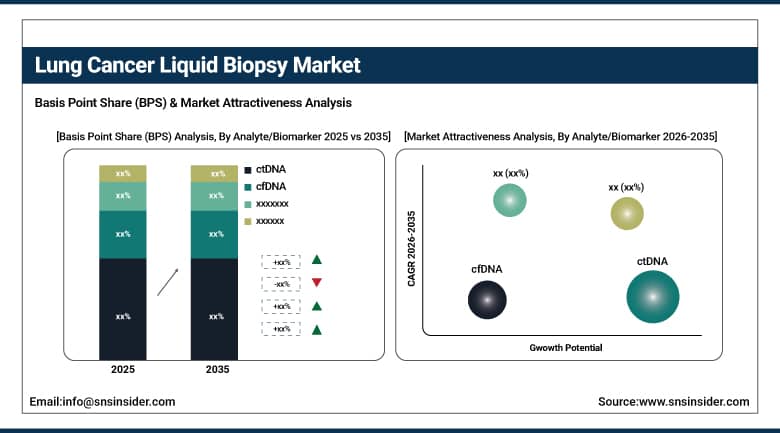
By Analyte/Biomarker, ctDNA segment dominated the Lung Cancer Liquid Biopsy Market in 2025 with 61.80% share; Exosomes/Extracellular Vesicles segment is the fastest growing segment.
-
By Technology, NGS-Based Comprehensive Genomic Profiling segment dominated the market in 2025 with 52.70% share; Fragmentomics/Methylation Analytics segment is the fastest growing segment.
-
By Clinical Use Case, Therapy Selection segment dominated the market in 2025 with 40.20% share; MRD/Recurrence Surveillance segment is the fastest growing segment.
-
By End User, Independent Reference Laboratories segment dominated the market in 2025 with 45.30% share; Hospitals segment is the fastest growing segment.
By Analyte, ctDNA Leads the Market While Exosomes Post the Fastest Growth
The ctDNA segment dominated the Lung Cancer Liquid Biopsy Market due to its extensive clinical validation for identifying actionable gene mutations for targeted cancer therapies, especially in patients with advanced-stage cancers where circulating tumor cells are less detectable. Physician proficiency with ctDNA analysis assays and FDA-approved companion diagnostics predominantly involving ctDNA ensured this analyte as the default choice for almost all oncology testing scenarios. Established laboratory infrastructure and reimbursement precedent further cemented ctDNA's continued revenue leadership. Continued expansion of FDA-cleared companion diagnostic indications tied specifically to ctDNA testing has further reinforced this analyte's central role across most oncology testing algorithms.
The Exosomes/Extracellular Vesicles segment is the fastest growing in the Lung Cancer Liquid Biopsy Market, driven by increase in investigator interest on cell-free RNA and protein cargo that have potential to elucidate underlying resistance mechanisms and grasp biomarker expression patterns not captured by DNA mutation analysis. Pharmaceutical partnerships focused on the validation of exosomal biomarkers for immunotherapy selection are continuously propelling this niche segment, while automated processing kits help minimize the considerable hands-on time required for traditional exosome isolation. Growing interest from pharmaceutical companies in validating exosomal biomarkers together with existing ctDNA panels reinforces the idea that this analyte will be a complementary test rather than a competing one.
By Technology, NGS Dominates While Fragmentomics and Methylation Analytics Record the Fastest Growth
The NGS-Based Comprehensive Genomic Profiling segment dominated the Lung Cancer Liquid Biopsy Market in 2025, supported by its ability to simultaneously assess hundreds of genes across a single blood draw, providing comprehensive mutation profiling that single-gene assays cannot match. Broad adoption of large gene panels among reference laboratories and academic medical centers reinforced NGS technology as the preferred platform for comprehensive lung cancer molecular profiling across most clinical testing pathways. Continued expansion of gene panel size among leading vendors has further widened the diagnostic scope achievable through a single blood draw compared with earlier-generation targeted panels.
The Fragmentomics/Methylation Analytics segment is the fastest growing in the Lung Cancer Liquid Biopsy Market with low-coverage assays cutting sequencing depths drastically, resulting in substantial cost savings versus deep-coverage NGS panels. The segment continues benefiting from growing uptake by cash-strapped health systems, who can deploy tests using existing next-generation sequencing capacity. Compatibility with current high-throughput sequencing pipelines helps drive the segment's rapid expansion, helping tertiary hospitals integrate testing capabilities into routine operations without compromising on detection precision or reliability.
By Clinical Use Case, Therapy Selection Dominates While MRD Surveillance Emerges as the Fastest-Growing Application
The Therapy Selection segment accounted for the highest share in the Lung Cancer Liquid Biopsy Market during 2025 as it represents the most clinically proven application supported by most existing FDA-approved companion diagnostics used to guide targeted therapies. Rising launch of novel targeted and immuno-oncology therapies requiring molecular confirmation before treatment initiation continued reinforcing this use case as the largest revenue-generating clinical application. Growing pharmaceutical company sponsorship of companion diagnostic development continues reinforcing sustained investment in this clinical use case across drug approval and post-approval monitoring pathways.
The MRD/Recurrence Surveillance segment is the fastest growing in the Lung Cancer Liquid Biopsy Market as emerging trial evidence demonstrates that post-operative circulating tumor DNA status predicts benefit from adjuvant immunotherapy. Growing adoption of serial monitoring protocols that extend testing cadence across an entire treatment continuum continues expanding this use case's addressable market well beyond single-timepoint therapy selection testing. Expanding evidence linking postoperative ctDNA clearance to long-term survival outcomes continues strengthening the clinical rationale for broader surveillance testing adoption.
By End User, Independent Reference Laboratories Dominate While Hospitals Post the Fastest Growth
The Independent Reference Laboratories segment dominated the Lung Cancer Liquid Biopsy Market in 2025 due to its existing large-scale infrastructure, extensive menu of assays, and established relationships with community oncology clinics unable to perform in-house molecular diagnostics testing. The extensive existing laboratory infrastructure and established FDA clearance portfolio of independent reference laboratories cemented the segment’s dominance as the biggest category of end users for liquid biopsy tests for lung cancer. Relationships built between independent reference laboratories and community oncology networks unable to conduct molecular testing served as ongoing drivers of market dominance.
The Hospitals segment is the fastest growing in the Lung Cancer Liquid Biopsy Market as academic medical centers and large hospital networks increasingly internalize sequencing capability to reduce turnaround time and protect testing revenue margin. Growing capital investment in on-site next-generation sequencing infrastructure continues driving this segment's growth as hospitals seek to compress diagnostic timelines during critical treatment decision windows. Growing hospital system consolidation continues creating additional opportunities for centralized in-house testing capability across multi-site academic medical networks.
Regional Analysis:
|
Region |
Major Country |
Share within Region, 2025 (%) |
|---|---|---|
|
North America |
United States |
88.0% |
|
Europe |
Germany |
22.0% |
|
Asia Pacific |
China |
34.0% |
|
Latin America |
Brazil |
36.0% |
|
Middle East & Africa |
UAE |
30.0% |
North America Lung Cancer Liquid Biopsy Market Insights
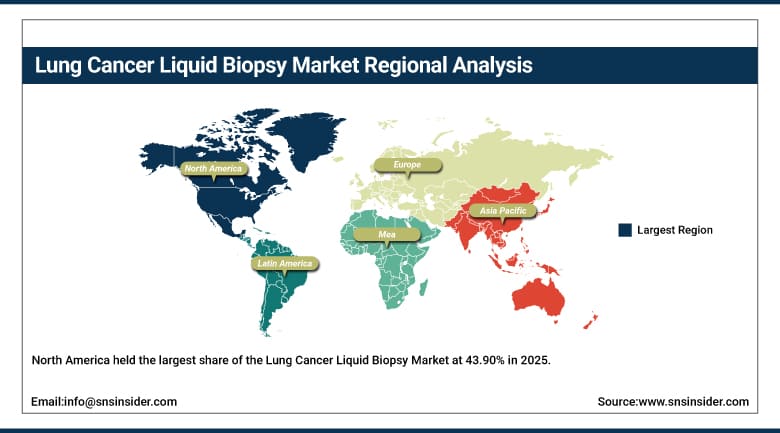
North America held the largest share of the Lung Cancer Liquid Biopsy Market at 43.90% in 2025. Medicare reimbursement decisions establishing national payment floors for major assays, a dense concentration of leading testing vendors headquartered in the region, and a mature clinical trial ecosystem continued reinforcing this dominant regional position. Strong hospital investment in onsite sequencing infrastructure and vendor-pharma collaboration further supported sustained regional demand throughout the current forecast period.
The United States accounted for the substantial majority of regional revenue, anchored by its concentration of leading testing vendors and a mature reimbursement framework covering major FDA-cleared assays. Canada added further regional demand through steady public healthcare system engagement with molecular oncology testing, and that combined strength kept the continent the largest addressable market for lung cancer liquid biopsy vendors through the forecast period.
Get Customized Report as Per Your Business Requirement - Enquiry Now
Europe Lung Cancer Liquid Biopsy Market Insights
Europe exhibited mixed but meaningful momentum, supported by growing national reimbursement recognition for plasma-based testing in advanced disease and strong clinical trial infrastructure across the region's leading economies. Continued regulatory alignment under ESMO consensus statements and expanding national health service coverage decisions reinforced sustained demand for lung cancer liquid biopsy technology across the region's major healthcare systems.
Germany, the United Kingdom, and France led regional demand by introducing procedure codes that reimburse plasma testing when tissue biopsy is contraindicated, collectively raising European access meaningfully within a short span. Divergent coding policies across other member states continue fragmenting broader adoption, while IVDR compliance costs delay the launch of newer assay innovations across smaller laboratory networks.
Asia Pacific Lung Cancer Liquid Biopsy Market Insights
Asia Pacific is projected to register the fastest growth at a CAGR of 15.60% from 2026 to 2035, driven by recent reimbursement decisions by China and Japan, rapidly rising lung cancer incidence, and growing domestic testing vendor capability offering assays at lower price points than established Western providers. Expanding regulatory approval activity across the region's largest economies kept the region's growth trajectory well ahead of every other region tracked in this report.
China led regional demand, supported by national regulatory approval of multiple ctDNA panels and provincial pilot reimbursement programs that continue expanding domestic testing penetration into lower-tier hospitals. Japan and India contributed meaningful additional demand, with Japan's insurers covering liquid biopsy when tissue sampling risks complications and India's growing oncology testing infrastructure both reinforcing the region's position as the fastest-growing market tracked in this report.
MEA and Latin America Lung Cancer Liquid Biopsy Market Insights
The Middle East and Africa and Latin America both showed steady growth, driven by expanding hospital infrastructure investment, growing government focus on cancer diagnostics, and rising collaborative initiatives introducing advanced liquid biopsy technology across both regions. As these markets continued building out modern oncology testing infrastructure, liquid biopsy offered a genuinely effective way to expand diagnostic capacity beyond limited tissue biopsy availability alone.
The UAE led Middle East and Africa demand through government-backed collaborative initiatives advancing blood-based genomic profiling across national cancer treatment networks. Saudi Arabia contributed further demand through its own oncology infrastructure investment programs. In Latin America, Brazil accounted for the largest share of regional demand, with growing private healthcare investment continuing to anchor regional adoption of lung cancer liquid biopsy testing.
Market Dynamics:
Growth Drivers: Regulatory Endorsement and Expanding Reimbursement Coverage
The industry is driven by rising regulatory and clinical guideline endorsement of blood-based genomic profiling, expanding reimbursement coverage across major healthcare systems, and growing lung cancer incidence that continues expanding the testing addressable population. As clinical guidelines increasingly recommend comprehensive blood-based profiling when tissue sampling is inadequate or contraindicated, the clinical need for reliable liquid biopsy alternatives continues driving adoption across oncology treatment pathways globally.
Growing pharmaceutical demand for circulating tumor DNA endpoints in clinical trials continues reinforcing this driver, as drug developers increasingly embed molecular monitoring throughout registrational studies to accelerate approval timelines. Rising physician and patient preference for blood-based testing over repeat tissue biopsy continues improving diagnostic turnaround time, and that combination of regulatory validation and patient preference is exactly what keeps oncology testing demand climbing at such a sustained, steady pace.
Restraints: Analytical Sensitivity Limitations and Inconsistent Global Reimbursement
Analytical sensitivity limitations in early-stage disease and low tumor shedding continue posing a genuine restraint on faster market-wide expansion, as detection rates for early-stage cancer remain well below those achievable with radiologic imaging modalities. That sensitivity gap keeps clinicians prioritizing tissue confirmation in scenarios where liquid biopsy results alone would risk false reassurance.
Inconsistent global reimbursement policies for screening and minimal residual disease applications continue posing a further restraint, as coverage decisions differ meaningfully by country, province, and individual insurer. That policy fragmentation compels vendors to mount extensive country-level health-economic evidence dossiers, delaying broader commercial scale-up outside markets with established reimbursement precedent.
Opportunities: Multi-Analyte Panel Innovation and Emerging Market Testing Expansion
Advancing multi-analyte panel technology that combines ctDNA mutation data with exosomal RNA and protein biomarkers represents a genuinely significant opportunity, as richer biological context could meaningfully improve diagnostic and prognostic accuracy beyond single-analyte testing. Vendors positioned early with validated multi-analyte platforms stand to capture meaningful share as clinical evidence continues accumulating in favor of combined biomarker approaches.
Expanding testing infrastructure and reimbursement recognition across emerging markets offers a second substantial opportunity, as recent regulatory and reimbursement decisions across China, Japan, and other Asian markets continue creating fresh demand for accessible molecular testing capacity. Vendors with proven, cost-competitive testing platforms stand to capture meaningful share as developing healthcare systems build out modern oncology testing capability from a comparatively low existing base.
Recent Developments:
-
2025: M42, AstraZeneca, and SOPHiA GENETICS launched a UAE Liquid Biopsy Initiative aimed at advancing cancer diagnosis and treatment through blood-based genomic profiling across the region.
-
2025: The Cancer Research Institute enrolled the first patient in the second stage of the BR.36 clinical trial, using circulating tumor DNA to measure early immunotherapy response in advanced lung cancer patients.
-
2024: Roche expanded its Foundation Medicine liquid biopsy portfolio with enhanced tumor fraction reporting capability, improving clinicians' ability to interpret low-level ctDNA results in early-stage lung cancer monitoring.
Lung Cancer Liquid Biopsy Market key players are:
-
Natera, Inc.
-
Illumina, Inc.
-
Agilent Technologies, Inc.
-
Bio-Rad Laboratories, Inc.
-
Biocept, Inc.
-
Burning Rock Biotech Limited
-
Exact Sciences Corporation
-
GRAIL, LLC
-
Laboratory Corporation of America Holdings (Labcorp)
-
Menarini Silicon Biosystems S.p.A.
-
NeoGenomics, Inc.
-
Personalis, Inc.
-
QIAGEN N.V.
-
Singlera Genomics, Inc.
-
Tempus AI, Inc.
-
Delfi Diagnostics, Inc.
-
MDxHealth SA
Lung Cancer Liquid Biopsy Market Report Scope:
| Report Attributes | Details |
|---|---|
| Market Size in 2025 | USD 1,142.60 Million |
| Market Size by 2035 | USD 3,947.60 Million |
| CAGR | CAGR of 13.2% From 2026 to 2035 |
| Base Year | 2025 |
| Forecast Period | 2026-2035 |
| Historical Data | 2022-2024 |
| Report Scope & Coverage | Market Size, Segments Analysis, Competitive Landscape, Regional Analysis, DROC & SWOT Analysis, Forecast Outlook |
| Key Segments | • By Analyte/Biomarker (ctDNA, cfDNA, CTCs, Exosomes/Extracellular Vesicles, Methylation/Fragmentomics Signatures) • By Technology (NGS-Based Comprehensive Genomic Profiling, PCR/ddPCR, Fragmentomics/Methylation Analytics, Others) • By Clinical Use Case (Therapy Selection, Treatment-Response Monitoring, MRD/Recurrence Surveillance, Early Detection/Screening) • By End User (Independent Reference Laboratories, Hospitals, Oncology Clinics) |
| Regional Analysis/Coverage | North America (US, Canada), Europe (Germany, UK, France, Italy, Spain, Russia, Poland, Rest of Europe), Asia Pacific (China, India, Japan, South Korea, Australia, ASEAN Countries, Rest of Asia Pacific), Middle East & Africa (UAE, Saudi Arabia, Qatar, South Africa, Rest of Middle East & Africa), Latin America (Brazil, Argentina, Mexico, Colombia, Rest of Latin America). |
| Company Profiles | Guardant Health, Inc., F. Hoffmann-La Roche AG (Foundation Medicine), Thermo Fisher Scientific Inc., Natera, Inc., Illumina, Inc., Agilent Technologies, Inc., Bio-Rad Laboratories, Inc., Biocept, Inc., Burning Rock Biotech Limited, Exact Sciences Corporation, GRAIL, LLC, Laboratory Corporation of America Holdings (Labcorp), Menarini Silicon Biosystems S.p.A., NeoGenomics, Inc., Personalis, Inc., QIAGEN N.V., Singlera Genomics, Inc., Tempus AI, Inc., Delfi Diagnostics, Inc., MDxHealth SA. |

Frequently Asked Questions
Key players include Guardant Health, Roche, Thermo Fisher Scientific, Natera, Illumina, Agilent Technologies, Bio-Rad Laboratories, and Exact Sciences, among others.
Key opportunities include multi-analyte panel innovation, minimal residual disease testing expansion, reimbursement growth, and emerging-market molecular testing infrastructure development.
The market is driven by regulatory endorsement, expanding reimbursement coverage, rising lung cancer incidence, and increasing adoption of blood-based genomic profiling.
The ctDNA segment dominated the Lung Cancer Liquid Biopsy Market, accounting for approximately 61.80% market share in 2025.
The North America region dominated the Lung Cancer Liquid Biopsy Market in 2025 with a 43.90% share, driven by reimbursement coverage and advanced testing infrastructure.
