
Wireless Intraoral Camera Market Report Scope & Overview:
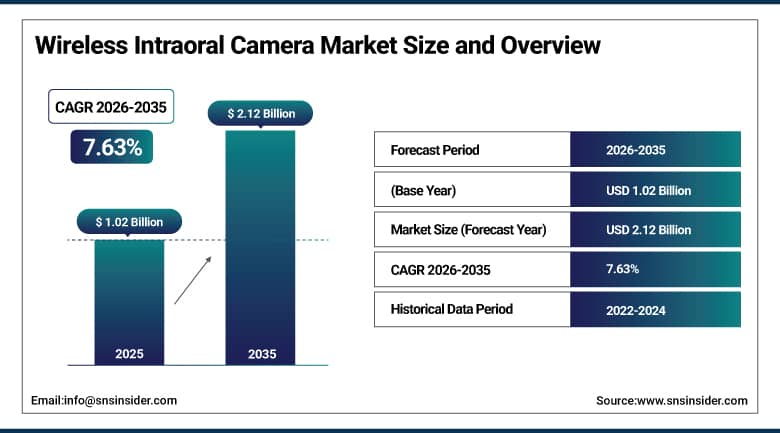
The Wireless Intraoral Camera Market was valued at USD 1.02 Billion in 2025 and is expected to reach USD 2.12 Billion by 2035, growing at a CAGR of 7.63% from 2026 to 2035.
The Wireless Intraoral Camera market is witnessing continuous growth owing to the increase in the number of cases associated with oral health disorders such as dental caries, periodontitis, and edentulism around the globe. Moreover, the growth can be attributed to the rising adoption of digital dentistry practices coupled with the advancements made in wireless imaging sensors with improved resolution and clarity. The wireless intraoral cameras are handheld devices used in dentistry to obtain clear images of the teeth and gums. The images obtained are transmitted wirelessly on an attached display screen without the use of any cables that can hinder the process.
In 2022, the company Acteon Group Ltd. launched the latest C50 intraoral camera that offers exceptional clarity in imaging for improved treatment workflows.
To Get More Information On Wireless Intraoral Camera Market - Request Free Sample Report
Wireless Intraoral Camera Market Trends:
-
Rising integration of AI-assisted diagnostic algorithms is enhancing the clinical accuracy of wireless intraoral imaging platforms.
-
Growing adoption of Full High-definition sensors is improving visualization of early-stage caries and fine restorative margins.
-
Increasing demand for real-time patient education tools is expanding wireless camera use during routine dental consultations.
-
Expanding partnerships between camera manufacturers and dental practice management software providers are streamlining chairside workflows.
-
Rising focus on infection control is accelerating adoption of lightweight, easy-to-sterilize wireless camera housings.
U.S. Wireless Intraoral Camera Market Outlook:
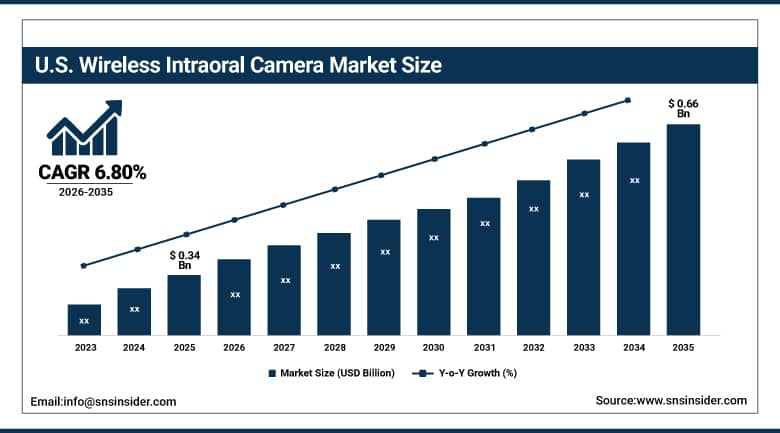
The U.S. Wireless Intraoral Camera Market was valued at USD 0.34 Billion in 2025 and is projected to reach USD 0.66 Billion by 2035, growing at a CAGR of 6.80% during 2026–2035.
Both major device vendors as well as dental practice networks throughout the United States continue to extend the applications of wireless intraoral cameras due to the increased focus on aesthetic dentistry, more popularity of digital diagnostics, and rising number of hospital-based and specialty dentistry centers. The tendency towards the increasing need for chairside imaging for same-day patient education and consent to the procedure also plays a significant role in the expanding adoption of advanced wireless camera solutions. In addition, local producers will invest in artificial intelligence and integration with practice management software to remain ahead of foreign companies that aim to enter the U.S. dental imaging market.
In 2023, Carestream Dental expanded the line of CS 1500 wireless intraoral cameras by providing the users with improved LED illumination and more convenient USB-C connectivity.
Wireless Intraoral Camera Market Segment Analysis:
-
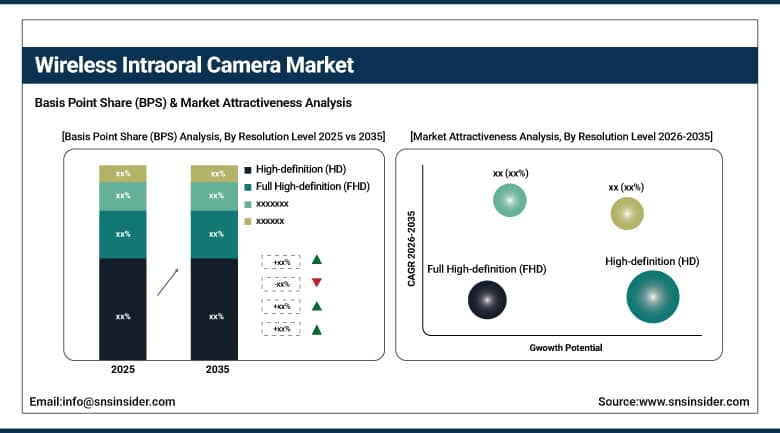
By Resolution Level, High-definition (HD) dominated the Wireless Intraoral Camera Market with a 63.00% share in 2025, while Full High-definition (FHD) is the fastest-growing resolution level segment with a CAGR of 9.40% from 2026–2035.
-
By Application, Endodontics dominated the Wireless Intraoral Camera Market with a 54.00% share in 2025, while Implantology is the fastest-growing application segment with a CAGR of 9.60% from 2026–2035.
-
By End User, Hospitals dominated the Wireless Intraoral Camera Market with a 57.00% share in 2025, while Oral and Maxillofacial Surgery is the fastest-growing end-user segment with a CAGR of 9.50% from 2026–2035.
By Resolution Level, High-definition (HD) dominated the Wireless Intraoral Camera Market, while Full High-definition (FHD) is the fastest-growing segment.
Market share for the High-definition segment was recorded at 63.00%. The popularity of the HD cameras can be attributed to the well-balanced features of image quality, cost-effectiveness, and interoperability with the majority of dental practice management software solutions. Such an array of features allows dentists to detect such minute details as cracks or cavities that can go unnoticed during conventional examination of the teeth. Since there is a huge variety of HD cameras offered by various manufacturers at different price ranges and since they proved to be effective in general dentistry and in educating patients, it is not surprising that this segment holds the leading market position.
The Full High-definition segment is expected to witness the highest CAGR of 9.40% during the forecast period 2026-2035. Rising demand for superior image clarity to support complex restorative and cosmetic dentistry procedures is propelling above-average segment growth, as FHD cameras enable practitioners to capture finer detail in enamel texture, restoration margins, and soft tissue conditions critical to esthetic case planning. Growing integration of FHD imaging with AI-assisted diagnostic software, which benefits from higher-resolution input data to improve detection accuracy, continues to widen adoption among technologically progressive dental practices, positioning this segment as an increasingly important area of manufacturer investment and premium product differentiation.
By Application, Endodontics dominated the Wireless Intraoral Camera Market, while Implantology is the fastest-growing segment.
The Endodontics segment dominated the Wireless Intraoral Camera Market with a revenue share of 54.00% in 2025. Endodontics remains the largest application category owing to the critical role wireless intraoral cameras play in providing improved diagnosis of the pulp and surrounding tissues of the tooth during root canal and related procedures, while helping reduce infection risk since images can be captured without prolonged close contact with the patient's mouth. The segment's continued dominance is reinforced by the high global incidence of dental caries requiring endodontic intervention, along with growing practitioner reliance on intraoral imaging to document pre- and post-treatment tooth condition for both clinical recordkeeping and patient communication purposes.
The Implantology segment is expected to register the fastest CAGR of 9.60% during the forecast period 2026-2035. Rising global demand for dental implant procedures, driven by an aging population experiencing tooth loss and growing patient willingness to invest in permanent restorative solutions, is driving above-average adoption of wireless intraoral cameras for pre-surgical site assessment, implant placement guidance, and post-operative monitoring. Increasing integration of intraoral imaging with digital implant planning software continues to expand its clinical utility, positioning this segment as an increasingly important growth driver for camera manufacturers targeting oral surgery and implantology-focused practices.
By End User, Hospitals dominated the Wireless Intraoral Camera Market, while Oral and Maxillofacial Surgery is the fastest-growing segment.
Hospitals have dominated the market in terms of market share with 57.00% of the revenue share captured in 2025. They are considered the leading end-users in the market, due to the increase in the number of healthcare institutions providing dental and oral healthcare services, capability of handling complicated cases that require collaboration of various dental, surgical, and imaging professionals, and high capacity of imaging equipment and patients' visits. The mentioned factors make it evident why hospitals play a significant role in demand for wireless intraoral cameras especially in cases of trauma, oral pathology, or combined treatment of diseases.
The fastest growing end user segment in the analyzed market is Oral and Maxillofacial Surgery with a forecasted CAGR of 9.50% by 2035. The rising demand for precision during pre- and post-procedural documentation in complicated cases such as implants, jaw reconstruction, and pathology examinations, as well as the need to provide detailed visualization during the treatment of oral and facial defects drives the above average adoption rate. In addition, the growing specialization of the oral surgery practices and investments in imaging technology contribute to the growth of the mentioned segment.
Regional Analysis:
|
Region |
Major Country |
Share within Region, 2025 (%) |
|
North America |
United States |
85.00% |
|
Europe |
Germany |
24.00% |
|
Asia Pacific |
China |
38.00% |
|
Middle East & Africa |
UAE |
24.00% |
|
South and Central America |
Brazil |
40.00% |
North America Wireless Intraoral Camera Market Insights
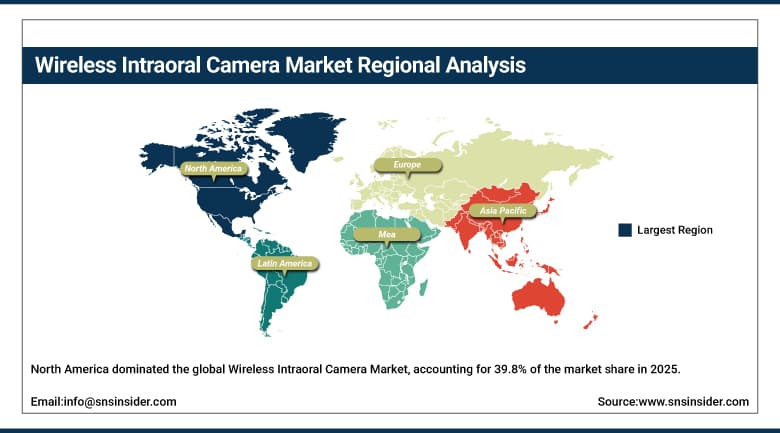
North America dominated the global Wireless Intraoral Camera Market, accounting for 39.8% of the market share in 2025. The region’s leading position is attributed to the widespread adoption of advanced dental imaging technologies, increasing demand for minimally invasive diagnostic procedures, and strong investments in modern dental care infrastructure. Growing awareness among dental professionals regarding digital imaging solutions, coupled with the presence of established healthcare providers and technology manufacturers, continues to support regional market growth. Favorable reimbursement policies and technological advancements further strengthen North America’s market leadership.
The US was the leading country within the North America Wireless Intraoral Camera Market in 2025 with a market share of 85.00% of the regional market, driven by extensive domestic dental practice networks, high consumer awareness of digital dentistry benefits, and the presence of leading intraoral camera and dental imaging manufacturers headquartered domestically. Canada is contributing to regional growth through expanding public and private healthcare investment in digital dental diagnostic infrastructure across major metropolitan dental practice networks.
Get Customized Report as Per Your Business Requirement - Enquiry Now
Europe Wireless Intraoral Camera Market Insights
Europe held a meaningful share of global revenue, supported by Wireless Intraoral Camera Market in 2025, expected to register steady growth for advanced, high-resolution imaging systems during the forecast period. This is attributed to the region's strong regulatory framework under EU-MDR supporting medical-grade imaging devices, a rising aging population requiring restorative and implant dentistry, and growing clinical emphasis on digital documentation across national health systems.
Germany is one of the major markets in Europe owing to its strong dental practice infrastructure and presence of leading dental imaging manufacturers serving both domestic and international customers. Other countries such as the United Kingdom, France, and Italy, home to established dental care networks and growing private practice investment, are also contributing to market growth through expanding procedure volumes and rising practitioner adoption of wireless diagnostic imaging tools.
Asia Pacific Wireless Intraoral Camera Market Insights
The Asia Pacific Wireless Intraoral Camera Market is expected to witness the fastest growth rate during the forecast period 2026-2035, registering a CAGR of 10.20%. The market growth is driven by rising awareness about oral hygiene, an increasing geriatric population, and expansion in dental and medical tourism across the region, supported by rapidly growing dental practice infrastructure and increasing patient willingness to invest in cosmetic and restorative dental procedures.
China is one of the main growth drivers in the Asia Pacific Wireless Intraoral Camera Market, owing to its large patient population and rapidly expanding domestic dental device manufacturing capability supporting both local and export-oriented customers. India and Japan are also contributing to regional growth through accelerating investment in dental practice modernization and rising incidence of oral disease requiring diagnostic imaging support.
Middle East & Africa and South and Central America Wireless Intraoral Camera Market Insights
Middle East & Africa and South and Central American regions are gradually expanding wireless intraoral camera adoption as dental practice investment grows across both regions, supported by increasing government healthcare modernization initiatives and growing physician training in digital dentistry techniques across major metropolitan dental care networks.
Brazil is set to be a prominent South American market fueled by its expanding private dental practice network and growing patient awareness of digital diagnostic alternatives to traditional dental examination methods. The Middle East & Africa region has the UAE and Saudi Arabia investing in advanced dental care infrastructure that is gradually increasing demand for wireless intraoral imaging systems across their expanding dental clinic and hospital networks.
Market Dynamics:
Growth Drivers: Rising oral disease prevalence and digital dentistry adoption driving market growth
The rise in prevalence of dental diseases globally, including dental caries, periodontal disease, and edentulism, is a major factor driving the growth of the Wireless Intraoral Camera Market. According to the WHO Global Oral Health Status Report, oral diseases affect nearly 3.5 billion people worldwide, with the majority of affected patients living in middle-income countries, continuing to expand the pool of patients requiring accurate, efficient diagnostic and treatment tools that wireless intraoral cameras readily provide.
Increase in focus on esthetic appeal and growing adoption of digital dentistry continues to boost overall market growth, as wireless intraoral cameras allow accurate and efficient diagnosis and treatment planning for various oral conditions without the cable constraints of legacy systems. Ongoing innovation in wireless sensor miniaturization, LED illumination, and AI-assisted diagnostic software is further improving the clinical relevance and ease of use of these devices, encouraging broader adoption among both general dentistry and specialty practices across developed and emerging markets alike.
Restraints: High device costs and preference for wired alternatives limiting market expansion
The relatively expensive cost associated with the acquisition of premium wireless intraoral cameras is another challenge to the market. This is because many dentists who operate with smaller budgets will find it difficult or not willing to pay for the wireless connection and other imaging capabilities that are equally found in cheaper wired intraoral cameras, which provide similar basic diagnostic capabilities.
Some dentists are also preferring to use the conventional wired intraoral cameras due to the increased reliability and few technical problems associated with connectivity. In addition, some wireless intraoral camera systems have software compatibility problems with different dental practice management systems.
Opportunities: Affordable device innovation and remote consultation integration creating new growth avenues
The rise of cost-effective wireless intraoral cameras presents significant growth prospects for the Wireless Intraoral Camera Market. Many manufacturers have started focusing on offering a cost-efficient line of products that retain the essential features needed for diagnosis, catering to budget-conscious dental practices and emerging markets. Focus on enhancing the patient experience via real-time imaging is another area where there can be opportunities for wireless intraoral cameras with integrated patient consent workflows.
A huge growth potential exists in the area of tele-dentistry consultations as wireless intraoral cameras will help dental professionals to collect and share diagnostic images remotely without the need for a physical exam for the patients. The continued innovation in the domain of diagnostic accuracy using artificial intelligence as well as an increase in research and development activities in the global dental technology industry will further fuel growth during the forecast period.
Recent Developments:
-
2025: Planmeca introduced an upgraded wireless intraoral camera module compatible with its Romexis imaging software suite, aimed at streamlining chairside diagnostic workflow for connected dental practices.
-
2024: Dentsply Sirona expanded its Primescan Connect digital ecosystem with intraoral camera integration, enabling real-time chairside imaging alongside its existing intraoral scanning workflow.
-
2023: Carestream Dental launched an updated CS 1500 wireless intraoral camera featuring enhanced LED illumination and simplified USB-C connectivity for faster practice integration.
-
November 2022: Acteon Group Ltd. unveiled the next-generation C50, its most advanced intraoral camera, at the ADF Congress, offering dental professionals extremely sharp images to improve treatment workflows.
-
August 2021: PolaroidHealth launched the Polaroid P720, an HD 720p resolution intraoral camera designed to be lightweight, durable, and easy to use across general dental practices.
Wireless Intraoral Camera Market Key Players are:
-
Dentsply Sirona
-
Carestream Dental LLC
-
Planmeca Oy
-
Acteon Group Ltd.
-
Flight Dental Systems
-
Oasis Scientific Inc.
-
Shenzhen Bangvo Technology Co., Ltd.
-
RF America IDS
-
PolaroidHealth
-
Dexcowin Global Inc.
-
Ashtel Dental (Ashtel Studios)
-
DEXIS LLC
-
Danaher Corporation
-
Owandy Radiology
-
KaVo Dental GmbH
-
Air Techniques, Inc.
-
Video Dental Concepts
-
Vatech Co., Ltd.
-
MouthWatch, LLC
-
SOTA Imaging
Wireless Intraoral Camera Market Report Scope:
| Report Attributes | Details |
|---|---|
| Market Size in 2025 | USD 1.02 Billion |
| Market Size by 2035 | USD 2.12 Billion |
| CAGR | CAGR of 7.63% From 2026 to 2035 |
| Base Year | 2025 |
| Forecast Period | 2026-2035 |
| Historical Data | 2022-2024 |
| Report Scope & Coverage | Market Size, Segments Analysis, Competitive Landscape, Regional Analysis, DROC & SWOT Analysis, Forecast Outlook |
| Key Segments | • By Resolution Level (High-definition (HD), Full High-definition (FHD)) • By Application (Implantology, Endodontics) • By End User (Oral and Maxillofacial Surgery, Hospitals) |
| Regional Analysis/Coverage | North America (US, Canada), Europe (Germany, UK, France, Italy, Spain, Russia, Poland, Rest of Europe), Asia Pacific (China, India, Japan, South Korea, Australia, ASEAN Countries, Rest of Asia Pacific), Middle East & Africa (UAE, Saudi Arabia, Qatar, South Africa, Rest of Middle East & Africa), Latin America (Brazil, Argentina, Mexico, Colombia, Rest of Latin America). |
| Company Profiles | Dentsply Sirona, Carestream Dental LLC, Planmeca Oy, Acteon Group Ltd., Flight Dental Systems, Oasis Scientific Inc., Shenzhen Bangvo Technology Co., Ltd., RF America IDS, PolaroidHealth, Dexcowin Global Inc., Ashtel Dental (Ashtel Studios), DEXIS LLC, Danaher Corporation, Owandy Radiology, KaVo Dental GmbH, Air Techniques, Inc., Video Dental Concepts, Vatech Co., Ltd., MouthWatch, LLC, SOTA Imaging |
Frequently Asked Questions
Key players include Dentsply Sirona, Carestream Dental, Planmeca, Acteon Group, Flight Dental Systems, Oasis Scientific, DEXIS, and MouthWatch, among others.
Key opportunities include affordable device innovation, remote consultation integration, AI-assisted diagnostics, and expanding patient education applications across dental practices.
The market is driven by rising oral disease prevalence, digital dentistry adoption, wireless imaging innovation, and increasing demand for real-time patient education.
The High-definition (HD) segment dominated the Wireless Intraoral Camera Market, accounting for approximately 63.00% market share in 2025.
The North America region dominated the Wireless Intraoral Camera Market in 2025, while Asia Pacific registered the fastest growth at 10.20% CAGR.
