
qPCR Instruments Market Report Scope and Overview:
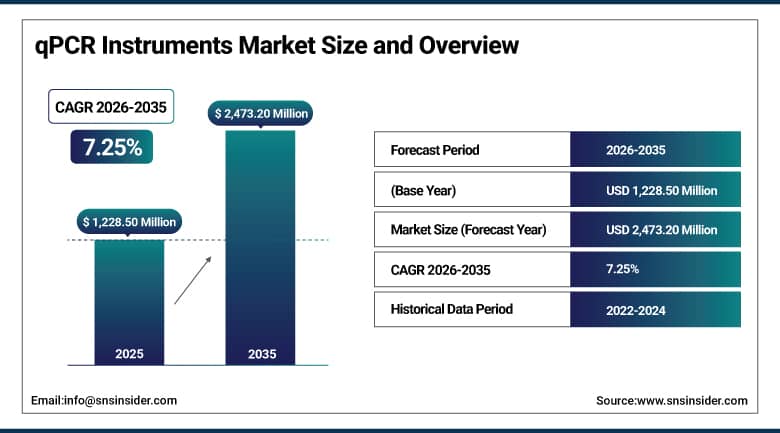
The qPCR Instruments Market was valued at USD 1,228.50 Million in 2025 and is projected to reach USD 2,473.20 Million by 2035, registering a CAGR of 7.25% from 2026 to 2035.
The qPCR Instruments Market is supporting expanding molecular diagnostic and research applications by providing accurate, real-time quantification of nucleic acid targets across clinical, research, forensic, and food safety testing settings. The market is characterized by increasing demand for infectious disease testing, proliferation of multiplex assays detecting multiple pathogens within a single test run, and wider adoption of digital PCR technology enabling absolute quantification without reliance on standard curves. Rapid development is taking place in the area of portable and point-of-care qPCR devices, automated sample-to-answer systems, and agricultural and food safety tests, since modern labs prefer more efficient nucleic acid detection methods rather than classical PCR and culturing.
Bio-Rad Laboratories launched the CFX Duet System throughout 2025, a next-generation real-time PCR platform combining qPCR and digital PCR capability in a single benchtop instrument, targeting research and clinical laboratories seeking flexible quantification workflows.
To Get More Information On qPCR Instruments Market - Request Free Sample Report
qPCR Instruments Market Trends:
-
Rising adoption of multiplex assay panels continues enabling simultaneous detection of multiple pathogens within a single qPCR testing run.
-
Growing integration of digital PCR technology continues supporting absolute nucleic acid quantification without external reference standards.
-
Expanding portable and point-of-care qPCR platform development continues bringing molecular testing capability closer to patient and field settings.
-
Increasing automation of sample-to-result workflows continues reducing hands-on technician time across high-throughput clinical laboratories.
-
Rising agricultural and food safety testing demand continues broadening qPCR instrument adoption beyond traditional clinical diagnostic applications.
U.S. qPCR Instruments Market Outlook:
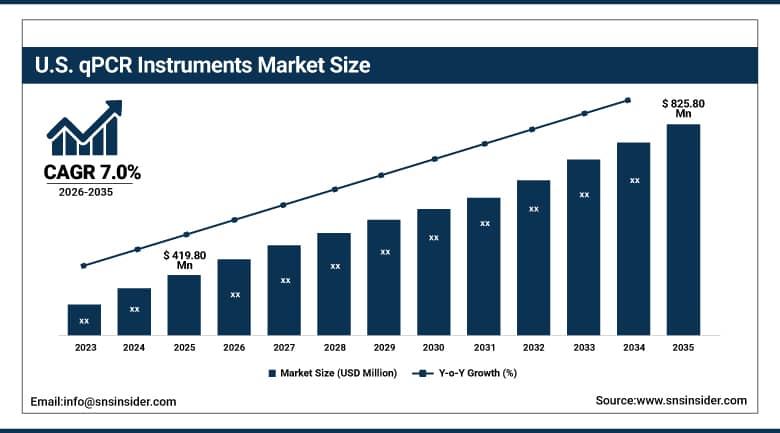
The U.S. qPCR Instruments Market was valued at approximately USD 419.80 Million in 2025 and is projected to reach approximately USD 825.80 Million by 2035, registering a CAGR of approximately 7.0% from 2026 to 2035.
Demand across the United States continued to be shaped by extensive clinical diagnostic laboratory infrastructure, a dense concentration of leading instrument manufacturers headquartered domestically, and sustained infectious disease testing volumes across hospital and reference laboratory networks. Rising adoption of multiplex respiratory and sexually transmitted infection panels continued reinforcing the country's position as both the largest and most commercially advanced market for qPCR instrumentation. Growing academic research funding, expanding food safety testing regulation, and rising pharmaceutical quality control testing added further layers of sustained domestic demand extending well beyond traditional clinical diagnostic laboratories into agricultural and industrial testing settings nationwide.
Thermo Fisher Scientific introduced an expanded configuration of its QuantStudio Absolute Q system throughout 2025, integrating microfluidic digital PCR technology with streamlined sample-to-result workflow automation across American research and clinical laboratories.
qPCR Instruments Market Segment Analysis:
-
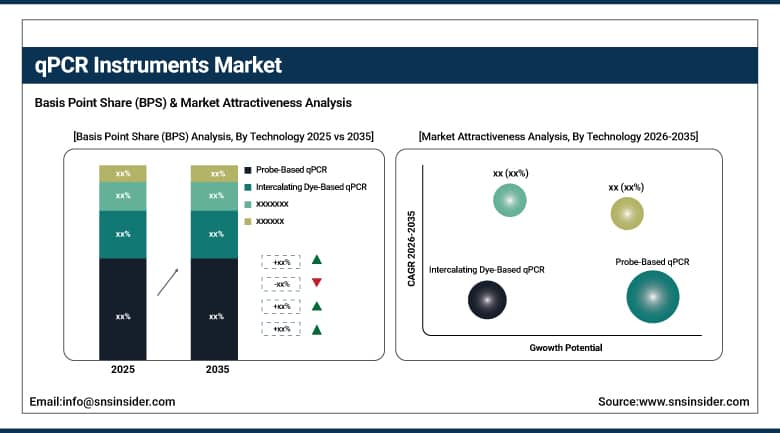
By Technology, Probe-Based qPCR segment dominated the market in 2025 with 62.30% share; Intercalating Dye-Based qPCR segment is the fastest growing segment.
-
By Product Type, Standard/Benchtop qPCR Systems segment dominated the qPCR Instruments Market in 2025 with 58.40% share; Portable/Point-of-Care qPCR Systems segment is the fastest growing segment.
-
By Application, Clinical Diagnostics segment dominated the market in 2025 with 46.70% share; Agriculture & Food Testing segment is the fastest growing segment.
-
By End User, Diagnostic Laboratories segment dominated the market in 2025 with 38.90% share; Hospitals segment is the fastest growing segment.
By Technology, Probe-Based Systems Dominate While Dye-Based Systems Record the Fastest Growth
The Probe-Based qPCR segment dominated the qPCR Instruments Market in 2025. This can be attributed to its highly specialized and accurate detection of targets along with the capability to test multiple targets simultaneously in a single well. Widespread clinical acceptance of the probe chemistry technology, especially in tests related to infectious diseases, has strengthened the status of this technology in regulated clinical settings.
The Intercalating Dye-Based qPCR segment is the fastest growing in the qPCR Instruments Market as its lower reagent cost and simpler assay design continue attracting cost-sensitive research and emerging market laboratories expanding basic molecular testing capability. Growing academic and agricultural testing demand in developing regions, where budget constraints often outweigh multiplexing requirements, continues accelerating dye-based technology adoption ahead of the broader market average.
By Product Type, Benchtop Systems Lead the Market While Portable Systems Post the Fastest Growth
The Standard/Benchtop qPCR Systems segment dominated the qPCR Instruments Market in 2025, supported by their established presence across clinical, academic, and industrial laboratories requiring high-throughput, multi-sample processing capability for routine molecular testing workflows. Deep integration with existing laboratory information systems and accumulated regulatory validation history reinforced benchtop systems as the default instrument choice across most centralized testing environments. The ongoing investments from vendors for increasing the sample capacity and multiplexing capability have kept this segment's revenues in the forefront. With the growing preference of laboratories towards modularity and upgradable benchtop systems, the need for replacements has been well-sustained.
The Portable/Point-of-Care qPCR Systems segment is the fastest growing in the qPCR Instruments Market, driven by rising demand for rapid, decentralized molecular testing capability in emergency departments, field diagnostics, and resource-limited healthcare settings. Growing miniaturization of PCR chemistry and detection hardware continues expanding the clinical and field-testing scenarios where portable platforms can deliver laboratory-grade accuracy without requiring centralized laboratory infrastructure. Continued miniaturization of optical detection components and thermal cycling hardware continues narrowing the performance gap between portable and traditional benchtop systems.
By Application, Clinical Diagnostics Dominates While Agriculture and Food Testing Emerges as the Fastest-Growing Application
The Clinical Diagnostics segment dominated the qPCR Instruments Market in 2025, anchored by sustained infectious disease testing demand across hospital and reference laboratory networks and expanding oncology and genetic testing applications requiring precise nucleic acid quantification. Rising global infectious disease surveillance activity continued reinforcing this application as the largest revenue-generating segment across the current forecast period. Expanding pharmaceutical quality control testing requirements for cell and gene therapy manufacturing have further reinforced sustained clinical diagnostic instrument demand.
The Agriculture & Food Testing segment is the fastest growing in the qPCR Instruments Market as expanding food safety regulation and growing consumer demand for pathogen and genetically modified organism testing continue driving adoption across agricultural supply chains. Growing regulatory enforcement of food contamination testing standards across major export markets continues expanding this application's addressable market beyond traditional clinical and research use cases. Growing international trade compliance requirements for genetically modified organism labeling continue expanding testing obligations across food exporters in developing economies.
By End User, Diagnostic Laboratories Dominate While Hospitals Post the Fastest Growth
The Diagnostic Laboratories segment dominated the qPCR Instruments Market in 2025 driven by its experience in terms of test volume, wide menu of tests, and relationship with the referral physician network in laboratories without any capability to conduct molecular testing. The maturity level of the laboratory system and past experience in getting regulatory approvals helped make this segment the biggest end-user group for qPCR instruments. Long-standing relationships with referring physician networks continue reinforcing independent laboratories central role in the broader testing ecosystem.
The Hospitals segment is the fastest growing in the qPCR Instruments Market as hospital networks increasingly internalize molecular testing capability to reduce turnaround time for critical infectious disease and sepsis-related diagnostic decisions. Growing capital investment in on-site molecular diagnostic infrastructure continues driving this segment's growth as hospitals seek to compress diagnostic timelines during time-sensitive treatment decision windows.
Regional Analysis:
|
Region |
Major Country |
Share within Region, 2025 (%) |
|---|---|---|
|
North America |
United States |
85.00% |
|
Europe |
Germany |
25.00% |
|
Asia Pacific |
China |
33.00% |
|
Middle East and Africa |
UAE |
31.00% |
|
Latin America |
Brazil |
39.00% |
North America qPCR Instruments Market Insights
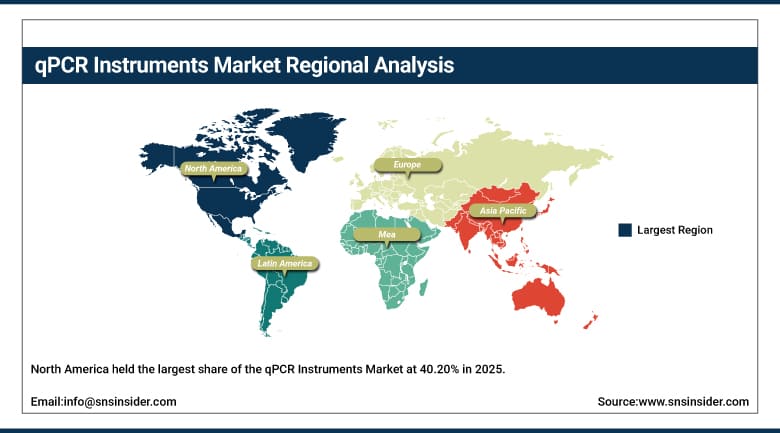
North America held the largest share of the qPCR Instruments Market at 40.20% in 2025. Extensive clinical diagnostic laboratory infrastructure, a dense concentration of leading instrument manufacturers, and sustained infectious disease testing volumes continued reinforcing this dominant regional position. Strong reimbursement coverage for molecular diagnostic testing, combined with substantial academic and pharmaceutical research funding, further supported sustained regional demand throughout the current forecast period. Ongoing hospital laboratory modernization initiatives continued adding incremental instrument replacement demand across both academic medical centers and community healthcare networks.
The United States accounted for the substantial majority of regional revenue, anchored by its concentration of leading instrument manufacturers and extensive hospital and reference laboratory testing infrastructure. Canada added further regional demand through steady public healthcare system investment in molecular diagnostic capability, and that combined strength kept the continent the largest addressable market for qPCR instrument vendors through the forecast period.
Get Customized Report as Per Your Business Requirement - Enquiry Now
Europe qPCR Instruments Market Insights
Europe held a meaningful share of global revenue, supported by well-established public healthcare systems, strong academic research infrastructure, and growing regulatory emphasis on food safety and agricultural testing standards across the region's major economies. Continued national health system investment in molecular diagnostic capacity reinforced sustained demand for qPCR instrumentation across the region's leading healthcare and research economies. Growing pharmaceutical manufacturing quality control requirements across the region continue reinforcing steady baseline instrument demand.
Germany led demand within the region, supported by its strong precision-instrument manufacturing base and deep academic and clinical research infrastructure. The United Kingdom and France contributed substantial additional demand through national health system investment and growing food safety testing regulation, and continued European research funding expansion should keep regional demand for qPCR instrumentation climbing steadily through the forecast period.
Asia Pacific qPCR Instruments Market Insights (Fastest Growing Region - 9.60% CAGR, 2026-2035)
Asia Pacific is projected to register the fastest growth, expanding at a CAGR of 9.60% from 2026 to 2035, driven by rapidly expanding healthcare infrastructure, rising infectious disease testing demand, and growing government investment in molecular diagnostic capability across the region's largest economies. Growing domestic instrument manufacturing capability kept the region's growth trajectory well ahead of every other region tracked in this report. Expanding domestic pharmaceutical manufacturing capacity across the region's leading economies continued creating fresh demand for both entry-level and advanced qPCR instrumentation.
China led regional demand, supported by substantial government investment in healthcare infrastructure and rapidly expanding domestic molecular diagnostic instrument manufacturing capability. Japan and India contributed meaningful additional demand, with India's growing diagnostic laboratory network and Japan's advanced healthcare technology adoption both reinforcing the region's position as the fastest-growing market tracked in this report.
MEA and Latin America qPCR Instruments Market Insights
The Middle East and Africa and Latin America both showed steady growth, driven by expanding healthcare infrastructure investment, growing government focus on infectious disease surveillance, and rising demand for modern molecular diagnostic capacity across both areas. As these markets continued building out modern healthcare infrastructure, qPCR instruments offered a genuinely effective way to expand diagnostic testing capacity beyond conventional culture-based methods alone.
The UAE led Middle East and Africa demand, supported by the country's advanced private healthcare infrastructure and substantial diagnostic capacity investment. Saudi Arabia contributed further demand through its own healthcare modernization programs. In Latin America, Brazil accounted for the largest share of regional demand, with growing public and private laboratory investment continuing to anchor regional demand for qPCR instrumentation.
Market Dynamics:
Growth Drivers: Rising Infectious Disease Testing and Multiplex Assay Adoption
The industry is driven by rising demand for diagnostic testing against infectious diseases globally, the emergence of multiplex assay systems capable of testing against multiple pathogens simultaneously, and the wide range of clinical and research applications that require nucleic acid quantification. The strong emphasis on accurate molecular diagnosis as opposed to traditional culture tests has led to the persistent need for reliable qPCR equipment, thus sustaining investments in diagnostics platforms in labs and hospitals all over the world. Moreover, governments are implementing programs to increase stockpiles of equipment to combat any potential pandemics.
Growing integration of digital PCR technology continues reinforcing this driver, as absolute quantification capability without external reference standards expands qPCR instrumentation's utility across research and applied testing applications. Rising automation of sample-to-result workflows continues reducing technician labor requirements, and that combination of analytical precision and workflow efficiency is exactly what keeps clinical and research laboratory demand climbing at such a sustained, steady pace.
Restraints: High Instrument Costs and Skilled Technician Requirements
The substantial capital investment required for advanced qPCR and digital PCR instrumentation continues posing a genuine restraint on faster market-wide expansion, particularly for smaller laboratories and healthcare facilities in cost-constrained settings without the capital budgets that large reference laboratories and hospital networks can commit. That cost profile has kept advanced molecular testing capability concentrated among comparatively well-resourced institutions. Price competition among established vendors has further compressed margins on entry-level benchtop systems in cost-sensitive market segments.
Skilled technician requirements continue posing a further restraint, as operating and interpreting qPCR instrumentation requires specialized molecular biology training that remains in limited supply across smaller laboratory settings and emerging markets. That expertise gap keeps some healthcare facilities reliant on centralized reference laboratories rather than developing in-house molecular testing capability.
Opportunities: Point-of-Care Innovation and Emerging Market Testing Capacity Expansion
Advancing point-of-care qPCR technology represents a genuinely significant opportunity, as continued miniaturization and simplification of PCR chemistry could substantially expand molecular testing access into decentralized clinical and field settings currently reliant on slower, centralized laboratory testing. Vendors positioned early with validated portable platforms stand to capture meaningful share as healthcare systems seek to decentralize diagnostic capability. Growing convergence between point-of-care qPCR platforms and smartphone-based data interpretation applications continues creating additional opportunities for vendors targeting resource-limited testing environments.
Expanding healthcare and food safety testing infrastructure across emerging markets offers a second substantial opportunity, as government investment programs across Asia Pacific, Latin America, and the Middle East continue creating fresh demand for accessible molecular diagnostic capacity. Vendors with proven, cost-competitive instrument platforms stand to capture meaningful share as developing healthcare systems build out modern testing capability from a comparatively low existing base.
Recent Developments:
-
2024: QIAGEN launched the QIAstat-Dx Rise system, a high-throughput syndromic testing platform incorporating real-time PCR technology for expanded infectious disease panel testing.
-
2025: Roche Diagnostics expanded its cobas 5800 system portfolio with new qPCR-based assay menus targeting respiratory and sexually transmitted infection testing in mid-volume clinical laboratories.
-
2024: Analytik Jena introduced the qTOWER4 real-time PCR thermal cycler with enhanced multiplexing capability for research and applied testing markets.
qPCR Instruments Market key players are:
-
Thermo Fisher Scientific Inc.
-
Bio-Rad Laboratories, Inc.
-
QIAGEN N.V.
-
F. Hoffmann-La Roche Ltd
-
Agilent Technologies, Inc.
-
Danaher Corporation (Cepheid)
-
Illumina, Inc.
-
Bio-Techne Corporation
-
Takara Bio Inc.
-
Analytik Jena GmbH+Co. KG
-
Eppendorf SE
-
Meridian Bioscience, Inc.
-
Promega Corporation
-
Sacace Biotechnologies S.r.l.
-
Seegene Inc.
-
Bioneer Corporation
-
Jena Bioscience GmbH
-
Fluxergy, Inc.
-
Coyote Bioscience Co., Ltd.
-
Hangzhou Bioer Technology Co., Ltd.
qPCR Instruments Market Report Scope:
| Report Attributes | Details |
|---|---|
| Market Size in 2025 | USD 1,228.50 Million |
| Market Size by 2035 | USD 2,473.20 Million |
| CAGR | CAGR of 7.25% From 2026 to 2035 |
| Base Year | 2025 |
| Forecast Period | 2026-2035 |
| Historical Data | 2022-2024 |
| Report Scope & Coverage | Market Size, Segments Analysis, Competitive Landscape, Regional Analysis, DROC & SWOT Analysis, Forecast Outlook |
| Key Segments | • By Product Type (Standard/Benchtop qPCR Systems, Portable/Point-of-Care qPCR Systems, Digital PCR Systems) • By Technology (Probe-Based qPCR, Intercalating Dye-Based qPCR, Others) • By Application (Clinical Diagnostics, Research Applications, Forensic Science, Agriculture & Food Testing) • By End User (Diagnostic Laboratories, Hospitals, Academic & Research Institutes, Pharmaceutical & Biotechnology Companies) |
| Regional Analysis/Coverage | North America (US, Canada), Europe (Germany, UK, France, Italy, Spain, Russia, Poland, Rest of Europe), Asia Pacific (China, India, Japan, South Korea, Australia, ASEAN Countries, Rest of Asia Pacific), Middle East & Africa (UAE, Saudi Arabia, Qatar, South Africa, Rest of Middle East & Africa), Latin America (Brazil, Argentina, Mexico, Colombia, Rest of Latin America). |
| Company Profiles | Thermo Fisher Scientific Inc., Bio-Rad Laboratories, Inc., QIAGEN N.V., F. Hoffmann-La Roche Ltd, Agilent Technologies, Inc., Danaher Corporation (Cepheid), Illumina, Inc., Bio-Techne Corporation, Takara Bio Inc., Analytik Jena GmbH+Co. KG, Eppendorf SE, Meridian Bioscience, Inc., Promega Corporation, Sacace Biotechnologies S.r.l., Seegene Inc., Bioneer Corporation, Jena Bioscience GmbH, Fluxergy, Inc., Coyote Bioscience Co., Ltd., Hangzhou Bioer Technology Co., Ltd. |
Frequently Asked Questions
Key players include Thermo Fisher Scientific, Bio-Rad Laboratories, QIAGEN, Roche, Agilent Technologies, Danaher, Illumina, and Takara Bio, among others.
Key opportunities include point-of-care qPCR innovation, portable testing, digital PCR integration, and expanding molecular testing infrastructure across emerging markets.
The market is driven by rising infectious disease testing, multiplex assays, digital PCR adoption, automation, and increasing molecular diagnostics demand worldwide.
The Standard/Benchtop qPCR Systems segment dominated the qPCR Instruments Market, accounting for approximately 58.40% market share.
The North America region dominated the qPCR Instruments Market in 2025 with a 40.20% share, driven by advanced diagnostic infrastructure and testing demand.
The North America region dominated the qPCR Instruments Market in 2025 with a 40.20% share, driven by advanced diagnostic infrastructure and testing demand.
