
Wearable Sleep Trackers Market Report Scope & Overview:
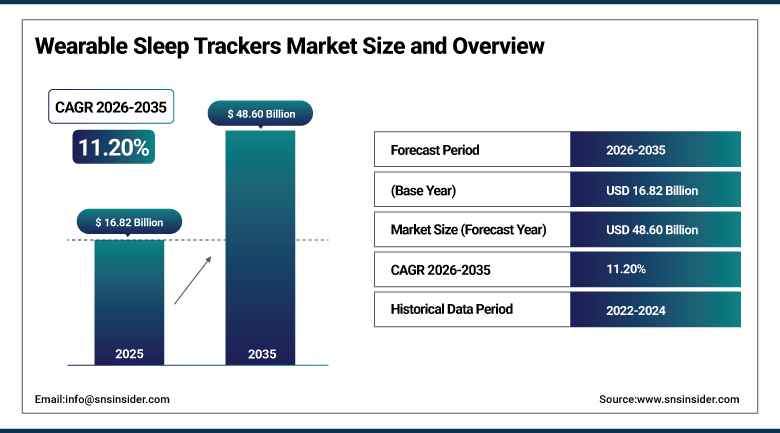
The Wearable Sleep Trackers Market was valued at USD 16.82 Billion in 2025 and is expected to reach USD 48.60 Billion by 2035, growing at a CAGR of 11.20% from 2026 to 2035.
The wearable sleep tracker market continues to grow at a constant pace as many people are affected by conditions such as insomnia and sleep apnea, driving interest in monitoring their sleep cycle continuously and non-invasively. The increasing use of photoplethysmography sensors, skin temperature sensors, and machine learning based sleep stage classifier on watches, bands, rings, and earbuds allows for a more precise measurement of the quality of sleep. Moreover, the rise of disposable income levels, increased health awareness, and collaborations between wearable manufacturers and telemedicine or behavioral healthcare providers are driving the uptake of sleep tracking wearables among the general populace and individuals suffering from chronic sleep-related conditions.
In June 2026, the company Ōura Health launched the Oura Ring 5 which was 40% smaller than its previous version, featuring enhanced Health Radar sensors that can detect the breath signals during night time and provide insights into GLP-1.
To Get more information Wearable Sleep Trackers Market - Request Free Sample Report
Wearable Sleep Trackers Market Trends:
-
Rising integration of AI-driven sleep-stage analytics is turning everyday wearables into near clinical-grade sleep diagnostic tools.
-
Growing popularity of smart rings such as the Oura Ring and Ultrahuman Ring AIR is expanding the market beyond wrist-worn devices.
-
Increasing collaboration between wearable technology companies and telehealth platforms is enabling real-time sleep data sharing with physicians.
-
Expanding use of multi-sensor fusion combining SpO2, heart rate variability, and skin temperature is improving sleep apnea detection accuracy.
-
Growing consumer preference for subscription-based sleep coaching platforms is creating new recurring revenue streams for device manufacturers.
U.S. Wearable Sleep Trackers Market Outlook:
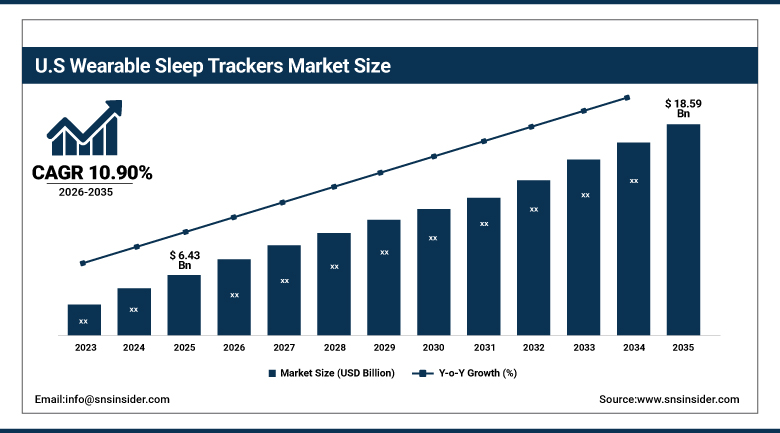
The U.S. Wearable Sleep Trackers Market was valued at USD 6.43 Billion in 2025 and is projected to reach USD 18.59 Billion by 2035, growing at a CAGR of 10.90% during 2026–2035.
Top wearable device and medtech companies in the nation have been increasingly launching sleep tracking features due to the increasing prevalence of insomnia and obstructive sleep apnea. Thanks to established reimbursement processes for sleep diagnostics and increased willingness from consumers to purchase subscriptions of health-monitoring services, the value of sleep data is rising. Smartphones becoming more ubiquitous, strong networks for consumer electronics devices, and FDA approvals for wellness and clinical adjacent technologies have enabled watches, bands, and earbuds to continuously monitor sleep cycles, breathing problems, and nightly recovery scores of both wellness and medical customers.
On May 2026, Apple released Sleep Apnea Notifications to more people from the United States and around the world by Apple Watch Series 11, Series 10, and Ultra 3 after receiving the 510(k) FDA approval of Sleep Apnea Notifications.
Wearable Sleep Trackers Market Segment Analysis:
-
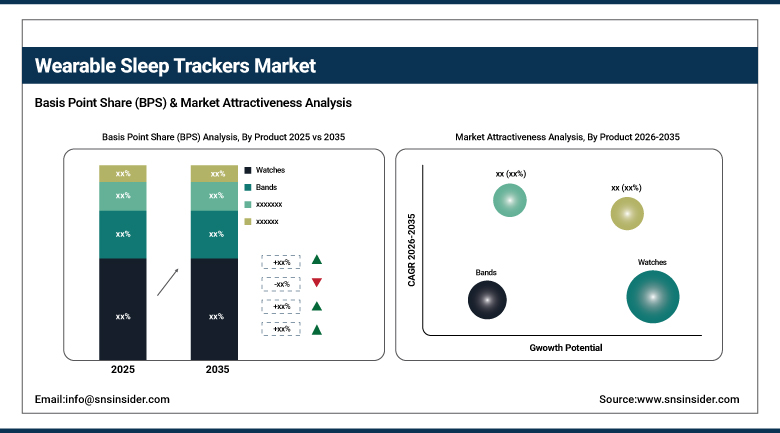
By Product, Watches dominated the Wearable Sleep Trackers Market with a 78.50% share in 2025, while Bands is the fastest-growing product segment with a CAGR of 13.80% from 2026–2035.
-
By Application, Insomnia dominated the Wearable Sleep Trackers Market with a 47.20% share in 2025, while Sleep Apnea is the fastest-growing application segment with a CAGR of 12.60% from 2026–2035.
By Product, Watches dominated the market, while Bands is the fastest-growing segment.
The Watches segment was able to retain its top position in the Wearable Sleep Trackers Market in 2025. The leading product type is smartwatches because of the many useful features they offer, including sleep staging, heart rate variability, SpO2 level, and daytime activity tracking all in one watch. The already existing awareness about such brands as Apple, Garmin, Samsung, and Huawei together with improvements in sensors and battery life has led to increased preference for watches in entering the world of wearable sleep trackers in both developed and emerging regions.
On the other hand, the Bands segment is expected to grow at the fastest. The demand for cheaper, longer-lasting and more compact devices, as opposed to smartwatches, has stimulated the purchase of bands, especially among first-timers and budget customers. Product launches by companies like Xiaomi and Huawei with special bands designed for sleep tracking equipped with AMOLED display and batteries for several days have accelerated growth in the most price-sensitive APAC and Latin American regions.
By Application, Insomnia dominated the market, while Sleep Apnea is the fastest-growing segment.
The Insomnia segment dominated the Wearable Sleep Trackers Market in 2025. Rising global prevalence of chronic sleep-onset and sleep-maintenance difficulties, coupled with growing consumer awareness of the long-term health consequences of poor sleep, continues to drive demand for wearables offering nightly sleep-stage breakdowns, sleep-score trends, and personalized coaching recommendations. Increasing use of wearable-generated sleep data by behavioral health and telehealth providers to support cognitive behavioral therapy for insomnia programs is further reinforcing this segment's leading position.
The Sleep Apnea segment is expected to witness the fastest CAGR. Regulatory clearance of wrist-worn breathing-disturbance detection algorithms and growing public health campaigns raising awareness of undiagnosed obstructive sleep apnea are accelerating adoption of wearables capable of flagging at-risk users for clinical follow-up. Rising integration of SpO2 and respiratory-rate sensors across mainstream watches and rings is expanding accessible, low-cost pre-screening options for a condition that remains substantially underdiagnosed worldwide.
Regional Analysis:
|
Region |
Major Country |
Share within Region, 2025 (%) |
|---|---|---|
|
North America |
United States |
87.80% |
|
Europe |
Germany |
26.40% |
|
Asia Pacific |
China |
38.60% |
|
Middle East & Africa |
Saudi Arabia |
24.80% |
|
Latin America |
Brazil |
35.40% |
North America Wearable Sleep Trackers Market Insights
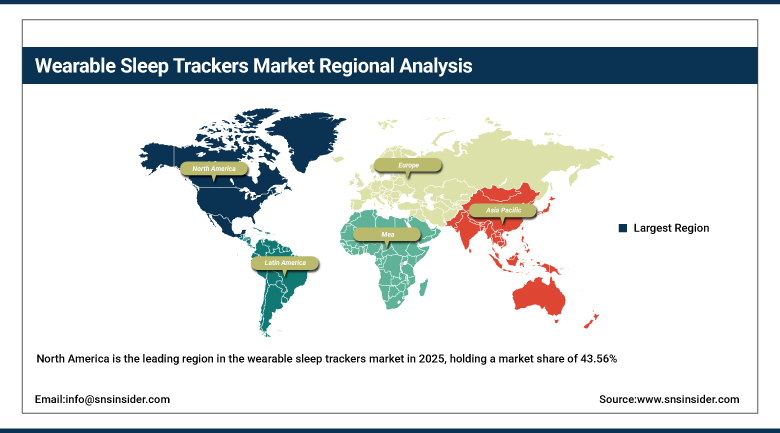
North America is the leading region in the wearable sleep trackers market in 2025, holding a market share of 43.56%. The factors responsible for such dominance include high consumer disposable income, healthy culture in the country and early adoption of connected health devices. The region's developed healthcare sector, reimbursement practices in diagnosing sleep disorders and increasing integration of data collected by wearables with telemedicine solutions contribute to the growing demand for sleep tracking watches, bands and earbuds for consumer wellness and clinical purposes.
The leading country of North America's market was the US. Such results are achieved due to high smartphone and smartwatch penetration rates, the availability of major device manufacturers and increasing prevalence of diagnosis of insomnia and obstructive sleep apnea. Another significant contributor to regional growth is Canada, where the growth of the digital health sector and increased use of wearables in preventive healthcare takes place.
Get Customized Report as per Your Business Requirement - Enquiry Now
Europe Wearable Sleep Trackers Market Insights
The Europe Wearable Sleep Trackers Market is witnessing steady growth, driven by rising awareness of sleep health, increasing adoption of fitness and wellness technologies, and growing interest in preventive healthcare. Expanding use of smartwatches, fitness bands, and connected earbuds is supporting market penetration across the region. Strong digital healthcare infrastructure, growing integration of wearable-generated data into healthcare services, and increasing consumer focus on personalized health monitoring are further contributing to demand. Germany, the U.K., France, and Italy remain key markets for wearable sleep-tracking solutions.
Germany is one of the major markets in Europe owing to the presence of leading wearable technology manufacturers and strong consumer purchasing power supporting premium device adoption. Other countries such as the UK, France, and Italy are also contributing to regional growth through rising public awareness campaigns on sleep health and expanding retail availability of sleep-tracking watches, bands, and earbuds across both mass-market and premium price tiers.
Asia Pacific Wearable Sleep Trackers Market Insights
The Asia Pacific Wearable Sleep Trackers Market is expected to witness the fastest CAGR of 13.10% during the forecast period 2026–2035. Market growth is driven by rising prevalence of sleep-related issues linked to stressful urban lifestyles and long working hours, rapidly growing middle-class disposable income, and increasing availability of affordable, locally manufactured wearable devices across the region's major and emerging economies.
The largest market share in Asia Pacific Wearable Sleep Trackers Market in 2025 belongs to China, due to strong manufacturing capability of wearable technology in the country and increasing importance of individual wellbeing due to growing concern about lack of proper sleep. India and Japan are playing an important role in market growth as well; India gets an advantage from fast adoption of smartphone-based wearables, and Japan is fueled by government-driven programs for sufficient sleep among workforce.
Middle East & Africa and Latin America Wearable Sleep Trackers Market Insights
Middle East & Africa and Latin American regions are gradually expanding wearable sleep tracker adoption as healthcare digitization and consumer wellness spending grow across both regions, supported by rising smartphone penetration, improving retail distribution networks, and increasing government and provider-led awareness campaigns around sleep apnea and related chronic conditions.
Brazil is set to be a prominent Latin American market, fueled by a growing trend toward personalized health and fitness tracking and rising availability of internationally distributed wearable brands. Within the Middle East & Africa region, Saudi Arabia and the UAE are investing in digital health infrastructure and preventive wellness initiatives that are gradually increasing consumer demand for sleep-tracking watches, bands, and rings across their expanding health-conscious populations.
Market Dynamics:
Growth Drivers: Rising sleep-disorder prevalence and consumer health awareness driving market growth
The rising incidences of insomnia and obstructive sleep apnea worldwide, along with heightened consumer awareness regarding the health risks associated with a lack of good quality sleep over a long period, has been one of the key factors driving the Wearable Sleep Trackers Market. Wearable devices allow continuous and non-invasive monitoring of sleep conditions, which were possible through clinical polysomnography before. Thus, wearable devices help monitor sleep stages, sleep disturbances, and recovery parameters at home. This has increased the addressable market significantly for both consumer wellness and clinically driven customers.
Technological advancements in terms of sensor size, power consumption, and sleep stage detection using machine learning have made these devices much more comfortable during a whole night's use. Integration of sleep data collected using wearable devices in telehealth and behavioral health platforms, regulatory clearance of clinical-like functionalities such as sleep apnea alerts, and investments in multi-sensor fusion technology have helped increase the demand in the forecast period.
Restraints: Data accuracy concerns and privacy regulations limiting market expansion
The first and foremost problem that the Wearable Sleep Trackers industry faces is the difference in the accuracy of measurements performed by consumer optical sensors compared to clinical polysomnography. The differences are particularly pronounced when it comes to detecting sleep stage transitions and breathing disorders. Due to that, wearable devices' data cannot be considered clinical diagnosis, which means that the majority of people have to conduct laboratory tests in order to have their condition diagnosed properly. Thus, this product line does not have a substitution for clinical monitoring.
Moreover, stringent rules concerning data privacy, for instance, the GDPR in Europe, and the increasing need to protect health-related information in other parts of the world make the compliance with laws costly for the developers. Apart from that, there are subscription fees for accessing more complex analytics offered by leading players in the market.
Opportunities: Expansion of clinical-grade features and emerging-market penetration creating new growth avenues
The growing pursuit of regulatory clearance for clinical-adjacent features, such as sleep apnea breathing-disturbance notifications and blood pressure signal detection, is creating substantial opportunities for wearable manufacturers to expand beyond general wellness positioning into recognized preventive-health tools. Rising collaboration between wearable technology companies, telehealth providers, and behavioral health platforms is enabling combined sleep-therapy and monitoring ecosystems, opening new recurring-revenue business models built around personalized sleep coaching and remote patient monitoring.
There is also immense potential for growth in emerging markets across Asia Pacific and Latin America, where rising middle-class disposable income and increasing availability of affordable, locally manufactured bands and watches are expanding first-time wearable adoption. Continued innovation in smart ring and earbud form factors, offering discreet, all-night comfort relative to traditional watches, is expected to unlock additional consumer segments over the forecast period.
Recent Developments:
-
2026: Fitbit introduced major sleep-tracking improvements in March, including a reported 15% increase in sleep-staging accuracy for Public Preview users and more advanced AI-powered personalized sleep guidance.
-
2026: Ultrahuman launched Ring PRO in February, offering up to 15 days of battery life and introducing Jade, an AI system designed to provide real-time interpretation of health data.
-
2025: Whoop launched the Whoop 5.0 and Whoop MG devices, introducing Sleep Debt tracking, Healthspan metrics, and an ECG-capable hardware option targeting users seeking deeper cardiovascular and sleep-recovery insights.
-
2025: ResMed expanded integration between its myAir platform and third-party wearable sleep trackers, enabling combined sleep-apnea therapy compliance data and wearable-derived sleep metrics within a single patient dashboard.
Wearable Sleep Trackers Market Key Players are:
-
Fitbit LLC (A Google Company)
-
Koninklijke Philips N.V.
-
ResMed Inc.
-
Huawei Device Co., Ltd.
-
Xiaomi Corporation
-
Samsung Electronics Co., Ltd.
-
Withings SA
-
Zepp Health Corporation Ltd.
-
Polar Electro Oy
-
Suunto Oy
-
Whoop, Inc.
-
Beurer GmbH
-
RingConn Inc.
-
Ultrahuman Healthcare Pvt. Ltd.
-
Mobvoi Inc.
-
Biostrap Labs, Inc.
-
Fireboltt Innovations Pvt. Ltd.
Wearable Sleep Trackers Market Report Scope:
| Report Attributes | Details |
|---|---|
| Market Size in 2025 | USD 16.82 Billion |
| Market Size by 2035 | USD 48.60 Billion |
| CAGR | CAGR of 11.20% From 2026 to 2035 |
| Base Year | 2025 |
| Forecast Period | 2026-2035 |
| Historical Data | 2022-2024 |
| Report Scope & Coverage | Market Size, Segments Analysis, Competitive Landscape, Regional Analysis, DROC & SWOT Analysis, Forecast Outlook |
| Key Segments | • By Product Type (Watches, Bands, Earbuds, Others) • By Application (Insomnia, Sleep Apnea, Other) |
| Regional Analysis/Coverage | North America (US, Canada), Europe (Germany, UK, France, Italy, Spain, Russia, Poland, Rest of Europe), Asia Pacific (China, India, Japan, South Korea, Australia, ASEAN Countries, Rest of Asia Pacific), Middle East & Africa (UAE, Saudi Arabia, Qatar, South Africa, Rest of Middle East & Africa), Latin America (Brazil, Argentina, Mexico, Colombia, Rest of Latin America). |
| Company Profiles | Apple Inc., Fitbit LLC (A Google Company), Garmin Ltd., Ōura Health Oy, Koninklijke Philips N.V., ResMed Inc., Huawei Device Co., Ltd., Xiaomi Corporation, Samsung Electronics Co., Ltd., Withings SA, Zepp Health Corporation Ltd., Polar Electro Oy, Suunto Oy, Whoop, Inc., Beurer GmbH, RingConn Inc., Ultrahuman Healthcare Pvt. Ltd., Mobvoi Inc., Biostrap Labs, Inc., Fireboltt Innovations Pvt. Ltd. |

Frequently Asked Questions
Key players include Apple, Fitbit, Garmin, Ōura Health, Philips, ResMed, Huawei, Xiaomi, Samsung, Withings, Whoop, Ultrahuman, and others.
Key opportunities include clinical-grade feature expansion, telehealth integration, smart ring adoption, personalized sleep coaching, and emerging-market penetration through affordable devices.
The market is driven by rising sleep-disorder prevalence, growing health awareness, continuous monitoring demand, technological advances, and increasing wearable adoption.
The Watches segment dominated the Wearable Sleep Trackers Market, accounting for approximately 78.50% market share in 2025, supported by multifunctional features.
North America dominated the Wearable Sleep Trackers Market in 2025 with a 43.56% share, supported by high incomes and early adoption.
