
Synchrophasor Market Report Scope and Overview:
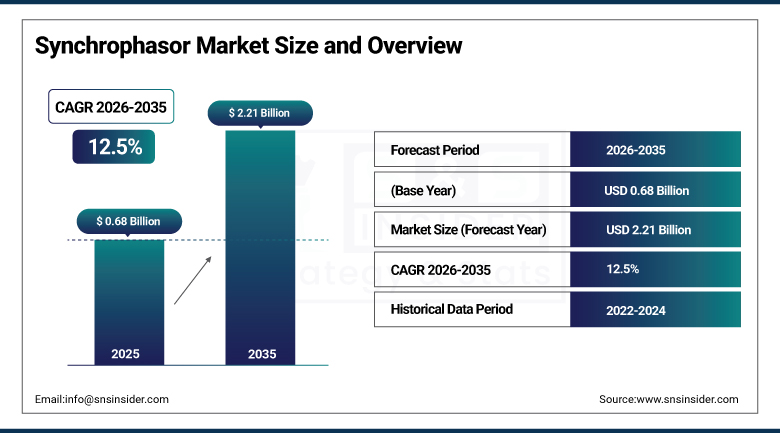
The Synchrophasor Market was valued at USD 0.68 Billion in 2025 and is projected to reach USD 2.21 Billion by 2035, registering a CAGR of 12.5% from 2026 to 2035.
Synchrophasor Market is revolutionizing power system visibility with the help of GPS synchronized Phasor Measurement Units, which collect voltage, current, and frequency information up to 30 to 60 times per second, as compared to just the reporting rate of SCADA systems. Key drivers of this market include increasing regulatory requirement for PMUs in new generation stations, more usage of Artificial Intelligence based state estimation and fault analysis solutions, and applications in renewable energy incorporation, grid monitoring, and data exchange between Independent System Operators. There have been more synchrophasor network deployments, mandatory tariffs from regional transmission organizations, and partnership deployments by utilities with vendors owing to high investments made by PMU vendors, grid analytics vendors, and communication infrastructure providers.
In 2026, the growth of the Synchrowave suite of technology by Schweitzer Engineering Laboratories Inc. (SEL) ensures real-time synchrophasor analysis that enables accurate measurements and assessments of frequency, phase angle, voltage, oscillation, generation loss, and disturbances within the system.
To Get more information On Synchrophasor Market - Request Free Sample Report
Synchrophasor Market Trends
-
Expanding regulatory mandates requiring PMU installation on new generation facilities continue accelerating synchrophasor network expansion.
-
Growing utility adoption of AI-driven state estimation continues improving predictive fault detection accuracy across interconnected grids.
-
Rising distribution-level micro-PMU deployment continues extending wide-area monitoring visibility beyond transmission-class substations.
-
Increasing renewable energy penetration continues strengthening demand for synchrophasor-based grid stability and islanding detection tools.
-
Growing cross-regional data sharing among independent system operators continues expanding synchrophasor network interoperability.
U.S. Synchrophasor Market Size Outlook
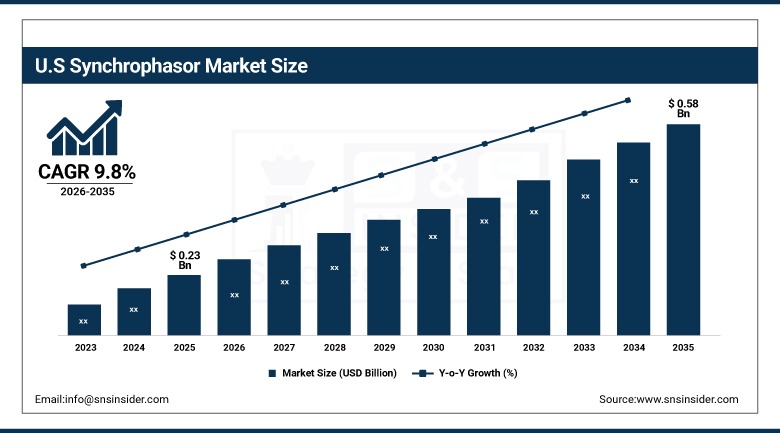
The U.S. Synchrophasor Market was valued at approximately USD 0.23 Billion in 2025 and is projected to reach approximately USD 0.58 Billion by 2035, registering a CAGR of approximately 9.8% from 2026 to 2035.
Demand for synchrophasor technologies in the U.S. was additionally stimulated by the federally approved tariff changes within regional transmission organizations, which required installation of PMUs in all newly constructed generation plants with capacity of 100 MW or higher; increasing backing of synchrophasor modernization from the Department of Energy; and high demand of transmission owners for tools providing wider area visualization of the increasingly complex and renewable generation-including electricity grids. Installation of synchrophasor networks at the major regional transmission organizations, such as expansion of PJM network to the number of almost 720 instruments located in 488 substations, was one of the most influential factors in increasing the role of the U.S. as the leader in synchrophasor market on a global scale.
In 2026, San Diego Gas & Electric and Schweitzer Engineering Laboratories aid San Diego Gas & Electric with situational-awareness software for wide areas, which utilizes synchrophasors obtained from PMUs, allowing quick identification of power-grid dynamics and improving operations of the transmission system.
Synchrophasor Market Segment Analysis
-
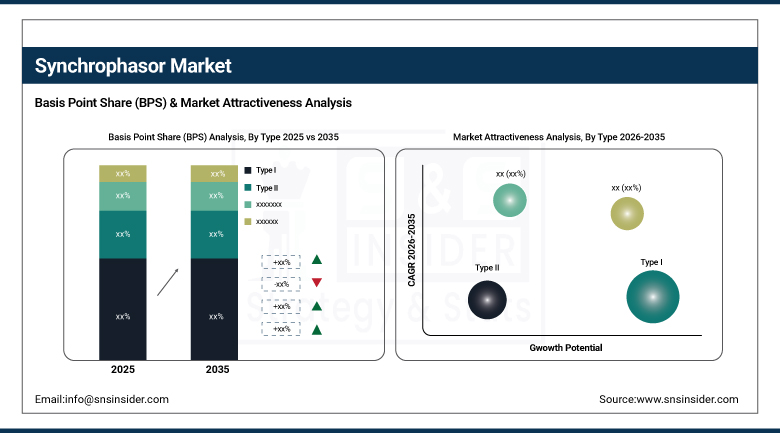
By Type, Type I segment dominated the Synchrophasor Market in 2025 with 62% share; Type II segment is the fastest growing segment, registering a CAGR of 14.8% from 2026 to 2035.
-
By Component, PMU Hardware segment dominated the market in 2025 with 65% share; Software & Analytics segment is the fastest growing segment, registering a CAGR of 14.5% from 2026 to 2035.
-
By Application, Fault Analysis segment dominated the market in 2025 with 28% share; Renewable Energy Integration segment is the fastest growing segment, registering a CAGR of 15.2% from 2026 to 2035.
-
By End Use, Power Transmission segment dominated the market in 2025 with 44% share; Power Distribution segment is the fastest growing segment, registering a CAGR of 14.5% from 2026 to 2035.
-
By Deployment, On-Premise segment dominated the market in 2025 with 71% share; Cloud-Based segment is the fastest growing segment, registering a CAGR of 14.9% from 2026 to 2035.
By Type, Type I Leads, While Type II Grows Fastest
Type I was the leading segment in the Synchrophasor Market in 2025 due to its extensive use in grid monitoring on a smaller scale, providing reliable information in the form of data synchronization at reduced costs related to bandwidth usage. The proven reliability of Type I synchrophasors in all nationwide smart grid applications is the reason why Type I devices have been established as the default option for utilities starting synchrophasor implementation; therefore, it is the most profitable market type.
Type II were forecasted to be the fastest-growing segment in the Synchrophasor Market due to the increased demand for synchrophasors that can provide additional wide-area applications needed for state estimation and dynamic line rating. The increased number of regulations requiring improved grid visualization, such as installation of PMUs on newly constructed large power generating facilities, is fueling the use of Type II synchrophasors by transmission owners.
By Component, PMU Hardware Dominates, Software & Analytics Post Fastest Growth
The PMU Hardware component segment was the leading one in the Synchrophasor Market in 2025 since the phasor measurement unit continues to be an important hardware sensor that is needed to implement a synchrophasor application. The PMU hardware range of Schweitzer Engineering Laboratories that incorporates phasor measurement function directly into protection relays and meters shows how buying hardware continues to drive the highest portion of the market spending as a key component of WAM systems.
The Software & Analytics component is expected to register the fastest CAGR over the forecast period since more utilities use AI and machine learning techniques to translate synchrophasor data into valuable fault detection and predictive maintenance information. The PredictiveGrid solution by Powerside, which uses the BTrDB data architecture that was developed as part of the micro-PMU project sponsored by the U.S. Department of Energy's ARPA-E program, is an example of the importance of analytics software.
By Application, Fault Analysis Leads, Renewable Energy Integration Grows Fastest
Fault Analysis was the dominant application segment in the Synchrophasor Market in 2025 due to the pressing requirement to detect faults accurately and fastly to avoid outages. It was well-established due to years of practice of using synchrophasor technology to analyze events, and hence it became the most funded synchrophasor application area by the utilities trying to discover faults to their components before they become the cause of system-wide problems.
Renewable Energy Integration became the fastest-growing application segment due to the increasing importance of synchrophasor technology in controlling wind and solar energy production. Renewable energy integration led to the formation of complicated power networks, which required the development of situational awareness systems to detect changes in topology and grid instability. The trend is confirmed by Powerside's use of microPMUs for the research purposes of investigating the impact of renewable energy penetration on distribution networks.
By End Use, Power Transmission Dominates, Power Distribution Gains Fastest Traction
Power Transmission will remain the leading end-use segment of the Synchrophasor Market in 2025 as transmission level substations have high risks and hence require investment in synchrophasors sooner than other substation categories. PJM’s synchrophasor system has grown into a program that captures data from 719 devices placed at 488 substations under the company members, depicting how the transmission level deployment has been the major revenue source of the market.
Power Distribution is anticipated to grow rapidly in terms of revenue generation due to the advancement in micro-PMUs to incorporate synchrophasors in low voltage distribution systems experiencing growing DERs. Powerside’s microPMU, after a five year ARPA-E funded research program and implementation globally including Mexico and the Philippines, shows how synchrophasor deployment has been extended to new applications beyond the traditional transmission class applications.
Regional Analysis:
|
Region |
Major Country |
Share within Region, 2025 (%) |
|---|---|---|
|
North America |
United States |
83.00% |
|
Europe |
Germany |
22.80% |
|
Asia Pacific |
China |
36.40% |
|
Middle East and Africa |
Saudi Arabia |
27.10% |
|
Latin America |
Brazil |
30.60% |
North America Synchrophasor Market Insights
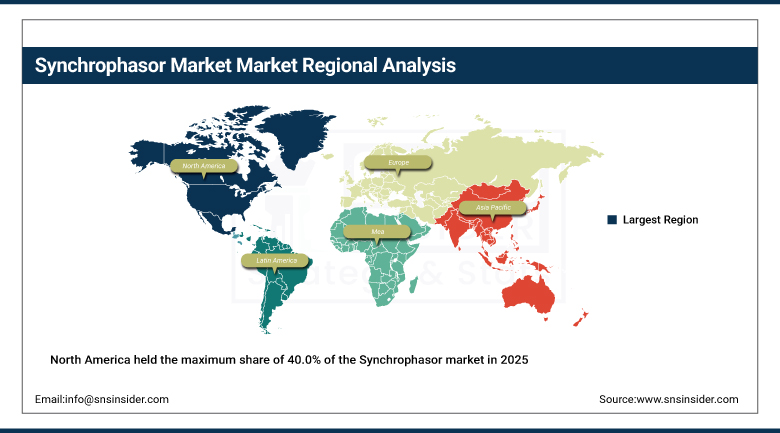
North America held the maximum share of 40.0% of the Synchrophasor market in 2025. The growth is attributed to the continuous federal government support to synchrophasor networks through DOE Smart Grid Investment Grants programs, the increasing requirement of PMUs installations on new generation sources through regional transmission organization tariff mandates, and presence of the leading manufacturers of PMUs in the region. Transmission owners' and independent system operators' close association further enhanced the dominance of North America in transmission and distribution applications of synchrophasor networks.
The U.S. accounted for majority share of the revenue generated in North America because of strong adoption of the expanding network of PJM's synchrophasors, currently gathering information from 719 devices in 488 member substations and federal government approved updates of tariff mandating all the new generation facilities with capacity more than 100 MW to install PMUs. Synchrophasor network expansions of other regional transmission organizations in Canada have also enabled the region to contribute more to North America's dominance in the market.
Get Customized Report as per Your Business Requirement - Enquiry Now
Europe Synchrophasor Market Insights
Europe continued to enjoy sustainable market revenues from its synchrophasor market share due to its sophisticated power network, increased use of smart grid technology and increasing deployment of PMU-based monitoring. The importance of stability and disturbance detection across the connected transmission networks in Europe has also encouraged grid operators in Europe to develop wide area synchrophasor monitoring capability.
Germany was the top revenue generator within Europe due to its market demand, which was mainly attributed to synchrophasor installation by the transmission system operators of the country as part of renewable energy generation. The UK played an important role in the demand generated by the region in terms of PMU-based stability monitoring within high voltage substations.
Asia Pacific Synchrophasor Market Insights
Asia Pacific region demonstrates the fastest rate of growth compared to other regions analyzed in the market with a CAGR of 16.8% owing to the increasing trend of urbanization, industrialization, and growing necessity of efficient power grid management in China, India, and Japan. Chinese State Grid Company keeps on developing its country-wide wide area monitoring system based on PMUs' standardization in China initiated back in 2002, and which requires installing phasor measurement units at all 500 kV substations and power generation facilities.
Leading position was occupied by China due to huge investments in modernizing power grids and domestic production of PMUs in accordance with national standards. Some other important countries which have contributed to this result are India, where PMUs are being installed in power grids for managing the fast solar and wind capacity growth, and Japan, with advanced grids constantly expanding monitoring and analytics capabilities.
MEA and Latin America Synchrophasor Market Insights
ME&A & LATAM exhibited stable growth in the Synchrophasor Market due to increasing investments in upgrading grid infrastructure, development of governmental renewable energy diversification projects, and cooperation between local utilities and PMU technology suppliers, despite the fact that these regions are still at an early stage of adoption as compared to North America, Europe, and APAC regions.
Saudi Arabia was the leading market in ME&A due to the high level of investments into grid infrastructure upgrade associated with national solar and renewable diversification projects. ME&A also exhibited contribution from the grid modernization projects underway in the UAE. In LATAM, Brazil was the leading revenue earning market owing to large transmission grid networks and increasing need for wide area visibility after previous micro-PMU pilots conducted in Mexico with international research funding.
Market Dynamics:
Growth Drivers: Rising Regulatory Mandates and Expanding Renewable Integration Needs
The market will continue to push itself forward as regulatory pressure continues to rise for PMU installation at new generation facilities; increased adoption of AI-driven synchrophasor analysis tools, an increase in renewables that require advanced monitoring of grid stability; and increased use case scenarios such as fault analysis, state estimation, and dynamic line ratings. With increasing numbers of regional transmission organizations announcing additional synchrophasor requirements as part of their reliability needs, the demand for both PMU hardware and wide area analytic software systems is expected to stay strong.
The additional partnerships being made between PMU vendors and grid analytics firms, combined with utilities becoming more committed to regional sharing of their data before the new reliability requirements come into play, also serves to support the trends. Government funding that has been allocated toward the continued development of synchrophasor technology, building upon projects, such as the U.S. Department of Energy's Smart Grid Investment Grant program, is another factor behind the increasing baseline deployment capabilities, all driving growth in demand moving forward.
Restraints: High Implementation Costs and Data Integration Complexity
The prohibitive expenses associated with the implementation of synchrophasor technology, namely the purchase of PMUs along with other components such as communication systems and software for processing the data, remain one of the real barriers to market expansion since small utilities or those from developing countries with budget constraints do not have enough financial resources to implement wide-area monitoring. Thus, most sophisticated applications of synchrophasor technology have been implemented by major transmission companies with sufficient financial resources.
The problems of data integration persist due to the fact that synchrophasor data, which is collected at the rates of 30 to 60 samples per second, needs to be correlated with the data collected using the conventional SCADA system. Solving this problem will require the establishment of standardized communication protocol as well as validation of the data concentration architecture.
Opportunities: AI-Enabled Analytics and Distribution-Level Micro-PMU Expansion
The emergence of AI-powered synchrophasor analytics tools presents a critical opportunity as utilities move to use big data of high frequency phasor measurements to gain predictive insights into grid performance. Providers of scalable and validated synchrophasor analysis solutions such as the Powerside PredictiveGrid will benefit from the trend of utilities moving away from basic data logging to using AI and analytics to automate grid operations.
A critical opportunity is also offered by the development of synchrophasor technology beyond the transmission level to microgrid and distribution grids with the help of micro-PMU tools that are capable of delivering microsecond resolution and milli-degree precision needed in microgrids and distribution grids. Providers of cost-efficient and easily deployable micro-PMUs for renewable energy-rich distribution grids will enjoy disproportionate revenues in terms of spending on new deployments.
Recent Developments:
-
2026: PJM's federally approved Open Access Transmission Tariff update took effect, requiring all new generating facilities of 100 MW or greater to install PMUs and stream synchrophasor data to the grid operator, expanding its network to approximately 719 devices across 488 substations.
-
2026: ABB is continuously improving its capabilities for synchrophasor-based grid monitoring with their protection and automation solutions by providing synchronized measurements to utilities for system stability assessment and disturbance monitoring.
-
2025: Powerside expanded deployment of its microPMU synchrophasor technology for distribution-level monitoring, building on ARPA-E funded research to support renewable penetration studies and grid stability applications across international utility and research partnerships.
Synchrophasor Companies are:
-
Powerside
-
ABB Ltd
-
Siemens AG
-
ETAP (Operation Technology, Inc.)
-
Hitachi Energy Ltd.
-
Electric Power Group, LLC
-
Arbiter Systems, Inc.
-
RTDS Technologies Inc.
-
NR Electric Co., Ltd.
-
Kalki Communication Technologies Pvt. Ltd. (Kalkitech)
-
Mitsubishi Electric Corporation
-
Toshiba Energy Systems & Solutions Corporation
-
Doble Engineering Company
-
Eaton Corporation plc
-
Itron, Inc.
-
Landis+Gyr Group AG
-
NARI Technology Co., Ltd.
-
Megger Group Limited
Synchrophasor Market Report Scope:
| Report Attributes | Details |
|---|---|
| Market Size in 2025 | USD 0.68 Billion |
| Market Size by 2035 | USD 2.21 Billion |
| CAGR | 12.5% from 2026 to 2035 |
| Base Year | 2025 |
| Forecast Period | 2026-2035 |
| Historical Data | 2022-2024 |
| Report Scope & Coverage | Market Size, Segments Analysis, Competitive Landscape, Regional Analysis, DROC & SWOT Analysis, Forecast Outlook |
| Key Segments |
• By Type (Type I, Type II) • By Component (PMU Hardware, Software & Analytics, Phasor Data Concentrators, Communication Infrastructure) • By Application (Fault Analysis, Renewable Energy Integration, Wide Area Situational Awareness, State Estimation) • By End Use (Power Transmission, Power Distribution, Power Generation) • By Deployment (On-Premise, Cloud-Based) |
| Regional Analysis/Coverage | North America (US, Canada), Europe (Germany, UK, France, Italy, Spain, Russia, Poland, Rest of Europe), Asia Pacific (China, India, Japan, South Korea, Australia, ASEAN Countries, Rest of Asia Pacific), Middle East & Africa (UAE, Saudi Arabia, Qatar, South Africa, Rest of Middle East & Africa), Latin America (Brazil, Argentina, Mexico, Colombia, Rest of Latin America). |
| Company Profiles | Schweitzer Engineering Laboratories, Inc., Powerside, ABB Ltd, Siemens AG, GE Vernova Inc., ETAP (Operation Technology, Inc.), Hitachi Energy Ltd., Electric Power Group, LLC, Arbiter Systems, Inc., RTDS Technologies Inc., NR Electric Co., Ltd., Kalki Communication Technologies Pvt. Ltd. (Kalkitech), Mitsubishi Electric Corporation, Toshiba Energy Systems & Solutions Corporation, Doble Engineering Company, Eaton Corporation plc, Itron, Inc., Landis+Gyr Group AG, NARI Technology Co., Ltd., and Megger Group Limited. |

Frequently Asked Questions
Key players include Schweitzer Engineering Laboratories, Inc., Powerside, ABB Ltd, Siemens AG, and GE Vernova Inc., among others.
Key opportunities include accelerating grid modernization, renewable energy integration, increasing synchrophasor deployment, real-time grid monitoring, wide-area situational awareness, and growing demand for improved grid stability.
The major growth factor is rising regulatory mandates requiring PMU installation on new generation facilities, expanding deployment of AI-driven synchrophasor analytics, and growing renewable energy penetration requiring advanced grid stability and state estimation capability.
The Type I segment dominated the Synchrophasor Market by type, representing the largest share of revenue in 2025.
