
UPS Battery Market Report Scope & Overview
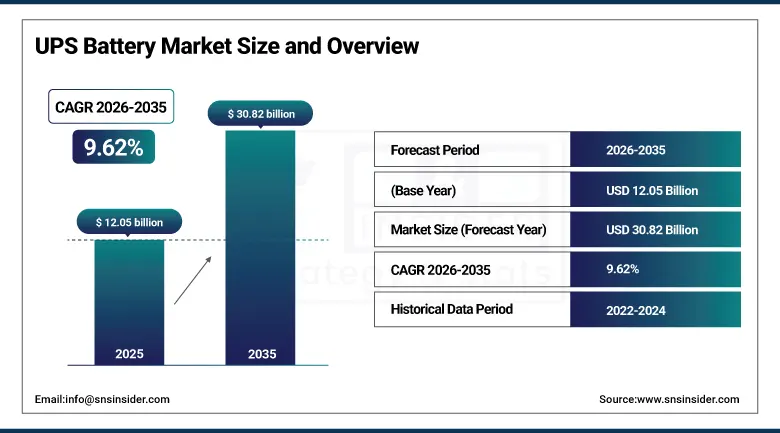
The UPS Battery Market was valued at USD 12.05 billion in 2025 and is expected to reach USD 30.82 billion by 2035, growing at a CAGR of 9.62% from 2026–2035.
The global UPS battery market’s growth trajectory is being powerfully shaped by the AI computing infrastructure build-out that is driving hyperscale data centre capacity expansion at a pace and capital intensity unprecedented in the industry’s history, as the power density requirements of GPU-intensive AI training and inference workloads and the criticality of continuous AI infrastructure operation create extraordinary demand for high-performance UPS battery systems capable of sustaining the densest power loads that modern computing facilities present. The simultaneous expansion of 5G telecommunications infrastructure, the proliferation of edge computing deployment, the electrification of industrial processes, and the growing adoption of home and commercial UPS systems in regions with unreliable utility power are together creating a multi-dimensional demand expansion that positions the UPS battery market for sustained double-digit growth across the forecast period.
The January 2025 preview by EnerSys of its NexSys™ Battery Energy Storage System and Synova™ Sync charger at LogiMAT and ProMat 2025 trade shows reflects the strategic direction in which leading UPS battery manufacturers are investing to address the growing convergence of UPS power protection and broader energy storage capability, as data centre and industrial clients increasingly seek battery systems that serve both instantaneous backup power and demand response, peak shaving, and renewable energy integration functions within a single integrated platform.
To Get more information on UPS Battery Market - Request Free Sample Report
UPS Battery Market Trends
-
Accelerating transition from valve-regulated lead-acid to lithium-ion battery chemistry in data centre and telecommunications UPS applications, driven by lithium-ion’s superior energy density that reduces UPS battery footprint and weight by 40 to 60%, longer cycle life of 8 to 12 years versus 4 to 6 years for VRLA that reduces replacement frequency and maintenance costs, faster recharge capability that reduces the time window of reduced power protection following discharge events, and operating temperature tolerance that reduces data centre cooling load.
-
Growing deployment of modular and scalable UPS battery architectures in hyperscale data centre and edge computing facility applications, where hot-swappable battery module designs enable capacity expansion without system shutdown, individual string failure without system outage, and predictive replacement scheduling based on real-time battery state-of-health monitoring that eliminates the unplanned capacity degradation events that traditional monolithic battery string failures create.
-
Rising integration of UPS battery systems with building energy management platforms, data centre infrastructure management software, and smart grid demand response programmes that enable UPS battery assets to contribute ancillary services to electricity markets during normal operation when their power protection function is not being invoked, improving the economics of UPS battery investment by generating revenue from grid services that partially offset the capital and operating costs of the backup power infrastructure.
-
Growing adoption of advanced battery management system technology in UPS battery systems that enables cell-level state-of-charge monitoring, state-of-health tracking, thermal management, and predictive failure detection through electrochemical impedance spectroscopy and machine learning analytics applied to historical battery performance data, providing data centre operators and facilities managers with actionable visibility into battery reliability that the traditional manual capacity testing approach cannot deliver at comparable accuracy or frequency.
-
Expanding demand for UPS battery solutions in regions with unreliable utility power infrastructure across South and Southeast Asia, Sub-Saharan Africa, Latin America, and the Middle East, where frequent power outages, voltage fluctuations, and grid instability create commercial and operational imperatives for power protection across manufacturing, retail, healthcare, and professional service organisations that are progressively investing in UPS systems as their operations become more digitally dependent.
U.S. UPS Battery Market Outlook
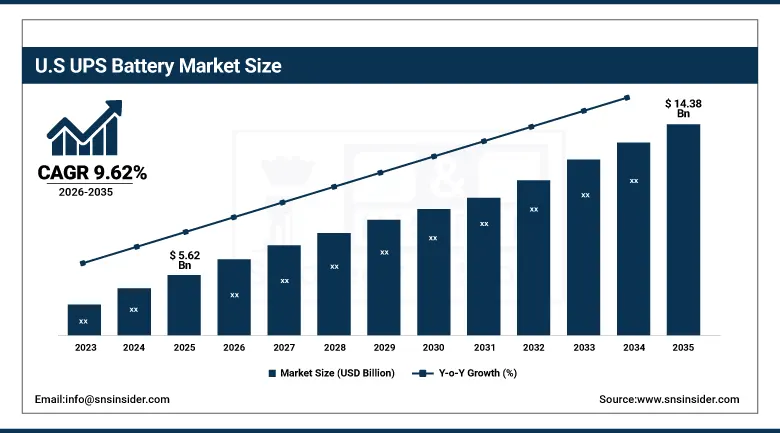
The U.S. UPS battery market was valued at approximately USD 5.62 billion in 2025 and is expected to reach approximately USD 14.38 billion by 2035, growing at a CAGR of 9.62% from 2026–2035, driven by the world’s most extensive hyperscale data centre concentration whose extraordinary AI computing infrastructure expansion is creating the most commercially valuable UPS battery procurement environment in the global market, the most critical telecommunications and healthcare infrastructure requiring highest-reliability power protection, and the progressive electrification of industrial operations whose automation systems cannot tolerate power interruptions.
The U.S. federal government’s substantial investment in critical infrastructure cybersecurity and resilience under the National Cybersecurity Strategy and the Department of Energy’s Grid Resilience programmes is creating an additional demand stream for high-reliability UPS battery systems across federal agency facilities, national laboratory infrastructure, and the defence industrial base’s classified computing and communications facilities whose power protection requirements combine the highest reliability standards with the security clearance and compliance certifications that the commercial UPS battery market is progressively developing the capability to serve.
UPS Battery Market Segment Analysis
-
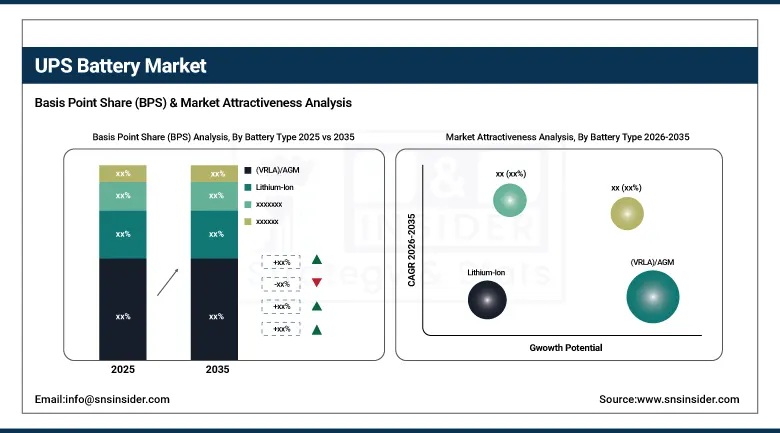
By Battery Type, VRLA/AGM batteries dominated the UPS battery market with approximately 42.57% revenue share in 2025, reflecting their cost-effectiveness, widespread adoption across small-to-medium UPS systems, and the enormous installed base of VRLA-based UPS systems requiring replacement battery procurement; lithium-ion is the fastest-growing battery type at a CAGR of approximately 10.53% through 2035.
-
By Capacity, Large (20–100 kVA) systems dominated the UPS battery market with approximately 31.35% share in 2025, reflecting their extensive deployment in enterprise servers, edge data centres, and commercial facilities requiring stable and efficient power backup; very large (above 100 kVA) systems are the fastest-growing capacity segment.
-
By End Use, Data centres dominated the UPS battery market with the largest revenue share in 2025, reflecting their status as the most power-critical and highest-value UPS battery application category whose continuous growth is driven by cloud computing, AI infrastructure, and enterprise digital transformation investment; industrial sector are the fastest-growing driven by the need to store and dispatch renewable electricity and protect sensitive electronics from grid instability associated with high renewable energy penetration.
-
By Distribution Channel, Direct sales held the dominant market share with approximately 40.12% in 2025, reflecting the large-volume, relationship-driven procurement model that characterises data centre and industrial UPS battery purchasing where long-term manufacturer relationships, customised system specifications, and on-site service commitments are central to procurement decisions; online retail is the fastest-growing distribution channel driven by the growing commercial and residential UPS battery replacement market’s adoption of e-commerce purchasing for standard battery models and capacities.
VRLA/AGM Leads Battery Type, Lithium-Ion Grows Fastest
VRLA/AGM batteries retained the dominant position with approximately 42.57% of the UPS battery market in 2025, anchored by the technology’s extraordinary commercial depth across the globally installed base of small to medium UPS systems in enterprise IT rooms, commercial offices, telecommunications cabinets, healthcare equipment rooms, and residential power protection applications where VRLA’s combination of maintenance-free sealed construction, reliable performance across standard indoor temperature ranges, and competitive acquisition cost make it the pragmatic battery chemistry choice for the majority of UPS applications that do not justify lithium-ion’s higher upfront investment. The VRLA replacement market represents a particularly stable and recurring revenue stream, as the 4 to 6-year service life of VRLA batteries in UPS float applications creates a predictable replacement procurement cycle that is independent of new UPS system installation rates and provides battery manufacturers and distributors with a consistent baseline demand that sustains revenue across economic cycles.
Lithium-ion is the fastest-growing segment at approximately 10.53% CAGR through 2035, as the technology’s demonstrated advantages in data centre UPS applications—where its 60% smaller footprint relative to equivalent VRLA capacity frees white space for additional revenue-generating IT equipment, its 10-year or greater service life eliminates two VRLA replacement cycles over a typical data centre lease period, and its integrated battery management system provides the remote monitoring and predictive maintenance capability that modern data centre operations require—are progressively making the total cost of ownership case for lithium-ion UPS investment compelling across a broadening range of application segments.
Data Centres Dominate End Use, Telecommunications Remains Critical
Data centres retained the dominant end use position in the UPS battery market in 2025, reflecting the sector’s status as both the most power-critical and fastest-growing UPS battery application category whose expansion is driven by the compounding forces of cloud computing adoption, AI infrastructure build-out, streaming media consumption, and enterprise digital transformation that are collectively making the global data centre capacity the fastest-growing major construction and infrastructure investment category in the world. The data centre UPS battery market is bifurcated between the hyperscale segment where the largest cloud operators are investing in custom large-scale lithium-ion UPS battery installations designed to their specific power architecture requirements, and the colocation and enterprise data centre segment where standardised modular UPS battery solutions from major vendors including Eaton, Vertiv, and Schneider Electric serve the power protection requirements of the thousands of facilities that collectively host the global digital economy’s diverse computing requirements.
Telecommunications represents the second-largest end use and one of the most technically demanding in terms of the environmental operating conditions, discharge cycle frequency, and long-term float reliability that UPS batteries in outdoor telecommunications cabinets, roof-mounted base station shelters, and underground network equipment rooms must withstand across the 7 to 12-year replacement intervals that network operators specify for their battery infrastructure in the most demanding installation environments.
Regional Analysis
|
Region |
Major Country |
Share Within Region, 2025 (%) |
|---|---|---|
|
North America |
United States |
87.4% |
|
Europe |
Germany |
22.3% |
|
Asia Pacific |
China |
61.7% |
|
Middle East & Africa |
Saudi Arabia |
38.4% |
|
Latin America |
Brazil |
44.2% |
North America UPS Battery Market Insights
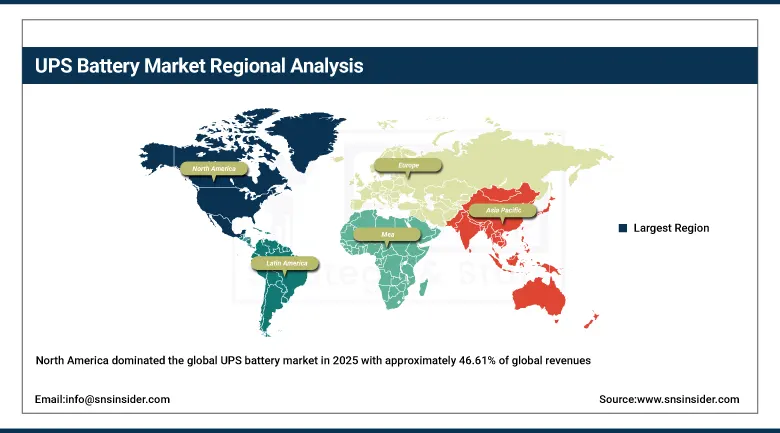
North America dominated the global UPS battery market in 2025 with approximately 46.61% of global revenues, the United States accounting for approximately 87.4% of North American revenues, driven by the highest concentration of hyperscale data centres, the world’s most advanced telecommunications network infrastructure, extensive critical healthcare facility power protection requirements, and the progressive adoption of lithium-ion UPS battery technology in premium applications that generates the highest revenue per kilowatt-hour of backup capacity in the global market. The AI computing infrastructure investment wave, concentrated primarily in U.S. data centre markets in Virginia, Texas, Arizona, and the Pacific Northwest, is creating an unprecedented UPS battery procurement cycle that is simultaneously expanding market volume and upgrading average system specifications toward the premium lithium-ion configurations that the AI server rack power density environment demands. Canada contributes approximately 12.6% of North American UPS battery revenues through its growing data centre sector, extensive telecommunications infrastructure, and healthcare facility power protection market.
Get Customized Report as per Your Business Requirement - Enquiry Now
Europe UPS Battery Market Insights
Europe is a technically sophisticated UPS battery market characterised by stringent regulatory requirements for data centre power reliability, the world’s most advanced renewable energy integration creating grid stability management challenges that elevate the commercial value of UPS battery power quality protection, and a strong domestic manufacturing sector for UPS systems and battery components that includes major players across Germany, France, Italy, and the United Kingdom. Germany accounts for approximately 22.3% of European UPS battery revenues as the region’s largest national market, with a major industrial automation sector creating substantial UPS battery demand for manufacturing facility power protection, a large telecommunications infrastructure requiring battery backup across a dense mobile and fixed network, and data centre development in Frankfurt’s status as Europe’s primary digital hub driving premium UPS battery procurement. The European market’s progressive decarbonisation agenda and the EU’s circular economy regulation for batteries is simultaneously creating compliance requirements for UPS battery end-of-life management that favour manufacturers with established battery recycling programmes and driving technology investment toward lithium-ion systems whose longer service life reduces replacement frequency and lifecycle environmental impact.
Asia Pacific UPS Battery Market Insights
Asia Pacific is the fastest-growing regional UPS battery market at a CAGR of approximately 10.20% through 2035, driven by China’s extraordinary data centre expansion programme whose government cloud computing and AI infrastructure investment is making the country one of the world’s largest annual UPS battery procurement markets, India’s rapidly expanding digital economy creating data centre and telecommunications UPS battery demand growth that is among the fastest in the global market, and Southeast Asian markets including Singapore, Malaysia, and Indonesia whose data centre hub development and telecommunications infrastructure investment are creating regionally significant UPS battery procurement volumes. China accounts for approximately 61.7% of Asia Pacific UPS battery revenues and represents one of the most commercially dynamic UPS battery markets globally, combining domestic data centre growth with the world’s largest telecommunications network requiring UPS battery infrastructure across hundreds of thousands of base stations, and the world’s most extensive manufacturing sector whose industrial automation UPS protection requirements generate large volumes of industrial-grade UPS battery procurement.
Latin America and MEA UPS Battery Market Insights
Latin America and the Middle East and Africa are growing UPS battery markets where the combination of unreliable utility power driving commercial and industrial UPS adoption, rapid telecommunications infrastructure expansion, and growing data centre investment is creating sustained UPS battery demand growth across markets whose power backup requirements reflect both the inadequacy of local utility supply and the progressive digitisation of economies whose commercial infrastructure is becoming increasingly sensitive to power interruptions. Brazil accounts for approximately 44.2% of Latin American UPS battery revenues through its large industrial sector, extensive telecommunications network, growing data centre market in São Paulo and Brasilia, and the widespread commercial and residential UPS system adoption driven by the country’s historically unreliable utility grid in many regions. Saudi Arabia leads Middle East and Africa UPS battery revenues at approximately 38.4% of the regional total, driven by Vision 2030’s data centre and telecommunications infrastructure investment, the Kingdom’s extreme climate conditions creating elevated UPS battery thermal management requirements, and the rapid development of smart city infrastructure across NEOM and other giga-project developments that require comprehensive power backup systems.
Market Dynamics
Growth Drivers: Hyperscale data centre AI infrastructure expansion creating unprecedented UPS battery demand, 5G telecommunications build-out requiring distributed battery backup infrastructure, and lithium-ion technology transition creating replacement cycle investment
The primary structural growth drivers for the UPS battery market are the extraordinary AI computing infrastructure build-out that is creating a once-in-a-generation demand surge for data centre power backup systems at the scale and specification level that hyperscale UPS battery procurement has not previously experienced, combined with the 5G telecommunications infrastructure expansion that is deploying hundreds of thousands of new base stations globally each requiring battery backup and the progressive replacement of ageing VRLA UPS battery installed bases with lithium-ion systems whose superior service economics are creating a technology upgrade investment cycle that generates incremental market revenue beyond organic UPS system installation rate growth. The critical infrastructure protection imperative, where the business consequences of data centre outages measured in millions of dollars per hour for major cloud platform operators, the regulatory consequences of healthcare facility power failures, and the operational consequences of manufacturing line shutdowns are making UPS battery investment a board-level reliability and risk management priority rather than a discretionary capital expenditure that competes with other technology investments during budget constraint periods, provides the demand resilience that sustains UPS battery market growth across economic cycles.
Restraints: High upfront cost of lithium-ion UPS battery systems limiting adoption in price-sensitive segments, technical integration complexity in legacy infrastructure retrofitting, and lead-acid battery raw material price volatility affecting VRLA cost competitiveness
A significant restraint on the UPS battery market is the technical complexity and organisational challenge of integrating new-generation lithium-ion UPS battery systems into existing power infrastructure that was designed around VRLA battery characteristics, as the different charging voltage profiles, temperature management requirements, and battery management system communication interfaces of lithium-ion systems require infrastructure modifications, personnel retraining, and updated maintenance procedures that add cost and implementation complexity to what might otherwise appear to be a straightforward battery replacement decision.
Opportunities: AI data centre power density requiring next-generation UPS battery architecture, dual-use UPS battery platforms serving backup and grid storage functions, and emerging market infrastructure growth creating first-installation demand
The AI data centre UPS battery opportunity represents the most commercially valuable near-term market development in the sector, as the extraordinary power density of GPU server clusters creates UPS battery requirements in terms of instantaneous discharge current, energy capacity per rack, and thermal management performance that are pushing the boundaries of current commercial UPS battery technology and creating a product development investment cycle whose innovation outputs will define the next generation of data centre power protection standards across both the hyperscale and enterprise segments of the global market.
Recent Developments
-
2025: EnerSys previewed its new NexSys™ Battery Energy Storage System and Synova™ Sync charger at the LogiMAT and ProMat 2025 trade shows in January 2025, demonstrating a new integrated battery and charging platform designed to address the growing convergence of UPS backup power and broader energy storage functions in industrial and data centre applications.
-
2025: East Penn Manufacturing introduced the Unigy High Rate Series of absorbed valve-regulated lead-acid batteries in March 2025, designed for standby power applications with a 10-year design life and front access construction for easier maintenance in dense rack-mounted UPS system environments, expanding the company’s premium VRLA product range for critical infrastructure applications.
-
2025: Vertiv expanded its lithium-ion UPS battery portfolio with new configurations optimised for edge data centre and distributed IT room deployments, where the space and weight advantages of lithium-ion relative to VRLA equivalents translate directly into physical infrastructure cost reduction and operational flexibility benefits that the edge computing market’s compact footprint requirements specifically demand.
-
2025: Eaton launched enhanced battery monitoring and management software capabilities integrated with its intelligent power management platform, providing data centre operators with real-time battery state-of-health analytics, predictive end-of-life indication, and automated maintenance scheduling tools that improve UPS battery reliability management without requiring dedicated on-site engineering oversight.
UPS Battery Market Key Players
-
EnerSys
-
East Penn Manufacturing Co.
-
Eaton Corporation plc
-
Vertiv Holdings Co.
-
Schneider Electric SE
-
Exide Industries Ltd.
-
CSB Energy Technology Co., Ltd.
-
FIAMM Energy Technology S.p.A.
-
Leoch International Technology Limited
-
Saft (TotalEnergies)
-
Yuasa Battery (GS Yuasa)
-
Clarios LLC
-
Enersys LLC
-
C&D Technologies Inc.
-
Power Sonic Corporation
-
Delta Electronics Inc.
-
ABB Ltd.
-
Emerson Electric Co.
-
Socomec Group
-
Active Power Inc.
UPS Battery Market Report Scope:
| Report Attributes | Details |
|---|---|
| Market Size in 2025 | USD 12.05 Billion |
| Market Size by 2035 | USD 30.82 Billion |
| CAGR | CAGR of 9.62% From 2026 to 2035 |
| Base Year | 2025 |
| Forecast Period | 2026-2035 |
| Historical Data | 2022-2024 |
| Report Scope & Coverage | Market Size, Segments Analysis, Competitive Landscape, Regional Analysis, DROC & SWOT Analysis, Forecast Outlook |
| Key Segments | • By Battery Type (Valve-Regulated Lead-Acid (VRLA)/AGM, Lithium-Ion, Nickel Cadmium, Others) • By Capacity (Small (<10 KVA), Medium (10–20 KVA), Large (20–100 KVA), Very Large (>100 KVA)) • By End Use (Data Centers, Telecommunications, Healthcare, Industrial, Residential, Others) • By Distribution Channel (Direct Sales, Distributors/Dealers, Online Retail) |
| Regional Analysis/Coverage | North America (US, Canada, Mexico), Europe (Eastern Europe [Poland, Romania, Hungary, Turkey, Rest of Eastern Europe] Western Europe] Germany, France, UK, Italy, Spain, Netherlands, Switzerland, Austria, Rest of Western Europe]), Asia Pacific (China, India, Japan, South Korea, Vietnam, Singapore, Australia, Rest of Asia Pacific), Middle East & Africa (Middle East [UAE, Egypt, Saudi Arabia, Qatar, Rest of Middle East], Africa [Nigeria, South Africa, Rest of Africa], Latin America (Brazil, Argentina, Colombia, Rest of Latin America) |
| Company Profiles | EnerSys, East Penn Manufacturing Co., Eaton Corporation plc, Vertiv Holdings Co., Schneider Electric SE, Exide Industries Ltd., CSB Energy Technology Co., Ltd., FIAMM Energy Technology S.p.A., Leoch International Technology Limited, Saft (TotalEnergies), Yuasa Battery (GS Yuasa), Clarios LLC, Enersys LLC, C&D Technologies Inc., Power Sonic Corporation, Delta Electronics Inc., ABB Ltd., Emerson Electric Co., Socomec Group, Active Power Inc. |

Frequently Asked Questions
The UPS battery market is expected to grow at a CAGR of 9.62% from 2026 to 2035.
The UPS battery market was valued at usd 12.05 billion in 2025.
The key driver of the UPS battery market is the growing demand for reliable, uninterrupted power supply across data centers, telecom, healthcare, industrial sectors, and renewable energy integration.
North America dominated the ups battery market in 2025 with approximately 46.61% of global revenues, with the United States as the leading national market within the region.
The extraordinary ai computing infrastructure build-out driving unprecedented hyperscale data centre ups battery procurement, combined with global 5g telecommunications infrastructure expansion requiring distributed battery backup across hundreds of thousands of new base stations.
