
Frost Heave Prevention System Market Report Scope & Overview:
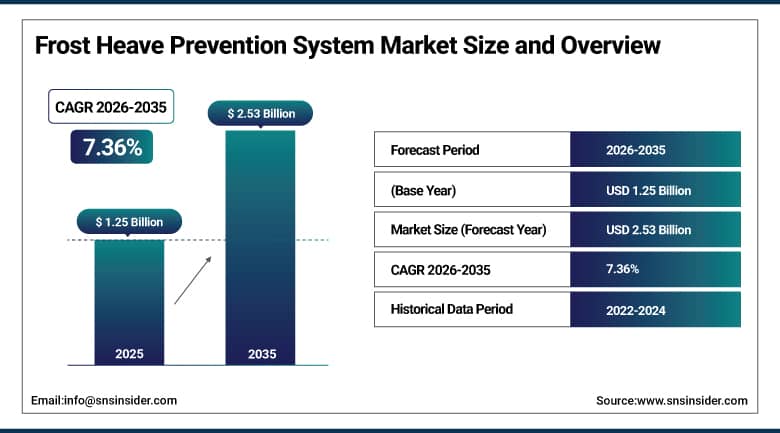
The Frost Heave Prevention System Market was valued at USD 1.25 Billion in 2025 and is projected to reach USD 2.53 Billion by 2035, expanding at a CAGR of 7.36% during the forecast period 2026–2035.
People are putting money into roads and other things that need to be built in cold places. This means there is a need for things that can keep the cold out like special insulation and heating systems in areas where it freezes and thaws a lot. The government and people who build things are using solutions to stop damage from frost so they do not have to spend a lot of money to fix things later.
This is making people use systems to stop frost from damaging important things like highways, airports and train tracks. New technology like monitors and special sensors that can talk to the internet are changing the way people do things. More money is being spent on making roads dealing with climate change and building strong cities, which means there are more opportunities for businesses to grow and make money around the world. Frost protection systems are being used more and more for things, like highway construction, airport development and railway networks because people want to build things that can withstand the cold.
Market Size and Forecast
-
Market Size 2026E: USD 1.34 Billion
-
Market Size 2035: USD 2.53 Billion
-
CAGR: 7.36% from 2026 to 2035
-
Fastest Growing Region: Asia Pacific
-
Largest Region: North America
To Get More Information On Frost Heave Prevention System Market - Request Free Sample Report
Frost Heave Prevention System Market Trends
-
Growing deployment of frost protection systems across transportation infrastructure projects in cold-climate regions.
-
Increasing adoption of smart temperature monitoring and automated ground heating technologies.
-
Rising investments in resilient infrastructure modernization to mitigate freeze-thaw related structural failures.
-
Expansion of energy pipeline protection systems utilizing advanced insulation and geosynthetics technologies.
-
Growing integration of IoT-based monitoring, predictive maintenance platforms, and energy-efficient heating solutions for infrastructure asset management.
The U.S. Frost Heave Prevention System Market Size Outlook
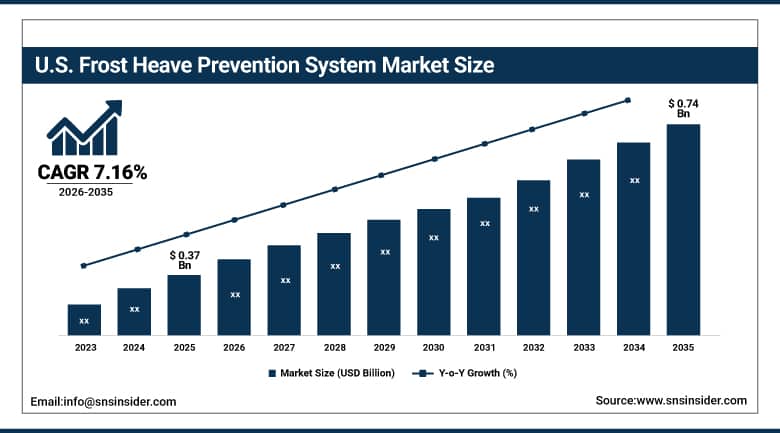
The U.S. Frost Heave Prevention System Market was valued at USD 0.37 billion in 2025 and is expected to reach approximately USD 0.74 billion by 2035, expanding at a CAGR of 7.16% during 2026–2035.
Despite ongoing advancements in transportation and urban development, the US remains responsible for the greatest share of the North American market due to its large transportation infrastructure, aging highway network, expanding airport modernization programs, and sustained investments into utility/energy infrastructures. Federal and state agencies continue increasing funds allocated towards developing resilient infrastructures that will be able to withstand harsh freeze thaw cycles experienced by northern states. The growing trend involves deploying intelligent monitoring technology, automated heating systems, as well as advanced insulation products to ensure reliability of infrastructure systems at an acceptable cost to governments. The US Department of Transportation supports these developments through their federal infrastructure initiatives focusing on creating resilient infrastructures resistant to extreme weather events.
Frost Heave Prevention System Market Segmentation Analysis
-
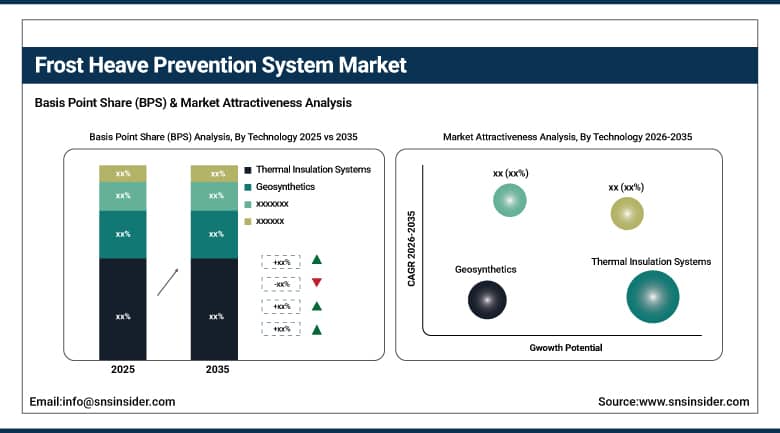
By Technology, thermal insulation systems dominated the market with 37.00% share in 2025, while geosynthetics are projected to witness the fastest growth with 8.22% CAGR during the forecast period.
-
By Application, roads & highways dominated the market with 33.00% share in 2025, while pipelines & energy infrastructure are projected to witness the fastest growth with 8.74% CAGR during the forecast period.
-
By End User, government infrastructure agencies dominated the market with 39.00% share in 2025, while oil & gas companies are projected to witness the fastest growth with 8.25% CAGR during the forecast period.
By Technology, thermal insulation systems dominated, while geosynthetics fastest-growing segment.
The thermal insulation systems (TIS) segment represented the largest revenue share for Owens Corning, accounting for 37.00%. TIS plays a critical role in various infrastructure segments such as transportations, including building foundations, airports pavements, utility corridors, etc., all being developed in cold climates where maintaining high-performance insulation material minimizes frost penetration, reduces soil movements, and prolongs the service-life of infrastructure while reducing maintenance requirement. Increased use cases driven by need for improved thermal properties & durability among harsh environment have led Owens Corning’s expansion into this area through addition of Advanced Insulation Portfolio covering multiple end-use verticals related to both infrastructure developments as well as general purpose application areas requiring superior quality insulating materials.
Geosynthetics segment will witness highest CAGR of 8.22% during entire forecast period mainly attributed toward rising demand for usage geotextile/geogrid/composite product applications especially within Frost Mitigation Applications category segment which includes everything from snow melting system design right down-to specialized types specifically targeting prevention issues seen often around waterways subjecting nearby landmasses prone frequent freezing periods thereby causing significant damage resulting lost productivity levels amongst impacted industries alike. Tensar introduces enhanced geogrid solutions that improves pavement resilience and provides ground stabilization against severe environmental impact affecting transportation infrastructures globally.
By Application, roads & highways dominated, while pipelines & energy infrastructure fastest-growing segment.
In 2025, the roads & highways segment accounted for the largest market share with a revenue contribution of approximately 33.00%. The reason we are seeing this is because of the money being put into making highways. This includes making existing bridges better improving the roads in cities and making sure the roads can handle weather. Frost is still a problem that causes roads to crack makes them uneven and costs a lot to fix especially in the northern parts of the world. Many groups that take care of roads in North America are spending money on building new roads because the government wants to make sure the roads can handle the cold.
The part of the business that deals with pipelines and energy is expected to grow the most at a rate of 8.74% over the few years. This is because energy companies are working hard to build pipelines in cold areas. When the ground freezes and thaws it can damage pipelines and other important systems, whish’s a big problem, for oil, gas and other utilities. To fix this companies are using systems to heat the ground keep it warm and monitor the temperature all the time. As we try to make sure we have energy and keep our pipelines safe this will help the market grow in the long term especially in the Arctic region where it is very cold.
By End User, government infrastructure agencies dominated, while oil & gas companies’ fastest-growing segment.
The government infrastructure agencies segment had the revenue share of 39.00% in 2025. This is because the government always invests money in highway and airport and railway and bridge and municipal infrastructure. These things can get damaged because of frost heave. So the government uses construction techniques to make them strong. They use things like engineered frost protection systems to reduce maintenance costs over time.
The government wants to make infrastructure that can withstand weather. So they are funding projects to make infrastructure strong and modern. This has increased the demand for frost prevention technologies over the world.
The oil and gas companies segment will grow the fastest at 8.25% CAGR between 2035. This is because oil and gas companies are exploring and building pipelines and energy infrastructure in the Arctic and subarctic regions. These regions have a lot of frost heave. So oil and gas companies are using frost heave prevention systems to protect their pipelines and storage facilities and compressor stations and other assets. They are also using automated monitoring and insulation and predictive maintenance technology. This is helping the oil and gas companies segment to grow. Big energy companies are investing money in programs to manage infrastructure integrity.
Regional Analysis:
|
Region |
Major Country |
Share within Region, 2025 (%) |
|---|---|---|
|
North America |
United States |
87.00% |
|
Europe |
Germany |
28.00% |
|
Asia Pacific |
China |
21.00% |
|
Middle East & Africa |
UAE |
9.00% |
|
Latin America |
Brazil |
8.00% |
North America Frost Heave Prevention System Market Insights
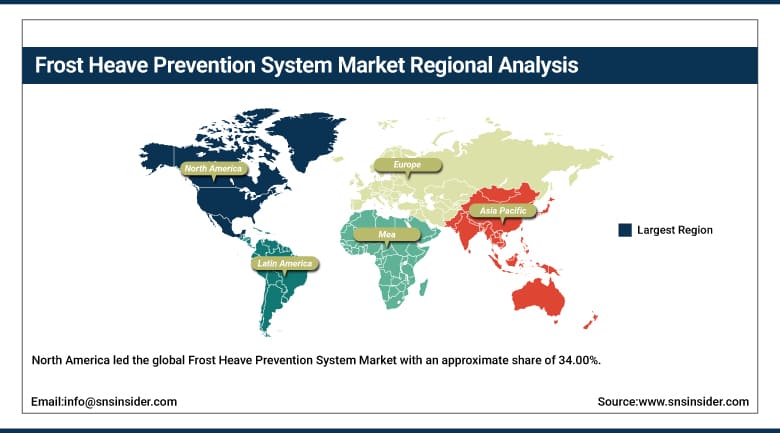
North America led the global Frost Heave Prevention System Market with an approximate share of 34.00%. In North America, there has been a noticeable increase in investment activity on frost heave prevention systems as a result of various government initiatives being implemented in different regions, especially in areas where roads are prone to freezing up due to cold winters. Additionally, government agencies have started utilizing more advanced frost heave prevention system technology such as thermal insulation, intelligent ground heating systems, and digital monitoring solutions to prevent damage caused by frequent thawing events that happen during winters.
These factors have contributed significantly towards boosting revenues generated from sales activities related to this particular product category within the entire continent's economy landscape since 2025 onwards. U.S. Department Of Transportation Continued To Make Progress Towards Climate-Resilience Infrastructure Investment As Part Of Their Federal Funding Programs For Transportation Assets Exposed To Severe Winter Conditions.
Get Customized Report as Per Your Business Requirement - Enquiry Now
Europe Frost Heave Prevention System Market Insights
Continuous investments were made towards supporting Europe’s infrastructure development goals through rail system modernization projects, improvements to roadways and airports in countries such as Germany, Nordic states, France and UK, and sustainable construction methods. Increased adoption rates for strict durability criteria for buildings/structures combined with heightened focus on cost reductions over an assets’ life cycle helped boost uptake of various forms of frost prevention tech – from sophisticated types of insulating material down through thermosyphons and automated ground temperature sensors.
Various European governments and private sector participants including civil engineering firms have been focusing efforts around implementing more resilient ways to protect transport routes from damage due to lengthy periods during which temperatures dip below zero degrees Celsius. These developments formed part of broader infrastructure modernizations programs being enacted throughout parts of Europe seeking out better ways manage impacts from climate change upon roads/trains etc.
Asia Pacific Frost Heave Prevention System Market Insights
The Asia Pacific region is expected to witness a significant rise at the highest rate (CAGR of 8.34%) during the projected timeframe as attributed to infrastructural developments, railway expansion growth, airport constructions, and investment escalation concerning pipelines related to energy supply in countries such as China, Japan, South Korea, and northern parts of India. Additionally, rising expenditures by governments for establishing resilient transportations along with an increase in knowledge about optimizing long-term maintenance requirements will contribute significantly towards integrating EFPS among others.
On account of technological evolution concerning geosynthetics materials, automation via heating, and Internet of Things-based monitoring systems, and this industry has tremendous potential all over the world owing to its numerous applications. There has been an upsurge amongst infrastructure developers operating in Eastern Asia towards embracing smart technology that allows them real-time visibility into their work progressions coupled with engineered soil stabilization measures especially when developing transportation facilities amidst climatic challenges associated with frost weathering conditions.
Middle East & Africa and Latin America Frost Heave Prevention System Market Insights
The Middle East & Africa market is experiencing steady growth attributed to increased investments in high-altitude transportation infrastructure, mining projects, and energy developments in regions characterized by seasonal freezing conditions. Governments and industry stakeholders have been investing in innovative thermal protection systems and ground stabilization technologies to ensure enhanced operational performance while minimizing infrastructure maintenance expenses. Additionally, ongoing implementation of climate adaptation strategies and modernization efforts for critical infrastructure contribute to sustained market development within select regional markets.
The demand has witnessed a significant surge as a result of infrastructure modernization projects and mining ventures being undertaken in high altitude zones of several South American nations including Chile and Argentina. These states are highly affected due to frost induced ground movements impacting their transportation and industrial resources. Growing expenditures on resilient construction techniques, energy infrastructures, and intelligent monitoring mechanisms have led to the widespread application of frost heave mitigation systems over these nations. Infrastructure operators across Latin America expanded investments in climate-resilient engineering solutions to improve durability and operational safety of transportation & industrial assets exposed to harsh environmental conditions.
Growth Drivers: Increasing investments in cold-region transportation and civil infrastructure.
The market for frost heave prevention system is really taking off because a lot of money is being invested in transportation infrastructure in areas. Governments are spending money on things like roads, airports, train tracks, bridges and tunnels that can handle the freezing and thawing that can damage them. This is where Frost Heave Prevention System comes in. It helps make these structures last longer and saves money on maintenance.
Frost heave prevention system uses things like insulation, ground heating and monitoring systems to keep the infrastructure safe. Because of this the Frost Heave Prevention System Market is growing. More and more people are working on making infrastructure that can handle the effects of climate change. The U.S. Department of Transportation is helping to make transportation infrastructure stronger by investing in projects that can handle the changing climate. The Frost Heave Prevention System Market is getting a boost, from all these efforts to make infrastructure more resilient.
Restraints: High Installation Costs and Complex Infrastructure Integration.
The market for frost prevention systems is growing,. It still has some problems. One of the issues is that these systems are very expensive to set up. They often need engineering and excavation work, which requires a lot of money and time. You also need to have the power infrastructure and equipment to monitor the systems, which adds to the cost. When you try to add these systems to existing roads and utility networks it can be more complicated.
This can cause disruptions. They may not have the budget to invest in these systems in developing countries where they have to choose between spending money now and saving money in the long run. So the people who own the infrastructure are looking closely at how much these systems will cost over time before they decide to use them in projects.
Opportunities: Integration of smart monitoring, IoT and predictive infrastructure management.
There are chances for companies that make frost heave prevention systems. This is because more and more people are using ways to manage infrastructure. Things like IoT-enabled temperature sensors, cloud-connected monitoring platforms, automated heating controls and predictive analytics help people who take care of infrastructure. They can see when the soil temperature is changing and stop damage from happening because of frost. These new technologies make it easier to plan maintenance reduce repairs use less energy. More people are investing in roads digital infrastructure management platforms and ways to make infrastructure withstand climate change. This will help companies that make frost prevention systems grow. Companies that make infrastructure technology are still making their digital asset management platforms better.
Recent Developments
-
2026: Owens Corning expanded its FOAMULAR insulation portfolio for transportation and civil infrastructure applications, supporting enhanced thermal performance and frost protection for roads, railways, airport pavements, and building foundations.
-
2025: Tensar International introduced advanced geogrid and ground stabilization solutions designed to improve pavement durability, mitigate frost-related ground movement, and reduce lifecycle maintenance costs for transportation infrastructure.
-
2026: nVent expanded its electric heat tracing and freeze protection solutions for critical infrastructure, including transportation facilities, pipelines, and industrial assets operating in cold-weather environments.
-
2025: Watts Water Technologies enhanced its commercial freeze protection and heating cable solutions to improve operational reliability of municipal, industrial, and utility infrastructure exposed to freezing temperatures.
Frost Heave Prevention System Market Key Players are:
-
Thermon Group Holdings, Inc.
-
nVent RAYCHEM
-
Danfoss A/S
-
BriskHeat Corporation
-
Heat Trace Limited
-
Emerson Electric Co.
-
TraceTek
-
Sika AG
-
Fujikura Ltd.
-
Heat-Line Corporation
-
Thermatek
-
Trasor
-
WILECO Thermal Management
-
Drexan
-
Delta-Therm
-
RSTI
-
Watlow Electric Manufacturing Company
Frost Heave Prevention System Market Report Scope:
| Report Attributes | Details |
|---|---|
| Market Size in 2025 | USD 1.25 Billion |
| Market Size by 2035 | USD 2.53 Billion |
| CAGR | CAGR of 7.36% From 2026 to 2035 |
| Base Year | 2025 |
| Forecast Period | 2026-2035 |
| Historical Data | 2022-2024 |
| Report Scope & Coverage | Market Size, Segments Analysis, Competitive Landscape, Regional Analysis, DROC & SWOT Analysis, Forecast Outlook |
| Key Segments | • By Technology (Thermal Insulation Systems, Ground Heating Systems, Thermosyphons, Geosynthetics, Others) • By Application (Roads & Highways, Railways, Airports, Pipelines & Energy Infrastructure, Others) • By End User (Government Infrastructure Agencies, Oil & Gas Companies, Construction Companies, Airport Authorities, Others) |
| Regional Analysis/Coverage | North America (US, Canada), Europe (Germany, UK, France, Italy, Spain, Russia, Poland, Rest of Europe), Asia Pacific (China, India, Japan, South Korea, Australia, ASEAN Countries, Rest of Asia Pacific), Middle East & Africa (UAE, Saudi Arabia, Qatar, South Africa, Rest of Middle East & Africa), Latin America (Brazil, Argentina, Mexico, Colombia, Rest of Latin America). |
| Company Profiles | Thermon Group Holdings, Inc., nVent RAYCHEM, Danfoss A/S, BriskHeat Corporation, Heat Trace Limited, Emerson Electric Co., Chromalox, Inc., TraceTek, Sika AG, Fujikura Ltd., Heat-Line Corporation, Thermatek, Loheat, TRM, Trasor, WILECO Thermal Management, Drexan, Delta-Therm, RSTI, Watlow Electric Manufacturing Company |

Frequently Asked Questions
