
Blue Ammonia Market Report Scope & Overview:
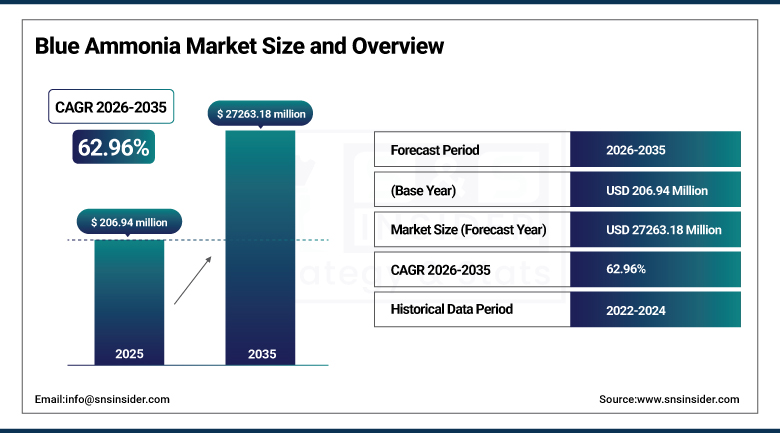
The Blue Ammonia Market size was valued at USD 206.94 million in 2025 and is expected to reach USD 27,263.18 million by 2035, growing at a CAGR of 62.96% from 2026 to 2035.
The Blue Ammonia Market is booming due to increased investment in carbon neutral energy, deployment of carbon capture technology and the demand for clean fuel applications in power generation, transportation and industries. Blue ammonia is being embraced as a hydrogen carrier and decarbonisation solution because it can offer a cleaner way to produce ammonia while leveraging existing energy infrastructure. “Energy security, net-zero goals and sustainable industries are driving organisations and governments to invest more in blue ammonia projects. The market is also further driven by the growing use of blue ammonia in power plants, fertiliser, chemicals, and international hydrogen transportation.
In 2025, Japan's METI proposed to provide JERA and Mitsui & Co. with some USD 6.8 billion in Contract for Difference (CfD) subsidies over a 15-year period for the import of some 772,000 metric tonnes of blue ammonia annually from 2030. The initiative is to aid power generation and decarbonisation and to close the financial gap between traditional and clean energy.
Market Size and Forecast
-
Market Size in 2026E: USD 336.38 Million
-
Market Size by 2035: 27,263.18 Million
-
CAGR: 62.96% from 2026 to 2035
-
Fastest Growing Region: Asia Pacific
-
Largest Region: North America
To Get more information on Blue Ammonia Market - Request Free Sample Report
Blue Ammonia Market Trends
-
Increasing adoption of carbon capture, utilization, and storage (CCUS) technologies is improving the environmental performance of blue ammonia production and supporting low-carbon energy transition initiatives.
-
Rising global demand for clean fuels and hydrogen-based energy carriers is accelerating the deployment of blue ammonia across power generation, transportation, and industrial applications.
-
Expansion of government incentives, subsidies, and international hydrogen strategies is encouraging investments in large-scale blue ammonia production facilities and supply chain development.
-
Growing adoption of ammonia co-firing technologies in thermal power plants and marine fuel applications is creating new opportunities for blue ammonia utilization.
-
Increasing collaborations between energy companies, technology providers, and governments are supporting the development of global blue ammonia trade networks, storage infrastructure, and advanced production technologies.
U.S. Blue Ammonia Market Size Outlook
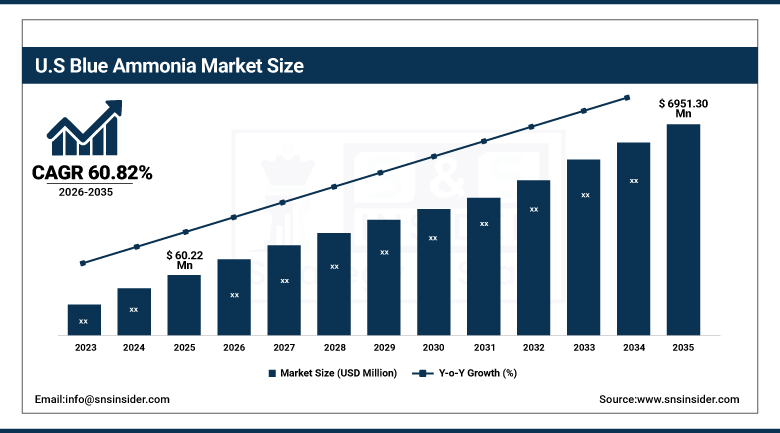
The U.S. Blue Ammonia Market was valued at USD 60.22 million in 2025 and is expected to reach USD 6951.30 million by 2035, growing at a CAGR of 60.82% from 2026 to 2035.
The U.S. Blue Ammonia Market is witnessing growth due to the increased investments in clean energy infrastructure, adoption of CCUS technologies, and increasing demand for low-carbon hydrogen fuel for power generation, agriculture, and other sectors. A number of developments and investments in blue ammonia projects are attributed to different government policies relating to decarbonisation, energy transition plans and investments from companies. The presence of natural gas reserves, advanced ammonia production facilities and the use of blue ammonia as fertilisers, hydrogen fuel and power generation are further adding to the growth of this market. Increased efforts towards the reduction of emissions in industries and net zero targets will propel the use of blue ammonia solutions.
In 2026, the Danish company Topsoe signed a significant agreement with the US developer J Westling & Co (JWC) for the supply of its SynCOR Ammonia autothermal reforming technology and related catalysts for a blue ammonia plant in Nebraska. The project will produce 500 short tonnes of blue ammonia per day for farmers in the Midwest region.
Blue Ammonia Market Segmentation Analysis
-
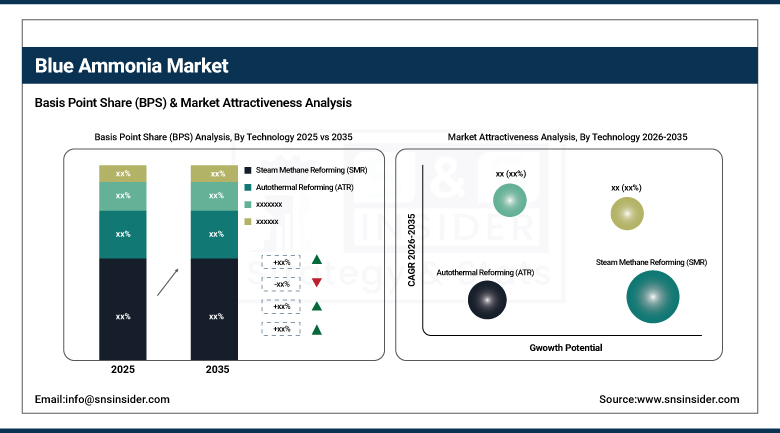
By Technology, Steam Methane Reforming (SMR) dominated the Blue Ammonia Market with a 46.80% share in 2025, while Autothermal Reforming (ATR) is the fastest-growing technology segment with a CAGR of 66.50% from 2026–2035.
-
By Manufacturing Process, Thermochemical Process dominated the Blue Ammonia Market with a 48.20% share in 2025, while Electrochemical Process is the fastest-growing manufacturing process segment with a CAGR of 66.73% from 2026–2035.
-
By Application, Fertilizers dominated the Blue Ammonia Market with a 41.70% share in 2025, while Transportation Fuel is the fastest-growing application segment with a CAGR of 71.38% from 2026–2035.
-
By End User, Agriculture dominated the Blue Ammonia Market with a 43.80% share in 2025, while Automotive & Transportation is the fastest-growing end-user segment with a CAGR of 70.37% from 2026–2035.
By Technology, Steam Methane Reforming (SMR) dominated the Blue Ammonia Market, while Autothermal Reforming (ATR) is expected to register the fastest CAGR during the forecast period 2026–2035
The Steam Methane Reforming (SMR) dominated the Blue Ammonia Market with a revenue share of 46.80% in 2025. The segment continues to lead the market based on its commercial acceptance, mature production infrastructure, and wide usage in hydrogen production process for ammonia production. This process is highly favoured due to its production efficiency, availability of natural gas feedstocks, and compatibility with carbon capture utilization and storage (CCUS). The combination of carbon capture technology with SMR-based ammonia production allows reducing carbon emissions and using existing industrial infrastructure. Investment in low-carbon hydrogen projects and large ammonia plants continue to drive the dominance of SMR technology across the globe.
Autothermal Reforming (ATR) will grow at the fastest CAGR of 66.50% during the forecast period 2026-2035. The growth is propelled by increasing preference towards reforming processes that offer greater carbon capture efficiency and low carbon intensity. The technology allows enhancing integration of hydrogen production with CCUS systems thanks to the highly concentrated carbon dioxide stream produced during the process. It makes ATR highly appropriate for large scale blue ammonia production.
By Manufacturing Process, Thermochemical Process dominated the Blue Ammonia Market, while Electrochemical Process is expected to register the fastest CAGR during the forecast period 2026–2035
Thermochemical Process was the dominant market share of 48.20% in 2025. The segment is projected to hold the largest share in the market owing to the extensive use of ammonia-based fertilisers for crop production. Blue ammonia helps the agricultural industry by allowing the production of lower carbon fertilisers and maintaining existing ammonia supply chains. It is being aided by rising demand from agricultural users for sustainable farming practices, a greater focus on reducing agricultural emissions and government initiatives to promote cleaner fertiliser production. The segment is expected to continue its dominance due to the existence of well-established fertiliser distribution networks and rising investments in sustainable agriculture.
Automotive & Transportation segment is expected to register feast CAGR of 70.37% during the forecast period 2026-2035. This growth is majorly attributed to the growing efforts to decarbonise the transportation systems and the growing adoption of ammonia-based fuels for heavy transport applications. From the point of view of effective storage, transportation and utilisation characteristics, blue ammonia has advantages as a hydrogen carrier and alternative fuel. The automotive and transportation sectors are expected to gain traction over the forecast period owing to investments in clean mobility infrastructure, ammonia fuelled marine engines and low emission transportation technologies.
By Application, Fertilizers dominated the Blue Ammonia Market, while Transportation Fuel is expected to register the fastest CAGR during the forecast period 2026–2035
Fertilizers dominated the Blue Ammonia Market with a revenue share of 41.70% in 2025. The sector continues to be the largest application area, as ammonia-based fertilisers are widely used in the global agriculture. Blue ammonia can be a lower carbon alternative for fertiliser production, while safeguarding food security and sustainable agriculture. The demand for low-carbon ammonia solutions is driven by the growing global population, increasing requirements for agricultural productivity and reducing emissions from fertiliser manufacturing. Governments and agriculture industries are moving to cleaner fertiliser supply chains, driving further the use of blue ammonia in this market.
Transportation Fuel is expected to witness the fastest CAGR of 71.38% in the forecast period 2026-2035. This rapid growth is driven by the increasing application of ammonia as a clean energy carrier for maritime transportation, heavy-duty vehicles and hydrogen-based mobility solutions. Blue ammonia is gaining attention for its high energy density, easier storage than hydrogen, and the potential to reduce transport emissions. Increased investment into ammonia-powered vessels, clean fuel infrastructure and international decarbonisation initiatives are likely to accelerate the adoption of blue ammonia as an alternative transportation fuel.
By End User, Agriculture dominated the Blue Ammonia Market, while Automotive & Transportation is expected to register the fastest CAGR during the forecast period 2026–2035
Agriculture dominated the Blue Ammonia Market with a revenue share of 43.80% in 2025. Agriculture accounted for the largest revenue share of 43.80% in 2026 in the Blue Ammonia Market. The segment is expected to hold the largest share of the market, as ammonia-based fertilisers are used widely for crop production. Blue ammonia is beneficial for the agricultural sector as it facilitates the production of lower-carbon fertilisers and ensures the continuation of existing ammonia supply chains. Increasing demand for sustainable farming practices, increased focus on reducing agricultural emissions and government initiatives to encourage cleaner fertiliser production are fuelling adoption among agricultural users. The segment is expected to continue its dominance on the back of ready-made fertiliser distribution networks and rising investments in sustainable agriculture.
The Automotive & Transportation segment is expected to register the fastest CAGR of 70.37% in the forecast period of 2026-2035. The growth is driven by the increasing efforts to decarbonise transportation systems and the rising adoption of ammonia-based fuels for heavy transport applications. From the perspective of effective storage, transportation, and use characteristics, blue ammonia has benefits as a hydrogen carrier and alternative fuel. Investments in clean mobility infrastructure, ammonia fuelled marine engines and low emission transportation technologies are expected to boost the adoption in automotive and transportation sectors during the forecast period.
Regional Analysis
|
Region |
Major Country |
Share within Region, 2025 (%) |
|---|---|---|
|
North America |
United States |
83.67% |
|
Europe |
Germany |
28.40% |
|
Asia Pacific |
China |
36.90% |
|
Middle East & Africa |
UAE |
25.10% |
|
Latin America |
Brazil |
46.27% |
North America Blue Ammonia Market Insights
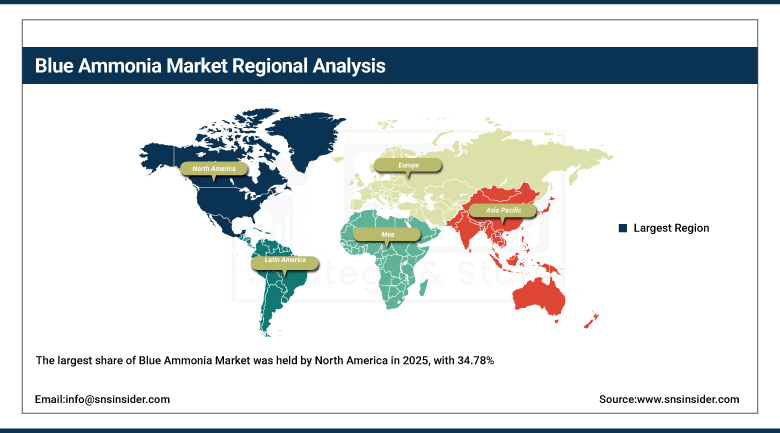
The largest share of Blue Ammonia Market was held by North America in 2025, with 34.78%. Rising investments in low-carbon hydrogen technologies, adoption of carbon capture and storage (CCS) solutions, government incentives for clean energy development and growing demand for decarbonised fuels across power generation and industrial sectors are supporting regional growth. The region’s energy infrastructure is strong and it has advanced ammonia production along with large energy companies developing blue ammonia projects. In 2025, the United States contributed about 83.67% of regional revenue as a result of large-scale clean energy investments, hydrogen initiatives, and industrial decarbonisation efforts.
The U.S. Blue Ammonia Market is growing due to the increasing investments in carbon capture technologies, growing construction of low carbon ammonia production facilities, and increasing demand from the power generation, agriculture, and chemical industries. The country is seeing increasing adoption of blue ammonia, as a hydrogen carrier and alternative fuel solution to achieve emission reduction goals. Canada is also becoming a big contributor, with rich natural gas assets, carbon storage capability and government policies pushing for clean hydrogen manufacturing. The North American market is expected to pick up further momentum with more public-private partnerships, infrastructure development and expansion of export-oriented blue ammonia projects.
Get Customized Report as per Your Business Requirement - Enquiry Now
Europe Blue Ammonia Market Insights
Europe held a prominent share in the Blue Ammonia Market in 2025, supported by strong climate policies, strict decarbonisation targets, and increasing investments in hydrogen-based energy solutions. The region wants to reduce industrial emissions by using clean fuels, carbon capture technologies and adding renewable energy. Germany, the United Kingdom, France, Norway and the Netherlands are all pursuing hydrogen and ammonia strategies to support their energy transition goals. The growing need for clean fuels for power generation, maritime transportation and heavy industries is driving the uptake of blue ammonia across the region.
Germany remains a key player in the European Blue Ammonia Market owing to its robust industrial foundation, progress in hydrogen infrastructure, and increasing focus on low-carbon energy alternatives. The United Kingdom and Norway are also helping expand markets by investing in carbon capture projects and blue hydrogen production facilities. European companies are increasingly partnering to lock in ammonia supply chains and develop large-scale import terminals. Increased focus on energy security, industrial decarbonisation and use of clean fuels is expected to drive market growth across Europe in the forecast period.
Asia Pacific Blue Ammonia Market Insights
Asia Pacific is the fastest growing region in the Blue Ammonia Market with a CAGR of 65.87% during 2026–2035. Growing energy demand, industrialisation, government support for hydrogen economies and greater investments in clean energy infrastructure are driving regional growth. Across the region, countries are eyeing blue ammonia as a transition fuel to cut carbon emissions while safeguarding energy security. China, Japan, South Korea, India and Australia are all working on ammonia supply chains, carbon capture projects and hydrogen infrastructure to meet long-term decarbonisation goals.
Asia Pacific Blue Ammonia Market is segmented on the basis of Country (China, India, Japan, South Korea, Australia, and RoW). Japan and South Korea are also leading the pack with ammonia-based power generation projects and international supply agreements. Australia is becoming a strategic supplier thanks to its natural gas resources and its potential for large scale ammonia exports. The growth of blue ammonia adoption in the Asia Pacific region will be driven by increasing government initiatives, rising demand for low carbon fuels, and increasing collaborations between energy companies.
Middle East & Africa and Latin America Blue Ammonia Market Insights
Latin America and the Middle East & Africa are emerging as markets for blue ammonia with increasing investments in clean energy infrastructure, availability of natural gas resources and growing interest in hydrogen exports. Brazil, Chile and Argentina have a specific interest in blue ammonia production opportunities to support the decarbonisation of their industries and energy transition strategies. The region is already benefitting from emerging international partnerships, the development of ammonia supply chains and growing demand for low-carbon fuels in international markets.
The Middle East & Africa Blue Ammonia Market is Fuelled by the Region’s Rich Natural Gas Reserves, Carbon Storage Potential, and Government Initiatives for Clean Energy. The UAE, Saudi Arabia and Qatar are among countries investing in hydrogen and ammonia projects to diversify their energy portfolios and improve their position in the global clean fuel markets. But some developing regions may hinder the market growth due to high costs of projects, limitations in infrastructure and regulatory hurdles. Greater emphasis on energy diversification, export opportunities and sustainable industrial development should open up new growth opportunities across Latin America and Middle East & Africa.
Growth Drivers: Increasing investments in clean energy transition and carbon capture technologies driving market expansion
Global uptake of blue ammonia solutions is increasing, fuelled by the rising demand for low carbon fuels, a greater emphasis on decarbonisation, and a push to lower greenhouse gas emissions in industrial sectors. Governments and energy companies are investing in hydrogen-based energy solutions, carbon capture, utilisation and storage (CCUS) technologies and clean fuel infrastructure to support net-zero targets. Blue ammonia is an increasing important efficient hydrogen carrier and low-carbon fuel alternative for power generation, transportation and industrial applications. Worldwide, clean energy subsidies and international hydrogen partnerships, along with supportive government policies, are driving the development of large-scale blue ammonia projects.
Technology advancements in steam methane reforming (SMR), autothermal reforming (ATR), carbon capture systems and ammonia production processes are making production more efficient and reducing carbon emissions. The rising demand for sustainable fuels from the power generation, maritime transportation, fertilisers, chemicals, and petrochemical industries is also aiding the growth of the market. Energy companies are growing blue ammonia production capacity through strategic alliances, long-term supply contracts and investment in hydrogen infrastructure. The blue ammonia solutions are expected to witness high demand during the forecast period owing to the increasing focus on energy security, industrial decarbonisation and adoption of clean fuels.
Restraints: High production costs and carbon capture challenges affecting market adoption
The blue ammonia market is majorly hampered due to the high cost of blue ammonia production and carbon capture technology. Also, the total project cost compared to the traditional ammonia production processes is increased by the capital investment for the carbon capture infrastructure, hydrogen production facilities and transportation networks. The reliance on natural gas pricing and availability introduces uncertainty to the economics of production especially in regions with volatile energy markets.
Challenges for blue ammonia projects could also include the efficiency of carbon capture, availability of storage, regulatory approvals and the complex supply chain demand for wide-scale deployment. High investments and lack of technological capabilities may pose challenges for developing countries to develop blue ammonia at scale. But longer term, blue ammonia could be challenged by green ammonia technologies and emerging renewable hydrogen solutions. However, the challenges in the viability and commercialisation of such projects remains, as does the growing demand for low carbon energy solutions.
Opportunities: Expansion of hydrogen economies and development of large-scale clean fuel infrastructure
Increased investments across the globe on hydrogen economy, clean energy infrastructure and carbon reduction initiatives are expected to offer lucrative growth opportunities for the Blue Ammonia Market. Governments and energy companies are constructing large-scale plants to produce blue ammonia, export terminals and international supply chains that will support the clean energy transition goals. Demand for ammonia-based power generation, hydrogen transportation and industrial decarbonisation is increasing, generating new opportunities for producers and technology providers.
Investments in blue ammonia projects are higher in emerging markets in Asia Pacific, Europe and North America amid growing concerns on energy security and carbon neutrality pledges. Energy companies, technology vendors and governments are working together to accelerate innovation in carbon capture, ammonia transport and storage solutions. Increasing usage of blue ammonia as an alternative clean fuel in power generation, maritime transportation, fertilisers and chemical industries are likely to offer long-term growth opportunities for the market players across the globe.
Recent Developments:
-
2025: Saudi Aramco acquired a 50% stake in Blue Hydrogen Industrial Gases (BHIG) in Jubail, Saudi Arabia, strengthening its focus on commercially scalable blue hydrogen and blue ammonia solutions. The company also established technology partnerships with Linde Engineering and CoorsTek to advance ammonia cracking and hydrogen generation technologies.
-
2025: JERA, Mitsui & Co., and CF Industries reached a $4 billion Final Investment Decision (FID) for the Blue Point blue ammonia facility. The project will utilize autothermal reforming (ATR) and carbon capture and storage (CCS) technologies to produce low-carbon ammonia for global power and industrial markets.
-
2025: Mitsui O.S.K. Lines (MOL) partnered with NH3 Clean Energy and Oceania Marine Energy to develop Western Australia’s Pilbara region as a blue ammonia bunkering hub. The collaboration will support ammonia-fuelled shipping operations and strengthen clean fuel supply chains between Australia and East Asia.
-
2026: QatarEnergy and QAFCO advanced the construction of the Ammonia-7 (QAFCO-7) facility in Mesaieed Industrial City. The project is expected to become the world’s largest single-site blue ammonia plant, integrating carbon capture and storage technology for international industrial and fertilizer applications.
Blue Ammonia Companies are:
-
QatarEnergy
-
CF Industries Holdings, Inc.
-
OCI Global
-
ExxonMobil Corporation
-
Shell plc
-
BP plc
-
TotalEnergies SE
-
Linde plc
-
Air Products and Chemicals, Inc.
-
Mitsubishi Corporation
-
Mitsui & Co., Ltd.
-
JERA Co., Inc.
-
Equinor ASA
-
INPEX Corporation
-
Woodside Energy Group Ltd.
-
Uniper SE
-
Fertiglobe plc
-
Topsoe A/S
Blue Ammonia Market Report Scope:
| Report Attributes | Details |
|---|---|
| Market Size in 2025 | USD 206.94 Million |
| Market Size by 2035 | USD 27,263.18 Million |
| CAGR | CAGR of 62.96% From 2026 to 2035 |
| Base Year | 2025 |
| Forecast Period | 2026-2035 |
| Historical Data | 2022-2024 |
| Report Scope & Coverage | Market Size, Segments Analysis, Competitive Landscape, Regional Analysis, DROC & SWOT Analysis, Forecast Outlook |
| Key Segments | • By Technology (Steam Methane Reforming (SMR), Autothermal Reforming (ATR), Gas Partial Oxidation, Haber-Bosch Process) • By Manufacturing Process (Thermochemical Process, Steam Methane Reforming (SMR), Electrochemical Process) • By Application (Fertilizers, Power Generation, Transportation Fuel, Industrial Feedstock, Chemicals & Petrochemicals, Pharmaceuticals, Polymers) • By End User (Agriculture, Power Generation, Automotive & Transportation, Chemical & Petrochemical Industry, Pharmaceutical Industry) |
| Regional Analysis/Coverage | North America (US, Canada), Europe (Germany, UK, France, Italy, Spain, Russia, Poland, Rest of Europe), Asia Pacific (China, India, Japan, South Korea, Australia, ASEAN Countries, Rest of Asia Pacific), Middle East & Africa (UAE, Saudi Arabia, Qatar, South Africa, Rest of Middle East & Africa), Latin America (Brazil, Argentina, Mexico, Colombia, Rest of Latin America). |
| Company Profiles | Saudi Aramco, QatarEnergy, CF Industries Holdings, Inc., Yara International ASA, OCI Global, ExxonMobil Corporation, Shell plc, BP plc, TotalEnergies SE, Linde plc, Air Products and Chemicals, Inc., Mitsubishi Corporation, Mitsui & Co., Ltd., JERA Co., Inc., Equinor ASA, INPEX Corporation, Woodside Energy Group Ltd., Uniper SE, Fertiglobe plc, Topsoe A/S |
Frequently Asked Questions
