
Ureteral Stent Market Report Scope & Overview:
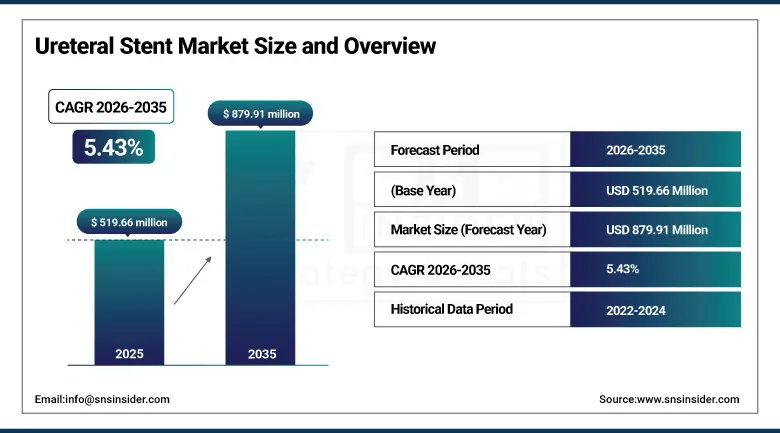
The Ureteral Stent Market was valued at USD 519.66 million in 2025 and is expected to reach USD 879.91 million by 2035, growing at a CAGR of 5.43% from 2026–2035.
The Ureteral Stent Market is anticipated to witness steady growth due to the increasing incidence of urological disorders such as kidney stone disease and urinary obstructions, post-surgical complications, growing prevalence of urological diseases, better acceptance with minimally invasive urology procedures. Consequently, patient comfort, effective urinary drainage, fewer complications and replacement procedures have led to the growing preference of advanced stent solutions. Ongoing improvements in polymer-based stents that are biocompatible, biodegradable stents, drug-eluting stents and progress in coating technology reinforce high clinical performance and low encrustation risk along with the general development of long-term safer options for wide-spectrum urology care applications.
In 2026, the World Health Organization highlighted the increasing global burden of non-communicable diseases, including kidney-related disorders, which are recognized as a major contributor to morbidity and mortality worldwide, supporting the growing need for effective urological interventions.
To Get more information on Ureteral Stent Market - Request Free Sample Report
Ureteral Stent Market Trends
-
Rising adoption of advanced polymer-based and biocompatible stents improving patient comfort, reducing encrustation, and lowering complication rates.
-
Growing shift toward drug-eluting and coated ureteral stents to minimize infections, reduce biofilm formation, and enhance long-term clinical outcomes.
-
Increasing preference for minimally invasive urological procedures driven by faster recovery, reduced hospital stay, and improved patient safety.
-
Expansion of Ambulatory Surgical Centers (ASCs) supporting outpatient urological procedures, improving cost efficiency and procedural accessibility.
-
Rising global burden of kidney stones, urinary strictures, and urological cancers due to lifestyle changes, dehydration, obesity, and aging population.
-
Technological advancements in biodegradable and next-generation stents reducing the need for removal procedures and improving patient compliance.
-
Increasing use of advanced imaging and guide wire assisted placement techniques enhancing accuracy and reducing procedural complications.
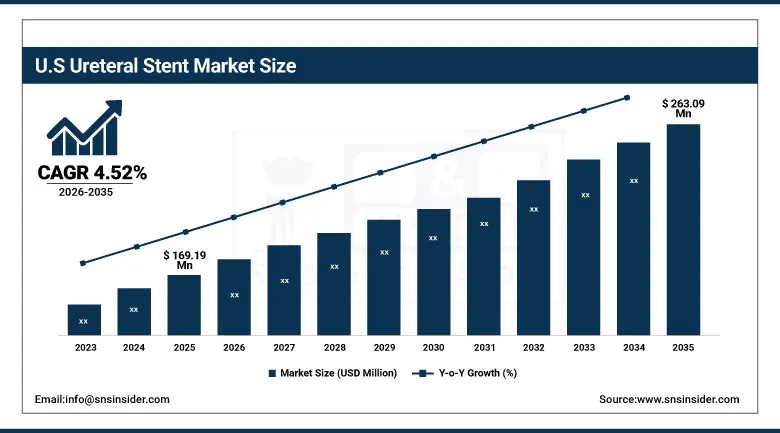
United States Ureteral Stent Market was valued at USD 169.19 Million and it is expected to reach USD 263.09 million by 2035, growing at a CAGR of 4.52% over the forecast period of 2026–2035.
The U.S. Ureteral Stent Market is the largest regional market globally, driven by an advanced healthcare infrastructure, high adoption of minimally invasive urological procedures and established reimbursement policies under Medicare and private insurance systems. Increasing adoption of stent materials such as polyurethane, silicone, coated and biodegradable globally by major medical device companies in hospitals as well as ambulatory surgical centers is further anticipated to boost market growth.
According to clinical reimbursement policies, preference for outpatient urological procedures drive the uptake of ureteral stents across healthcare facilities. Market growth in the country is also gaining momentum as focus shifts on reduction of procedural complications, improving comfort for patients, and reducing length of stay.
Jan 2026, Driving this trend, another report out of the Centers for Disease Control and Prevention suggests that kidney stone disease and other urologic disorders are being traced in the United States at higher than ever levels, strongly related to lifestyle choices obsity dehydration and metabolic conditions further contributing to urinary tract obstruction promoting an increase need for ureteral stenting.
Ureteral Stent Market Segment Analysis
-
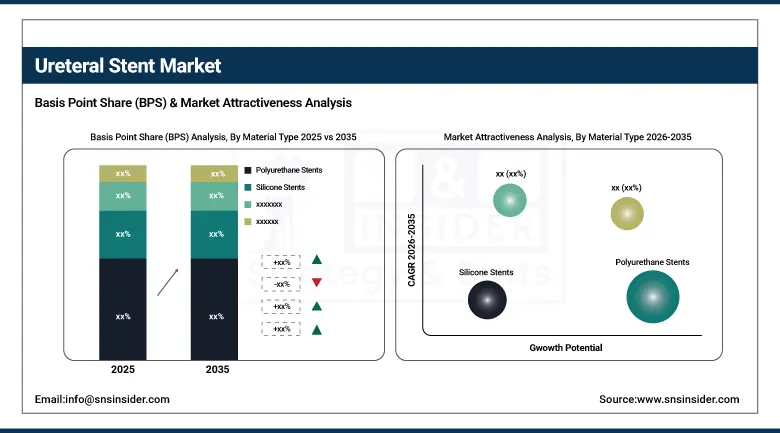
By Material Type, Polyurethane Stents dominated the Ureteral Stent Market with 32.5% share in 2025; Coated Stents fastest growing (CAGR).
-
By Application, Kidney Stones dominated the Ureteral Stent Market with 38.4% share in 2025; Post-Surgical Recovery fastest growing (CAGR).
-
By Length Category, 20–24 cm dominated the Ureteral Stent Market with 36.5% share in 2025; 25–28 cm fastest growing (CAGR).
-
By End User, Hospitals dominated the Ureteral Stent Market with 57.8% share in 2025; Ambulatory Surgical Centers fastest growing (CAGR).
By Material Type, Polyurethane Stents segment dominates the Ureteral Stent Market, Coated Stents segment expected to grow fastest
The Polyurethane Stents segment continued to be the leading segment in Ureteral stent Market acquiring almost half of the total market shares owing to its flexible nature and durability and affordability that made it a commonly used and preferred material for regular urological procedures by 2025. We should mention that these stents are easy to insert and resist external compression, which is critical in urological obstruction. This generalizability to various patient anatomies and clinical conditions has fueled their prevalence across hospitals and surgical centers. Without losing the basic principles of material engineering, continuous advancements in this field have additionally optimised performance and patient comfort.
The Coated Stents segment is projected to have the highest growth during 2026–2035. Rising focus on difficulty prevention such as encrustation, bacterial colonization and a contamination is pushing the use of progressive coated stents. With these innovations, such as antimicrobial coatings, drug-eluting surfaces and hydrophilic layers (and continuing), there is promise of better patient outcomes with a decrease in repeat interventions. Various research and development investments by the medical device manufacturers are boosting the market for next-generation coated stents.
By Application, Kidney Stones segment dominates the Ureteral Stent Market, Post-Surgical Recovery segment expected to grow fastest
The Kidney Stones segment dominates the market due to the high and rising global prevalence of urolithiasis, which significantly increases the demand for ureteral stent placement. Ureteral stents are routinely used to ensure urine flow, relieve obstruction, and support healing following stone removal procedures such as ureteroscopy and lithotripsy. Increasing lifestyle-related risk factors, including dehydration and dietary habits, are contributing to the growing incidence of kidney stones, thereby sustaining segment dominance.
The Post-Surgical Recovery is projected to expand at a faster rate over the assessment timeframe. Rising number of urological surgeries (tumor removal and reconstructive procedures) is thus increasing the demand for stents in post-operative settings. Importance Stents are important in preventing ureteral obstruction and securing proper healing. Additionally, the rising number of minimally invasive surgical procedures also drives the need for stents in recovery management.
By Length Category, 20–24 cm segment dominates the Ureteral Stent Market, 25–28 cm segment expected to grow fastest
The 20–24 cm segment is anticipated to hold the highest share in ureteral stent market at 36.5% by length in 2025, since it represents the most predominantly used length of ureteral stents for average adult patients. This size range allows for ideal placement between the kidney and bladder to facilitate drainage, and therefore is the standard in most clinical situations. Its broad applicability across multiple patient types and procedure types also supports its leading market share.
The 25–28 cm segment is anticipated to witness highest (CAGR over the forecast period of 2026–2035. Rising demand for personalized and patient-specific treatment approaches specifically for taller persons and complex anatomical conditions is anticipated to fuel the adoption. Also supporting this segment growth is the increase in complexity and difficulty of cases with more challenging urological indications requiring longer stents to provide effective drainage.
By End User, Hospitals segment dominates the Ureteral Stent Market, Ambulatory Surgical Centers segment expected to grow fastest
The Hospitals segment is expected to account for the highest share of 57.8% in 2025 due to higher numbers of urological procedures being performed in hospitals, as well as the need for skilled professionals and post-operative care facilities which require advanced infrastructure. Hospitals handle a high volume of complex cases, including kidney stones, tumors, and strictures, which necessitate the use of ureteral stents. The availability of comprehensive diagnostic and surgical capabilities further strengthens their leading position.
The Ambulatory Surgical Centers (ASCs) segment is expected to register the fastest market growth during the forecast period. Cost efficiency, reduced length of hospital stays, and quicker patient recovery are all contributing to the adoption of ASCs globally as the trend shifts more towards outpatient care now. Reimbursement policies and improvements in surgical technologies have led to a greater number of minimally invasive procedures (i.e. ureteroscopy) being undertaken within these settings.
Ureteral Stent Market Regional Analysis
|
Region |
Major Country |
Share (%) |
|---|---|---|
|
North America |
United States |
38.45% |
|
Europe |
Germany |
18.75% |
|
Asia Pacific |
China |
26.30% |
|
Middle East & Africa |
UAE |
7.30% |
|
Latin America |
Brazil |
9.20% |
North America Ureteral Stent Market Insights
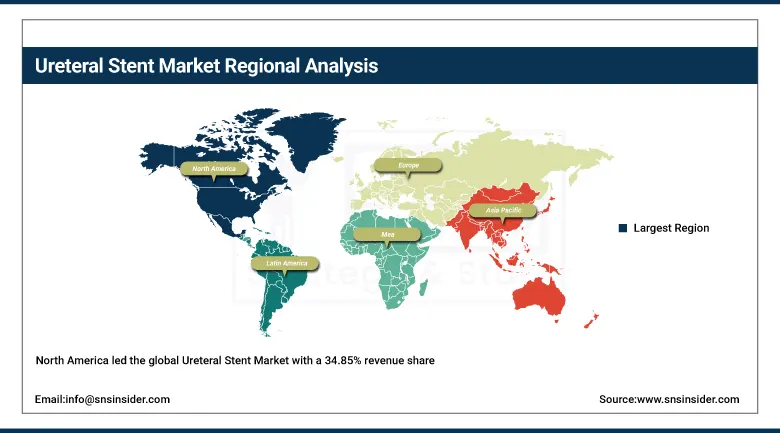
North America continued to be the largest region and increased its Ureteral Stent Market share at peak of 34.85% of the global Ureteral Stent Market revenue due to highly developed urological healthcare infrastructure, high capacity to spend on health-related expenses, higher prevalence rates of kidney stones and urinary tract disorders, presence of leading medical device manufacturing companies offering advanced stenting technologies during the forecast period. Early adoption of minimally invasive urological procedures (including ureteroscopy and laser lithotripsy) and routine use of ureteral stents further enhances the prospects for this territory. The US represents the highest regional performance with almost 85% of intra-regional share (due to the extensive use into hospitals and ambulatory surgical centers) leading to high penetration in advanced polymer and coated stent technologies.
The Centers for Medicare & Medicaid Services (CMS) provides reimbursement coverage for a wide range of urological procedures under Medicare, including inpatient and outpatient services, supporting procedural adoption across healthcare facilities.
The American Urological Association (AUA) highlights the widespread use of ureteral stents in the management of kidney stones and urinary obstructions, supported by increasing adoption of minimally invasive urological techniques.
Get Customized Report as per Your Business Requirement - Enquiry Now
Asia Pacific Ureteral Stent Market Insights
The Asia Pacific region is projected to register the highest growth with a CAGR of 7.33% from 2026-2035 due to rapidly improving healthcare infrastructure, prevalence of kidney stone disease, rising awareness regarding urological treatments and substantial government investments in healthcare growth. Major countries including China, India, Japan, South Korea, and Australia are key contributors, with China alone representing 55% of regional revenue. Increasing patient population, lifestyle-related risk factors, and enhanced access to affordable urological care are major drivers boosting demand for ureteral stents in the region.
Supporting this growth, China’s National Medical Products Administration (NMPA) to facilitate expedited approval and help expedite commercialisation of advanced technologies. Japan's Ministry of Health, Labour and Welfare (MHLW) has set a clear reimbursement route for devices granted medical approval as part of the public healthcare insurance scheme encouraging more hospitals and specialty clinics to offer urological treatments.
Europe Ureteral Stent Market Insights
Europe held the Third-largest revenue share in the global Ureteral Stent Market, accounting for 18.75% in 2025, driven by a well-established healthcare system, strong adoption of minimally invasive urology procedures, and a growing aging population susceptible to urinary tract disorders. Countries such as Germany, the United Kingdom, France, Italy, and Spain are major contributors, with increasing penetration of advanced stent materials including silicone and coated variants in clinical practice.
Supporting this position, the European Commission keeps on funding research and innovation programs from healthcare to medical device sectors, backing up advanced technologies. Additionally, the finalization of the EU Medical Device Regulation (MDR 2017/745) has introduced harmonized and higher assurances for medical device safety, clinical evaluation, and performance requirements with unprecedented levels of transparency, traceability and overall clinical reliability into European healthcare systems.
Middle East & Africa and Latin America Ureteral Stent Market Insights
The Middle East & Africa (MEA) region is witnessing steady growth in the Ureteral Stent Market, supported by improving healthcare infrastructure, increasing awareness of urological diseases, and rising investments in advanced medical technologies. Countries such as the UAE, Saudi Arabia, and South Africa are leading adoption due to government initiatives focused on healthcare modernization and expansion of specialized urology services. The UAE is emerging as a regional hub for advanced urological procedures with increasing deployment of modern technologies in tertiary care hospitals. Saudi Arabia’s Vision 2030 further supports healthcare expansion and procurement of advanced medical devices.
Latin America keeps steadily growing, with Brazil leading the way on a regional basis. The commercialization of medical devices in both public and private healthcare sectors is being facilitated by evolving regulatory frameworks and approval processes. The increasing incidence of Kidney Stones and Urinary Tract disorders, apart from establishing better access to urological care, is boosting the demand for these devices in the region as well as enhancing the treatment outcomes for patients.
Ureteral Stent Market Growth Drivers:
-
Rising global prevalence of kidney stones and urinary tract disorders significantly increasing demand for ureteral stent placement procedures worldwide
The rising occurrence of kidney stones and urinary tract disorders is a major factor driving the global ureteral stents market. Sedentary lifestyles, dehydration, and dietary changes are contributing to a higher prevalence of urolithiasis, particularly in developing and urban populations. Ureteral stents are widely used to relieve obstruction, ensure urine flow, and support recovery after stone removal procedures. Additionally, the growing aging population, which is more susceptible to urological conditions, further strengthens demand. Continuous advancements in diagnostic techniques are also leading to early detection and increased procedural volumes across hospitals and specialty clinics.
In Feb 2026, Clinical observations reported a surge in kidney stone and urinary tract infection cases, driven by dehydration, obesity, and sedentary lifestyles, leading to a higher number of urological interventions and increasing demand for ureteral stent placement procedures globally.
Ureteral Stent Market Restraints:
-
High incidence of stent-related complications including infection, encrustation, and patient discomfort limiting widespread adoption and repeat procedures
Increasing occurrence of complications associated with ureteral stents is a significant challenge for market growth. Uncomfortable, painful, hemorrhagic and urgent urination can threaten quality of life in patients. Moreover, mechanically-placed stents may contribute to encrustation and bacterial colonization over time, exacerbating infection risk and necessitating more invasive therapies. Consequently, these complications come with early removal and replacement of stents, imposing an additional economic burden to the health care system. Post-procedural discomfort and complications can deter adoption, particularly when other treatment options exist for the same or similar conditions; patients expressed concerns as did health care providers.
Ureteral Stent Market Opportunities:
-
Advancements in coated and biodegradable stent technologies creating significant potential for improved patient outcomes and reduced complication rates globally
Increasing focus on innovation in ureteral stent materials is creating strong growth opportunities in the market. Control of metal ion release from these coated stents, which provide antimicrobials and anti-encrustation properties in addition to the mechanical support previously provided by traditional devices, are key factors in satisfying some of the most significant clinical challenges associated with their use. Additionally, biodegradable stents that eliminate the need for removal procedures are gaining attention for their potential to enhance patient comfort and reduce healthcare costs. Ongoing research and collaboration between medical device companies and research institutions are accelerating product development. These technological advancements are expected to improve treatment outcomes and expand the adoption of next-generation ureteral stents.
In Jan 2026, Recent research introduced novel biodegradable hydrogel ureteral stents with controlled degradation properties, enabling elimination of removal procedures and improving patient safety and clinical efficiency.
Recent Developments:
-
2026: Advancements in biodegradable ureteral stents and smart sensor-enabled monitoring devices improved patient convenience by eliminating removal procedures and enabling real-time tracking of stent performance, reducing complications and enhancing clinical outcomes.
-
2025: Rising complication rates associated with traditional stents accelerated the adoption of advanced solutions such as anti-encrustation coatings, hydrophilic surfaces, and drug-eluting stents, driving innovation-focused product development across the market.
-
2024: Ongoing advancements in ureteral stent materials and coating technologies, including antimicrobial and anti-encrustation designs, have improved device performance and reduced complication risks in urological treatments.
Ureteral Stent Market Key Players
-
Boston Scientific Corporation
-
Cook Medical Inc.
-
Becton Dickinson and Company
-
Teleflex Incorporated
-
Olympus Corporation
-
B. Braun Melsungen AG
-
Medtronic plc
-
Applied Medical Resources Corporation
-
Allium Medical Solutions Ltd.
-
Urovision GmbH
-
Pnn Medical A/S
-
Optimed Medizinische Instrumente GmbH
-
Taewoong Medical Co. Ltd.
-
M.I. Tech Co. Ltd.
-
SRS Medical Systems Inc.
-
Rocamed SAM
-
Endo-Flex GmbH
-
Well Lead Medical Co. Ltd.
| Report Attributes | Details |
|---|---|
| Market Size in 2025 | USD 519.66 Million |
| Market Size by 2035 | USD 879.91 Million |
| CAGR | CAGR of 5.43% From 2026 to 2035 |
| Base Year | 2025 |
| Forecast Period | 2026-2035 |
| Historical Data | 2022-2024 |
| Report Scope & Coverage | Market Size, Segments Analysis, Competitive Landscape, Regional Analysis, DROC & SWOT Analysis, Forecast Outlook |
| Key Segments | • By Material Type (Polyurethane Stents, Silicone Stents, Hydrogel Stents, Plastic Stents, Metal Stents, Coated Stents) • By Application (Kidney Stones, Urinary Strictures, Tumors, Post-Surgical Recovery, Others) • By Length Category (Below 20 cm, 20–24 cm, 25–28 cm, Above 28 cm) • By End User (Hospitals, Ambulatory Surgical Centers, Specialty Clinics, Others) |
| Regional Analysis/Coverage | North America (US, Canada), Europe (Germany, UK, France, Italy, Spain, Russia, Poland, Rest of Europe), Asia Pacific (China, India, Japan, South Korea, Australia, ASEAN Countries, Rest of Asia Pacific), Middle East & Africa (UAE, Saudi Arabia, Qatar, South Africa, Rest of Middle East & Africa), Latin America (Brazil, Argentina, Mexico, Colombia, Rest of Latin America). |

Frequently Asked Questions
The Polyurethane Stents segment dominated the Ureteral Stent Market in 2025.
Rising prevalence of kidney stones, urinary tract disorders, and increasing adoption of minimally invasive urological procedures are the primary growth drivers of the market.
North America dominated the Ureteral Stent Market in 2025.
The Ureteral Stent Market was valued at USD 519.66 million in 2025.
The Ureteral Stent Market is expected to grow at a CAGR of 5.43% from 2026 to 2035.
