
Video as a Sensor Market Report Scope & Overview:
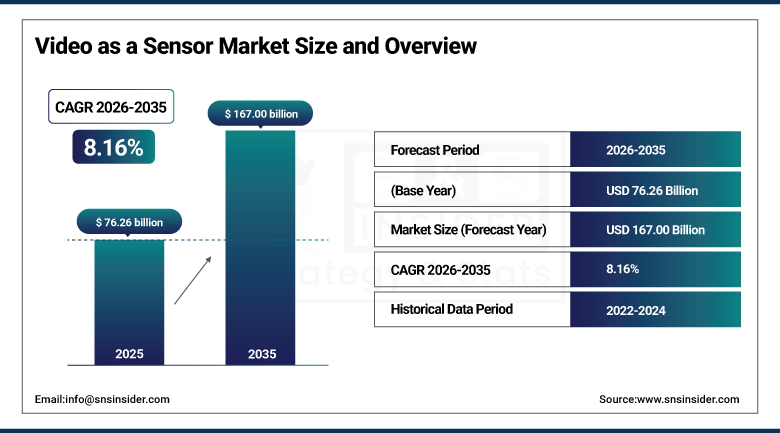
The Video as a Sensor Market size was valued at USD 76.26 Billion in 2025 and is projected to reach USD 167.00 Billion by 2035, expanding at a CAGR of 8.16% during the forecast period 2026–2035.
The market for video as a sensor continues to grow at a steady rate as corporations employ cameras as intelligent sensing devices that not only perform traditional surveillance but are able to generate valuable business data. The capabilities of artificial intelligence, computer vision, deep learning, and edge computing allow video streams to operate as live sensors for event detection, asset monitoring, workflow optimization, and situational awareness. Corporations such as government agencies, transportation companies, manufacturers, retailers, and healthcare services invest in intelligent vision technologies to improve their automation, security, predictive analysis, operational efficiency, and reduce human labor involved in monitoring operations.
The industry is also driven by fast-growing developments in video analytics software powered by AI technologies, intelligent edge computing processors, cloud video analysis services, and imaging hardware designed to process vast amounts of video data in real time. Smart city infrastructures, industrial digitalization, intelligent transportation systems, and autonomous monitoring systems will contribute further to commercial growth. In January 2026 brought continued development of AI-powered intelligent transportation projects initiated by the U.S. Department of Transportation to monitor and analyze traffic situations via cameras mounted on road infrastructure.
To Get more information Video as a Sensor Market - Request Free Sample Report
Video as a Sensor Market Trends:
-
Rapid deployment of AI-powered video analytics across enterprise operations.
-
Increasing adoption of edge AI cameras for real-time decision intelligence.
-
Growing investments in smart city visual sensing infrastructure worldwide.
-
Expansion of industrial computer vision supporting autonomous operations.
-
Integration of cloud-native video intelligence with IoT ecosystems.
U.S. Video as a Sensor Market Size Outlook:
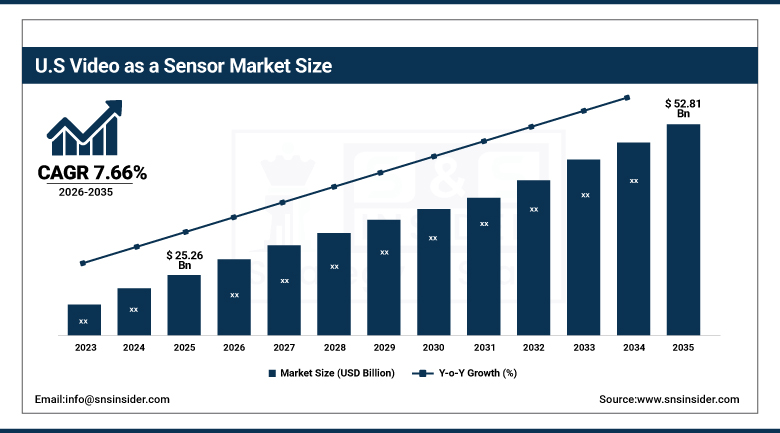
The U.S. Video as a Sensor Market was valued at USD 25.26 billion in 2025 and is expected to reach approximately USD 52.81 billion by 2035, expanding at a CAGR of 7.66% during 2026–2035.
The dominance of the United States' market in North America is ensured by the high level of usage of AI-enabled surveillance cameras, intelligent transport infrastructures, industrial automation systems, and advanced public safety technologies. The investments from federal agencies, municipal governments, hyperscale cloud providers, and enterprise organizations contributed to the fast implementation of computer vision applications that can support predictive monitoring, automation of security systems, infrastructure operations, and business optimizations. Increasing the number of edge AI devices installed in manufacturing plants, airports, logistic centers, retail stores, and hospitals adds to the leading position of the national market.
The constant technology innovations represent an important feature of the U.S. market due to the innovations introduced by the semiconductor producers, AI software providers, cloud service providers, and smart infrastructure providers, providing more advanced video sensing capabilities. Generative AI, multimodal perception, digital twins, edge computing, and real-time analytics systems improve decision making, decreasing the latency and costs of the operations. In May 2026, the company NVIDIA Corporation enhanced enterprise AI vision capabilities for real-time video analytics, industrial inspection, robotics, and smart infrastructures, adding to the wide adoption of AI-enabled video sensing systems.
Video as a Sensor Market Segment Analysis:
-
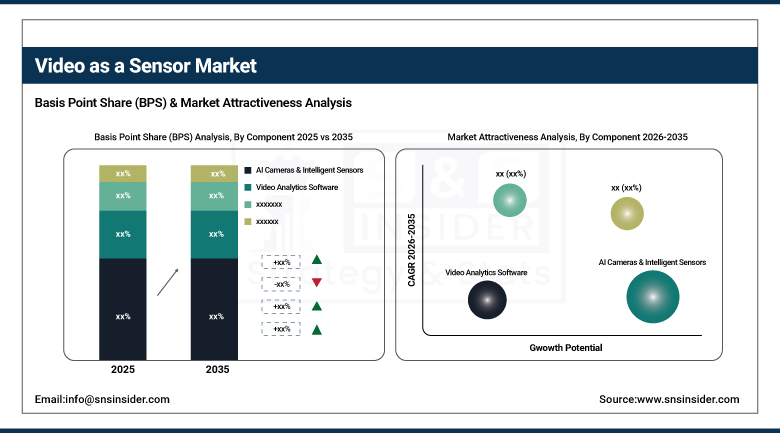
By Component, AI cameras & intelligent sensors dominated the market with 36.00% share in 2025, while video analytics software is projected to witness the fastest growth with a CAGR of 9.61% during the forecast period 2026–2035.
-
By Application, smart cities & public safety dominated the market with 28.00% share in 2025, while logistics & warehousing is projected to witness the fastest growth with a CAGR of 9.44% during the forecast period 2026–2035.
-
By End User, government & smart cities dominated the market with 26.00% share in 2025, while manufacturing is projected to witness the fastest growth with a CAGR of 9.24% during the forecast period 2026–2035.
By Component, AI cameras & intelligent sensors dominated, while video analytics software grows fastest.
AI cameras and intelligent sensors represented a 36.00% share in the video as a sensor market across the world in 2025 and emerged as the leading revenue segment owing to the rising use of intelligent AI cameras that have the capability of conducting real-time object detection, facial recognition, anomaly detection, and behavior analysis at the edge level. These intelligent sensors decrease the network bandwidth and facilitate faster decision-making in smart cities, industrial complexes, transport infrastructures, and office buildings. Advances in the embedded AI processors, vision chips with low power consumption, and high resolution imaging sensors help boost their adoption in mission critical environments where continuous monitoring of the environment is needed.
Software for video analytics is forecasted to have the highest growth rate of 9.61% during 2026 to 2035 due to growing enterprise demand for software solutions for intelligent video processing. Businesses are increasingly adopting intelligent software for automatic surveillance, efficient processes, improved safety at the workplace, and predictive maintenance with the help of sophisticated AI algorithms, deep learning models, and computer vision platforms. Fast growth of cloud-based analytics, multimodal AI and generative AI for video analysis is expected to significantly boost the demand for such software solutions.
By Application, smart cities & public safety dominated, while logistics & warehousing grows fastest.
The market segment of smart cities & public safety occupied the biggest market share in 2025, which was 28.00% due to growing investments in intelligent city infrastructure, traffic management, emergency management solutions, and critical infrastructure protection. The governments across the world are implementing AI-driven cameras to provide public safety, to manage traffic flows better, to supervise public places, and improve disaster recovery capacities. The combination of video sensors with IoT infrastructure, ITS, and command centers helps to increase effectiveness of operations and facilitate data-driven urban management and security.
Logistics & warehousing is expected to grow with the highest CAGR of 9.44% throughout the forecast period as logistics companies utilize AI-based video vision systems for inventory management, packaging tracking, worker safety monitoring, and warehouse optimization purposes. The fast development of e-commerce, autonomous materials handling, robotics integration, and smart fulfillment centers is pushing the implementation of intelligent video analysis. Companies use the computer vision technologies to increase the visibility of the operations, reduce losses, and improve supply chain efficiency.
By End User, government & smart cities dominated, while manufacturing grows fastest.
Government and smart cities accounted for 26.00% of the market revenue share in 2025 owing to constant investments in intelligent surveillance systems, border security systems, transport management systems, public safety systems, and critical asset monitoring systems. National and local governments have started incorporating AI-driven video sensing technologies into their digital transformation initiatives to facilitate improved emergency response, resilience of infrastructure, environmental sensing, and efficient policing and law enforcement operations. Massive scale adoption of smart cities projects is still contributing towards sustained growth in video sensing technologies demand globally.
The manufacturing segment is anticipated to register the highest CAGR of 9.24% during the forecast period driven by rising adoption of industry 4.0 initiatives and growing use of machine vision with AI capabilities in quality inspection, predictive maintenance, worker safety and productivity, and autonomous process monitoring. Manufacturing organizations have started utilizing intelligent camera technologies that can detect machinery malfunctions, monitor production processes, compliance, and improve overall operational efficiencies. Constant investments in digital factories, industrial robots, and edge computing capabilities with AI support will continue fueling the demand going forward.
Regional Analysis:
|
Region |
Major Country |
Share within Region, 2025 (%) |
|---|---|---|
|
North America |
United States |
92.00% |
|
Europe |
Germany |
33.00% |
|
Asia Pacific |
China |
22.00% |
|
Middle East & Africa |
UAE |
5.00% |
|
Latin America |
Brazil |
4.00% |
North America Video as a Sensor Market Insights
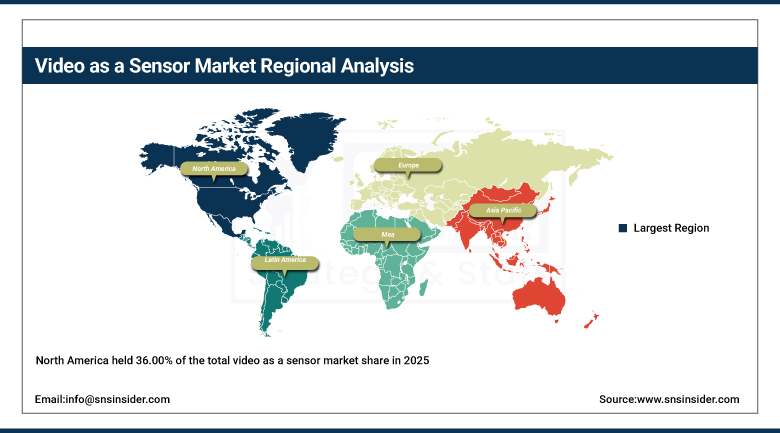
North America held 36.00% of the total video as a sensor market share in 2025 due to the early adoption of AI, advanced computer vision technologies, well-established cloud environment, and intelligent surveillance system infrastructure investments. The government, transportation companies, manufacturers, and businesses are implementing the video sensing platform powered by AI to enhance their efficiency in terms of public safety, productivity, infrastructure management, and business intelligence. Technology ecosystems, digital enterprise, and constant innovations in edge AI processors and intelligent imaging solutions are contributing more to the growth of the regional market.
The region is benefiting from huge investments in the development of smart cities, autonomous transportation, automation industry, and the modernization of infrastructure. The growing adoption of the AI-based video analytics along with IoT platforms, digital twins, cyber security architecture, and edge computing is opening many commercial opportunities in various sectors. In February 2026, the U.S. Department of Homeland Security continued providing support for AI-powered computer vision technologies for infrastructure protection, border surveillance, and public safety modernization through intelligent surveillance programs.
Get Customized Report as per Your Business Requirement - Enquiry Now
Europe Video as a Sensor Market Insights
Europe still remains an important market for video as a sensor technologies owing to the growing investments into industrial automation, ITS, and AI-based security and safety measures. Among the leading countries are Germany, the UK, France, Italy, and the Nordics, which are actively deploying the computer vision systems in their manufacturing industries, logistics, urban mobility, and infrastructure. As a result of the strong regulation in the area of safety and resilience, as well as digitization, companies find it more reasonable to use video sensors able to increase efficiency and ensure compliance with regulations at the same time.
Edge AI cameras and privacy-friendly analytics that comply with the strict rules of data governance also become widely used in the region. Industrial digitalization, growing smart mobility, and intelligent traffic management systems contribute to the high demand for advanced video analytics platforms. Regular investments into innovations in AI and semiconductors will ensure the competitive position of the region in the long term.
Asia Pacific Video as a Sensor Market Insights
Asia Pacific video as a sensor market is expected to exhibit the highest regional CAGR of 9.40% throughout the forecast period, owing to the high rate of urbanization, expansion of smart city projects, automation in industries, and huge investments in AI-infrastructure. Rapid deployment of intelligent camera networks in transportation systems, manufacturing sites, logistics centers, hospitals, and other commercial infrastructures in countries such as China, Japan, South Korea, India, Singapore, and Southeast Asian economies is driving demand within the region.
Initiatives by governments towards the growth of digital cities, intelligent manufacturing plants, and transportation systems are further fueling the adoption of AI-infrastructure among the commercial entities. Companies are making heavy investments in research and development to develop AI chips, machine vision software, and AI-powered analytics platforms. In January 2026, Huawei Technologies Co., Ltd. launched AI-powered intelligent vision solutions for smart cities, transportation management, industrial monitoring, and digital enterprise transformation in Asia-Pacific region.
Middle East & Africa and Latin America Video as a Sensor Market Insights
The ME&A market is consistently gaining traction because of growing investments towards smart city development, protection of critical infrastructure, transportation improvement, and public safety measures. Nations such as UAE, Saudi Arabia, and South Africa are making use of video sensing solutions powered by artificial intelligence in their airports, smart mobility projects, industrial infrastructure, and government infrastructure. Growth in the use of cloud computing, traffic management, and command-and-control systems is forecasted to drive the market during the coming decade.
There is an increase in the use of video sensing solutions driven by AI in various sectors such as transportation, retail, manufacturing, logistics, and public safety. Nations such as Brazil, Mexico, Chile, and Colombia are investing in the development of intelligent surveillance infrastructure and industrial automation to ensure better visibility and security of infrastructure. The market is expected to have a positive outlook in the future because of increased digital transformation initiatives and smart logistics networks.
Market Dynamics:
Growth Drivers: Increase in use of AI-based computer vision in smart infrastructure and industrial automation.
The increasing adoption of artificial intelligence and computer vision technologies is one of the key drivers of the video as a sensor market. More companies are converting the traditional surveillance cameras to smart sensors that can detect assets, identify abnormalities, recognize objects, analyze behavior and provide predictive operational insights. The need for these sensors is increasing in the areas of smart cities, industrial plants, transport infrastructure, logistic centers, healthcare organizations, and businesses due to increased focus on automation, productivity, workplace safety and infrastructure resilience. Adoption of AI processors at the edge, sophisticated neural networks and high-speed data transfer is enabling better decision-making by minimizing the latency and the use of bandwidth, which makes the intelligent video sensing economically viable.
Continuous investments in the digital infrastructure, AI chips, cloud native analytical capabilities and intelligent edge devices have opened new business opportunities for various organizations across the public and private sectors. Businesses are incorporating video sensing along with IoT, digital twins, robotics, autonomous systems and predictive maintenance solutions. In March 2026, NVIDIA Corporation made an addition to its AI vision platform through the launch of the AI computing platform for industrial automation, intelligent transport, robotics and real-time video analytics.
Restraints: Issues relating to data privacy and infrastructure costs.
While the market offers tremendous long-term growth potential, market expansion remains affected by issues related to data privacy legislation, cyber security, and the need for significant infrastructure investments. The deployment of enterprise-level AI-enabled cameras, intelligent edge computing devices, cloud platforms for analytics, storage infrastructure, and network solutions necessitates large financial expenditures, especially for organizations that operate at various geographical locations. Moreover, complying with the ever-changing data protection laws, video retention rules, biometric privacy legislation, and international data laws makes deployment even more complex.
Additionally, businesses have to consider issues like cyber security risks associated with the camera network, AI solutions, and cloud infrastructure while maintaining high levels of system availability and reliability. The need for specialized AI personnel, the integration with the existing infrastructure, and regular software updates increase operational expenses. European data protection board was constantly highlighting the responsible approach towards the deployment of AI and video surveillance solutions.
Opportunities: Edge AI growth, smart cities, and autonomous visual intelligence.
Fast growth in edge AI computing, intelligent transport infrastructure, and smart city spending provides considerable long-term opportunities for the Video as a Sensor Market. The government and corporate sectors are adopting distributed AI-powered video solutions that have the capability to process video data locally and reduce latency and cloud connectivity requirements. Intelligent cameras are becoming multilayered sensors used in optimizing traffic, environmental monitoring, industrial quality control, public safety, retail, healthcare, and maintenance prediction among others. The transformation opens up commercial prospects for many end user industries.
Further innovations in AI accelerators, neuromorphic computing, multimodal analysis, digital twins, and autonomous robotics will generate further revenues for technology vendors throughout the forecast period. Adoption of 5G-enabled edge computing devices and intelligent manufacturing ecosystems and cloud-edge hybrid architecture will continue driving investments by enterprises. In April 2026, Intel Corporation extended its edge AI offerings with vision processing products that were aimed at accelerating computer vision, industrial inspections, smart retail, and intelligent infrastructure applications.
Recent Developments:
-
2026: NVIDIA Corporation announced enhancements to its AI Vision platform and edge AI ecosystem, enabling improved real-time video analytics, industrial inspection, robotics, and smart infrastructure deployments through accelerated computer vision capabilities.
-
2026: Axis Communications expanded its portfolio of AI-powered network cameras with advanced edge analytics for object classification, behavioral analysis, and intelligent event detection, strengthening enterprise video sensing applications.
-
2026: Siemens AG enhanced its industrial AI vision capabilities for factory automation, enabling real-time visual inspection, predictive quality control, and intelligent manufacturing analytics across Industry 4.0 environments.
-
2025: Bosch Building Technologies introduced next-generation AI-enabled video analytics solutions supporting perimeter protection, intelligent traffic monitoring, and critical infrastructure security through advanced edge-based processing.
Video as a Sensor Companies are:
-
NVIDIA Corporation
-
Cisco Systems, Inc.
-
Bosch Building Technologies
-
Motorola Solutions, Inc.
-
Verkada Inc.
-
Hanwha Vision Co., Ltd.
-
Hikvision Digital Technology Co., Ltd.
-
Milestone Systems A/S
-
Genetec Inc.
-
Ambarella Inc.
-
Intel Corporation
-
Honeywell International Inc.
-
Teledyne FLIR LLC
-
Huawei Technologies Co., Ltd.
-
Qualcomm Incorporated
-
Sony Semiconductor Solutions Corporation
-
Eagle Eye Networks, Inc.
-
Zebra Technologies Corporation
Video as a Sensor Market Report Scope:
| Report Attributes | Details |
|---|---|
| Market Size in 2025 | USD 76.26 Billion |
| Market Size by 2035 | USD 167.00 Billion |
| CAGR | CAGR of 8.16% From 2026 to 2035 |
| Base Year | 2025 |
| Forecast Period | 2026-2035 |
| Historical Data | 2022-2024 |
| Report Scope & Coverage | Market Size, Segments Analysis, Competitive Landscape, Regional Analysis, DROC & SWOT Analysis, Forecast Outlook |
| Key Segments | • By Component (AI Cameras & Intelligent Sensors, Video Analytics Software, Edge AI Hardware, Cloud Analytics Platforms, Services & Integration) • By Application (Smart Cities & Public Safety, Industrial Automation, Transportation & Traffic Management, Healthcare Monitoring, Logistics & Warehousing, Others) • By End User (Government & Smart Cities, Manufacturing, Transportation Authorities, Retail & Commercial, Others) |
| Regional Analysis/Coverage | North America (US, Canada), Europe (Germany, UK, France, Italy, Spain, Russia, Poland, Rest of Europe), Asia Pacific (China, India, Japan, South Korea, Australia, ASEAN Countries, Rest of Asia Pacific), Middle East & Africa (UAE, Saudi Arabia, Qatar, South Africa, Rest of Middle East & Africa), Latin America (Brazil, Argentina, Mexico, Colombia, Rest of Latin America). |
| Company Profiles | NVIDIA Corporation, Cisco Systems, Inc., Axis Communications AB, Bosch Building Technologies, Motorola Solutions, Inc., Verkada Inc., Hanwha Vision Co., Ltd., Hikvision Digital Technology Co., Ltd., Dahua Technology Co., Ltd., Milestone Systems A/S, Genetec Inc., Ambarella Inc., Intel Corporation, Honeywell International Inc., Teledyne FLIR LLC, Huawei Technologies Co., Ltd., Qualcomm Incorporated, Sony Semiconductor Solutions Corporation, Eagle Eye Networks, Inc., Zebra Technologies Corporation |
Frequently Asked Questions
The Video as a Sensor Market was valued at USD 76.26 Billion in 2025.
The market is projected to reach USD 167.00 Billion by 2035.
The market is anticipated to expand at a CAGR of 8.16% during the forecast period.
North America dominated the global Video as a Sensor Market in 2025 with a 36.00% revenue share.
AI Cameras & Intelligent Sensors accounted for the largest revenue share of 36.00% in 2025.
