
Viral Vector CDMO Market Report Scope & Overview:
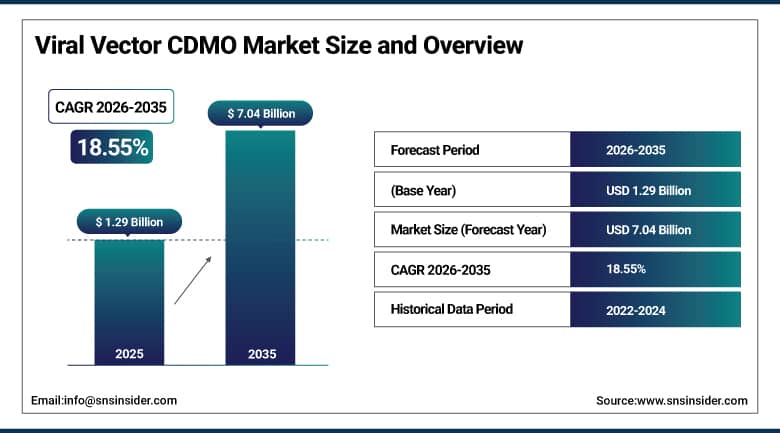
The Viral Vector CDMO Market was valued at USD 1.29 Billion in 2025 and is projected to reach USD 7.04 Billion by 2035, expanding at a CAGR of 18.55% during the forecast period 2026–2035.
Market witnessing extraordinary growth due to the fast-paced commercialization of gene therapies, cell therapies, and viral vector-based vaccines along with the increasing outsourcing trends by biotech and pharma companies. Viral vector CDMOs have emerged as an important partner in speeding up the process of developing therapies owing to their specialized knowledge in process development, analytical testing, clinical manufacturing, commercial manufacturing, and regulatory compliance. With more gene therapy candidates entering the clinical stage worldwide, there has been an increase in demand for scalable and high-quality manufacturing capacity of viral vectors.
The development in vector engineering technology, manufacturing technology, and regulation of advanced therapy medicinal products (ATMPs) will further aid in the sustained growth of the market in the coming years. Complexity of viral vector manufacturing, high investment, and stringent quality standards have led many drug manufacturers to seek outsourcing of manufacturing to viral vector CDMOs.
To Get More Information On Viral Vector CDMO Market - Request Free Sample Report
Viral Vector CDMO Market Trends
-
Increasing outsourcing of viral vector development and GMP manufacturing services.
-
Growing adoption of suspension cell culture and single-use bioprocessing technologies.
-
Rising investments in AAV and lentiviral vector manufacturing platforms.
-
Expansion of automated analytical testing and digital biomanufacturing solutions.
-
Increasing strategic collaborations between biotechnology companies and specialized CDMOs.
The U.S. Viral Vector CDMO Market Size Outlook
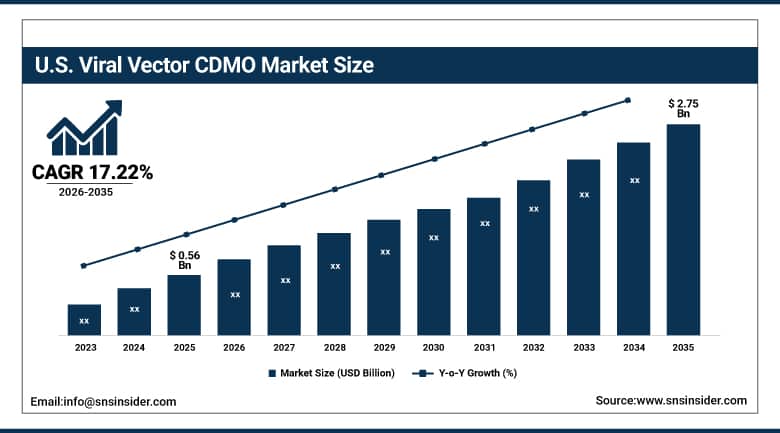
The U.S. Viral Vector CDMO Market was valued at USD 0.56 billion in 2025 and is expected to reach approximately USD 2.75 billion by 2035, expanding at a CAGR of 17.22% during 2026–2035.
The United States holds around 93.00% of the North American market share and remains the largest viral vector manufacturer worldwide because of its well-developed biotechnology sector, excellent clinical research sector, and leading players in the gene therapy segment as well as CDMO service providers. Growth in the approval of gene therapies, increased investments in advanced biologics manufacturing, and huge funding for cell and gene therapy are driving the market demand in the country. Pharmaceutical as well as biotechnology companies are increasingly adopting the strategy of manufacturing outsourcing for product development while adhering to the regulatory standards and scalability of the products.
The United States is benefiting from huge investments in advanced bioprocessing, funding from venture capitals for innovations in the biotechnology sector, and advanced therapy regulatory pathway. Clinical trials for rare diseases, oncology, ophthalmology, and neurological diseases are continuously generating demand for the development and manufacturing of viral vectors.
Viral Vector CDMO Market Segment Analysis
-
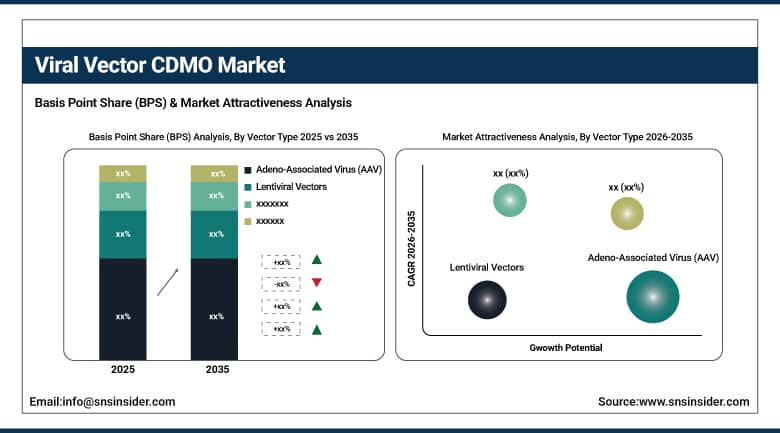
By Vector Type, adeno-associated virus (AAV) dominated the market with a 38.00% share in 2025, while lent viral vectors are projected to register the fastest CAGR of 19.37% during the forecast period.
-
By Service Type, clinical manufacturing dominated the market with a 31.00% share in 2025, while commercial manufacturing is projected to witness the fastest CAGR of 23.46% during the forecast period.
-
By Application, gene therapy dominated the market with a 43.00% share in 2025, while vaccines are projected to register the fastest CAGR of 23.69% during the forecast period.
-
By End User, biotechnology companies dominated the market with a 39.00% share in 2025, while government organizations are projected to witness the fastest CAGR of 21.90% during the forecast period.
By Vector Type, adeno-associated virus (AAV) dominated the market, while lent viral vectors are fastest-growing.
The market segment dominated by the adeno-associated virus (AAV) constituted the highest revenue share in the viral vector CDMO market in 2025 owing to its extensive application in gene therapy treatments of rare genetic diseases, inherited retinal disorders, neuromuscular diseases, and diseases affecting the central nervous system. The CDMOs are aggressively scaling up AAV production capacities through substantial investments in suspension manufacturing technology, single-use bioreactors, and advanced purification systems. During the period 2025-2026, several major CDMOs have made announcements of capacity expansion in the manufacturing of GMP-grade AAV vectors that would help in accelerating the commercialization of gene therapies for rare genetic diseases.
The lentiviral vector market segment is expected to witness the fastest CAGR of 19.37% during the forecast period due to the fast adoption of this viral vector in the manufacture of CAR-T cell therapy, hematopoietic stem cell therapy, and other gene-modified cellular therapies. CDMOs are continuously optimizing their processes and investing in the manufacturing of lentiviral vectors through advanced closed systems and automated manufacturing platforms. During 2026, several manufacturers of viral vectors launched new-generation lentiviral manufacturing technologies for improving the scalability and yield of lentiviral vectors for rapidly scaling cell therapy programs.
By Service Type, clinical manufacturing dominated the market, while commercial manufacturing is fastest-growing.
In terms of revenue shares, the clinical manufacturing segment emerged as the market leader with 31.00% share in 2025. It can be attributed to the increased number of gene and cell therapy pipeline candidates in Phase I, Phase II, and Phase III clinical trials. CDMOs with expertise in clinical manufacturing are being preferred by biopharmaceutical companies due to the rigorous regulatory requirements for viral vectors, which need to be produced under GMP conditions in order to expedite the clinical development timeline. Several global CDMOs added dedicated clinical manufacturing facilities featuring single-use bioreactors and advanced process control systems in 2025–2026 to cater to the rising number of clinical gene therapy projects.
It is expected that the commercial manufacturing segment will witness the highest CAGR of 23.46% during the forecast period. The reason for it is the increased commercialization of approved gene therapies and the need for viral vector manufacturing at a commercial scale. With the approval of advanced therapies, the biotechnology and pharmaceutical players require reliable commercial manufacturing partners who will ensure continuous product supply and quality standards. Leading viral vector CDMOs launched commercial manufacturing facilities in 2026 to support the launch and long-term commercial production of gene therapies.
By End User, biotechnology companies dominated the market, while government organizations are fastest-growing.
Biotechnology companies was the major contributor to the viral vector CDMO market with 39.00% revenue share in 2025 due to biotechnology companies being the biggest developer of gene therapies, cell therapies, and viral vectors. Majority of start-up biotech companies have very limited manufacturing infrastructure and therefore are heavily reliant on specialist CDMOs for process development, analysis, GMP manufacturing, and regulatory services. Rising venture capitalist investments, increased pipeline in biotechnology, and rise in number of gene therapy companies at clinical stages fuel outsourcing requirements. Companies entered into long term manufacturing agreements with major viral vector CDMOs to ensure manufacturing capability of expanding clinical and commercial gene therapy pipelines.
Government organizations is expected to be the fastest growing CAGR of 21.90% over the forecast period attributed to rising investments in advanced manufacturing of biologics, pandemic preparedness, biotechnology innovations, and national health care infrastructure. Governments from various countries are investing in viral vector manufacturing to improve domestic biopharma manufacturing, clinical research, and pandemic preparedness. Public private partnerships, research grants, and national biotechnology initiatives are promoting collaborations among governments, universities, and commercial CDMOs. Several biotechnology initiatives funded by governments announced investments in domestic viral vector manufacturing during 2026.
Regional Analysis
|
Region |
Major Country |
Share within Region, 2025 (%) |
|---|---|---|
|
North America |
United States |
93.00% |
|
Europe |
Germany |
29.00% |
|
Asia Pacific |
China |
18.00% |
|
Middle East & Africa |
UAE |
3.00% |
|
Latin America |
Brazil |
3.00% |
North America Viral Vector CDMO Market Insights
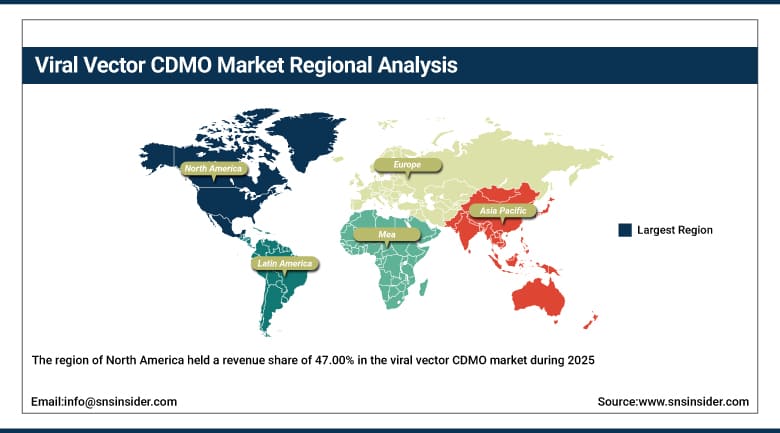
The region of North America held a revenue share of 47.00% in the viral vector CDMO market during 2025 as a result of high sophistication of its biotechnology sector, high presence of gene therapy developers, robust manufacturing infrastructure, and favorable regulatory framework for ATMPs. The region is favored by having leading viral vector CDMOs, substantial spending on R&D, and a rapidly growing pipeline of gene and cell therapies. Pharmaceutical and biotech firms are increasingly outsourcing the manufacture of viral vectors to dedicated CDMOs in order to facilitate the process of development of such products as well as comply with strict GMP requirements. The US emerges as the primary driver of the regional market growth thanks to increased FDA approvals.
In 2026, many North American CDMOs have been reported to make multi-million dollar investments into manufacturing of commercial-grade viral vectors utilizing advanced single use bioprocessing and production technologies.
Get Customized Report as Per Your Business Requirement - Enquiry Now
Europe Viral Vector CDMO Market Insights
The region of Europe is considered to be among the frontrunners in terms of contract development and manufacturing of viral vectors due to the development of biopharmaceutical sector, strong academic research capabilities, as well as commercialization of advanced therapy medicinal products. Countries including Germany, the UK, France, Switzerland, Belgium, and the Netherlands are constantly enhancing their capabilities in regional manufacturing through investments into facilities with GMP compliance and sophisticated bioprocessing technologies. At the same time, European regulation of ATMPs, alongside with strong cooperation between research institutions, biotech companies, and manufacturing organizations, encourages innovations in viral vectors manufacturing. Moreover, increasing partnership between pharmaceutical companies and CDMO companies enhances the capabilities of manufacturing of commercial gene and cell therapies.
During 2026, several European companies engaged in viral vectors manufacturing increased manufacturing capabilities thanks to the use of highly productive bioreactor technologies and quality control labs.
Asia Pacific Viral Vector CDMO Market Insights
The Asia Pacific region is expected to have the highest CAGR of 23.46% over the forecast period due to the rapid expansion of biotechnology industries, increased government support for advanced therapeutics, and investments in infrastructure for manufacturing of biologics. Nations such as China, Japan, South Korea, Singapore, and India are working on their capabilities for research and development in gene therapy, cell therapy, and viral vectors manufacturing by means of public-private partnerships and regulatory incentives. Increased activities in conducting clinical trials, increasing use of advanced bioprocessing technology, and growing demand for cost-effective manufacturing processes are driving companies to set up their manufacturing facilities in this region.
In 2026, a number of CDMOs from the Asia-Pacific region have opened GMP manufacturing facilities for the production of viral vectors to meet their needs in gene therapy clinical trials and manufacturing in the future.
Middle East & Africa and Latin America Viral Vector CDMO Market Insights
There have been ongoing efforts towards increasing involvement of the Middle East & Africa region in the viral vector CDMO industry by investing in biotechnology infrastructure, healthcare system improvement, and development of scientific research initiatives. Biotechnology development is one of the areas promoted by governments in the context of economic diversification and the implementation of research programs in advanced biologics and precision medicine. The development of healthcare infrastructure, collaboration with global biotechnology corporations, and the increasing attention to regional pharmaceutical manufacturing are gradually developing. In 2026, several organizations from the Middle East region launched their biotechnology investment programs, which involved expansion of biologics manufacturing capacities and the development of advanced gene and cell therapy manufacturing capabilities.
Latin America appears as an emerging market for the services of viral vector CDMOs due to continued government and healthcare organization investments in biotechnology research and biologics manufacturing infrastructure development. Clinical research activities increase, pharmaceutical manufacturing capabilities are being developed, and collaborations with international biotechnology companies contribute to the gradual growth of the market. In 2026, several Latin American biotechnology organizations have established strategic collaborations with international CDMOs to access viral vector manufacturing technologies and develop gene therapy initiatives.
Market Dynamics
Growth Drivers: High growth in gene & cell therapies pipeline and increased outsourcing to CDMOs with specialized expertise.
The high growth rate of gene and cell therapy development around the globe is the key factor that propels the growth of the Viral Vector CDMO Market. Companies dealing in biotechnology and pharma are developing a large number of gene and cell therapies for rare genetic disorders, oncology, ophthalmology, neurological disorders, and infectious diseases using viral vectors. The development of viral vectors involves specialized skill set, advanced infrastructure, GMP compliant facilities, and adherence to regulatory guidelines. Thus, companies opt to outsource the manufacturing process to experienced CDMOs.
This helps the companies save their investments, shorten their clinical trial period, gain access to latest technology for manufacturing, and focus on R&D. Additionally, the increasing approval of gene therapies along with the growing requirement for commercial manufacturing is pushing CDMOs to increase the manufacturing capacity by way of automated bioprocessing systems and digital manufacturing facilities. During 2026, leading viral vector CDMOs added new commercial manufacturing capacity for AAV and lentiviral vectors in order to cater to their growing late-stage pipeline of gene therapies.
Restraints: Difficult manufacturing process, limited capacity, and high development costs.
In spite of significant market growth, manufacturing of viral vectors is difficult from a technological perspective due to complicated upstream/downstream process of producing, strict requirements regarding quality and low availability of manufacturing capacity across the globe. Clinical grade production of viral vectors necessitates special facilities, skilled workforce, complex analysis and adherence to GMP rules that entail relatively high expenses and prolongation of time of manufacturing.
Moreover, variability in yield of viral vectors, scaling issues, unavailability of raw materials and difficult regulatory validations complicate the manufacturing process and increase costs of projects. These factors might slow down the development of products and be an obstacle for young biotechnology firms with small budgets. Within 2025-2026, there have been signed contracts on long-term manufacturing with a number of biotech firms by existing CDMOs.
Opportunities: Commercialization of advanced gene therapies & growth in global manufacturing capacity.
One of the major long-term opportunities within the Viral Vector CDMO Market is due to the rapid commercialization of gene therapies. With approval of novel gene and cell therapies being granted by regulatory agencies for the treatment of rare diseases, oncology, and inheritable diseases, there is an anticipated rise in demand for commercial-scale manufacture of viral vectors. Major investments by the CDMOs in large scale GMP facilities, continuous processing, quality control systems, and digital manufacturing are underway to cater to the future commercial demand.
Besides, increased investment in biotechnology innovations by governments, increasing investments in biotechnology by pharmaceutical companies and collaborations between gene therapy companies and manufacturing firms have led to increased global manufacturing capacity. In the year 2026, several global CDMOs launched facility expansion initiatives to expand commercial viral vector manufacturing capacity for advanced gene therapies and advanced cell therapy products.
Recent Developments
-
2026: Thermo Fisher Scientific expanded its viral vector manufacturing capabilities through investments in advanced GMP production facilities to support increasing commercial demand for gene and cell therapies.
-
2026: Catalent strengthened its viral vector CDMO portfolio by expanding commercial manufacturing capacity and implementing advanced automated bioprocessing technologies for scalable gene therapy production.
-
2025: Charles River Laboratories expanded its viral vector process development and analytical testing capabilities to accelerate clinical manufacturing programs for biotechnology customers developing advanced therapies.
-
2025: FUJIFILM Diosynth Biotechnologies announced additional investments in large-scale viral vector manufacturing infrastructure to support growing global demand for commercial gene therapy production.
Viral Vector CDMO Market Key Players are:
-
Thermo Fisher Scientific Inc.
-
Catalent Inc.
-
Lonza Group AG
-
FUJIFILM Diosynth Biotechnologies
-
Charles River Laboratories International, Inc.
-
WuXi Advanced Therapies
-
Oxford Biomedica plc
-
AGC Biologics
-
Viralgen Vector Core
-
Forge Biologics
-
SK pharmteco
-
YPOSKESI
-
Genezen Laboratories
-
Cognate BioServices
-
Batavia Biosciences
-
Cobra Biologics
-
Cell and Gene Therapy Catapult
-
Kaneka Eurogentec S.A.
-
Miltenyi Biotec
-
Andelyn Biosciences
Viral Vector CDMO Market Report Scope:
| Report Attributes | Details |
|---|---|
| Market Size in 2025 | USD 1.29 Billion |
| Market Size by 2035 | USD 7.04 Billion |
| CAGR | CAGR of 18.55% From 2026 to 2035 |
| Base Year | 2025 |
| Forecast Period | 2026-2035 |
| Historical Data | 2022-2024 |
| Report Scope & Coverage | Market Size, Segments Analysis, Competitive Landscape, Regional Analysis, DROC & SWOT Analysis, Forecast Outlook |
| Key Segments | • By Vector Type (Adeno-Associated Virus (AAV), Lentiviral Vectors, Adenoviral Vectors, Retroviral Vectors, Others (Herpes Simplex Virus (HSV), Vaccinia Virus, Poxvirus & Others) • By Service Type (Process Development, Analytical Development & Quality Control (QC) Testing, Clinical Manufacturing, Commercial Manufacturing, Fill-Finish & Packaging) • By Application (Gene Therapy, Cell Therapy (CAR-T/TCR), Vaccines, Oncolytic Viral Therapy, Others) • By End User (Biotechnology Companies, Pharmaceutical Companies, Academic & Research Institutes, Government Organizations, Others) |
| Regional Analysis/Coverage | North America (US, Canada), Europe (Germany, UK, France, Italy, Spain, Russia, Poland, Rest of Europe), Asia Pacific (China, India, Japan, South Korea, Australia, ASEAN Countries, Rest of Asia Pacific), Middle East & Africa (UAE, Saudi Arabia, Qatar, South Africa, Rest of Middle East & Africa), Latin America (Brazil, Argentina, Mexico, Colombia, Rest of Latin America). |
| Company Profiles | Thermo Fisher Scientific Inc., Catalent Inc., Lonza Group AG, FUJIFILM Diosynth Biotechnologies, Charles River Laboratories International, Inc., WuXi Advanced Therapies, Oxford Biomedica plc, AGC Biologics, Viralgen Vector Core, Forge Biologics, SK pharmteco, YPOSKESI, Genezen Laboratories, Cognate BioServices, Batavia Biosciences, Cobra Biologics, Cell and Gene Therapy Catapult, Kaneka Eurogentec S.A., Miltenyi Biotec, Andelyn Biosciences |
Frequently Asked Questions
The Viral Vector CDMO Market was valued at USD 1.29 billion in 2025.
The market is projected to reach USD 7.04 billion by 2035.
The Viral Vector CDMO Market is expected to grow at a CAGR of 18.55% during the forecast period.
North America dominated the market in 2025.
Asia Pacific is projected to register the fastest CAGR of 23.46% during the forecast period.
