
Dental Laboratory Handpiece Market Report Scope & Overview:
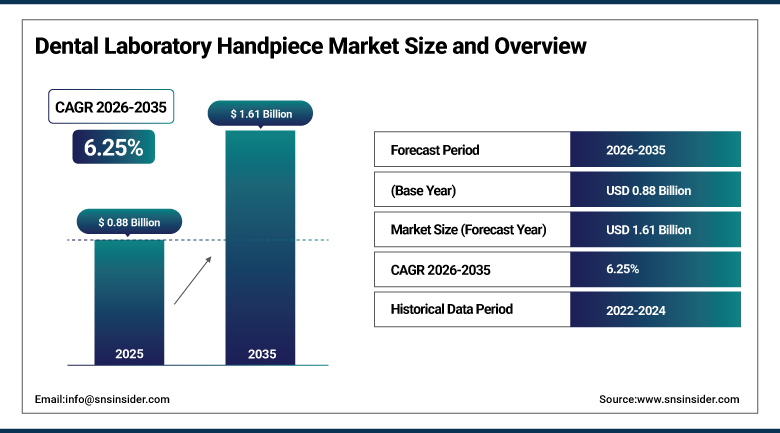
The Dental Laboratory Handpiece Market was valued at USD 0.88 Billion in 2025 and is expected to reach USD 1.61 Billion by 2035, growing at a CAGR of 6.25% from 2026 to 2035.
Dental laboratory handpieces have become an essential high-precision tool in today’s global system of dental production and procedure workflow by allowing dental technologists and laboratory technicians to achieve accurate rotation cutting, grinding, polishing, and finishing processes necessary for the manufacture and provision of crowns, bridges, dentures, implants, and orthodontics. The key advantage of advanced dental laboratory handpiece technology lies in its capability of delivering increased levels of procedural precision, surface finish quality, and ergonomic performance compared with traditional air-driven turbines which had been prevalent in the market for the previous decades. Electric dental laboratory handpieces provide torque consistent rotational speed over a much broader range of operation compared with their compressed air turbine counterparts, providing consistent cutting performance irrespective of the hardness of material being worked on. This is especially important considering that any changes in rotational speed would lead to decreased quality in restorative procedures performed.
Dentsply Sirona, the world's largest dental equipment manufacturer by revenue, reported full-year 2024 net revenue of USD 3.52 Billion, with its laboratory and technology segment identifying handpiece platform innovation and the integration of digital workflow compatibility as key investment priorities across its product development roadmap.
To Get more information Dental Laboratory Handpiece Market - Request Free Sample Report
Dental Laboratory Handpiece Market Trends
-
Transition from air-driven to electric dental laboratory handpieces is improving torque consistency, precision control, and restoration fabrication quality globally.
-
Integration of CAD/CAM systems and digital dentistry workflows is increasing demand for compatible high-precision laboratory handpiece platforms.
-
Rising dental implant and prosthodontic procedures are boosting adoption of high-torque, variable-speed laboratory handpiece systems.
-
Expanding dental tourism in Asia Pacific and Latin America is driving investments in advanced dental laboratory equipment and precision handpieces.
-
Growing use of zirconia and ceramic restorative materials is increasing demand for high-speed handpieces with enhanced cutting efficiency and durability.
The U.S. Dental Laboratory Handpiece Market Outlook
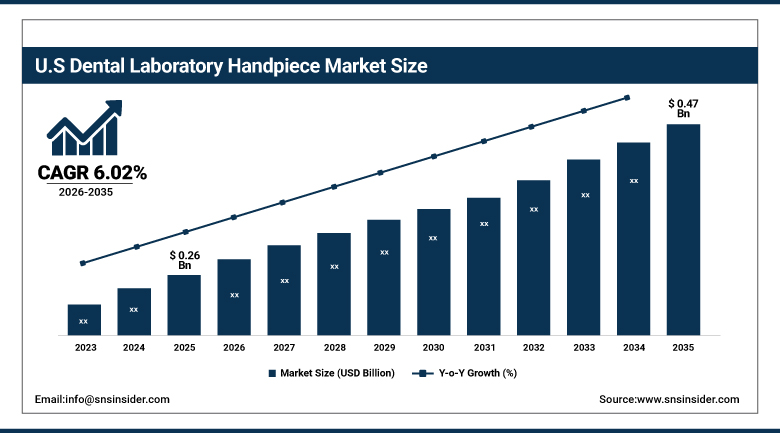
The U.S. Dental Laboratory Handpiece Market was valued at USD 0.26 Billion in 2025 and is expected to reach a USD 0.47 Billion by 2035, growing at a CAGR of 6.02%.
The US dental laboratory handpiece market enjoys the status of being the biggest individual national market in the world, driven by the advanced nature of dental care services offered in the country, relatively higher per capita dental spending, and the business and technical expertise of the country's domestic dental laboratory manufacturing sector. These include large-scale commercial manufacturing facilities as well as boutique laboratories where the precise nature of fabrication process results in a continuing commitment to quality handpiece technology solutions. The rapid adoption of digitized fabrication processes, such as CAD/CAM milling machines, and 3D printing in the manufacture of prosthetic devices and digital impressions in the US dental laboratory market has transformed the use of handpieces through their complementary combination with computerized milling and manual handpiece processes.
NSK Nakanishi Inc., a leading precision dental handpiece manufacturer, launched its NLX Nano electric micromotor system in the U.S. market in 2025, offering dental laboratory technicians a brushless motor-driven handpiece platform with programmable speed memory, enhanced torque output, and compatibility with a comprehensive range of laboratory bur and attachment types.
Dental Laboratory Handpiece Market Segment Analysis
-
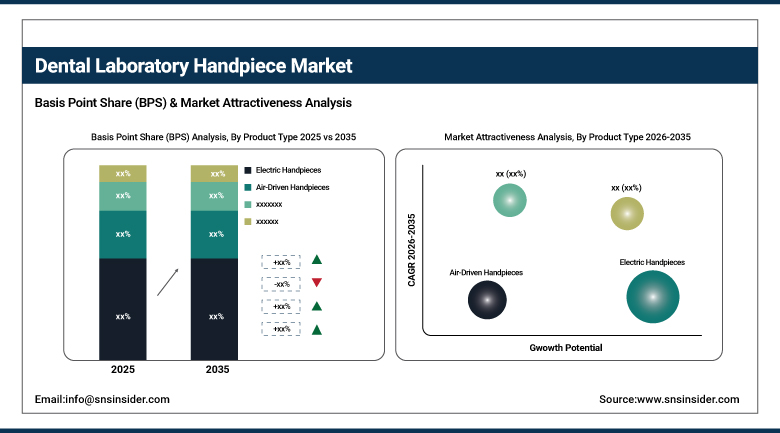
By Product Type, Electric Handpieces dominated the market with 47.14% share in 2025, and it remain the fastest growing product type with the CAGR of 6.52% throughout 2026 to 2035.
-
By Speed Type, High-Speed Dental Handpieces dominated the market with 60.14% share in 2025, and it is fastest growing speed type with CAGR of 9.42% from 2026 to 2035.
-
By End User, Dental Laboratories dominated the market with 46.21% share in 2025, while Dental Clinics are the fastest growing end user segment with the CAGR of 6.84% from 2026 to 2035.
-
By Application, Polishing dominated the market with 28.16% share in 2025, while Oral Surgery & Implantology is the fastest growing application with the highest CAGR of 7.72% from 2026 to 2035.
By Product Type, electric handpieces dominate the dental laboratory handpiece market, while electric handpieces are also the fastest-growing segment.
Electric handpieces segment dominated the dental laboratory handpiece market with the highest revenue share of about 47.14% in 2025 owing to increasing adoption of digitally integrated dental laboratory equipment requiring superior torque stability, precision speed control, and low-vibration performance. Growing use of CAD/CAM-based restorative workflows, zirconia processing, and complex prosthetic fabrication across commercial dental laboratories has accelerated demand for advanced electric laboratory handpiece systems globally. Electric handpieces segment is projected to register the fastest CAGR of 6.52% during the forecast period of 2026–2035 due to rising modernization of dental laboratories, increasing preference for ergonomic and energy-efficient systems, and growing adoption of implant-supported restorations requiring high-precision finishing capabilities. Continuous technological advancements in brushless micromotor systems and smart control integration are further supporting segment expansion.
By Speed Type, high-speed dental handpieces dominate the dental laboratory handpiece market, while high-speed dental handpieces are also the fastest-growing segment.
High-speed dental handpieces segment dominated the dental laboratory handpiece market with the highest market share of about 60.14% in 2025 due to their extensive usage in cutting, trimming, polishing, and shaping applications across restorative and prosthetic laboratory procedures. Their ability to deliver rapid material removal, operational efficiency, and precision handling for ceramic and zirconia restorations has strengthened adoption across dental laboratories globally. It is estimated to witness the fastest CAGR of 9.42% during 2026–2035 owing to increasing demand for faster restoration turnaround times, rising dental implant procedures, and expanding use of hard restorative materials requiring high rotational speed and enhanced cutting performance. Integration with advanced digital dentistry workflows is also contributing significantly to segment growth.
By End User, dental laboratories dominate the dental laboratory handpiece market, while dental clinics are the fastest-growing segment.
Dental Laboratories accounted for 46.21% of dental laboratory handpiece end-user revenue in 2025, reflecting the segment's structural position as the primary professional environment in which laboratory handpieces perform their designed function across the full range of restoration fabrication, repair, and modification procedures that define commercial dental laboratory operations. The dental laboratory segment encompasses both large-scale commercial fabrication facilities whose high-volume production environments require multiple handpiece stations with standardized electric drive systems, and specialist boutique laboratories whose custom fabrication of complex aesthetic restorations demands premium handpiece platforms with superior precision and control characteristics.
Dental Clinics are the fastest-growing end-user segment, driven by the expansion of in-office chairside fabrication capabilities enabled by compact milling units and clinical handpiece systems, the growth of single-visit dentistry protocols that require chairside finishing and adjustment of CAD/CAM-fabricated restorations, and the increasing investment by dental group practices and dental service organizations in laboratory-grade handpiece equipment that enables in-clinic laboratory procedures to reduce outsourcing costs and turnaround times.
By Application, polishing dominates the dental laboratory handpiece market, while oral surgery & implantology is the fastest-growing segment.
Polishing accounted for 28.16% of dental laboratory handpiece application revenue in 2025, reflecting the procedure's universal presence across all categories of dental restoration fabrication, where the achievement of high-gloss surface finishes on ceramic, resin, and metal restorations directly influences the aesthetic quality and patient acceptance outcomes that determine laboratory commercial performance. The expanding clinical adoption of monolithic zirconia restorations, which require extensive laboratory polishing procedures to achieve the surface smoothness specifications that minimize antagonist tooth wear, is particularly driving handpiece utilization growth within the polishing application category.
Oral Surgery & Implantology is the fastest-growing application segment, driven by the sustained global growth of implant-supported prosthodontic procedures, the increasing complexity of implant case fabrication requirements, and the expanding adoption of immediately loaded implant protocols that demand high-precision laboratory handpiece operations for abutment preparation, implant component characterization, and provisional restoration fabrication within compressed clinical timelines.
Regional Analysis:
|
Region |
Major Country |
Share within Region, 2025 (%) |
|---|---|---|
|
North America |
United States |
87.54% |
|
Europe |
Germany |
28.45% |
|
Asia Pacific |
China |
38.64% |
|
Middle East & Africa |
UAE |
30.65% |
|
Latin America |
Brazil |
46.14% |
North America Dental Laboratory Handpiece Market Insights
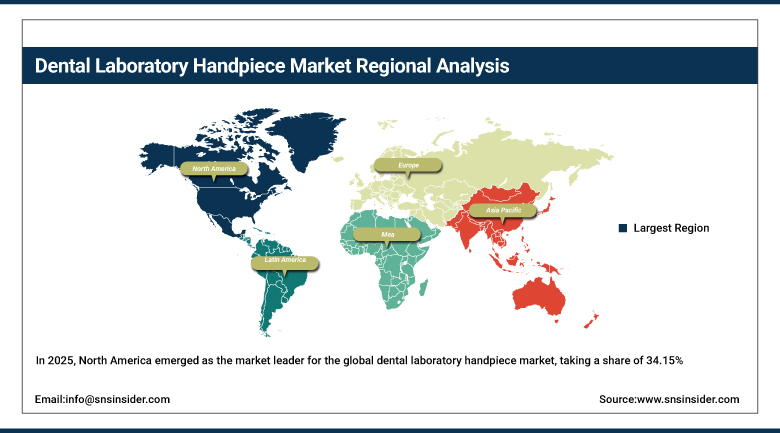
In 2025, North America emerged as the market leader for the global dental laboratory handpiece market, taking a share of 34.15% of global revenues in the region, with 87.54% of revenue generated in the United States. This dominance can be attributed to factors such as the region’s highly developed dental healthcare ecosystem, its commercial and technologically advanced dental laboratory sector, and the relatively high level of per capita spending on dentistry that translates into significantly higher clinical procedures performed as well as greater investment into high-quality equipment compared to the global average. The ongoing process of consolidation within the United States dental laboratory industry as a result of the rise of large-scale business entities and laboratory networks creates purchasing dynamics that make the use of more advanced and specialized electrical handpieces economically rational.
More than 68% of large U.S. commercial dental laboratories had integrated digitally controlled electric laboratory handpiece platforms into multi-station restorative fabrication workflows by 2025, reflecting rapid modernization across the regional dental prosthetics industry.
Get Customized Report as per Your Business Requirement - Enquiry Now
Europe Dental Laboratory Handpiece Market Insights
Europe accounted for 26.05% of global dental laboratory handpiece revenues in 2025. The European market benefits from a highly developed dental industry ecosystem that combines advanced clinical practice standards, sophisticated dental laboratory infrastructure, and a concentrated base of precision dental equipment manufacturers whose competitive product development continuously advances handpiece technology specifications. Germany represents a 28% of European revenues as the continent's largest dental equipment manufacturing center and a major market for premium laboratory handpiece systems, hosting the headquarters operations of key manufacturers including W&H Dentalwerk and the European operations of global leaders whose product innovation programmes shape regional market standards. The United Kingdom, France, Italy, and the Nordic countries contribute substantial regional demand through their respective dental laboratory industries. Approximately 61% of European dental laboratories processing zirconia and ceramic restorations utilized electric high-speed laboratory handpieces in 2025, driven by demand for precision finishing and advanced prosthetic fabrication standards.
Asia Pacific Dental Laboratory Handpiece Market Insights
The fastest-growing regional dental laboratory handpiece market is the Asia Pacific region with an expected CAGR of 6.93% from 2025 to 2035. The largest contributor to the Asia Pacific revenues in the region is China, accounting for about 38% because of being the world's largest producer of dental consumables and a quickly growing market of professional dental laboratory equipment fueled by its rapidly growing population that demands advanced dental care services. The rapidly growing Indian dental services industry, development of dental tourism infrastructure, and the growing adoption of international quality standards by Indian dental laboratories for domestic consumption and exports are contributing factors for India becoming the fastest-growing country-level market in the Asia Pacific. Japan and South Korea are significant regional market contributors owing to the highly advanced dental laboratories in these countries as well as the high adoption rate of premium-quality electric handpiece systems which fit perfectly with the high quality requirements of the domestic dental industries in these two countries.
More than 52% of newly established medium-sized and larger dental laboratories in China and India had adopted electric laboratory handpieces systems compatible with the CAD/CAM process by 2025.
MEA & Latin America Dental Laboratory Handpiece Market Insights
The Middle East and Latin America markets are emerging handpiece opportunities for dental laboratories based on growing investments in dental infrastructure, increased patient awareness of their dental health needs, and rising use of both restorative and aesthetic dental treatments. The leading regional revenue generator in MEA is the UAE with a 30% share, attributed to the highly developed health care infrastructure, strong importation of health care equipment, and an emerging dental laboratory industry catering to both local demand and the region's rapidly developing dental tourism segment which relies on high fabrication quality driven by international patients that drive investments in higher-end electric handpieces. Saudi Arabia with its healthcare development program and increased number of privately-owned dental practices is emerging as the fastest growing MEA country market. Brazil is the leader in the LATAM market with a 46% revenue share due to its large domestic dental market, professional dental laboratory industry, and efficient distribution infrastructure extending beyond major urban centers into the region.
In 2025 more than 40% of the dental labs in Brazil, UAE, and Saudi Arabia opted to invest in electric low vibration handpiece technology when modernizing their facilities.
Growth Drivers: Rising restorative procedure volumes and digital workflow integration
The continued rise in volume of dental restorative procedures performed across the globe, attributed to aging populations in mature markets, dental insurance in developing markets, and increasing patient preference for aesthetic treatments such as ceramic crowns, veneers, and implants, is driving structurally increasing demand for dental laboratory handpieces whose manufacturing capabilities define the success of restorative treatments. As digital manufacturing processes in the dental laboratory environment continue to evolve through CAD/CAM milling, post-processing of 3D printed models, and digitized workflows from impression taking through to restoration production, there is an increased need for dental laboratory handpieces where restoration components created using digital manufacturing processes need finishing, characterization, and adjustments requiring handpiece precision equivalent to traditional manual methods. The adoption of innovative and advanced restorative materials like monolithic zirconia, lithium disilicate, and polymer composite materials that are characterized by hardness, brittleness, and sensitivity to vibration require more sophisticated and precise handpiece capabilities that are only achievable in an electric platform.
Restraints: High equipment acquisition costs and compressed laboratory margins
In addition, the high cost of acquiring premium electric dental laboratory handpiece systems, which could be estimated at two to five times the cost of the corresponding air-driven counterparts, poses considerable barriers to adoption among small independent dental laboratories, given the tight capital budgets and limited access to equipment financing arrangements. The consolidation trend in the dentistry sector, whereby increasing numbers of dental patients are being served by large group practices or dental service organizations, is leading to cost pressures in dental laboratories, thus reducing the profitability and capital expenditure capacity, such that upgrading to premium handpiece platforms may not be feasible for laboratories without client contracts capable of generating enough business value to justify the investments in the handpiece platform and its return on investment within an acceptable time horizon. Handpieces, being technologically sophisticated, require the skills of competent dental technicians; hence, any change in the handpiece platform would need an accompanying technician training exercise.
Opportunities: Implantology expansion and emerging market laboratory development
The consistent growth worldwide in dental implant treatment procedures that utilize precise handpiece work to produce abutments, implant crowns, bridges and implant-supported overdentures from an increasingly larger number of patients taking up implant dentistry both among the high-end and mass-market dental services consumers has proven to be a very meaningful growth factor for the market of high-performance and versatile electric handpieces that possess all the technical advantages enabling precise manufacturing of implant components crucial for successful implant dentistry procedures. Building of dental tourism facilities in countries like Thailand, Hungary, Turkey, Mexico and Colombia results in the formation of laboratory business sectors characterized by internationally accepted standards and large production volumes and, thus, require investments into the purchase of high-quality electric handpieces suitable for manufacturing according to the requirements of competitive clinics that operate within the realm of dental tourism. Expansion of academic and vocational programmes providing training in dental laboratory technologies and equipment use in developing nations creates a pool of technicians who generate the demand for professional equipment as a result of their studies.
Recent Developments:
-
2025: W&H Dentalwerk Burmoos GmbH introduced its LUMiX 3 laboratory handpiece system with an updated brushless motor platform, enhanced speed memory programming, and improved ergonomic grip design, targeting commercial dental laboratories seeking electric handpiece upgrades that combine extended operational reliability with reduced technician fatigue during high-volume fabrication sessions.
-
2025: Dentsply Sirona expanded its laboratory handpiece portfolio with new zirconia-optimized cutting instruments and compatible micromotor handpiece configurations, providing dental laboratories processing growing volumes of monolithic zirconia restorations with integrated tool and drive system solutions engineered specifically for the material's distinctive hardness and brittleness properties.
Dental Laboratory Handpiece Market Key Players are:
-
Dentsply Sirona
-
Envista Holdings Corporation (KaVo Kerr)
-
NSK Nakanishi Inc.
-
W&H Dentalwerk Burmoos GmbH
-
Bien-Air Dental SA
-
Brasseler USA
-
ACTEON Group
-
J. Morita Corporation
-
Osada Electric Co. Ltd.
-
Saeshin Precision Co. Ltd.
-
MK-dent GmbH
-
Anthogyr (Straumann Group)
-
Straumann Group
-
Henry Schein Inc.
-
Planmeca Group
-
Ivoclar Vivadent AG
-
BA International
-
Dentflex
-
Sinol Dental Co. Ltd.
-
SciCan Ltd.
Dental Laboratory Handpiece Market Report Scope:
| Report Attributes | Details |
|---|---|
| Market Size in 2025 | USD 0.88 Billion |
| Market Size by 2035 | USD 1.61 Billion |
| CAGR | CAGR of 6.25% From 2026 to 2035 |
| Base Year | 2025 |
| Forecast Period | 2026-2035 |
| Historical Data | 2022-2024 |
| Report Scope & Coverage | Market Size, Segments Analysis, Competitive Landscape, Regional Analysis, DROC & SWOT Analysis, Forecast Outlook |
| Key Segments | • By Product Type (Electric Handpieces, Air-Driven Handpieces, Hybrid Handpieces) • By Speed Type (High-Speed Dental Handpieces, Low-Speed Dental Handpieces) • By End User (Dental Laboratories, Dental Clinics, Hospitals, Academic & Research Institutes • By Application (Polishing, Cutting, Finishing, Restoration Work, Oral Surgery & Implantology) |
| Regional Analysis/Coverage | North America (US, Canada), Europe (Germany, UK, France, Italy, Spain, Russia, Poland, Rest of Europe), Asia Pacific (China, India, Japan, South Korea, Australia, ASEAN Countries, Rest of Asia Pacific), Middle East & Africa (UAE, Saudi Arabia, Qatar, South Africa, Rest of Middle East & Africa), Latin America (Brazil, Argentina, Mexico, Colombia, Rest of Latin America). |
| Company Profiles | Dentsply Sirona, Envista Holdings Corporation (KaVo Kerr), NSK Nakanishi Inc., W&H Dentalwerk Bürmoos GmbH, Bien-Air Dental SA, Brasseler USA, ACTEON Group, J. Morita Corporation, Osada Electric Co. Ltd., Saeshin Precision Co. Ltd., MK-dent GmbH, Anthogyr (Straumann Group), Straumann Group, Henry Schein Inc., Planmeca Group, Ivoclar Vivadent AG, BA International, Dentflex, Sinol Dental Co. Ltd., SciCan Ltd.. |

Frequently Asked Questions
The dental laboratory handpiece market is expected to grow at a CAGR of 6.25% from 2026 to 2035.
The dental laboratory handpiece market was valued at USD 0.88 Billion in 2025.
The dental laboratory handpiece market is projected to reach USD 1.61 Billion by 2035.
The primary growth factors include the rising global volume of dental restorative and implant procedures, the accelerating transition from air-driven to electric handpiece platforms.
The electric handpieces segment dominated the dental laboratory handpiece market with 47.14% share in 2025.
