
A new investment cycle is emerging in the global analog semiconductor market as electrification, intelligent manufacturing and the ever more power-hungry world of computing systems reshape the demand for electronic components. Analog semiconductors, unlike digital processors, react directly to physical signals, allowing electronic devices to measure temperature, adjust voltage, manipulate sound, track current, and transform sensor data into useful information.
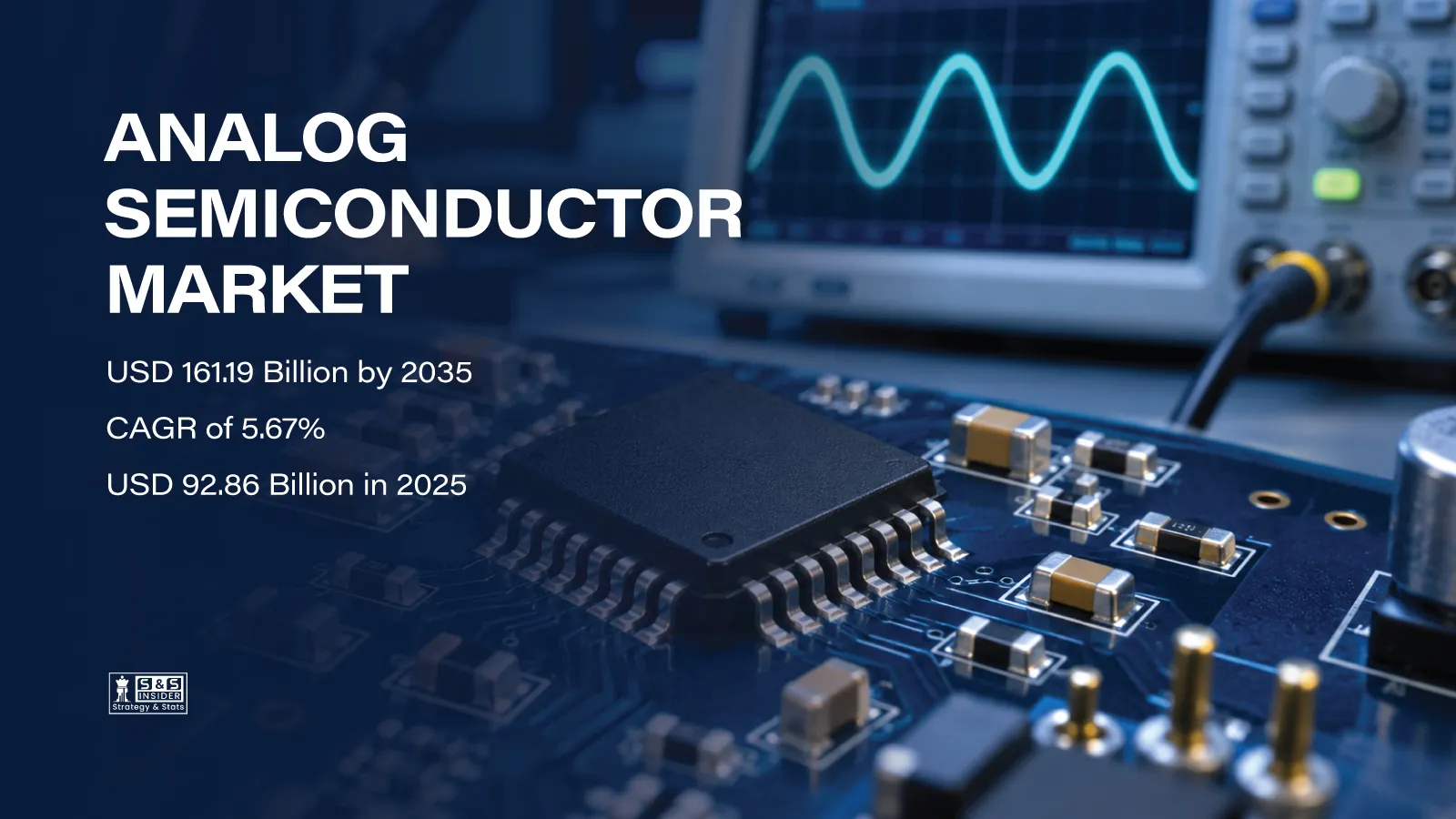
According to the updated SNS Insider Analog Semiconductor Market report, the global market was valued at USD 92.86 Billion in 2025, reached USD 98.13 Billion in 2026, and is projected to expand to USD 161.19 Billion by 2035, registering a CAGR of 5.67% during 2026–2035.
Growth increasingly reflects the amount of analog functionality incorporated into each electronic system rather than device shipments alone. Electric vehicles require sophisticated battery monitoring, motor control, and power conversion. Industrial automation depends on precision sensing, while AI data centers need efficient voltage regulation to manage growing computational workloads.
Asia-Pacific is leading the industry with its extensive electronics manufacturing infrastructure and growing capacity for semiconductor manufacturing. Meanwhile, manufacturers are investing in special analog designs, bigger wafer fabrication plants and advanced power technologies to fulfilll the changing demands of their customers.
Long-term industry outlook is positive but pricing competition, trade restrictions and semiconductor inventory cycles could weigh on near-term performance.
Market Size and Growth Outlook
|
Market Indicator |
Value |
|---|---|
|
Global Market Size, 2025 |
USD 92.86 Billion |
|
Global Market Size, 2026 |
USD 98.13 Billion |
|
Global Market Forecast, 2035 |
USD 161.19 Billion |
|
CAGR, 2026–2035 |
5.67% |
|
Leading Region, 2025 |
Asia-Pacific (45.63%) |
|
Fastest-Growing Region |
Asia-Pacific (6.41% CAGR) |
|
Leading Component |
Power Management ICs (33.84%) |
|
Leading End Use |
Consumer Electronics (29.86%) |
Demand Drivers and Market Constraints
Primary Demand Drivers
- Electric vehicle electrification: Battery management, charging systems, electric motors, and advanced driver assistance technologies are increasing analog semiconductor requirements per vehicle.
- Industrial automation: Robotics, smart factories, and predictive maintenance systems need reliable signal conditioning, precision sensing, and motor control components.
- AI data center expansion: Higher power densities in AI servers are creating demand for advanced voltage regulators, power management ICs, and efficient power conversion technologies.
- Connected consumer electronics: Smartphones, wearables, smart appliances, and IoT products require increasingly sophisticated analog interfaces and low-power circuitry.
- Semiconductor manufacturing investment: New wafer fabrication capacity and government incentives are supporting supply chain diversification and production efficiency.
- Medical electronics innovation: Portable diagnostic equipment, patient monitoring systems, and wearable healthcare devices need compact, low-noise analog components.
Potential Growth Constraints
- Trade restrictions, tariffs, and export controls affecting international semiconductor supply chains.
- Pricing pressure across standard analog components manufactured on mature process nodes.
- Semiconductor inventory fluctuations and cyclical demand from major end-use industries.
- Shortages of experienced analog circuit designers and specialized engineering professionals.
- High capital requirements for manufacturing expansion and advanced process development.
Demand Structure by Semiconductor Type
Application-Specific Analog Chips (2025 Market Share: 54.62%)
Application-specific analog semiconductors held the largest product category with a share of around 54.62% in terms of global market revenue in 2025. The segment is also expected to achieve the highest type-level growth with a CAGR of 6.04% during 2026–2035.
These chips are meant for applications such as battery monitoring, sensor interfaces, audio processing and motor control. Their made-to-order designs can provide benefits of performance and efficiency where off-the-shelf solutions may not meet the demanding design requirements.
Driving demand for specialized analog architectures are automotive electrification, industrial robotics and medical electronics. The trend for manufacturers is to pack more functions into small devices, with less complex circuits and better energy efficiency.
Current trend: Increasing adoption of customized analog solutions for performance-sensitive electronic applications.
Major trends: Application-specific power management, integrated sensor interfaces, automotive-grade designs, and advanced packaging.
General-Purpose Analog Semiconductors
The analog general-purpose devices continue to play a role in electronic system design, providing widely used functions such as amplification, voltage regulation, filtering, and signal conditioning.
These components help manufacturers find standardized, cost-effective solutions in consumer electronics, communications equipment and industrial products. Their wide compatibility and well-established distribution networks keep the demand going.
This is especially true for mature product categories where there are many suppliers providing similar functionality.
Current trend: Continued demand for standardized analog components, accompanied by growing price competition.
Demand Structure by Component
Power Management ICs (2025 Market Share: 33.84%)
Power management integrated circuits was the largest segment in the market, accounting for nearly 33.84% of the market’s revenue in 2025. These devices are used to manage voltages, distribute electrical power, control battery charging and improve energy efficiency in electronic systems.
They are more important due to increasing demand for efficient power architectures in electric vehicles, data centers, industrial equipment and portable electronics. A growing opportunity is AI computing infrastructure, as high-performance processors require stable electrical supplies that can quickly handle changing workloads.
Current trend: Growing demand for compact, efficient power regulation across computing and electrified systems.
Major trends: High-density power conversion, battery management integration, advanced voltage regulation, and energy-efficient circuit design.
Data Converters (Forecast CAGR: 7.46%)
Data converters will experience the highest component-level growth with an estimated CAGR of 7.46% through 2035. The conversion of analog to digital and digital to analog is an important link between physical signals and digital processing systems.
Applications are increasing with the growing demand for high-resolution sensing, industrial measurement, automotive radar, medical imaging and telecommunications infrastructure. To support more sophisticated equipment, manufacturers are focusing on higher conversion accuracy, faster sampling rates and lower power consumption.
Current trend: Rising adoption of precision signal conversion technologies in advanced electronic systems.
Demand Structure by Form Factor
Integrated Circuits (2025 Market Share: 72.38%)
Integrated circuits dominate the analog semiconductor market, accounting for nearly 72.38% of revenue in 2025. The ability to combine many electronic functions in small packages makes them attractive for use in smartphones, cars, industrial controllers and medical devices.
Integration reduces board space, eases manufacturing and can improve system reliability. The growing demand for smaller, more energy-efficient equipment emphasizes the commercial importance of integrated analog solutions.
Current trend: Greater functional integration and miniaturization across electronic products.
Discrete Components (Forecast CAGR: 7.67%)
Discrete analog and power components are projected to grow at a CAGR of 7.67% during 2026–2035. Demand is supported by electric vehicle charging systems, renewable energy installations, industrial power equipment, and data center electricity infrastructure.
Silicon carbide and gallium nitride technologies are particularly relevant to applications requiring higher switching efficiency, voltage tolerance, and power density.
Current trend: Increasing adoption of advanced discrete power devices for electrification and energy conversion.
Demand Structure by End Use
Consumer Electronics (2025 Market Share: 29.86%)
Consumer electronics represented the largest end-use category, accounting for approximately 29.86% of global revenue in 2025. Smartphones, tablets, televisions, wearable devices, audio products, and connected appliances require analog components for power management, sensing, and signal processing.
Although the sector faces strong pricing pressure, product replacement cycles and continued demand for improved functionality support substantial semiconductor consumption. Battery efficiency, device miniaturization, and increasingly sophisticated sensors remain important design priorities.
Current trend: Demand for low-power analog devices supporting multifunctional consumer products.
Automotive (Forecast CAGR: 7.93%)
Automotive is projected to become the fastest-growing end-use segment, registering a CAGR of 7.93% during 2026–2035. Electric vehicles require additional semiconductor content for battery management, traction inverters, charging, and thermal control.
Advanced driver assistance systems further increase demand for precision sensing, signal conditioning, and reliable power distribution. Automakers are also introducing more centralized and software-defined vehicle architectures, creating opportunities for sophisticated analog components that connect sensors and electrical subsystems.
Current trend: Rising semiconductor content per vehicle as electrification and automated driving technologies advance.
Regional Market Dynamics
Asia-Pacific (2025 Market Share: 45.63%)
Asia-Pacific accounted for approximately 45.63% of global analog semiconductor revenue in 2025 and is expected to remain the fastest-growing region, with a CAGR of 6.41% through 2035. China, Japan, South Korea, Taiwan, and India contribute substantially to the region's electronics manufacturing ecosystem.
China represented approximately 44.18% of Asia-Pacific market revenue in 2025. Expanding automotive production, industrial automation, electronics assembly, and semiconductor fabrication capacity are supporting demand for analog devices. Government-backed manufacturing programs and investment in mature-node semiconductor processes are also strengthening regional supply capabilities.
Direction: Continued regional leadership supported by electronics production and semiconductor manufacturing expansion.
North America (2025 Market Share: 27.18%)
North America held approximately 27.18% of the global market in 2025. The United States analog semiconductor market was valued at USD 21.81 Billion in 2025 and is projected to expand at a CAGR of 5.48% during 2026–2035.
Demand is supported by data center development, automotive electronics, aerospace applications, and industrial technology investment. The region's established semiconductor design ecosystem and investment in domestic fabrication capacity are strengthening its competitive position.
Direction: Steady expansion driven by AI infrastructure, industrial applications, and manufacturing investment.
Europe
Europe remains an important market for automotive, industrial, and power semiconductor applications. Germany accounted for approximately 28.35% of regional revenue in 2025.
Electric mobility, renewable energy infrastructure, factory automation, and industrial efficiency requirements support demand for advanced analog components. Regional semiconductor initiatives are also encouraging investment in production capacity and supply chain resilience.
Direction: Growth supported by automotive electrification and industrial modernization.
Middle East & Africa and Latin America
The Middle East & Africa market is benefiting from investment in telecommunications, data centers, renewable energy, and intelligent infrastructure. Saudi Arabia represented approximately 36.92% of regional market revenue in 2025.
In Latin America, Brazil accounted for approximately 54.26% of regional revenue, supported by electronics manufacturing, automotive production, and industrial applications. Mexico also contributes demand through vehicle and electronic equipment assembly.
Direction: Gradual expansion supported by industrial development, infrastructure investment, and electronics manufacturing.
Competitive Landscape
The global analog semiconductor industry includes established integrated device manufacturers and specialized component suppliers.
Major participants identified by SNS Insider include Texas Instruments, Infineon Technologies, STMicroelectronics, Renesas Electronics, Skyworks Solutions, and Microchip Technology.
Competition increasingly centers on energy efficiency, product reliability, specialized applications, manufacturing capacity, and supply security. Manufacturers are investing in larger wafer fabrication facilities, advanced power semiconductor technologies, and application-specific designs to strengthen their market positions.
Long-term relationships with automotive and industrial customers remain commercially important because component qualification requirements can extend product lifecycles and reduce supplier switching.
Market Outlook (2026–2035)
The SNS Insider baseline forecast anticipates that the global analog semiconductor market will reach USD 161.19 Billion by 2035, supported by sustained demand across electrified transportation, intelligent manufacturing, connected devices, and AI computing infrastructure. The industry's growth will increasingly reflect the integration of advanced sensing, power management, and signal processing capabilities into electronic systems.
Automotive electrification is expected to provide a significant growth opportunity, while data converters and discrete components should benefit from increasing performance requirements. Asia-Pacific will retain a central role in global manufacturing and semiconductor consumption, although regional production diversification may gradually reshape supply chains. Trade uncertainty, pricing competition, and capital-intensive manufacturing investment remain important risks.
Overall, the analog semiconductor market is positioned for steady expansion through 2035, with competitive advantage increasingly determined by power efficiency, application-specific innovation, manufacturing reliability, and the ability to support increasingly complex electronic systems.



