
The global bioinsecticides industry is entering a new growth phase as agricultural producers seek effective alternatives to conventional chemical insecticides. Increasing insect resistance, tighter pesticide residue requirements and expanding demand for sustainably cultivated food are encouraging farmers to incorporate biological solutions into crop protection programs. Microbial formulations, botanical extracts and newer biological technologies are gaining commercial relevance across horticulture, field crops and protected agriculture.
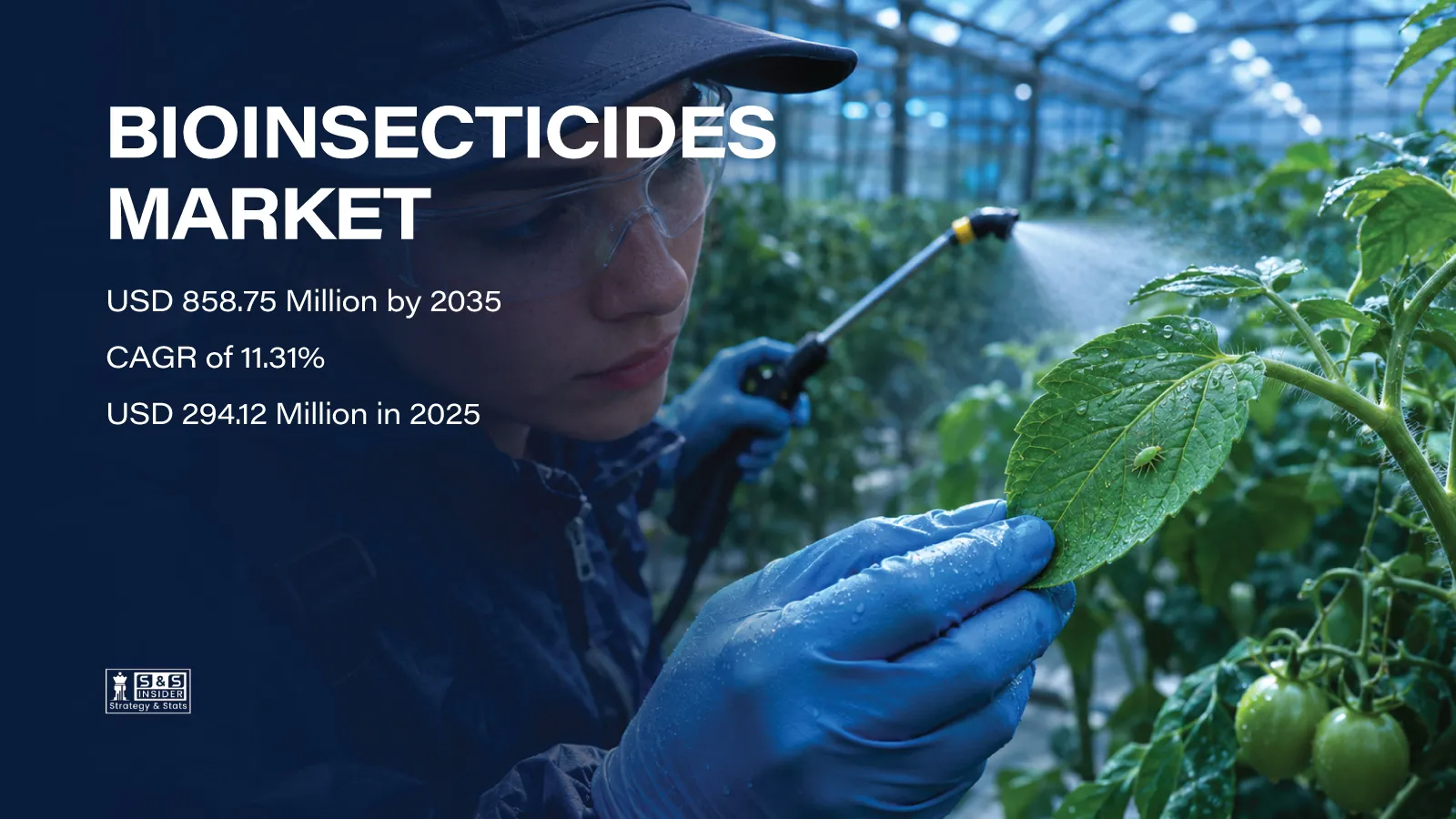
According to the updated SNS Insider Bioinsecticides Market report, the global market was valued at USD 294.12 million in 2025, is estimated to reach USD 327.38 million in 2026 and is forecast to attain USD 858.75 million by 2035, registering a CAGR of 11.31% during 2026–2035.
The industry is gradually shifting from niche organic applications toward broader integration within conventional agricultural pest management. Farmers increasingly use bioinsecticides alongside chemical products to manage resistant insect populations while meeting demanding food safety and environmental standards.
Microbial bioinsecticides dominate the market due to their established effectiveness and commercial availability. Plant-derived formulations are expanding as product developers improve stability, application convenience and pest-specific performance.
North America remains the largest regional market, while Latin America is projected to grow fastest as extensive soybean, corn and cotton cultivation creates demand for biological insect control.
Market Size and Forecast
|
Market Indicator |
Value |
|---|---|
|
Global Market Size, 2025 |
USD 294.12 Million |
|
Market Estimate, 2026 |
USD 327.38 Million |
|
Market Forecast, 2035 |
USD 858.75 Million |
|
CAGR, 2026–2035 |
11.31% |
|
U.S. Market Size, 2025 |
USD 98.47 Million |
|
Largest Region |
North America (36.59%) |
|
Fastest-Growing Region |
Latin America (12.93% CAGR) |
|
Leading Source |
Microbial (63.00%) |
|
Leading Crop Category |
Fruits and Vegetables (48.00%) |
Demand Drivers and Constraints
Primary Demand Drivers
-
Increasing insect resistance: Resistance to conventional insecticides encourages growers to adopt biological products with alternative modes of action.
-
Demand for low-residue produce: Food retailers and export buyers increasingly emphasize pesticide residue management, supporting biological insect control.
-
Expansion of sustainable agriculture: Organic cultivation and integrated pest management programs create opportunities for environmentally compatible pest protection.
-
Advances in biological formulations: Improved microbial strains, botanical extracts and delivery technologies are supporting more reliable product performance.
-
Regulatory pressure on conventional chemicals: Restrictions on selected synthetic insecticides encourage manufacturers and growers to consider alternative solutions.
-
Growing commercial crop applications: Biological products are expanding beyond horticulture into soybean, corn, cotton and other large-acreage crops.
Potential Growth Constraints
-
Higher application costs compared with certain generic chemical insecticides.
-
Performance variability under extreme temperatures, heavy rainfall, or intense ultraviolet exposure.
-
Limited awareness of biological application techniques among some agricultural producers.
-
Product storage and shelf-life challenges involving living microorganisms.
-
Complex registration procedures and differing regulatory requirements across countries.
Demand Structure by Source
Microbial Bioinsecticides (2025 Market Share: 63.00%)
Microbial bioinsecticides represented the largest product category, accounting for approximately 63.00% of global revenue in 2025.
These products use microorganisms and other naturally occurring biological agents to control damaging insect populations. Important biological agents of commercial crop protection include Bacillus thuringiensis, Beauveria bassiana, Metarhizium species and baculoviruses.
Established agricultural applications, pest-specific activity, and compatibility with integrated pest management programs support broad acceptance. The control of caterpillars and other groups of damaging insects in fruits, vegetables, cereals and commercial field crops is of special relevance for microbial formulations. Through 2035, further progress with fermentation and formulation technologies should enhance manufacturing scalability and product availability.
Current trend: Increasing adoption of microbial insect control within integrated agricultural protection programs.
Major trends: Bacillus-based formulations, baculovirus commercialization, microbial fermentation expansion, improved storage stability and biological resistance management.
Plant-Based Bioinsecticides (Forecast CAGR: 12.46%)
Plant-based bioinsecticides are projected to represent the fastest-growing source category, expanding at a CAGR of approximately 12.46% during 2026–2035. These products are made from naturally occurring compounds extracted from plants like neem, pyrethrum, garlic and specific essential oils.
Due to their insect-repellent, feeding-deterrent or contact-control properties, they are useful in a number of agricultural and horticultural applications. Growing organic production and interest in naturally derived crop protection inputs underpin demand. Manufacturers are trying to improve the formulations to overcome the limitations regarding stability, effectiveness of application and exposure to the environment.
Current trend: Rising commercialization of botanical formulations for specialty crops and protected agriculture.
Major trends: Neem-based products, essential oil formulations, natural repellents, improved delivery systems and organic crop protection.
Demand Structure by Crop
Fruits and Vegetables (2025 Market Share: 48.00%)
Fruits and vegetables dominated the bioinsecticides market, accounting for approximately 48.00% of global revenue in 2025.
Many high-value horticultural crops require multiple applications of insect control during their production cycle. Producers have to balance pest suppression with food quality, residue requirements and commercial harvest schedules. Bioinsecticides give berry, tomato, grape, leafy vegetable and other sensitive crop growers another weapon in their management toolbox.
Adoption is particularly relevant in greenhouse operations and export-oriented agricultural production systems where growers are confronted with demanding quality standards. Continued growth of premium horticulture and residue-conscious supply chains is expected to support demand for the segment.
Current trend: Strong utilization of biological pest control across commercial horticulture.
Major trends: Greenhouse cultivation, export-quality produce, integrated pest management, residue reduction and targeted insect control.
Oilseeds and Pulses (Forecast CAGR: 12.31%)
Oilseeds and pulses are forecast to become the fastest-growing crop category, registering a CAGR of approximately 12.31% from 2026 to 2035.
Caterpillars and pod borers are agricultural pests which cause huge economic losses in the cultivation of soybean, groundnut, chickpea and lentil. As resistance to traditional insecticides increases, growers are incorporating microbial and virus-based products into their crop management programs.
There are considerable opportunities to expand biological applications in Brazil, Argentina, India and the United States where there are large areas of cultivation. Commercial acceptance will be determined by competitive treatment costs, proven field performance, and better availability of locally produced formulations.
Current trend: Expanding biological pest control across large-acreage oilseed and pulse cultivation.
Major trends: Baculovirus applications, caterpillar resistance management, commercial soybean protection, affordable microbial formulations and integrated field crop programs.
Regional Market Dynamics
North America (2025 Market Share: 36.59%)
North America dominated the global bioinsecticides market, accounting for 36.59% of revenue in 2025. The region benefits from advanced agricultural production, established biological crop protection suppliers and demand for low-residue food products.
The United States market reached USD 98.47 million in 2025 and is projected to expand at a CAGR of 10.96% during 2026–2035. Specialty crop cultivation, organic farming and increasing adoption of integrated pest management support regional demand. Canada contributes through greenhouse horticulture and sustainable agricultural production.
Direction: Continued leadership driven by biological innovation and commercial agricultural adoption.
Asia-Pacific (2025 Market Share: 27.64%)
Asia-Pacific represented approximately 27.64% of global bioinsecticides revenue in 2025. China and India are key agricultural markets, and increasing crop production and demand for sustainable pest management are spurring the adoption of biological products.
Opportunities also exist in Japan, Australia and Southeast Asian countries due to commercial horticulture and regulatory interest in reducing pesticide residues. More local manufacturing capacity and agricultural training programs could make them more affordable and increase their adoption.
Direction: Expanding demand supported by agricultural modernization and sustainable crop protection initiatives.
Europe (2025 Market Share: 24.12%)
Europe accounted for approximately 24.12% of global market revenue in 2025.
Demand is supported by established organic agriculture, strict food quality requirements and efforts to reduce reliance on certain chemical pesticides. France, Spain, Italy and the Netherlands are important markets for biological pest control in orchards, vineyards, vegetables and greenhouse production.
Direction: Steady growth driven by regulatory requirements and low-residue agricultural production.
Latin America (Forecast CAGR: 12.93%)
Latin America is projected to become the fastest-growing regional market, expanding at a CAGR of 12.93% during 2026–2035. Brazil leads regional demand through extensive soybean, corn, cotton and sugarcane cultivation.
Increasing insect resistance, expanding local biological manufacturing and greater adoption of integrated pest management are accelerating market development. Argentina, Colombia and other agricultural economies provide additional opportunities.
Direction: Strongest regional growth potential through large-scale agricultural applications.
Middle East & Africa (2025 Market Share: 4.58%)
The Middle East and Africa accounted for 4.58% of global market revenue in 2025.
Demand is developing across export-oriented horticulture, commercial greenhouse production and agricultural programs focused on sustainable pest management. South Africa is a significant regional market, while selected Middle Eastern countries offer opportunities through controlled-environment agriculture.
Direction: Gradual market expansion supported by agricultural diversification and biological crop protection.
Competitive Landscape
The bioinsecticides industry includes multinational crop protection manufacturers and specialized biological technology developers. Important market participants include BASF SE, Bayer AG, BioWorks, Certis USA, Koppert Biological Systems, Nufarm, Suterra, Syngenta and Valent BioSciences.
Competitive differentiation increasingly depends on insect-specific effectiveness, formulation stability, manufacturing efficiency, regulatory approvals and access to agricultural distribution channels. Recent industry developments include BASF's acquisition of AgBiTech in March 2026 and Suterra's acquisition of selected Vestaron product lines and technology assets in May 2026. These developments illustrate growing strategic interest in biological insect control technologies.
Market Outlook (2026–2035)
The global bioinsecticides market is forecast to reach USD 858.75 million by 2035, supported by rising agricultural demand for sustainable and effective insect management solutions. Microbial products are expected to continue to hold a strong market position, while plant-based formulations offer faster growth opportunities.
Improvements in cost competitiveness and product effectiveness by manufacturers could increase the importance of large-acreage field crops. However, North America is anticipated to dominate the regional market. Latin America is a growth opportunity with commercial agricultural production. Difficulties with application costs, storage conditions and variable field performance will impact adoption.
Overall, the bioinsecticides industry is positioned for sustained expansion through 2035, with biological innovation, insect resistance management and demand for sustainable food production shaping long-term market opportunities.



