
According to the latest SNS Insider’s report, the medical robotics industry worldwide is experiencing an era of significant growth as hospitals make rapid advancements towards robot-assisted surgeries, rehabilitation therapies and clinical automation.
The medical robots market is moving from a niche area of surgery devices to a more inclusive one that incorporates healthcare technology. More hospitals are making purchasing decisions based on the ability of these robots to improve the accuracy of procedures, standardization of processes, productivity of staff, and accessibility of procedures. Additionally, there is a rising demand for small robotic platforms in ambulatory surgery centers and other healthcare institutions.
Product development in this market is driven by artificial intelligence, imaging technology, motion control and navigation. In addition to these, there are new systems that offer improved visualization and manipulation of instruments along with surgical planning capabilities. Moreover, there is growing interest in rehabilitation robots and automated hospital systems due to the aging population and staffing issues.
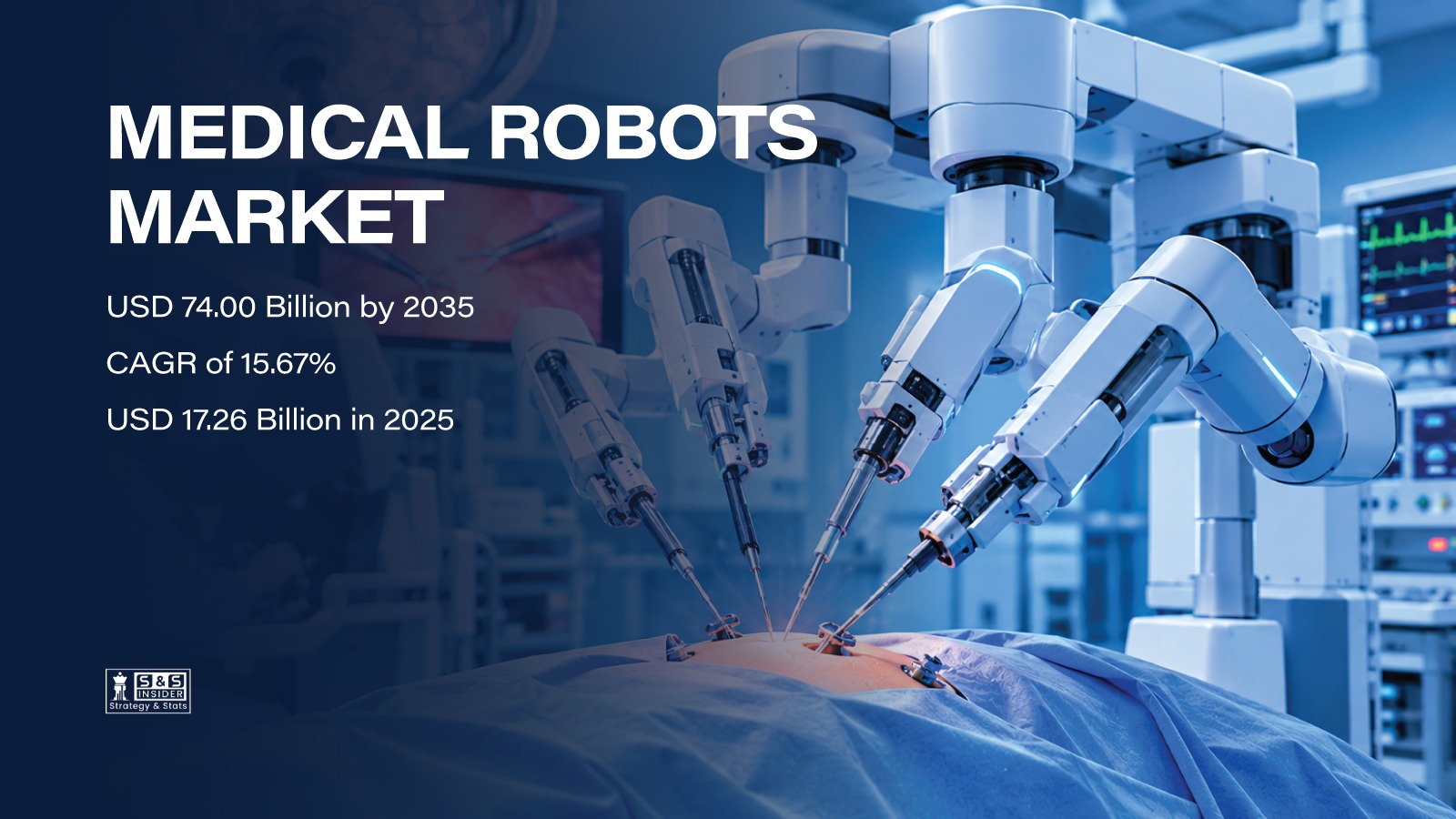
The global medical robots market size is valued at USD 17.26 billion in 2025 and expected to increase to USD 19.96 billion in 2026 with an anticipated market size of USD 74.00 billion by 2035, expanding at a CAGR of 15.67% during 2026-2035.
North America is the leader in this market with its established robotic surgery programs and highly developed healthcare system. Meanwhile, Asia Pacific is anticipated to be the fastest growing region due to healthcare investment, local manufacture of medical devices and growing use of robotic surgery.
In the coming years, success will depend on clinical performance, affordability, surgeon training, services availability, and integration with existing healthcare processes.
Demand Drivers and Constraints
Primary Demand Drivers
-
Rising adoption of robot-assisted surgery: Healthcare providers are expanding robotic applications across urology, gynecology, orthopedics and general surgery.
-
Growing demand for minimally invasive procedures: Advanced robotic instruments support controlled movements and complex surgical techniques.
-
Artificial intelligence integration: Image-guided navigation, procedure analytics and automated assistance are strengthening robotic capabilities.
-
Healthcare workforce shortages: Hospitals are evaluating automation to improve operational efficiency and reduce repetitive clinical workloads.
-
Expansion of outpatient surgery: Compact robotic platforms are making advanced surgical technologies more accessible to ambulatory surgical centers.
-
Increasing rehabilitation requirements: Aging populations and neurological conditions are supporting demand for robotic gait training, exoskeletons and assisted therapy.
Potential Growth Constraints
-
High initial equipment acquisition and ongoing maintenance costs.
-
Extensive training requirements for surgeons and supporting clinical personnel.
-
Complex regulatory approval processes for new robotic systems.
-
Limited affordability among smaller hospitals and developing healthcare markets.
-
Cybersecurity, equipment reliability and patient safety concerns.
-
Uncertainty regarding reimbursement and cost-effectiveness for certain procedures.
Demand Structure by Product Type
Surgical Robots (2025 Market Share: 52.47%)
Surgical robots represent the largest product category, accounting for approximately 52.47% of global market revenue in 2025.
The commercial success is based on wide applicability in various kinds of surgeries and high cost of robotic equipment and instruments.
The hospitals introduce robotic systems in their existing surgery programs in order to facilitate instrument control, visualization, and planning of procedures. Competition among producers also leads to the introduction of smaller systems and more flexible configuration of equipment.
Until 2035, the market demand will be influenced by the number of procedures performed, scientific evidence, economics of instruments, and versatility of robotic platforms.
Current trend: Continued expansion of robot-assisted surgical programs across major hospitals.
Major trends: Advanced visualization, AI-supported navigation, compact robotic platforms, enhanced instrument control and multi-specialty applications.
Representative participants: Intuitive Surgical, Medtronic, CMR Surgical and Johnson & Johnson MedTech.
Rehabilitation Robots (Forecast CAGR: 18.12%)
Robots for Rehabilitation are anticipated to witness rapid growth in terms of market share, with a CAGR of around 18.12% through 2026-2035.
These technologies help with structured physical therapy using robotic exoskeletons, gait trainers and upper-limb rehab systems.
The need for them is growing as healthcare professionals are looking for ways to provide repeatable therapeutic activities with monitoring of patients' progress.
Robotics-based rehabilitation systems are becoming more popular in stroke recovery, spinal cord injury rehabilitation and mobility recovery programs.
Wearable devices and therapy platforms could increase the availability of therapies beyond specialized rehabilitation centers.
Current trend: Accelerating adoption of robotic-assisted mobility and rehabilitation technologies.
Major trends: Wearable exoskeletons, intelligent gait training, remote rehabilitation monitoring, personalized therapy and sensor-based progress assessment.
Representative participants: Lifeward, Wandercraft and other rehabilitation robotics developers.
Demand Structure by Application
Laparoscopy (2025 Market Share: 34.91%)
Laparoscopy represents the largest application category, contributing approximately 34.91% of market revenue in 2025.
Robot-assisted laparoscopic procedures are used across abdominal, pelvic, urological and gynecological surgery.
The segment benefits from established surgical training programs and increasing demand for minimally invasive treatment options.
Advanced visualization and articulated robotic instruments can help surgeons perform complex procedures requiring precise movements within confined anatomical spaces.
Current trend: Increasing integration of robotic platforms into routine minimally invasive surgery.
Major trends: Three-dimensional imaging, enhanced robotic instruments, advanced camera control and expanded surgical indications.
Neurology (Forecast CAGR: 17.08%)
Neurology is expected to register the fastest application growth, with a CAGR of approximately 17.08% through 2035.
Robotic platforms support selected neurosurgical procedures requiring precise instrument positioning and carefully planned surgical trajectories.
Growing interest in image-guided interventions, stereotactic procedures and specialized neurological treatment is strengthening demand.
Current trend: Increasing adoption of image-integrated robotic assistance for neurological procedures.
Major trends: Stereotactic navigation, robotic biopsy assistance, surgical planning integration and precision instrument positioning.
Demand Structure by End User
Hospitals (2025 Market Share: 55.62%)
Hospitals dominate medical robotics demand, representing approximately 55.62% of global revenue in 2025.
Large hospitals and academic medical centers possess the infrastructure, specialized clinical teams and financial resources needed to support sophisticated robotic platforms.
Multi-specialty adoption also enables healthcare systems to distribute capital investment across different surgical departments.
As robotic procedures become more established, hospitals are increasingly evaluating equipment utilization, training requirements and long-term operating expenses before committing to additional systems.
Current trend: Expansion of integrated robotic surgery programs within major healthcare networks.
Major trends: Multi-department utilization, robotic training centers, equipment standardization and digital operating room integration.
Ambulatory Surgical Centers (Forecast CAGR: 17.46%)
Ambulatory surgical centers are projected to be the fastest-growing end-user segment, advancing at a CAGR of approximately 17.46% during 2026–2035.
The shift toward outpatient procedures is encouraging manufacturers to develop compact, economically accessible robotic systems.
Specialized orthopedic and urological procedures represent important opportunities as providers seek advanced capabilities outside traditional hospital settings.
Current trend: Growing demand for robotic systems designed for outpatient surgical environments.
Major trends: Smaller equipment footprints, lower-cost configurations, flexible procurement models and streamlined surgical workflows.
Demand Structure by Component
Instruments and Accessories (2025 Market Share: 41.37%)
Instruments and accessories account for approximately 41.37% of the global medical robots market in 2025.
This category is supported by recurring demand for robotic instruments, procedural accessories and replacement parts associated with installed systems.
The more robotic the processes are, the more revenue the manufacturers can generate after the initial equipment installs.
Current trend: Recurring demand linked to expanding robotic procedure volumes.
Major trends: Specialized instruments, improved durability, procedure-specific accessories and integrated equipment ecosystems.
Services (Forecast CAGR: 16.58%)
Services represent the fastest-growing component segment, with a projected CAGR of approximately 16.58% through 2035.
Demand includes maintenance, equipment support, software updates, training and technical assistance.
Hospitals increasingly prioritize predictable operating costs and reliable system availability, making long-term service relationships commercially important.
Current trend: Expansion of integrated equipment maintenance and lifecycle support.
Major trends: Remote diagnostics, software subscriptions, preventive maintenance, technical training and multiyear service agreements.
Key Market Participants
The medical robots industry includes established medical device manufacturers and specialized robotics developers.
Important participants identified in the SNS Insider report include Intuitive Surgical, Medtronic, Stryker, Zimmer Biomet, Johnson & Johnson MedTech, Accuray, Globus Medical, Smith+Nephew, CMR Surgical, PROCEPT BioRobotics, Distalmotion, Medicaroid, Microbot Medical, Lifeward, MicroPort MedBot, Moon Surgical and Wandercraft.
Competition increasingly centers on clinical evidence, platform versatility, equipment affordability, technological innovation and service quality.
Manufacturers are also seeking opportunities to differentiate through advanced navigation, integrated imaging, surgeon training and specialized procedural applications.
Regional Market Dynamics
North America (2025 Market Share: 38.64%)
North America leads the global market, accounting for approximately 38.64% of revenue in 2025.
The region benefits from established surgical robotics infrastructure, healthcare investment and extensive training capabilities.
The United States medical robots market reached USD 5.65 billion in 2025 and is projected to grow at a CAGR of 15.94% during 2026–2035.
Direction: Established leadership supported by continued surgical technology adoption.
Europe — Established Healthcare Technology Market
Europe is another major regional market driven by advanced medical infrastructure, clinical research and public healthcare spending.
Germany holds around 27.64% share of the Europe medical robots market in 2025.
Hospital procurement programmes, rehabilitation robotics and ongoing surgical technology development support regional demand.
Direction: Sustained expansion supported by clinical modernization and robotic healthcare investment.
Asia-Pacific (Forecast CAGR: 17.34%)
Asia-Pacific is projected to be the fastest-growing regional market, registering a CAGR of approximately 17.34% during 2026–2035.
China represents approximately 35.47% of the regional market in 2025.
Expanding healthcare infrastructure, domestic robotics manufacturing and increasing robotic surgery adoption across China, Japan, India and South Korea support growth.
Direction: Rapid expansion supported by healthcare investment and technological localization.
Latin America and Middle East & Africa
Latin America’s medical robots market is led by Brazil with a regional share of 45.93% in 2025, while Saudi Arabia accounts for 35.27% of the Middle East & Africa market.
Investment in private hospitals, specialised surgical centres and healthcare modernisation programmes can benefit suppliers of robotic equipment.
But equipment affordability and specialist training remain key barriers to adoption.
Direction: Gradual expansion concentrated in advanced healthcare facilities.
Market Outlook (2026–2035)
The SNS Insider forecast projects the medical robots market to reach USD 74.00 billion by 2035.
Future growth will reflect the broader adoption of robotic surgery, improvements in equipment accessibility and increasing demand for rehabilitation and hospital automation technologies.
Artificial intelligence and advanced imaging are expected to strengthen robotic capabilities, while compact platforms may expand access across outpatient facilities.
The growing installed base will also support recurring demand for instruments, accessories, software and maintenance services.
North America is expected to maintain a strong market position, while Asia-Pacific offers the fastest regional growth opportunities.
Overall, the medical robots market is positioned for substantial expansion through 2035, with long-term competitive advantage increasingly determined by clinical value, affordability, technological innovation and reliable healthcare integration.



