
The global semiconductor gases industry is poised for growth as semiconductor makers continue investing in chip production, high-speed memories and fabrication facilities. The growing demand for artificial intelligence chips, data centers, electric cars and connected devices has led to the increasing usage of ultra-pure gases that are used in the semiconductor manufacturing process.
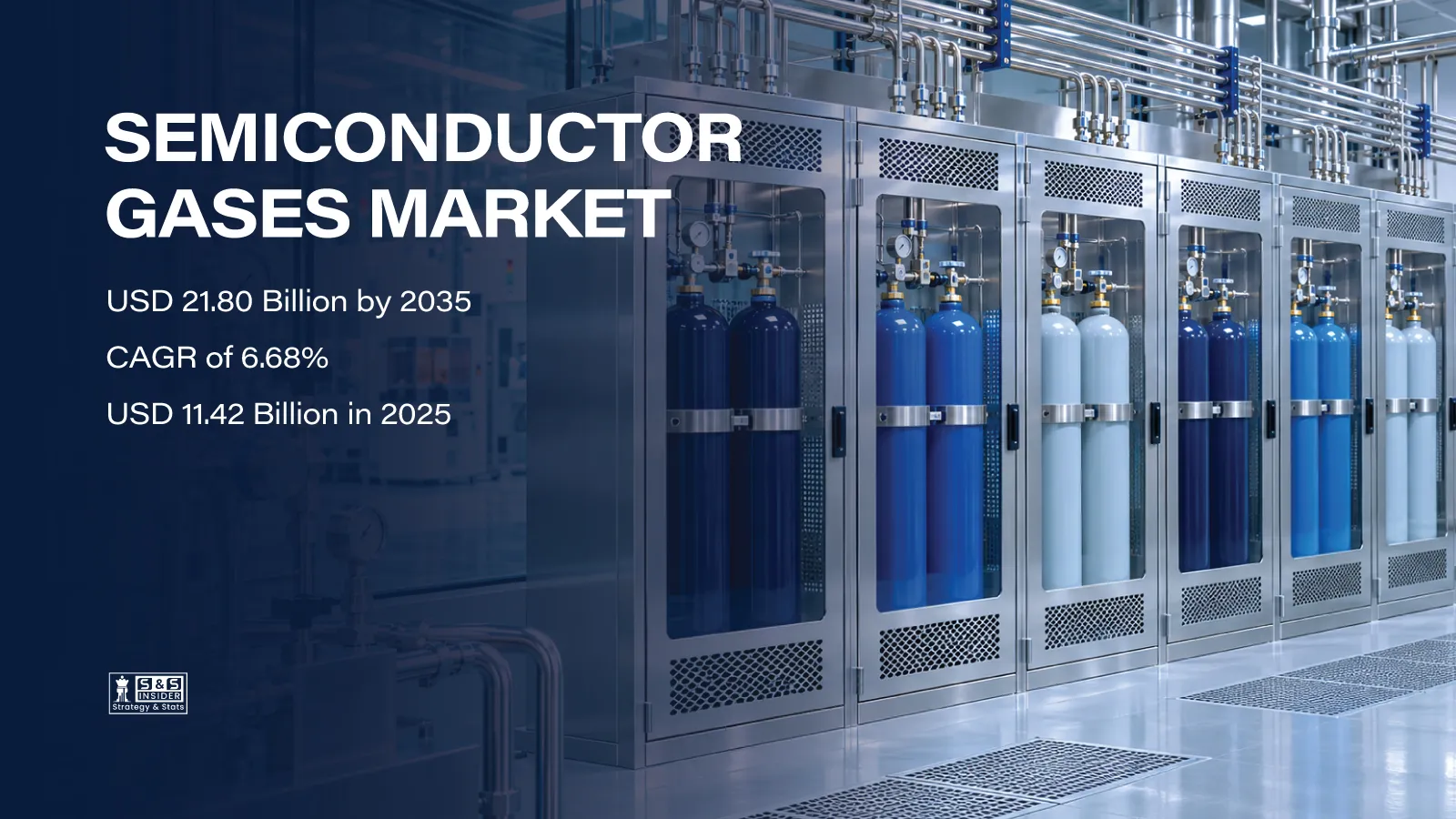
As per the report published by SNS Insider, the global semiconductor gases market size stood at USD 11.42 billion in 2025 and is projected to reach USD 12.18 billion in 2026 before growing to USD 21.80 billion in 2035, representing a CAGR of 6.68% during 2026 to 2035.
Semiconductor gases are essential in wafer processing applications such as chemical vapor deposition, plasma etching, cleaning chambers, doping and thermal control applications. As semiconductor technologies continue getting complex, manufacturers need specialized gas composition, higher purity levels and reliable delivery systems.
Demand is also being influenced by investments in semiconductor manufacturing capacity across North America and Asia-Pacific. While Asia-Pacific remains the largest regional consumer, North America is projected to record the fastest growth as new fabrication facilities increase demand for bulk and specialty gases.
The industry's long-term outlook reflects opportunities for industrial gas producers, specialty chemical manufacturers and suppliers developing advanced purification, recovery and sustainable gas technologies.
Market Size and Forecast
|
Market Indicator |
Value |
|---|---|
|
Market Size, 2025 |
USD 11.42 Billion |
|
Market Size, 2026 |
USD 12.18 Billion |
|
Market Forecast, 2035 |
USD 21.80 Billion |
|
CAGR, 2026–2035 |
6.68% |
|
Largest Region |
Asia-Pacific (47.91% in 2025) |
|
Fastest-Growing Region |
North America (7.42% CAGR) |
|
Leading Gas Category |
Electronic Specialty Gases |
|
Fastest-Growing Gas Category |
Noble and Rare Gases |
Demand Drivers and Constraints
Primary Demand Drivers
-
Increasing AI semiconductor production: Expansion of AI accelerators, advanced processors and high-performance computing infrastructure is increasing requirements for high-purity deposition, etching and cleaning gases.
-
Global semiconductor fabrication investments: New chip manufacturing facilities require significant quantities of nitrogen, hydrogen, argon, helium and specialized electronic gases.
-
Expansion of advanced memory manufacturing: Increasing production of high-bandwidth memory and three-dimensional NAND devices is supporting demand for complex gas-based manufacturing processes.
-
Technological advancements in chip architectures: Smaller process nodes and three-dimensional transistor designs require additional processing steps, increasing gas consumption per wafer.
-
Growth in automotive and power semiconductors: Electric vehicles, industrial automation and renewable energy technologies are creating demand for gases used in silicon carbide and gallium nitride semiconductor production.
-
Increasing purity requirements: Semiconductor manufacturers are investing in high-performance gas purification and monitoring technologies to minimize contamination and improve manufacturing yields.
Potential Growth Constraints
-
High capital expenditure associated with gas purification facilities, production systems and specialized distribution infrastructure.
-
Supply chain disruptions affecting helium, neon and other strategically important gases.
-
Environmental concerns surrounding fluorinated gases with high global warming potential.
-
Strict safety requirements for toxic, corrosive and flammable specialty gases.
-
Semiconductor manufacturing cycles that can influence production volumes and gas procurement.
Demand Structure by Gas Category
Electronic Specialty Gases — Leading Market Segment
Electronic specialty gases represent the largest category within the semiconductor gases market in 2025.
These gases include silane, ammonia, nitrogen trifluoride, tungsten hexafluoride, fluorocarbons and dopant compounds used in semiconductor manufacturing.
Their importance is linked to highly specialized processing operations that require precise chemical reactions and extremely low contamination levels.
Demand is increasing as chip manufacturers adopt advanced transistor architectures, multilayer memory structures and sophisticated deposition technologies.
Unlike conventional industrial gases, electronic specialty gases require extensive purification, analytical testing and controlled delivery systems.
Current trend: Increasing consumption of application-specific, ultra-high-purity gases in advanced semiconductor fabrication.
Major trends: Advanced deposition materials, specialized etching chemistries, precision doping and high-purity gas delivery.
Noble and Rare Gases — Forecast CAGR of 7.94%
Noble and rare gases are projected to be the fastest-growing gas category, expanding at a CAGR of 7.94% during 2026–2035.
Neon, krypton and xenon support important lithography and plasma-processing applications, while helium is widely used for wafer cooling and temperature control.
Increasing demand for advanced semiconductor manufacturing is encouraging suppliers to expand purification, recovery and recycling capabilities.
Supply concentration remains a significant consideration, particularly for gases whose production depends on limited industrial sources.
Semiconductor manufacturers are increasingly prioritizing long-term supply agreements and geographically diversified sourcing arrangements.
Current trend: Growing investment in rare-gas supply security and recovery technologies.
Major trends: Neon purification, helium recycling, strategic sourcing and long-term supply partnerships.
Demand Structure by Manufacturing Process
Chamber Cleaning — Dominant Manufacturing Process
Chamber cleaning accounts for the leading process category in the semiconductor gases market.
During semiconductor production, deposits accumulate inside manufacturing equipment and must be removed regularly to maintain process stability and product quality.
Fluorine-containing gases, including nitrogen trifluoride and selected fluorocarbons, are commonly used in plasma-based cleaning applications.
As semiconductor manufacturers increase the number of deposited layers in advanced devices, chamber maintenance requirements become more intensive.
This supports recurring consumption of specialized cleaning gases across logic and memory fabrication facilities.
Current trend: Increasing demand for efficient chamber cleaning and contamination-control technologies.
Deposition — Forecast CAGR of 7.21%
Deposition is expected to become the fastest-growing manufacturing process segment, recording a CAGR of 7.21% through 2035.
Chemical vapor deposition and atomic layer deposition are essential for producing thin films used in semiconductor devices.
These processes rely on gases and precursors such as silane, ammonia and tungsten hexafluoride to form precisely controlled material layers.
The transition toward three-dimensional semiconductor structures and advanced memory architectures is increasing the number of deposition steps required per wafer.
Consequently, suppliers capable of delivering consistent gas purity and application-specific formulations are positioned to benefit.
Current trend: Expansion of advanced thin-film deposition for next-generation semiconductor devices.
Demand Structure by Application
Logic Semiconductors — Leading Application
Logic semiconductors represent the largest application segment in 2025.
Advanced processors, artificial intelligence accelerators and system-on-chip devices require multiple fabrication stages involving deposition, etching, cleaning and doping.
Increasing manufacturing complexity at advanced process nodes is supporting demand for specialized gases even when overall wafer production remains relatively stable.
Major semiconductor manufacturing centers in Taiwan, South Korea, Japan and the United States continue to generate substantial requirements for high-purity gas infrastructure.
Current trend: Rising gas intensity associated with advanced logic manufacturing and AI processor production.
Memory Semiconductors — Forecast CAGR of 7.48%
Memory applications are projected to expand at a CAGR of 7.48% during 2026–2035.
Growing demand for high-bandwidth memory, server DRAM and three-dimensional NAND is encouraging manufacturers to expand production capabilities.
Advanced memory devices require repeated deposition, etching and chamber cleaning operations, increasing consumption of both bulk and specialty gases.
The rapid development of AI computing infrastructure is further strengthening demand for sophisticated memory technologies.
Current trend: Increasing gas consumption associated with high-bandwidth memory and multilayer semiconductor structures.
Regional Market Dynamics
Asia-Pacific — 47.91% Market Share in 2025
Asia-Pacific dominates the global semiconductor gases market, accounting for approximately 47.91% of revenue in 2025.
Taiwan, South Korea, China and Japan form major semiconductor manufacturing centers, supporting substantial demand for electronic specialty gases and high-purity bulk gases.
Taiwan accounts for approximately 31.40% of Asia-Pacific market revenue, reflecting its concentrated semiconductor fabrication industry.
Expanding manufacturing investments across Southeast Asia and India are also creating opportunities for gas suppliers.
Direction: Continued leadership supported by semiconductor manufacturing capacity and advanced memory production.
North America — Fastest-Growing Region at 7.42% CAGR
North America represents approximately 28.36% of global semiconductor gases revenue in 2025 and is projected to grow at a CAGR of 7.42% through 2035.
Semiconductor fabrication investments across Arizona, Texas, Ohio and New York are creating new requirements for bulk gas production, purification and specialty gas distribution.
The United States semiconductor gases market was valued at USD 3.05 billion in 2025 and is projected to expand at a CAGR of 7.35%.
Direction: Accelerating growth supported by domestic semiconductor manufacturing investments and localized supply infrastructure.
Europe — 19.84% Market Share
Europe accounted for approximately 19.84% of the market in 2025.
Germany remains an important semiconductor manufacturing center, supported by demand from automotive, industrial, power semiconductor and electronic component industries.
Regional investments in advanced chip manufacturing, combined with stringent environmental requirements, are encouraging demand for efficient gas delivery systems and lower-emission processing solutions.
Direction: Steady growth driven by semiconductor localization and advanced industrial applications.
Middle East & Africa and Latin America
The Middle East & Africa held approximately 2.47% of global market revenue in 2025, while Latin America accounted for 1.42%.
Israel represents an important semiconductor manufacturing center in the Middle East, while Brazil contributes to Latin American demand through electronics production and research activities.
Although both regions currently represent smaller markets, semiconductor investment initiatives and expanding technology infrastructure could support gradual growth.
Direction: Emerging opportunities linked to semiconductor manufacturing development and regional supply chain diversification.
Competitive Landscape
The semiconductor gases market includes established industrial gas producers and specialized electronic materials manufacturers.
Prominent companies include Linde plc, Air Liquide, Air Products and Chemicals, Nippon Sanso Holdings, Messer Group, Matheson Tri-Gas, Iwatani Corporation, Resonac and Sumitomo Seika Chemicals.
Competition increasingly depends on gas purity, production capacity, supply reliability, technical expertise and proximity to semiconductor fabrication facilities.
Companies are investing in on-site gas production, advanced purification systems and long-term supply arrangements to strengthen relationships with semiconductor manufacturers.
Sustainability is also becoming an important competitive factor, particularly as manufacturers seek alternatives to high-emission processing gases.
Market Outlook (2026–2035)
The global semiconductor gases market is forecast to reach USD 21.80 billion by 2035, supported by increasing semiconductor manufacturing complexity, AI infrastructure expansion and growing investment in advanced fabrication facilities.
Demand is expected to strengthen across electronic specialty gases, deposition materials and rare gases used in precision semiconductor manufacturing.
Asia-Pacific will remain an important center of consumption, while North America is positioned for faster expansion through new manufacturing investments.
Supply chain resilience, gas recycling, environmental performance and ultra-high-purity production capabilities will increasingly influence supplier competitiveness.
Overall, the semiconductor gases market is positioned for sustained expansion through 2035, with growth increasingly determined by advanced chip architectures, semiconductor manufacturing investment and the availability of reliable, high-purity gas supplies.



