
Content Authenticity Market Report Scope & Overview:
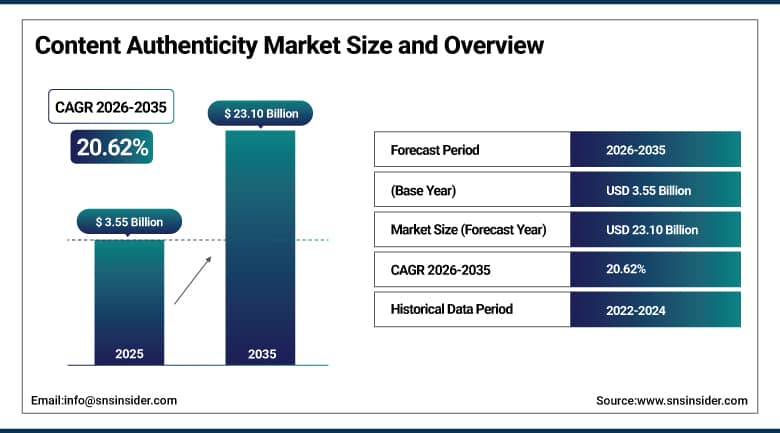
The Content Authenticity Market was valued at USD 3.55 Billion in 2025 and is expected to reach USD 23.10 Billion by 2035, growing at a CAGR of 20.62% from 2026–2035.
Some of the key drivers behind the growth of the global market for content authenticity include the fast emergence of AI content creation and deepfake generation technologies, high demand for content provenance and digital trust, the need for regulatory compliance with transparency requirements for AI, and increased investments in next-gen content verification technologies. AI-enabled detection, digital watermarking, cryptographic provenance, metadata verification, and blockchain-powered verification tools are used by companies to authenticate the origins and integrity of digital content, counter misinformation and protect intellectual property. Also, constant improvements in AI-driven detection technologies, and the establishment of content authenticity standards, like C2PA, boost market growth.
In May 2026, Google expanded SynthID watermarking capabilities and introduced a Content Detection API for Google Cloud Gemini, enabling enterprises to verify AI-generated content across multiple platforms in real time. This initiative strengthens digital content provenance, supports regulatory compliance, and enhances trust in AI-generated media.
To Get More Information On Content Authenticity Market - Request Free Sample Report
Content Authenticity Market Trends:
-
Rising concerns over AI-generated content, deepfakes, and digital misinformation are driving the adoption of content authenticity solutions across media, enterprises, and government organizations.
-
Increasing regulatory support for digital trust, content provenance, and AI transparency is accelerating the deployment of content authenticity technologies worldwide.
-
Content authenticity solutions enable verification of content origin, detection of manipulated media, protection of intellectual property, and enhanced trust in digital communications.
-
Advancements in AI-based detection, digital watermarking, cryptographic provenance, metadata authentication, and blockchain-based verification technologies are driving innovation in the Content Authenticity Market.
-
Growing adoption across media & entertainment, BFSI, government, healthcare, and enterprise sectors is supporting sustained market growth.
U.S. Content Authenticity Market Outlook:
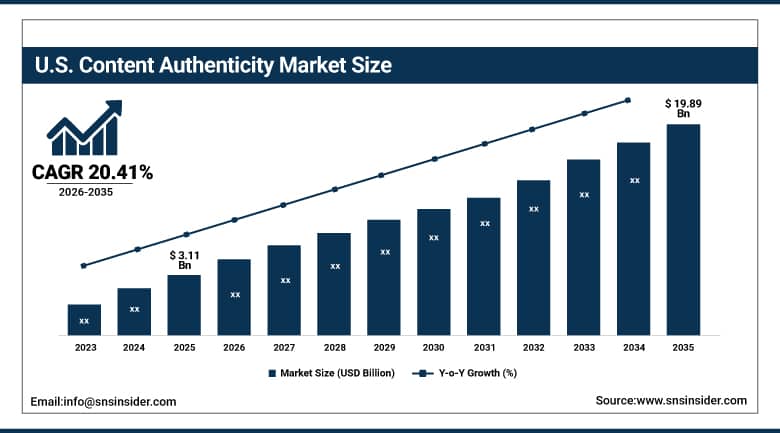
The U.S. Content Authenticity Market was valued at USD 3.11 Billion in 2025 and is expected to reach around USD 19.89 Billion by 2035, growing at a CAGR of 20.41% from 2026–2035.
The rising adoption of AI-generated content on digital platforms, increased concerns about deepfakes, and rising regulations regarding AI transparency have propelled the market for content authenticity in the US. Companies operating in media, government, BFSI, healthcare, and enterprises have started implementing AI-driven content detection, digital watermarking, cryptographic provenance, and metadata authentication technologies for the verification of content integrity and IP protection purposes.
Additionally, technological developments related to content authentication through AI, blockchain, and cryptographic provenance technologies have been driving the growth of the content authenticity market in the US. Increasing investments by technology companies, cloud companies, and cybersecurity providers in content authentication platforms and digital trust solutions have been aiding in the expansion of the market.
In May 2026, Canon launched its C2PA-compliant Authenticity Imaging System for professional newsrooms. The system embeds verifiable provenance data at the point of image capture and tracks content throughout the editorial workflow, helping media organizations authenticate digital content, combat misinformation, and strengthen trust in published images.
Content Authenticity Market Segment Analysis:
-
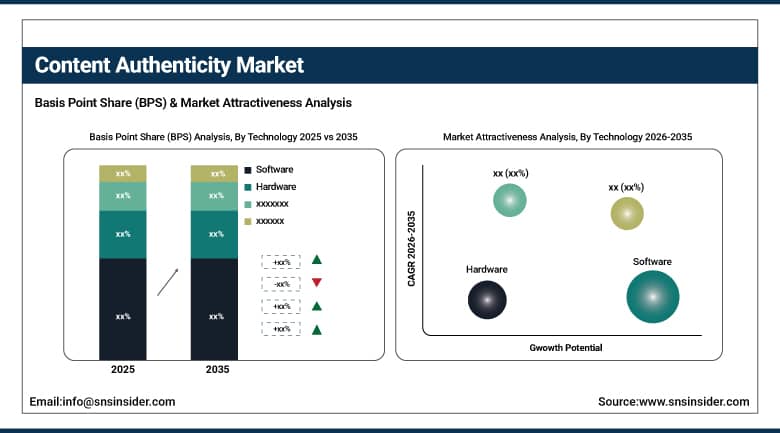
By technology, software dominated the content authenticity market with a 34.00% share in 2025, while hardware is projected to be the fastest-growing segment, registering a 22.24% CAGR during 2025–2035.
-
By content type, image dominated the content authenticity market with a 32.90% share in 2025, while audio is projected to be the fastest-growing segment, registering a 23.92% CAGR during 2025–2035.
-
By deployment mode, cloud dominated the content authenticity market with a 61.40% share in 2025, while on-premises is projected to be the fastest-growing segment, registering a 21.20% CAGR during 2025–2035.
-
By application, regulatory compliance dominated the content authenticity market with a 26.20% share in 2025, while deepfake detection is projected to be the fastest-growing segment, registering a 24.50% CAGR during 2025–2035.
-
By end user / industry vertical, media & entertainment dominated the content authenticity market with a 31.10% share in 2025, while healthcare is projected to be the fastest-growing segment, registering a 24.14% CAGR during 2025–2035.
By technology, software dominated the content authenticity market, while hardware is expected to grow fastest.
In 2025, the software was the highest revenue generator in the content authenticity market because of the increased usage of software-based AI content verification, digital watermarking, provenance through cryptography, and metadata authentication by enterprises, media companies, and digital platforms. The rise in the usage of AI-generated content, deepfakes, and online misinformation has increased the need for scalable software solutions to authenticate the content. The continuous development of AI algorithms, cloud-based authentication platforms, and industry standards like C2PA is further driving the market growth of software solutions.
On the other hand, the hardware segment is estimated to witness the highest growth rate during the forecast period as a result of the growing usage of secure imaging devices, trusted hardware, and edge authentication systems.
By content type, image dominated the content authenticity market, while audio is expected to grow fastest
The image segment comprised the highest share of the content authenticity market in 2025 owing to the extensive application of digital images on social media, news agencies, marketing and advertising campaigns, and online commerce platforms. The growing requirement for image manipulation detection, image provenance, and visual misinformation management has resulted in high adoption of content authenticity technologies. The application of digital watermarking, metadata authentication, and cryptographic provenance in image processes has added to the growth of this segment.
On the other hand, audio segment is estimated to grow at the fastest rate during the forecast period owing to the quick adoption of AI-powered voice-based content and voice cloning technologies.
By deployment mode, cloud dominated the content authenticity market, while on-premises is expected to grow fastest
For the same reasons, the cloud segment is estimated to have the biggest market share of the content authenticity market in 2025 due to scalable, cost-efficient, and easily deployable content authenticity solutions available on the cloud. These platforms provide real-time verification, centralized management, easy software upgrades, as well as integration with AI models and digital workflows.
On the other hand, the on-premises segment is forecast to register the highest CAGR during the forecast period due to the growing preference of enterprises requiring high security and privacy levels for their content.
Regional Insights:
|
Region |
Major Country |
Share within Region, 2025(%) |
|---|---|---|
|
North America |
United States |
87.60% |
|
Europe |
Germany |
22.80% |
|
Asia Pacific |
China |
41.50% |
|
Middle East & Africa |
Saudi Arabia |
28.50% |
|
Latin America |
Brazil |
42.80% |
North America Content Authenticity Market Insights
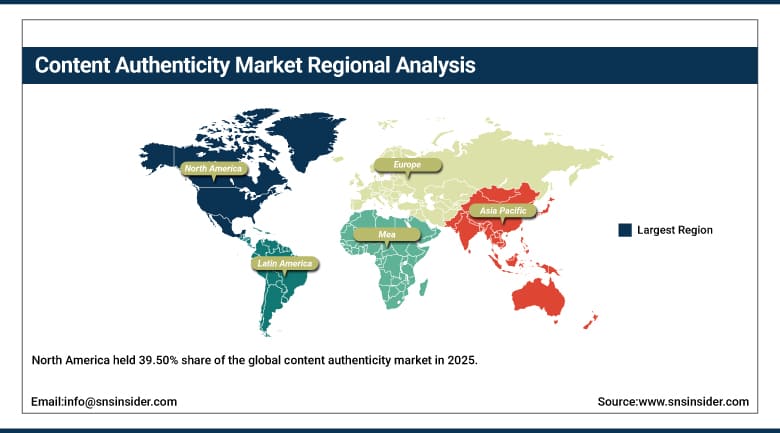
North America held 39.50% share of the global content authenticity market in 2025. The key drivers propelling the market growth comprise increased use of AI content generation, increasing concern over deepfakes and digital disinformation, increasing regulatory focus on AI transparency, and growing investment in content authentication technologies. The extensive use of AI-based detection, digital watermarking, cryptographic provenance, and metadata authentication systems in media, government, BFSI, and enterprises is bolstering digital trust and fueling market growth. In the same year, the United States held 87.60% share of the North America content authenticity market.
The key growth factors that will impact the market in the region include increased adoption of AI governance frameworks, increasing use of C2PA compliant content provenance standards, increasing demand for secure digital media authentication, and consistent investment in AI-based content verification systems. Moreover, technological advancements in cloud-based authentication, blockchain-based verification, and deepfake detection are likely to boost market growth in the United States and North America.
Get Customized Report as Per Your Business Requirement - Enquiry Now
Europe Content Authenticity Market Insights
The content authenticity market in Europe is seeing growth owing to the rising demands for AI transparency regulations, the adoption of digital trust framework, and the increasing use of content authenticity technology. In 2025, Germany makes up 22.80% of the content authenticity market in Europe due to its well-developed digital economy, increased use of AI technologies, and efforts to counter online misinformation.
Some of the major growth drivers of the market are increased use of AI-driven content verification solutions, increased use of digital watermarking and cryptographic provenance solutions, positive regulatory initiative in support of trustworthy AI, and increased investments in secure digital infrastructures.
Asia Pacific Content Authenticity Market Insights
Asia Pacific region will witness a high CAGR in the content authenticity market owing to fast digital transformation, rise in AI implementation, growing social media penetration, and increased investments in cybersecurity and digital trust solutions. The Asia Pacific content authenticity market share held by China was 41.50% in 2025 owing to the presence of huge digital ecosystem, use of AI, robust technology industry, and government initiatives to regulate AI-based content.
The regional market will gain momentum on the back of increasing adoption of AI-based content authentication solutions, investment in digital infrastructure, cloud implementation, and growing need for trustworthy digital content.
Middle East & Africa and Latin America Content Authenticity Market Insights
The Middle East & Africa content authenticity market is witnessing a growth trend owing to various digital transformation initiatives, cybersecurity spending, and the increasing use of AI-based content verification tools. The market share held by Saudi Arabia in the region stood at 28.50% in 2025, as a result of various digital transformation initiatives, AI adoption, and spending on digital infrastructure.
The Latin America content authenticity market is witnessing a growth trend owing to the focus of governments and companies on dealing with misinformation, cybersecurity, and digital trust. In 2025, Brazil held 42.80% of the Latin America content authenticity market as a result of its significant number of digital users, adoption of AI technology, investment in cloud computing, and demand for content authentication solutions.
Growth Driver: Rising adoption of AI-generated content and increasing need for digital trust accelerating content authenticity market growth
With the rising use of AI content on various digital platforms, the market for content authenticity is driven by many factors; one of the major driving factors being the increased adoption of AI content on digital platforms. Various organizations in the fields of media and entertainment, government, BFSI, healthcare, and enterprises are increasingly using content authenticity solutions for verifying the source and integrity of digital content and preventing deepfakes and misinformation on the internet.
Various initiatives by governments and regulations for implementing AI governance frameworks and policies for transparency have encouraged the use of digital watermarking, content provenance, and verification technologies. Rising investments in AI-driven detection technologies and cloud-based content authentication solutions and standards like C2PA, along with the increasing demand for trustworthy digital content, will help boost the growth of the market.
Restraints: High implementation complexity and evolving AI manipulation techniques may restrain content authenticity market growth
Further expansion of the market for the content authenticity industry is hindered by the fast development of manipulative practices related to AI use, costly implementations and the difficulty of incorporating content authenticity solutions into current digital processes. Due to the increasing capabilities of generative AI systems, image, video, audio, and textual manipulation detection involves constant updates of the underlying models and intensive computing power use. Furthermore, interoperability issues, the absence of common content authenticity standards and privacy risks may hinder wide adoption of these solutions.
Overcoming these obstacles will need additional research in the field of AI and development of the scalable content authentication techniques.
Opportunities: Expanding AI governance initiatives and adoption of content provenance standards
There are numerous business growth opportunities available in the content authenticity market due to the increased focus on digital trust and responsible use of AI across the world. The adoption of AI governance policies, digital watermarking, cryptography, blockchain technology, and C2PA content authenticity standards allows companies to validate the authenticity of digital content. The growing partnerships between technology providers, cloud platforms, media companies, and cybersecurity companies are contributing towards the rapid commercialization of content authenticity solutions.
Furthermore, the increasing regulations regarding AI transparency, rising implementation of generative AI, increasing need for trusted digital media, and continuous innovation in AI verification technologies are likely to offer many growth opportunities in the coming years. In light of digital trust, misinformation prevention, and secure content sharing, the demand for content authenticity solutions is expected to rise exponentially in the forecasted period.
Recent Developments:
-
2026: Google introduced advanced features of SynthID watermarking and Content Detection API for Google Cloud Gemini, allowing companies to authenticate the AI-generated content on different platforms.
-
2026: Adobe improved its Content Credentials ecosystem through the expansion of C2PA standards into Creative Cloud apps, providing creators and businesses with an ability to safely authenticate their digital content and its editing history.
-
2025: Microsoft entered industry initiatives for the promotion of C2PA standard by introducing content provenance and authenticity tools into AI and productivity ecosystem.
-
2025: Nikon Corporation released C2PA compliant digital signature software for professional cameras allowing photographers and news organizations to validate their images at the moment of creation.
Content Authenticity Market Key Players
-
Adobe Inc.
-
Google LLC
-
Microsoft Corporation
-
Meta Platforms, Inc.
-
OpenAI
-
NVIDIA Corporation
-
Intel Corporation
-
IBM Corporation
-
Cisco Systems, Inc.
-
Cloudflare, Inc.
-
Digimarc Corporation
-
Truepic Inc.
-
Canon Inc.
-
Sony Group Corporation
-
Getty Images Holdings, Inc.
-
Shutterstock, Inc.
-
Content Authenticity Initiative (CAI)
-
Coalition for Content Provenance and Authenticity (C2PA)
Content Authenticity Market Report Scope:
| Report Attributes | Details |
|---|---|
| Market Size in 2025 | USD 3.55 Billion |
| Market Size by 2035 | USD 23.10 Billion |
| CAGR | CAGR of 20.62% From 2026 to 2035 |
| Base Year | 2025 |
| Forecast Period | 2026-2035 |
| Historical Data | 2022-2024 |
| Report Scope & Coverage | Market Size, Segments Analysis, Competitive Landscape, Regional Analysis, DROC & SWOT Analysis, Forecast Outlook |
| Key Segments• | • By technology (Software, Hardware, Services, AI-based Detection, Digital Watermarking) • By content type (Image, Video, Audio, Text, Documents) • By deployment mode (Cloud, On-Premises) • By application (Media Verification, Deepfake Detection, Content Provenance Tracking, Copyright & IP Protection, Regulatory Compliance) • By end user / industry vertical (Media & Entertainment, BFSI, Government, Healthcare, Enterprises) |
| Regional Analysis/Coverage | North America (US, Canada, Mexico), Europe (Eastern Europe [Poland, Romania, Hungary, Turkey, Rest of Eastern Europe] Western Europe] Germany, France, UK, Italy, Spain, Netherlands, Switzerland, Austria, Rest of Western Europe]), Asia Pacific (China, India, Japan, South Korea, Vietnam, Singapore, Australia, Rest of Asia Pacific), Middle East & Africa (Middle East [UAE, Egypt, Saudi Arabia, Qatar, Rest of Middle East], Africa [Nigeria, South Africa, Rest of Africa], Latin America (Brazil, Argentina, Colombia, Rest of Latin America) |
| Company Profiles | Adobe Inc., Google LLC, Microsoft Corporation, Amazon Web Services, Inc., Meta Platforms, Inc., OpenAI, NVIDIA Corporation, Intel Corporation, IBM Corporation, Cisco Systems, Inc., Cloudflare, Inc., Digimarc Corporation, Truepic Inc., Canon Inc., Nikon Corporation, Sony Group Corporation, Getty Images Holdings, Inc., Shutterstock, Inc., Content Authenticity Initiative (CAI), Coalition for Content Provenance and Authenticity (C2PA) |
Frequently Asked Questions
The content authenticity market was valued at USD 3.55 billion in 2025.
The market is driven by the rising adoption of AI-generated content, increasing deepfake threats, and growing demand for digital trust and content verification technologies.
North America dominated the content authenticity market in 2025 with a 39.50% share.
The market is driven by the rising adoption of AI-generated content, increasing deepfake threats, and growing demand for digital trust and content verification technologies.
