
Customer Experience Artificial Intelligence Market Report Scope & Overview:
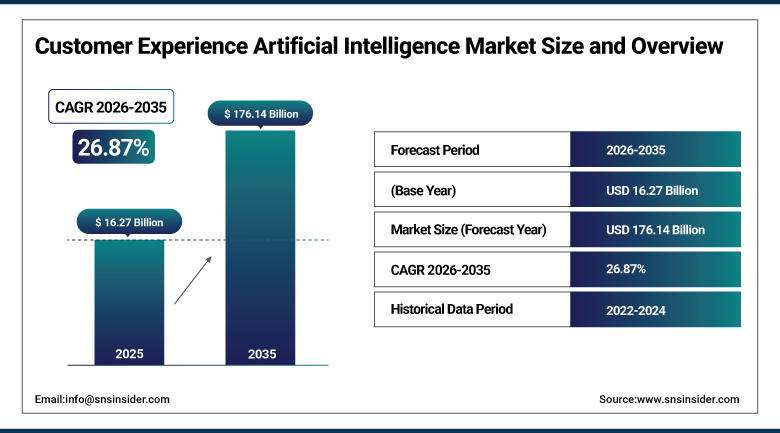
The Customer Experience Artificial Intelligence Market was valued at USD 16.27 Billion in 2025 and is expected to reach USD 176.14 Billion by 2035, growing at a CAGR of 26.87% from 2026–2035.
The Customer Experience Artificial Intelligence Market is experiencing consistent growth due to increasing demand for personalized, intelligent, and real-time customer interactions. The expansion of artificial intelligence across customer service, retail, e-commerce, banking, healthcare, telecommunications, and other industries is driving demand for AI-powered customer experience solutions. Advancements in machine learning, natural language processing, deep learning, computer vision, generative AI, and virtual assistants are enhancing customer engagement, personalization, automation, and decision-making capabilities. Companies are focusing on improving customer satisfaction, reducing response times, automating support operations, and delivering more personalized experiences. Growing adoption of chatbots and virtual assistants, sentiment analysis, customer behavior analytics, personalized recommendations, predictive analytics, and customer journey and feedback analysis is accelerating technological advancements.
In March 2026, leading AI and customer experience technology developments are accelerating the adoption of artificial intelligence for personalized and intelligent customer interactions. Advances in generative AI, conversational AI, natural language processing, predictive analytics, and AI-powered customer service are enabling businesses to automate customer support, analyze customer sentiment and behavior, deliver personalized recommendations, and improve customer engagement. These developments are expected to accelerate the deployment of next-generation AI-driven customer experience solutions globally by improving personalization, response efficiency, customer satisfaction, and operational scalability.
To Get more information Customer Experience Artificial Intelligence Market - Request Free Sample Report
Customer Experience Artificial Intelligence Market Trends
-
Growing demand for personalized customer interactions is driving AI adoption across digital channels.
-
Rising use of generative AI, machine learning, NLP, and predictive analytics is increasing demand for automated customer support and personalization.
-
Adoption of chatbots, virtual assistants, sentiment analysis, and customer analytics is improving customer engagement and service efficiency.
-
Advancements in AI-driven personalization and cloud-based customer experience platforms are supporting market growth
-
Growing adoption of generative AI, chatbots, and virtual assistants is improving customer engagement and enabling faster, personalized support.
-
Increasing use of predictive analytics, sentiment analysis, and customer behavior insights is helping businesses enhance customer satisfaction and optimize service operations.
U.S. Customer Experience Artificial Intelligence Market Outlook
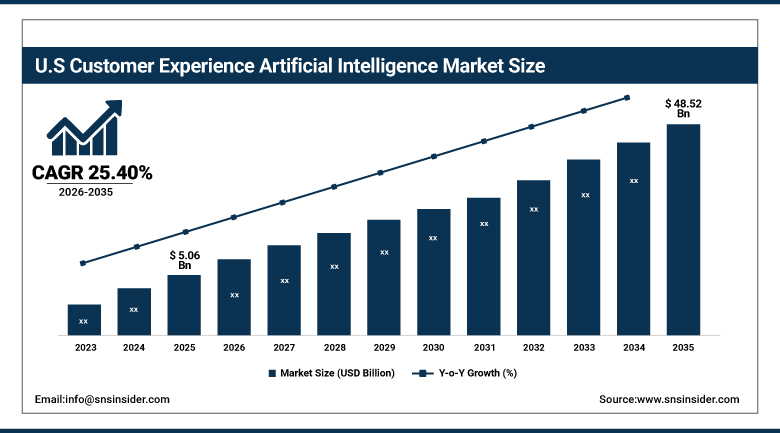
The U.S. Customer Experience Artificial Intelligence Market was valued at USD 5.06 Billion in 2025 and is expected to reach around USD 48.52 Billion by 2035, growing at a CAGR of 25.40% from 2026–2035.
The U.S. Customer Experience Artificial Intelligence Market is growing steadily due to rising demand for personalized, intelligent, and real-time customer interactions. The expansion of artificial intelligence, cloud computing, e-commerce, digital banking, healthcare technology, and omnichannel customer service is driving demand for AI-powered customer experience solutions. Investments in generative AI, machine learning, natural language processing, predictive analytics, and intelligent virtual assistants are improving customer engagement, personalization, automation, and service efficiency. Growing adoption of AI-powered chatbots, sentiment analysis, customer behavior analytics, personalized recommendations, and predictive analytics is supporting market demand. Companies are increasingly integrating cloud-based AI solutions into customer engagement platforms to deliver faster responses, personalized experiences, predictive insights, and automated support.
In the U.S., growing investments by enterprises in generative AI, AI-powered customer service, intelligent virtual assistants, and customer analytics are driving the adoption of AI-based customer experience technologies. U.S. businesses across retail, e-commerce, BFSI, healthcare, telecommunications, and hospitality are increasingly integrating AI into customer engagement platforms to provide real-time support, personalized experiences, predictive insights, and automated interactions. These developments are expected to strengthen the U.S. customer experience artificial intelligence market by increasing enterprise adoption, improving customer service efficiency, and accelerating AI-driven personalization.
Customer Experience Artificial Intelligence Market Segment Analysis
-
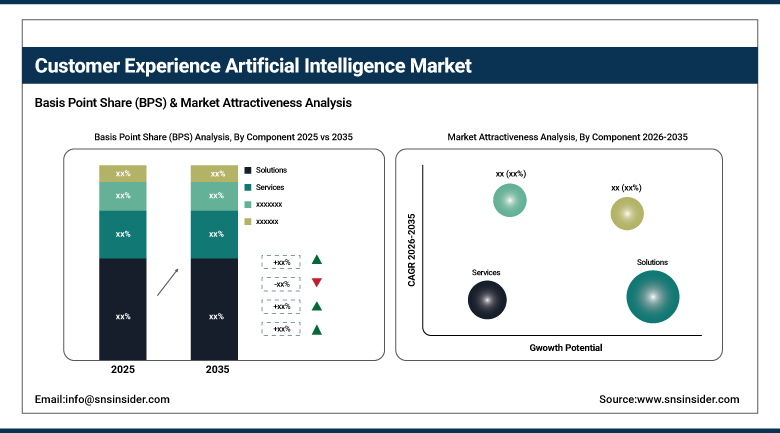
By Component, solutions dominated the Customer Experience Artificial Intelligence Market with a 68.40% share in 2025, while services are projected to be the fastest-growing segment, registering a 29.90% CAGR during 2026–2035.
-
By Technology, machine learning dominated the Customer Experience Artificial Intelligence Market with a 31.80% share in 2025, while generative AI is projected to be the fastest-growing segment, registering a 38.08% CAGR during 2026–2035.
-
By Application, chatbots & virtual assistants dominated the Customer Experience Artificial Intelligence Market with a 34.60% share in 2025, while personalized recommendations are projected to be the fastest-growing segment, registering a 33.73% CAGR during 2026–2035.
-
By Deployment, cloud dominated the Customer Experience Artificial Intelligence Market with a 76.30% share in 2025, while cloud is projected to be the fastest-growing segment, registering a 28.65% CAGR during 2026–2035.
-
By Organization Size, large enterprises dominated the Customer Experience Artificial Intelligence Market with a 64.80% share in 2025, while small & medium-sized enterprises (SMEs) are projected to be the fastest-growing segment, registering a 29.31% CAGR during 2026–2035.
-
By End Use Industry, retail & e-commerce dominated the Customer Experience Artificial Intelligence Market with a 25.90% share in 2025, while healthcare is projected to be the fastest-growing segment, registering a 32.99% CAGR during 2026–2035
By Component, solutions dominated the Customer Experience Artificial Intelligence Market, while services are expected to grow fastest.
Solutions held the leading position in the Customer Experience Artificial Intelligence Market in 2025, supported by their critical role in enabling automated customer interactions, personalization, analytics, and intelligent decision-making. Increasing demand for AI-powered customer service, chatbots, virtual assistants, predictive analytics, and personalized experiences is driving the adoption of customer experience AI solutions. The growing integration of machine learning, natural language processing, generative AI, and advanced customer analytics is further supporting their deployment across retail, banking, healthcare, telecommunications, and other industries.
Services are anticipated to register the highest CAGR during the forecast period from 2026 to 2035. Growing demand for AI implementation, integration, consulting, customization, maintenance, and managed services is encouraging organizations to expand their use of customer experience AI. The increasing complexity of AI deployments, cloud-based platforms, data integration requirements, and the need for continuous optimization are expected to accelerate demand for AI-related services.
By Network Type, chatbots & virtual assistants dominated the Customer Experience Artificial Intelligence Market, while personalized recommendations are expected to grow fastest.
Chatbots & Virtual Assistants accounted for the dominant share of the Customer Experience Artificial Intelligence Market in 2025, driven by increasing demand for automated, real-time, and personalized customer support. Businesses across retail, e-commerce, banking, telecommunications, healthcare, and travel are deploying intelligent conversational systems to improve response times, customer engagement, and service efficiency. Advances in natural language processing, machine learning, and generative AI are further improving conversational accuracy and enabling more sophisticated customer interactions.
Personalized Recommendations are projected to exhibit the highest growth rate during 2026–2035. The increasing availability of customer data, growing adoption of AI-driven analytics, and demand for individualized experiences are creating strong opportunities for recommendation technologies. Retailers, e-commerce platforms, financial institutions, and digital service providers are increasingly using AI to analyze customer behavior, predict preferences, and deliver relevant products, services, and content, supporting the expansion of personalized recommendation solutions.
By Application, chatbots & virtual assistants dominated the Customer Experience Artificial Intelligence Market, while personalized recommendations are expected to grow fastest.
Chatbots & Virtual Assistants held the dominant position in the Customer Experience Artificial Intelligence Market in 2025, supported by rising demand for automated customer support, faster response times, and 24/7 digital engagement. Organizations are increasingly implementing AI-powered conversational platforms across websites, mobile applications, messaging channels, and contact centers to improve customer service efficiency. Growing adoption of generative AI, natural language processing, and machine learning is further enhancing conversational capabilities and customer interaction quality.
Personalized Recommendations are expected to register the highest CAGR during the forecast period from 2026 to 2035. Increasing demand for tailored customer experiences is driving the use of AI to analyze purchasing behavior, preferences, browsing patterns, and interaction data. The expansion of e-commerce, digital services, and data-driven customer engagement is encouraging businesses to deploy intelligent recommendation systems, supporting higher customer satisfaction, engagement, and conversion rates.
Regional Analysis
|
Region |
Major Country |
Share within Region, 2025(%) |
|---|---|---|
|
North America |
United States |
82.19% |
|
Europe |
Germany |
34.30% |
|
Asia Pacific |
China |
48.54% |
|
Middle East & Africa |
Saudi Arabia |
23.50% |
|
Latin America |
Brazil |
23.00% |
North America Customer Experience Artificial Intelligence Market insights
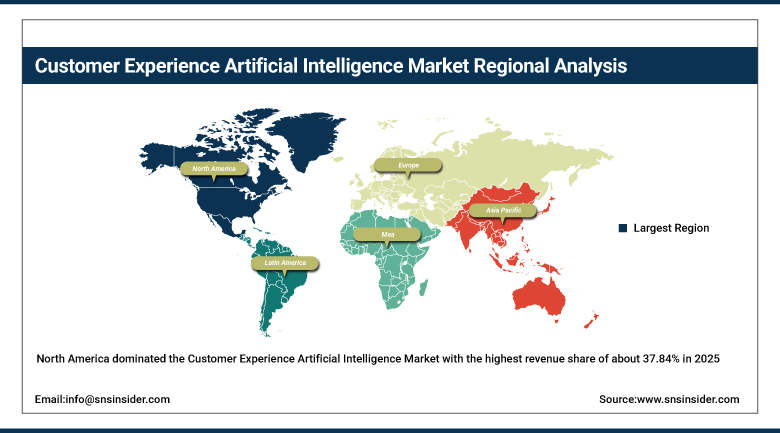
North America dominated the Customer Experience Artificial Intelligence Market with the highest revenue share of about 37.84% in 2025, supported by strong adoption of artificial intelligence, cloud computing, advanced analytics, and digital customer engagement technologies. The region has a mature technology ecosystem, widespread adoption of AI-powered customer service platforms, and a strong presence of leading technology providers. Increasing investments in generative AI, machine learning, natural language processing, predictive analytics, and intelligent virtual assistants are driving demand for advanced customer experience solutions. Growing adoption of AI-powered chatbots, personalized recommendations, sentiment analysis, and customer behavior analytics across retail, e-commerce, BFSI, telecommunications, healthcare, and other industries is further strengthening regional market growth.
Get Customized Report as per Your Business Requirement - Enquiry Now
Europe Customer Experience Artificial Intelligence Market insights
The Customer Experience Artificial Intelligence Market in Europe is expected to witness steady growth over the forecast period, supported by increasing adoption of artificial intelligence, cloud computing, digital customer engagement, and advanced analytics. Rising demand for personalized customer experiences, automated support, and data-driven decision-making is encouraging organizations to implement AI-powered customer experience solutions. Increasing adoption of machine learning, natural language processing, generative AI, predictive analytics, and virtual assistants is further supporting regional demand for advanced customer engagement technologies.
Asia Pacific Customer Experience Artificial Intelligence Market insights
Asia Pacific is expected to grow at the fastest CAGR of about 28.94% from 2026–2035, driven by rapid digital transformation, expanding e-commerce activity, increasing smartphone adoption, and accelerating deployment of artificial intelligence across customer-facing industries. Countries including China, Japan, South Korea, India, Singapore, and other Southeast Asian economies are increasingly adopting AI-powered customer service, personalization, analytics, and virtual assistant technologies. The expansion of digital platforms, online commerce, financial technology, telecommunications, healthcare technology, and cloud-based services is creating substantial demand for intelligent customer experience solutions.
Growing adoption of generative AI, machine learning, natural language processing, and predictive analytics is enabling businesses to deliver personalized interactions, automated support, and real-time customer insights. Increasing investments in cloud-based AI platforms and enterprise digital transformation are further supporting regional market growth. The rising use of chatbots, virtual assistants, personalized recommendations, sentiment analysis, and customer behavior analytics is expected to accelerate adoption across the region through 2035.
Middle East & Africa and Latin America Customer Experience Artificial Intelligence Market insights
The Customer Experience Artificial Intelligence Market in the Middle East & Africa and Latin America is expected to witness consistent growth from 2026 to 2035, supported by increasing digital transformation, cloud adoption, e-commerce expansion, telecommunications development, and growing investments in artificial intelligence. Businesses are increasingly adopting AI-powered customer service, chatbots, virtual assistants, predictive analytics, and personalization technologies to improve customer engagement and operational efficiency. Expanding digital platforms and increasing demand for automated and personalized customer interactions are creating opportunities for customer experience AI solutions.
In Latin America, Brazil is anticipated to remain a key country-level market due to its large consumer base, expanding e-commerce sector, growing digital banking ecosystem, and increasing adoption of cloud-based AI solutions. Other Latin American countries are also expected to contribute to regional growth through investments in digital platforms, AI-powered customer service, personalization, and customer analytics.
Growth Driver: Rising demand for personalized and intelligent customer interactions
The global customer experience artificial intelligence market is growing as businesses increasingly seek personalized, real-time, and automated customer interactions. Growing adoption of generative AI, machine learning, natural language processing, predictive analytics, chatbots, and virtual assistants is helping companies improve customer engagement and service efficiency. Businesses across retail, e-commerce, BFSI, healthcare, telecommunications, and travel are integrating AI into customer service operations to deliver faster responses and personalized experiences. Increasing use of cloud-based AI platforms, customer behavior analytics, sentiment analysis, and recommendation technologies is further supporting market expansion. Digital transformation and growing customer expectations for seamless omnichannel experiences are also accelerating AI adoption across industries.
Restraint: High implementation costs and integration complexity can limit market adoption
High implementation costs and integration complexity can restrict adoption of customer experience artificial intelligence solutions, particularly among small and medium-sized enterprises. Businesses may require significant investments in AI platforms, data infrastructure, cloud services, integration tools, and skilled professionals. Integrating AI systems with existing customer relationship management, contact center, and enterprise platforms can create technical challenges. Data quality, privacy, security, and regulatory requirements can further complicate deployment. Organizations may also face difficulties in training AI models, maintaining accuracy, and ensuring consistent customer interactions. These factors can increase implementation timelines and operational costs, potentially slowing adoption among cost-sensitive businesses and organizations with limited technical resources.
Opportunity: Rapid expansion of generative AI and automated customer service
The rapid adoption of generative AI and intelligent customer service technologies is creating significant opportunities in the customer experience artificial intelligence market. Businesses are increasingly deploying AI-powered chatbots, virtual assistants, personalized recommendation engines, predictive analytics, sentiment analysis, and customer behavior solutions to enhance engagement and automate repetitive service activities. Growing demand for real-time customer insights is encouraging companies to integrate AI across sales, marketing, support, and customer relationship management functions. Cloud-based AI platforms are also enabling organizations to scale customer experience capabilities with greater flexibility. Increasing digital transformation, e-commerce adoption, and omnichannel engagement across emerging and developed markets are expected to create further growth opportunities through 2035.
Recent Developments
-
2026: Salesforce expanded its Agentforce AI agent capabilities for customer service, enabling autonomous agents to handle customer inquiries, take actions, and deliver personalized support across channels.
-
2026: Microsoft enhanced Dynamics 365 Contact Center with real-time voice AI, enabling AI agents to listen, reason, respond naturally, maintain context, and support customer interactions across voice and digital channels.
-
2026: NICE advanced its CX AI and agentic AI portfolio, focusing on AI-powered customer engagement, workforce support, automation, and intelligent customer service operations.
-
2026: Genesys continued expanding Genesys Cloud AI capabilities, combining AI agents, AI copilots, real-time analytics, and automated customer interactions to improve customer experience and service efficiency.
-
2026: Adobe continued strengthening its AI-driven customer experience portfolio, including generative AI and AI-agent capabilities for marketing, personalization, customer engagement, and digital experience management.
-
2026: Salesforce strengthened its AI ecosystem through its partnership with Anthropic, integrating Claude with Salesforce technologies to enhance AI-powered sales, service, and marketing automation.
Customer Experience Artificial Intelligence Market Key Players are:
-
Salesforce
-
Microsoft
-
Oracle
-
ServiceNow
-
NICE
-
Genesys
-
Zendesk
-
Adobe
-
IBM
-
Amazon Web Services (AWS)
-
Google
-
Verint
-
Sprinklr
-
Freshworks
-
Five9
-
Intercom
-
Zoho
-
Qualtrics.
Customer Experience Artificial Intelligence Market Report Scope:
| Report Attributes | Details |
|---|---|
| Market Size in 2025 | USD 16.27 Billion |
| Market Size by 2035 | USD 176.14 Billion |
| CAGR | CAGR of 26.87 % From 2026 to 2035 |
| Base Year | 2025 |
| Forecast Period | 2026-2035 |
| Historical Data | 2022-2024 |
| Report Scope & Coverage | Market Size, Segments Analysis, Competitive Landscape, Regional Analysis, DROC & SWOT Analysis, Forecast Outlook |
| Key Segments | • By Component (Solutions, Services) • By Technology (Machine Learning, Natural Language Processing (NLP), Deep Learning, Computer Vision, Generative AI, Virtual Assistants) • By Application (Chatbots & Virtual Assistants, Sentiment Analysis, Customer Behavior Analytics, Personalized Recommendations, Predictive Analytics, Customer Journey & Feedback Analysis) • By Deployment (Cloud, On-Premises) • By Organization Size (Large Enterprises, Small & Medium-sized Enterprises (SMEs)) • By End-User Industry (Retail & E-commerce, BFSI, IT & Telecommunications, Healthcare, Travel & Hospitality, Media & Entertainment) |
| Regional Analysis/Coverage | North America (US, Canada), Europe (Germany, UK, France, Italy, Spain, Russia, Poland, Rest of Europe), Asia Pacific (China, India, Japan, South Korea, Australia, ASEAN Countries, Rest of Asia Pacific), Middle East & Africa (UAE, Saudi Arabia, Qatar, South Africa, Rest of Middle East & Africa), Latin America (Brazil, Argentina, Mexico, Colombia, Rest of Latin America) |
| Company Profiles | Salesforce, Microsoft, Oracle, SAP, ServiceNow, NICE, Genesys, Zendesk, Adobe, IBM, Amazon Web Services (AWS), Google, Verint, Sprinklr, Freshworks, Talkdesk, Five9, Intercom, Zoho, Qualtrics. |

Frequently Asked Questions
Key players include Salesforce, Microsoft, Oracle, SAP, ServiceNow, NICE, Genesys, Zendesk, Adobe, IBM, AWS, Google, Verint, Sprinklr, Freshworks, Talkdesk, Five9, Intercom, Zoho, and Qualtrics.
The Machine Learning segment dominated the market in 2025, accounting for approximately 31.80% share, supported by its broad use in customer analytics, personalization, automation, and predictive decision-making.
North America dominated the market in 2025 with a 37.84% share, supported by strong AI adoption, cloud infrastructure, digital transformation, and widespread enterprise use of advanced customer experience technologies.
