
Automation Components Market Report Scope & Overview:
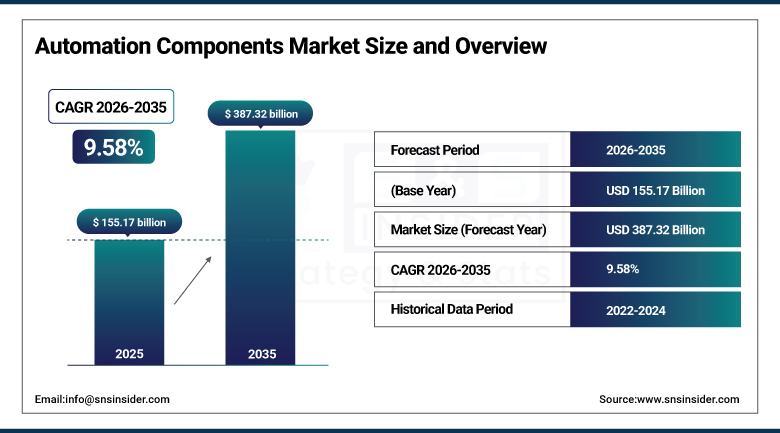
The Automation Components Market size was valued at USD 155.17 Billion in 2025 and is projected to reach USD 387.32 Billion by 2035, expanding at a CAGR of 9.58% during the forecast period 2026–2035.
The market is experiencing consistent growth due to increased investments by manufacturers in the digital factory, intelligent manufacturing systems, and connectivity of industrial infrastructure. Various components of automation such as sensors, programmable logic controllers (PLCs), industrial communication systems, servo drives, motion controllers, and pneumatic systems are essential for contemporary manufacturing. The increasing scarcity of labor, the rising requirement for high-quality products, and the desire to minimize downtime are motivating industries to adopt automated and intelligent control systems as opposed to manual production equipment. The growing use of industry 4.0 approaches in both the discrete and process industries will ensure continuous investment in automation hardware in the future.
Another factor driving the market is the rapid technological developments that have led to the integration of the industrial internet of things (IoT), artificial intelligence, edge computing, machine vision, and predictive maintenance technologies in industrial automation hardware. The manufacturers have launched intelligent sensors, AI controllers, cyber security-enabled communication systems, and energy-efficient motion systems that can help build autonomous manufacturing operations. In May 2025, Rockwell Automation, Inc. enhanced its AI-based industrial automation systems through strategic software and digital manufacturing solutions.
To Get more information Automation Components Market - Request Free Sample Report
Automation Components Market Trends:
-
Increasing adoption of AI-enabled industrial automation and predictive maintenance platforms.
-
Rapid deployment of Industrial IoT-enabled sensors and connected control systems.
-
Growing investments in smart factories supporting digital manufacturing transformation.
-
Rising implementation of industrial Ethernet and real-time communication technologies.
-
Expansion of robotics and motion control across automotive and electronics manufacturing.
U.S. Automation Components Market Size Outlook:
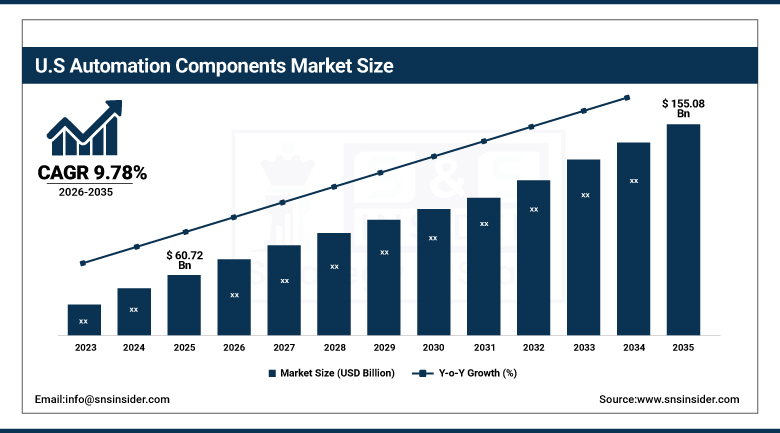
The U.S. Automation Components Market was valued at USD 60.72 billion in 2025 and is expected to reach approximately USD 155.08 billion by 2035, expanding at a CAGR of 9.78% during 2026–2035.
The United States still maintains its lead in the North America automation components market due to its well-developed manufacturing infrastructure, industrial automation trend and investments in smart production solutions. Intelligent sensors, industrial controllers, servo systems, and Industrial Internet of Things applications are more widely adopted by manufacturers working in the automotive, aerospace, semiconductor, food processing, pharmaceuticals and logistics industries as means of increasing operational effectiveness, flexibility of manufacturing and productivity of workers. Governmental support of domestic manufacturing, reshoring policies, and investment in semiconductor foundries further boost demand for innovative automation components in the country’s industrial sites.
Moreover, implementation of the latest trends like application of artificial intelligence, digital twins, industrial edge computing, and machine learning-based predictive maintenance transforms the approach to factory automation in the region. In March 2026, Rockwell Automation, Inc. launched new versions of its Factory Talk industrial software that included new AI-powered functionalities and cyber security solutions.
Automation Components Market Segment Analysis:
-
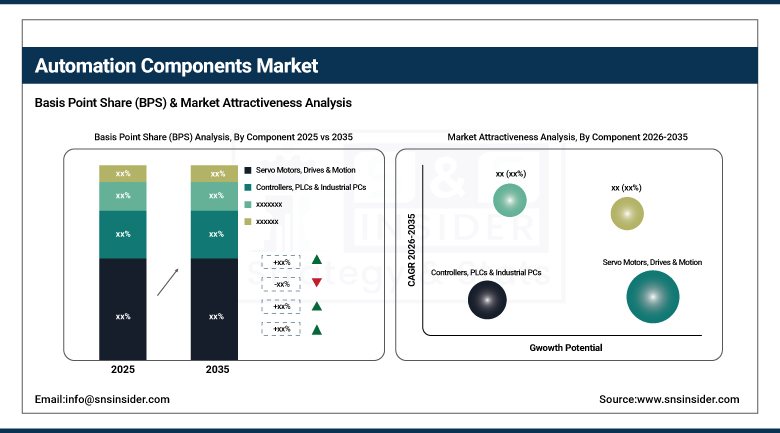
By Component, servo motors, drives & motion components dominated the market with 22.00% share in 2025, while industrial communication & I/O is projected to witness the fastest growth with 11.60% CAGR during the forecast period.
-
By Technology, conventional programmable automation dominated the market with 35.00% share in 2025, while AI-enabled automation is projected to witness the fastest growth with 14.53% CAGR during the forecast period.
-
By End-User Industry, automotive & EV dominated the market with 21.00% share in 2025, while logistics & warehousing is projected to witness the fastest growth with 12.06% CAGR during the forecast period.
By Component, servo motors, drives & motion components dominated, while industrial communication & I/O grows fastest.
The market share of servo motors and drives & motion components in 2025 was estimated at 22.00%, making it the largest component segment. The key drivers are growing adoption of highly efficient motion control systems in various segments like automotive manufacturing, semiconductor manufacturing, packaging machinery, industrial robots, and precise assembly operations. The companies are making efforts to develop energy efficient servo drives and integrated motion controllers and intelligent motors. In 2025, Siemens AG added digital connectivity and energy optimization capabilities to its SINAMICS drive product portfolio to enable high-performance industrial automation and smart manufacturing applications.
Growth at a CAGR of 11.60% is anticipated for the industrial communication & I/O market between 2026 and 2035. The rapid growth rate can be accredited to the growing usage of Industrial Ethernet, edge computing, remote I/O, and real-time industrial communication protocol in Industry 4.0 setup. The organizations are making efforts to build an effective industrial communication system in order to connect sensors, control systems, robotics, and cloud-based platforms. In November 2025, Phoenix Contact GmbH & Co. KG launched innovative industrial networking solutions and remote I/O systems to support secure communication in digital manufacturing environments.
By Technology, conventional programmable automation dominated, while AI-enabled automation grows fastest.
The conventional programmable automation was the market leader in terms of revenue share of 35.00% in 2025 owing to its wide application in manufacturing plants needing efficient, proven and cost-effective industrial control systems. Programmable logic controllers, traditional automation systems, industrial control panels and existing supervisory control systems are still being used for manufacturing in the automobile industry, food processing industry, chemical industry, energy industry and heavy manufacturing industries. Schneider Electric SE enhanced its Eco Struxure automation system in 2025 by improving its programmable control system for industrial efficiency, sustainability and digital manufacturing.
It is anticipated that the AI-based automation category will see the fastest growth at a CAGR of 14.53% between 2026 and 2035. The growing use of AI technology to forecast breakdowns of equipment, optimize processes, and conduct quality controls using machine learning technology is transforming the way industrial automation is performed globally. Industrial manufacturers are deploying AI-based controllers, vision systems, and edge AI technologies to reduce downtime, energy costs, improve product quality, and facilitate decision-making. ABB Ltd. introduced new intelligent automation systems in March 2026 for predictive operations and digital manufacturing.
By End-User Industry, automotive & EV dominated, while logistics & warehousing grows fastest.
Automotive & EV held a market share of 21.00% of the automation components market in 2025. It is expected to maintain its leadership on account of increasing automation in vehicle assembly, battery manufacturing, body welding, painting plant and powertrain manufacturing. Automakers are increasingly incorporating industrial robots, servo drives, PLCs, intelligent sensors, machine vision systems, and motion controllers in order to increase accuracy and reduce cost of operations. In January 2026, Rockwell Automation, Inc. launched enhanced digital manufacturing solutions for improving the efficiency of EV manufacturing through intelligent motion control, industrial analytics, and connected automation technologies.
Logistics & warehousing is anticipated to be the fastest growing segment of the automation components market at a CAGR of 12.06% in 2026–2035. Increasing investments in warehouse automation technologies is a result of rapid developments in e-commerce, Omni channel retailing, logistics centers' renovation and automation in fulfillment processes. Conveyors automation, autonomous mobile robots (AMRs), AS/RS, barcode identification, industrial sensors and artificial intelligence-driven control platforms are used to improve efficiency, increase accuracy of inventories and optimize operations. In March 2025, Honeywell International Inc. expanded its range of warehouse automation solutions with intelligent software and automation technologies for connected distribution centers and high throughput fulfillment operations.
Regional Analysis:
|
Region |
Major Country |
Share within Region, 2025 (%) |
|---|---|---|
|
North America |
United States |
91.00% |
|
Europe |
Germany |
26.00% |
|
Asia Pacific |
China |
24.00% |
|
Middle East & Africa |
UAE |
4.00% |
|
Latin America |
Brazil |
3.00% |
North America Automation Components Market Insights
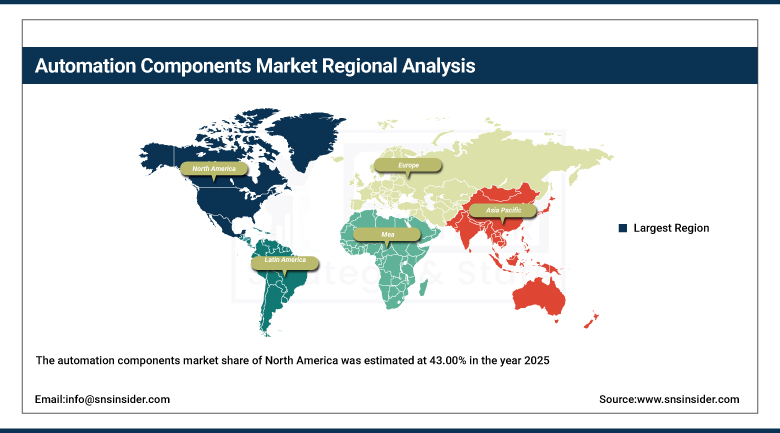
The automation components market share of North America was estimated at 43.00% in the year 2025, due to continuous dominance due to large-scale industrial automation, efficient manufacturing infrastructure, and ongoing investments in smart factory development. Various manufacturers in the automotive, aerospace, electronics, pharmaceutical, and logistics industries are using intelligent sensors, PLCs, industrial communications systems, servo drives, and AI-driven automation systems to enhance their productivity and resilience. Various government programs aimed at promoting domestic manufacturing, semiconductors, and digital industrial revolution continue boosting the demand for automation components in this region.
Further investments in various domains such as industrial AI, predictive maintenance, industrial cyber security, robotics, and digital twins are enhancing the competitive edge of North America. Rockwell Automation, Inc. launched its AI-based Factory Talk in February 2026 in North America to boost predictive maintenance, industrial analytics, and connected manufacturing.
Get Customized Report as per Your Business Requirement - Enquiry Now
Europe Automation Components Market Insights
Europe is among the most developed regions in terms of automation technology due to the presence of its mature industrial manufacturing base, high level of productivity standards, and implementation of the Industry 4.0 programs. German, Italian, French, UK, and other countries having strong manufacturing industries keep on spending money on intelligent factories via deployment of modern PLCs, sensors, servo drives, communication devices, and automated processes enabled by AI. Europe's leadership in the automotive industry, industrial machinery, food industry, and process industries keeps on driving stable demand for efficient automation components used to increase production efficiency, energy efficiency, and reliability.
Europe is becoming more engaged in sustainable manufacturing, digital twin technologies, cyber security, and predictive maintenance solutions in order to increase competitiveness of factories and meet environmental goals. In November 2025, Siemens AG launched the new Industrial Operations X technology which enhanced industrial AI, software-defined automation, and connected manufacturing in Europe.
Asia Pacific Automation Components Market Insights
The Asia Pacific Automation Components market is anticipated to witness the fastest CAGR of 10.56%. The industrialization, investments in the manufacturing industry, and smart manufacturing efforts by governments in countries like China, Japan, South Korea, India, and Southeast Asia are driving the usage of automation technologies in the region. Various industries such as automotive manufacturing, semiconductor manufacturing, electronics manufacturing, pharmaceuticals, and industrial machinery have been increasingly adopting automation technologies in order to ensure quality production and increase the efficiency of their processes.
Moreover, investments in the production of electric vehicles, batteries, and semiconductor chips are increasing in the region, which has increased the need for automation components. Mitsubishi Electric Corporation enhanced the Factory Automation products line in Asia Pacific in 2025, which included advanced controllers, servo systems, and digital manufacturing solutions.
Middle East & Africa and Latin America Automation Components Market Insights
The Middle East & Africa automation components industry is witnessing steady growth on account of rising industrial diversification, investment in smart factory infrastructures and modernization of the energy, petrochemicals, mining and food processing industries. The countries like UAE, Saudi Arabia and South Africa are utilizing industrial automation technology to enhance their efficiency, lower production costs and increase industrial competitiveness. ABB Ltd extended digital industrial automation offerings in the Middle East in 2025 to modernize energy, utility and industrial processes through intelligent control and electrification.
Latin America region is gaining momentum from increased modernization of industrial facilities, automotive manufacturing expansion, and food processing, mining operations and warehouses automation in countries such as Brazil, Mexico, Argentina and Chile. Companies are making investments in programmable controllers in order to increase efficiency as well as support their digital transformation plans. Foreign investments in manufacturing infrastructures and rising adoption of Industry 4.0 technologies will drive future demand for automation components in the region.
Market Dynamics:
Growth Drivers: Quick adaptation of Industry 4.0 and smart manufacturing drives automation components’ need.
The shift to Industry 4.0 technology has become one of the most powerful catalysts for the Growth of Automation Components Market. The companies in automotive, electronics, pharma, food processing, and logistics industry have started implementing sensors, controllers, communication modules, servo drives, and motion control systems into connected factories. Such technologies allow for real-time analysis, prediction of the condition of equipment, autonomous management, and production flexibility. The labor shortage and growing needs in increasing the efficiency of manufacturing processes drive the industries to implement such solutions all around the globe. In addition, the rising adoption of Industrial Internet of Things (IoT), artificial intelligence, edge computing, and cloud-based manufacturing platforms drives the demand for intelligent automation hardware.
Restraints: High capital investment and legacy system integration pose hurdles for market adoption.
While there is potential for sustained future growth, high costs continue to represent a formidable barrier to entry for the adoption of automated components especially in small and medium-sized manufacturers. The installation of intelligent sensors, industrial networks, programmable controllers, motion control devices and AI-powered automation systems requires substantial financial investment. Costs associated with design, integration, training, licensing and maintenance add to the overall expense, making such initiatives financially challenging for many factories. Another huge restraint is posed by the integration of new automated systems with existing manufacturing systems that lack standardized forms of communication or digitization.
Opportunities: Industrial automation and intelligent communication facilitated by AI are leading to opportunities for growth.
The rapid development of AI technology, edge computing, collaborative robots, and IoT technologies is resulting in considerable opportunities for the manufacturers of automation equipment. The implementation of the AI controllers, smart sensors, machine vision systems, industrial communication systems, and predictive maintenance solutions enables businesses to improve their efficiency, reduce downtime, ensure higher quality of the manufactured goods, and reduce operational costs. The implementation of such innovative technologies like autonomous manufacturing, digital twin technology, and industrial analytics leads to the rising demand for automation parts coming from various industries. The growing investments in the production of semiconductors, electric vehicles, intelligent warehouses, batteries, and electronics assembly will create business opportunities.
Recent Developments:
-
2026: Rockwell Automation, Inc. introduced new AI-powered enhancements to its Factory Talk Optix platform, enabling advanced visualization, edge analytics, and industrial application development to improve smart manufacturing productivity.
-
2026: ABB Ltd. expanded its Industrial AI portfolio by integrating advanced generative AI and digital automation capabilities into industrial operations to improve predictive maintenance, operational efficiency, and asset performance.
-
2025: Siemens AG announced expanded Industrial Operations X capabilities featuring software-defined automation, Industrial AI, and enhanced interoperability to accelerate digital factory transformation across manufacturing industries.
-
2025: Schneider Electric SE enhanced its Eco Struxure Automation Expert platform with advanced software-defined automation capabilities, enabling greater production flexibility, cyber security, and operational efficiency for industrial manufacturers.
Automation Components Companies are:
-
Siemens AG
-
ABB Ltd.
-
Rockwell Automation, Inc.
-
Mitsubishi Electric Corporation
-
Emerson Electric Co.
-
Honeywell International Inc.
-
Omron Corporation
-
Yokogawa Electric Corporation
-
Pepperl+Fuchs SE
-
SICK AG
-
Festo SE & Co. KG
-
Phoenix Contact GmbH & Co. KG
-
WEG S.A.
-
Eaton Corporation plc
-
Beckhoff Automation GmbH & Co. KG
-
Delta Electronics, Inc.
-
Advantech Co., Ltd.
-
Fuji Electric Co., Ltd.
Automation Components Market Report Scope:
| Report Attributes | Details |
|---|---|
| Market Size in 2025 | USD 155.17 Billion |
| Market Size by 2035 | USD 387.32 Billion |
| CAGR | CAGR of 9.58% From 2026 to 2035 |
| Base Year | 2025 |
| Forecast Period | 2026-2035 |
| Historical Data | 2022-2024 |
| Report Scope & Coverage | Market Size, Segments Analysis, Competitive Landscape, Regional Analysis, DROC & SWOT Analysis, Forecast Outlook |
| Key Segments | • By Component (Sensors & Measurement Components, Controllers, PLCs & Industrial PCs, Servo Motors, Drives & Motion Components, Actuators & Pneumatic Components, Industrial Communication & I/O, Others) • By Technology (Conventional Programmable Automation, Industrial IoT-Enabled Automation, Robotics & Motion Automation, AI-Enabled Automation, Machine Vision-Based Automation) • By End-User Industry (Automotive & EV, Electronics & Semiconductor, Machinery & Industrial Equipment, Food & Beverage, Pharmaceutical & Life Sciences, Oil, Gas & Chemicals, Logistics & Warehousing, Others) |
| Regional Analysis/Coverage | North America (US, Canada), Europe (Germany, UK, France, Italy, Spain, Russia, Poland, Rest of Europe), Asia Pacific (China, India, Japan, South Korea, Australia, ASEAN Countries, Rest of Asia Pacific), Middle East & Africa (UAE, Saudi Arabia, Qatar, South Africa, Rest of Middle East & Africa), Latin America (Brazil, Argentina, Mexico, Colombia, Rest of Latin America). |
| Company Profiles | Siemens AG, Schneider Electric SE, ABB Ltd., Rockwell Automation, Inc., Mitsubishi Electric Corporation, Emerson Electric Co., Honeywell International Inc., Omron Corporation, Bosch Rexroth AG, Yokogawa Electric Corporation, Pepperl+Fuchs SE, SICK AG, Festo SE & Co. KG, Phoenix Contact GmbH & Co. KG, WEG S.A., Eaton Corporation plc, Beckhoff Automation GmbH & Co. KG, Delta Electronics, Inc., Advantech Co., Ltd., Fuji Electric Co., Ltd. |
Frequently Asked Questions
The Automation Components Market was valued at USD 155.17 Billion in 2025.
The market is projected to reach USD 387.32 Billion by 2035.
The market is anticipated to expand at a CAGR of 9.58% during the forecast period.
North America dominated the global Automation Components Market in 2025 with a 43.00% revenue share.
Servo Motors, Drives & Motion Components accounted for the largest revenue share of 22.00% in 2025.
