
Machine Vision Camera Market Report Scope & Overview:
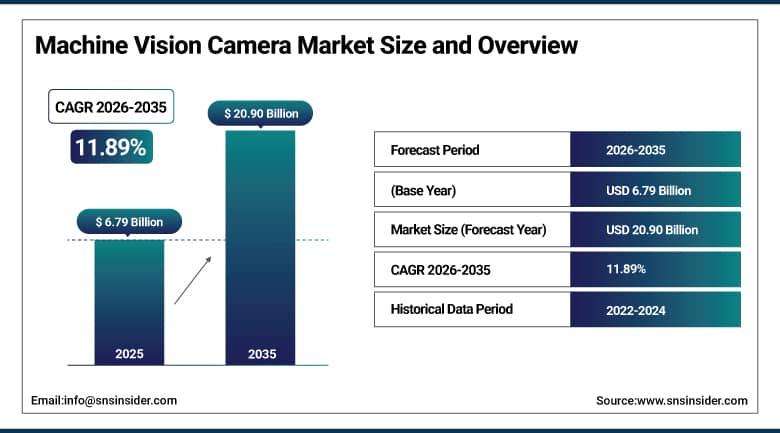
The global Machine Vision Camera Market size was valued at USD 6.79 Billion in 2025 and is expected to reach USD 20.90 Billion by 2035, growing at a CAGR of 11.89% from 2026 to 2035.
The Machine Vision Camera Market is growing because of the increasing use of industrial automation, the rising demand for high-speed, accurate visual inspection and the fast shift from manual quality-control processes to automated machine vision systems. Machine vision cameras can inspect, detect defects, measure, identify and monitor processes in real time in manufacturing environments. Growth in the market is further driven by the increasing adoption of artificial intelligence, robotics, edge computing and Industry 4.0 technologies. Rising demand from automotive, electronics, semiconductor, healthcare, logistics and industrial segments is driving adoption of advanced area scan, line scan and 3D machine vision cameras with high resolution imaging and improved processing capability.
Teledyne Technologies reported in its fiscal 2025 annual report that the industrial and scientific vision markets stabilized and grew strongly in 2026. The company reported record overall sales and 7.9% full year revenue growth driven by recovering factory automation demand and strong aerospace and defense activities, validating continued demand for its machine vision product portfolio including Blackfly S and Forge series cameras.
To Get More Information On Machine Vision Camera Market - Request Free Sample Report
Machine Vision Camera Market Trends:
-
Increasing adoption of industrial automation, smart manufacturing, and Industry 4.0 technologies is driving demand for advanced machine vision cameras capable of delivering high-speed, accurate, and real-time visual inspection.
-
Growing integration of artificial intelligence, deep learning, and edge computing is accelerating the adoption of intelligent machine vision systems for automated defect detection, quality control, object recognition, and predictive maintenance.
-
Rising demand for high-resolution area scan, line scan, and 3D cameras is supporting the deployment of machine vision solutions across automotive, electronics, semiconductor, healthcare, and industrial manufacturing applications.
-
Increasing use of robotics, autonomous systems, and automated production lines is creating strong demand for machine vision cameras that enable precise positioning, guidance, measurement, inspection, and real-time process monitoring.
-
Strategic collaborations among camera manufacturers, sensor developers, automation companies, and artificial intelligence technology providers are supporting the development of high-performance, energy-efficient, and next-generation machine vision solutions.
U.S. Machine Vision Camera Market Size Outlook:
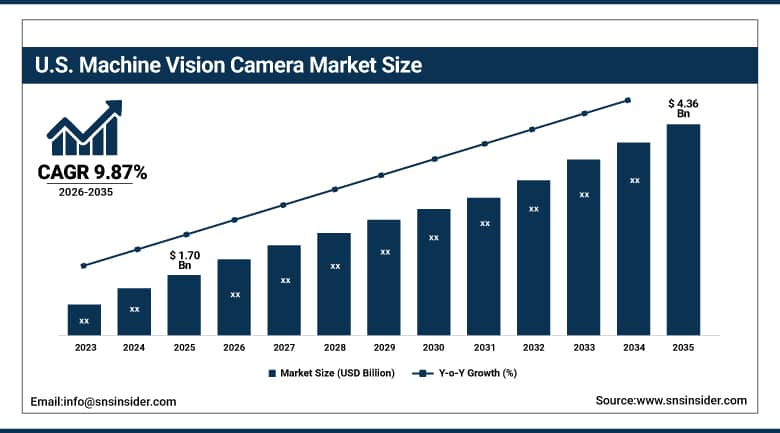
The U.S. Machine Vision Camera Market was valued at USD 1.70 Billion in 2025 and is expected to reach USD 4.36 Billion by 2035, growing at a CAGR of 9.87% from 2026 to 2035.
The United States Machine Vision Camera Market is expected to grow at a strong pace during the forecast period. Rising adoption of the industrial automation, artificial intelligence, robotics and advanced quality inspection technologies are expected to drive the growth of the United States Machine Vision Camera Market. The country boasts a robust manufacturing and technology ecosystem backed by top automation companies, semiconductor manufacturers, automotive producers and advanced research institutions. The demand for fast production, automatic defect detection, accurate measurement and real-time visual inspection is increasing, thus driving the adoption of machine vision cameras in automotive, electronics, semiconductor, healthcare, logistics, aerospace and industrial manufacturing applications.
In 2026, Cognex officially launched the In-Sight 3900 Vision System, the company’s highest-performance embedded AI vision system, developed at its U.S. headquarters and powered by Qualcomm platform technology. It provides processing speeds that are up to 4X faster and high-resolution imaging up to 25 megapixels at the network edge, enabling manufacturers to perform complex deep-learning inspections while maintaining production-line speeds.
Machine Vision Camera Market Segment Analysis:
-
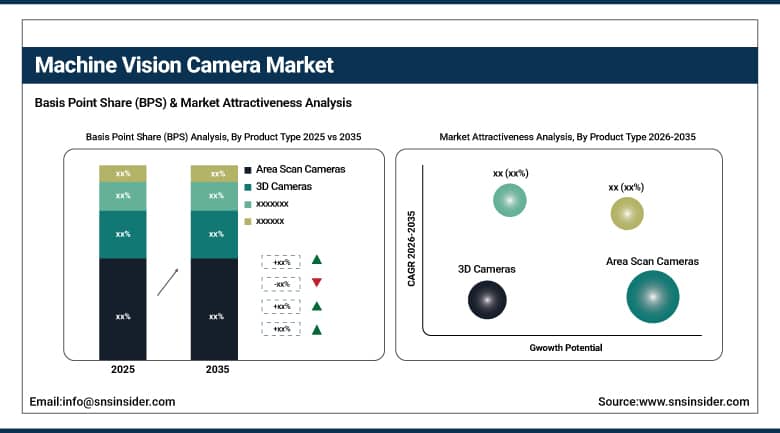
By Product Type, Area Scan Cameras dominated the Machine Vision Camera Market with a 56.40% share in 2025, while 3D Cameras are the fastest-growing product type segment with a CAGR of 15.83% from 2026–2035.
-
By Imaging Technology, 2D Vision dominated the Machine Vision Camera Market with a 32.40% share in 2025, while 3D Vision is the fastest-growing imaging technology segment with a CAGR of 15.79% from 2026–2035.
-
By Application, Inspection dominated the Machine Vision Camera Market with a 38.60% share in 2025, while Guidance is the fastest-growing application segment with a CAGR of 15.54% from 2026–2035.
-
By End User, Automotive dominated the Machine Vision Camera Market with a 34.80% share in 2025, while Healthcare is the fastest-growing end-user segment with a CAGR of 13.90% from 2026–2035.
By Product Type, Area Scan Cameras dominated the Machine Vision Camera Market, while 3D Cameras are expected to register the fastest growth.
The Area Scan Cameras segment dominated the Machine Vision Camera Market with a 56.40% revenue share in 2025. The segment benefits from the broad adoption in automotive manufacturing, electronics production, packaging, semiconductor inspection and general industrial automation. Area scan cameras are used for inspection, identification, quality control and measurement applications. They acquire full two-dimensional images in one shot. Strong market demand is continuing to be supported by their compatibility with advanced image-processing software, AI-based vision systems, and automated production equipment.
The 3D Cameras segment is expected to witness the fastest growth with a CAGR of 15.83% during the forecast period of 2026-2035. Demand for depth sensing, 3D measurement, robotic guidance and automated object recognition is driving growth. 3D machine vision cameras can provide detailed spatial information to enable robots and automated systems to know the object shape, position, height and orientation. Adoption of advanced 3D camera technologies is expected to be supported by rising investments in smart factories, autonomous robotics, warehouse automation and AI-enabled inspection systems.
By Imaging Technology, 2D Vision dominated the Machine Vision Camera Market, while 3D Vision is expected to register the fastest growth.
The 2D Vision segment dominated the Machine Vision Camera Market with a 32.40% revenue share in 2025. It’s broad application in product inspection, barcode reading, optical character recognition, defect detection and quality-control applications support its leadership. 2D vision systems are inexpensive to acquire images with and are commonly found on manufacturing lines in the automotive, electronics, food and beverage and packaging industries. The growing trend of replacing manual inspection with automated visual inspection is likely to drive the demand for 2D machine vision technologies.
The 3D Vision segment is expected to grow at the fastest CAGR of 15.79% during 2026-2035. The growth is fueled by increased deployment of autonomous robots, collaborative robots, automated guided vehicles and intelligent material handling systems. 3D vision technologies allow precise depth measurement and enhance the capability of automated systems to comprehend complex environments. Growing demand for robotic picking, bin-picking, dimensional inspection and real-time spatial analysis will create significant opportunities for growth in 3D vision solutions.
By Application, Inspection dominated the Machine Vision Camera Market, while Guidance is expected to register the fastest growth.
The Inspection segment dominated the Machine Vision Camera Market with a 38.60% revenue share in 2025. Automation quality control, defect detection, surface analysis and production line monitoring are driving the leadership of the segment. Manufacturers can use machine vision cameras to find product defects at high speeds and with consistent quality, reducing the need for manual inspection. The demand for machine vision inspection systems is growing due to the rising quality requirements in the automotive, electronics, semiconductor, pharmaceutical, and packaging industries.
The Guidance segment is projected to register the fastest CAGR of 15.54% during the forecast period. The growth is fueled by the increasing adoption of industrial robots, autonomous mobile robots, automated guided vehicles and robotic material handling systems. Machine vision cameras deliver real-time visual information that allows automated equipment to find, identify, and precisely position objects. Demand for machine vision guidance applications is forecast to improve due to rising investments in warehouse automation, smart manufacturing, robotic assembly and AI-powered production systems.
By End User, Automotive dominated the Machine Vision Camera Market, while Healthcare is expected to register the fastest growth.
The Automotive segment dominated the Machine Vision Camera Market with a 34.80% revenue share in 2025. Strong adoption of automated inspection, robotic assembly, component verification and precision measurement support the segment’s market leadership. Machine vision cameras are widely used in the inspection of vehicle components, identification of manufacturing defects, monitoring of assembly operations and maintenance of consistent production quality. The continued demand for machine vision camera systems is supported by the increasing automation in electric vehicle manufacturing, battery production, and advanced automotive assembly facilities.
The Healthcare segment is anticipated to witness the fastest CAGR of 13.90% during the forecast period of 2026 to 2035. Increasing adoption of automated medical inspection, laboratory automation, diagnostic imaging, pharmaceutical manufacturing and precision healthcare technologies are driving the growth. Machine vision cameras enable precise analysis, sample identification, quality verification and automated monitoring throughout healthcare environments. Increasing investments in digital healthcare, medical robotics, AI-enabled diagnostics, and sophisticated life-science research are projected to generate significant growth opportunities for machine vision camera providers.
Regional Analysis:
|
Region |
Major Country |
Share within Region, 2025 (%) |
|---|---|---|
|
North America |
United States |
82.31% |
|
Europe |
Germany |
26.40% |
|
Asia Pacific |
China |
52.80% |
|
Middle East & Africa |
UAE |
28.60% |
|
Latin America |
Brazil |
41.40% |
Asia Pacific Machine Vision Camera Market Insights
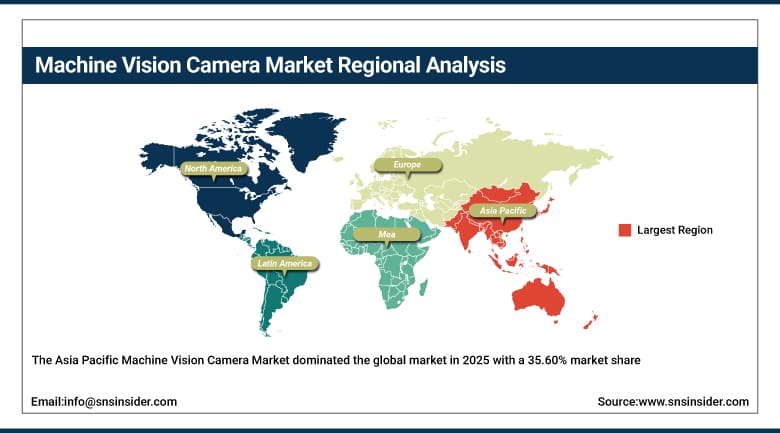
The Asia Pacific Machine Vision Camera Market dominated the global market in 2025 with a 35.60% market share and is also expected to register the fastest CAGR of 13.95% from 2026 to 2035. Rapid industrialization, growing electronics manufacturing, increasing uptake of smart factory technologies and healthy investments in industrial automation are the factors underlying the region’s leadership. As major automotive, semiconductor, consumer electronics and robotics manufacturing hubs continue to expand, demand for advanced machine vision cameras continues to grow in production and quality-control applications.
The Asia Pacific Machine Vision Camera Market is driven by the quick adoption of artificial intelligence, robotics, automated inspection systems, and high-speed manufacturing technologies. China is the largest regional contributor, supported by large electronics manufacturing base, growing industrial automation capabilities and increasing investment in smart manufacturing. And Japan, South Korea and India are also contributing to the expansion of the market with developments in robotics, automobile production, semiconductor manufacturing and digital industrial infrastructure. Increasing demand for precision inspection and automated production is likely to boost the region’s growth.
Get Customized Report as Per Your Business Requirement - Enquiry Now
North America Machine Vision Camera Market Insights
North America Machine Vision Camera Market in 2025 accounted for a significant share of the global market. The growth is attributed to the presence of advanced manufacturing infrastructure, high adoption of industrial automation, and rising investments in artificial intelligence and smart factory technologies. The region is home to the major players in machine vision technology, semiconductor companies, robotics developers and automotive manufacturers. Sophisticated machine vision camera systems are being deployed to meet the growing demands for automated quality inspection, accuracy measurement, flaw detection and high-speed production monitoring.
The United States accounted for the highest share of the North America Machine Vision Camera Market in 2025, with a share of 82.31% of the overall market in the region. The market growth is fueled by the country’s robust manufacturing ecosystem, increasing adoption of AI-enabled inspection systems, and rising investments in robotics and automated production. Machine vision cameras are increasingly adopted in automotive, electronics, healthcare, semiconductor, logistics and industrial applications. Canada is also joining in, with growing investments in smart manufacturing, industrial automation, robotics and advanced digital production technologies.
Europe Machine Vision Camera Market Insights
Europe Machine Vision Camera Market is expected to grow at a steady pace due to increasing industrial automation, growing adoption of Industry 4.0 technologies and increasing demand for automated quality-control systems. Manufacturing is a strong industry in the region, particularly the making of automobiles, machinery, electronics, aerospace and industrial equipment. The market growth is being driven by the increasing investments in smart factories, robotic production systems, and advanced inspection technologies. Also, increased focus on production efficiency, product quality, operational accuracy, and reduction of manufacturing errors is further accelerating the adoption of machine vision cameras.
Germany accounts for a major share of the Europe Machine Vision Camera Market, due to the country’s strong automotive and industrial manufacturing, well-established robotics ecosystem, and growing adoption of intelligent factory technologies. Automated inspection, robot guidance, part measurement and production line monitoring are all common applications of machine vision cameras. The United Kingdom, France, Italy and the Netherlands also make major contributions through investments in industrial automation, digital manufacturing and advanced robotics. Further development of industry 4.0 is expected to create further market opportunities.
Middle East & Africa and Latin America Machine Vision Camera Market Insights
The Middle East & Africa and Latin America Machine Vision Camera Markets are witnessing steady growth due to the growing industrial automation, rising manufacturing activities, and increasing investments in digital production technologies. Both regions are seeing a rise in the adoption of automated inspection, robotics and smart manufacturing systems, which is creating new opportunities. With the increasing demand for better production efficiency, product quality and operational accuracy, manufacturers are turning to machine vision solutions. The development of industrial infrastructure and the modernization of manufacturing facilities are expected to boost the long-term market.
Brazil is a significant contributor to the Latin America Machine Vision Camera Market owing to growing automotive manufacturing, industrial modernization, and rising adoption of automated production technologies. Growth in the Middle East & Africa market is being supported by investment from UAE and Saudi Arabia in smart manufacturing, industrial digitalization, logistics automation and advanced infrastructure. Industrial automation systems development also has a role to play in South Africa. Demand in the region is likely to be fueled by the rising adoption of AI-based inspection and robotics technologies.
Market Dynamics:
Growth Drivers: Rising adoption of industrial automation and AI-enabled inspection technologies driving market growth
The Machine Vision Camera Market is anticipated to grow significantly due to the increasing industrial automation, growing demand for automated quality inspection, and rising adoption of artificial intelligence in manufacturing environments. Machine vision cameras are increasingly being used for defect detection, product identification, dimensional measurement, robotic guidance, and real-time production monitoring. The rising demand for enhanced manufacturing precision, improved operational efficiency and decreased dependence on manual inspection is driving market adoption across automotive, electronics, semiconductor, healthcare, packaging and industrial sectors.
Advances in technology are changing industrial imaging with high-resolution cameras, CMOS sensors, deep learning algorithms, 3D vision and edge-based image processing. Growth of smart factories, Industry 4.0 initiatives, collaborative robotics and automated production systems are fueling demand for intelligent machine vision solutions. The Machine Vision Camera Market is expected to witness good growth opportunities during the forecast period with growing investments by industrial companies in advanced quality-control technologies, digital manufacturing, and robotics infrastructure.
Restraints: High system costs and integration complexities limiting wider market adoption
High upfront costs for sophisticated machine vision camera systems remain a major obstacle to market growth. High-performance cameras, specialist lenses, illumination systems, image-processing software, sensors and AI-enabled vision platforms can be a significant investment. Budget limitations can be a barrier for small and medium-sized manufacturers to deploy advanced machine vision solutions. Additional costs associated with system installation, software integration, maintenance, calibration and employee training could add to the total cost of deployment and restrict uptake in cost-sensitive industries.
Another major challenge is integration complexity, particularly when machine vision systems are deployed in existing manufacturing infrastructure. Compatibility issues with production equipment, industrial software, robotics platforms, and data-management systems can add to the time of implementation and the complexity of operations. Machine vision cameras may also have performance limitations in challenging environments such as poor lighting, reflective surfaces, high production speeds, or variable product conditions. Skilled professional’s shortages and concerns about cybersecurity and data management may further affect adoption.
Opportunities: Expansion of smart manufacturing and 3D vision technologies creating new growth avenues
The growing adoption of artificial intelligence, deep learning, robotics, and smart manufacturing technologies are likely to offer major growth prospects to the Machine Vision Camera Market. The demand for automated inspection, predictive quality management, intelligent robotic guidance and real-time production analysis is increasing, and manufacturers are encouraged to develop advanced machine vision solutions. The growing adoption of high-resolution cameras, 3D imaging systems, edge AI platforms, and smart image-processing technologies are expected to enhance the inspection accuracy, operational efficiency, and automation capabilities in industrial environments.
Emerging economies in Asia Pacific, Latin America & Middle East & Africa are anticipated to present substantial growth opportunities, supported by industrial expansion, modernization of manufacturing and growing investment in automation infrastructure. Machine vision applications are expected to be broadened by improvements in CMOS sensors, high-speed imaging, multispectral vision, cloud-connected platforms and AI-based analytics. We look forward to long-term market growth through innovation based on strategic partnerships among camera manufacturers, robotics companies, software developers, semiconductor vendors and industrial automation firms.
Recent Developments:
-
2026: Basler AG entered a technology partnership with Orbbec Inc. to develop advanced industrial 3D vision solutions for factory automation and logistics. Their first jointly developed product, the Basler Stereo mini 3D camera, was introduced at LogiMAT 2026 to support navigation, obstacle detection, and environmental mapping in Autonomous Mobile Robots (AMRs) and Automated Guided Vehicles (AGVs).
-
2026: Comprehensive market analysis reported that the global machine vision industry grew by 5.2% through 2025 and is projected to expand at an average annual growth rate of 7.2%, increasing from USD 5.9 billion to USD 8.3 billion. Growth is supported by rising deployment of advanced 3D machine vision cameras, automated inspection technologies, and specialized logistics automation infrastructure.
-
2026: Cognex Corporation completed the divestiture of its Japan-focused trading business, originally acquired through the Moritex transaction, for approximately USD 11.9 million. The transaction supports Cognex’s strategy to strengthen its focus on high-margin industrial machine vision hardware, edge-AI software, and core automation technologies.
Machine Vision Camera Companies are:
-
Basler AG
-
Teledyne Technologies Incorporated
-
KEYENCE Corporation
-
Omron Corporation
-
Hikrobot
-
IDS Imaging Development Systems GmbH
-
Allied Vision Technologies GmbH
-
JAI A/S
-
Sony Semiconductor Solutions Corporation
-
Canon Inc.
-
FLIR Systems
-
Euresys S.A.
-
Matrox Imaging
-
Teledyne DALSA
-
Vieworks Co., Ltd.
-
Baumer Group
-
LUCID Vision Labs Inc.
-
Leuze electronic GmbH + Co. KG
Machine Vision Camera Market Report Scope:
| Report Attributes | Details |
|---|---|
| Market Size in 2025 | USD 6.79 Billion |
| Market Size by 2035 | USD 20.90 Billion |
| CAGR | CAGR of 11.89% From 2026 to 2035 |
| Base Year | 2025 |
| Forecast Period | 2026-2035 |
| Historical Data | 2022-2024 |
| Report Scope & Coverage | Market Size, Segments Analysis, Competitive Landscape, Regional Analysis, DROC & SWOT Analysis, Forecast Outlook |
| Key Segments | • By Product Type (Area Scan Cameras, Line Scan Cameras, 3D Cameras) • By Imaging Technology (1D Vision, 2D Vision, 3D Vision, Visible Light, Visible + IR/NIR) • By Application (Inspection, Identification, Gauging, Positioning, Guidance, Others) • By End User (Automotive, Manufacturing, Healthcare, Industrial, Others) |
| Regional Analysis/Coverage | North America (US, Canada), Europe (Germany, UK, France, Italy, Spain, Russia, Poland, Rest of Europe), Asia Pacific (China, India, Japan, South Korea, Australia, ASEAN Countries, Rest of Asia Pacific), Middle East & Africa (UAE, Saudi Arabia, Qatar, South Africa, Rest of Middle East & Africa), Latin America (Brazil, Argentina, Mexico, Colombia, Rest of Latin America). |
| Company Profiles | Cognex Corporation, Basler AG, Teledyne Technologies Incorporated, KEYENCE Corporation, Omron Corporation, National Instruments Corporation, Hikrobot, IDS Imaging Development Systems GmbH, Allied Vision Technologies GmbH, JAI A/S, Sony Semiconductor Solutions Corporation, Canon Inc., FLIR Systems, Euresys S.A., Matrox Imaging, Teledyne DALSA, Vieworks Co., Ltd., Baumer Group, LUCID Vision Labs Inc., Leuze electronic GmbH + Co. KG |
Frequently Asked Questions
The Machine Vision Camera Market is expected to grow at a CAGR of 11.89% from 2026 to 2035.
The Machine Vision Camera Market was valued at USD 6.79 Billion in 2025.
The market is driven by increasing adoption of industrial automation, AI-enabled vision systems, smart manufacturing, robotics, and advanced imaging technologies.
The Area Scan Cameras segment dominated the Machine Vision Camera Market in 2025, accounting for approximately 56.40% market share.
The Asia Pacific region dominated the Machine Vision Camera Market in 2025, accounting for approximately 35.60% market share.
