
Artificial Lights Market Report Scope & Overview:
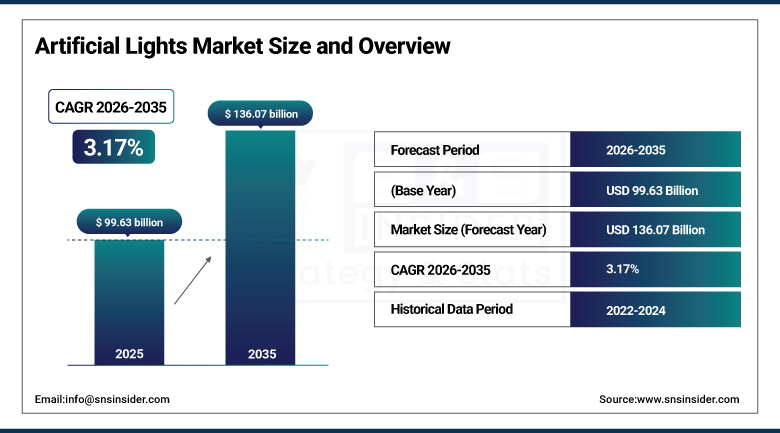
The Artificial Lights Market size was valued at USD 99.63 Billion in 2025 and is projected to reach USD 136.07 Billion by 2035, expanding at a CAGR of 3.17% during the forecast period 2026–2035.
The market for artificial lights is expanding since the government, businesses, and residential customers are increasing their investment in more efficient lights. The use of LED lights has become the main driver in the market because of the longer lifespan, low power consumption, reduced maintenance costs, and strict standards on energy efficiency. Demand for lighting systems with increased efficiency and better features is being created by urbanization, infrastructure developments, construction activities, and other investments in smart cities. In January 2026, the Department of Energy (DOE) continued funding the research projects on improving efficiency and creating more advanced connected lighting systems for commercial buildings.
Technological advancements have transformed artificial lighting systems from simple illumination products to smart infrastructures. Many companies are working on lighting ecosystems that include IoT connectivity, energy optimization with AI, occupancy and daylight sensors, building automation systems with wireless technology. An increase in the use of OLED lighting, horticulture lighting, and specialty lighting is also contributing to the revenue generation.
To Get more information Artificial Lights Market - Request Free Sample Report
Artificial Lights Market Trends:
-
Rapid transition toward intelligent connected LED lighting ecosystems.
-
Rising investments in smart city illumination infrastructure projects.
-
Increasing adoption of OLED lighting across premium architectural applications.
-
Expansion of horticulture lighting supporting controlled environment agriculture.
-
AI-enabled lighting controls improving commercial building energy efficiency.
U.S. Artificial Lights Market Size Outlook:
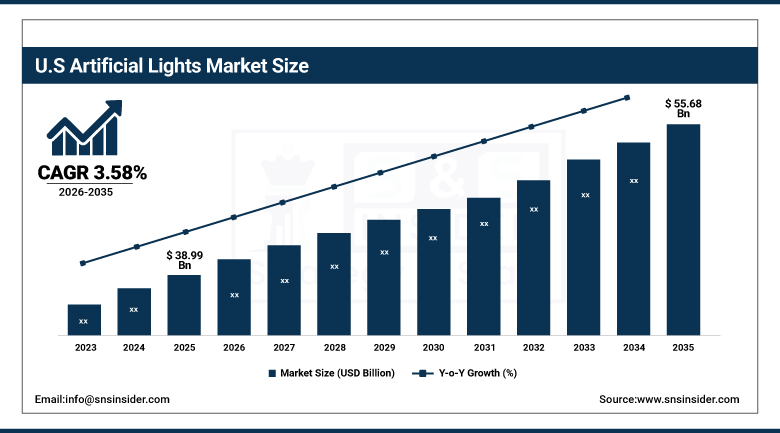
The U.S. Artificial Lights Market was valued at USD 38.99 billion in 2025 and is expected to reach approximately USD 55.68 billion by 2035, expanding at a CAGR of 3.58% during 2026–2035.
The USA is still the most significant source of revenue in North America because of extensive use of LEDs, modernization of the commercial buildings sector, a focus of regulation on energy efficient products, and development of connected building solutions. Modern offices, factories, hospitals, schools, and cities started switching traditional fluorescent and HID lighting solutions to smart LEDs that can be controlled remotely and are capable of monitoring their performance and energy efficiency. Energy saving programs of federal and local authorities still motivate companies to replace conventional lighting solutions in the public and private sectors.
Increasing investments into smart buildings management, data-driven facilities, electric vehicles manufacturing plants, logistics warehouses, and digital infrastructures push adaptive lighting systems' demand across the USA. Lighting analytics powered by artificial intelligence, wireless lighting controls, Li-Fi development, and building automation platforms are actively used in commercial and industrial facilities. In 2025, many American cities launched smart lighting projects with integration of IoT-based solutions to manage traffic and monitor public safety with LED luminaires.
Artificial Lights Market Segment Analysis:
-
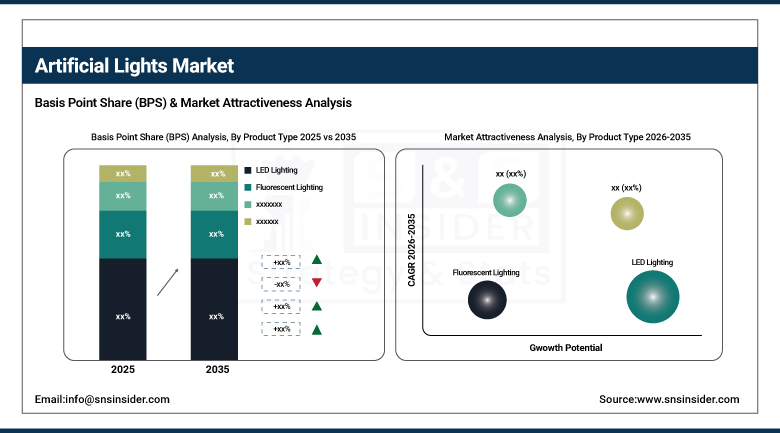
By Product Type, LED lighting dominated the market with 61.00% share in 2025, while OLED lighting is projected to witness the fastest growth with a CAGR of 7.09% during the forecast period 2026–2035.
-
By Application, residential dominated the market with 31.00% share in 2025, while horticulture lighting is projected to witness the fastest growth with a CAGR of 6.70% during the forecast period 2026–2035.
-
By End User, commercial buildings dominated the market with 29.00% share in 2025, while agriculture is projected to witness the fastest growth with a CAGR of 4.89% during the forecast period 2026–2035.
By Product Type, LED lighting dominated, while OLED lighting grows fastest.
LED lighting held 61.00% of the artificial lights market share in 2025 and continued its dominance across the artificial lights market by owing to high efficiency, long working life, decreasing prices of raw materials and subsequent falling product prices and replacing the traditional lights. Strict regulations concerning energy efficiency are put in place by governments in their own countries and they continue replacing incandescent and fluorescents with LEDs in order to keep abreast with fast growing use of light in commercial, industrial, residential and public infrastructure. Smart lighting integration, lower level of maintenance and luminous efficacy and continuous enhancements in the technological fronts have boosted their usage across the commercial applications, while constant spending in building smart spaces.
OLED lighting captured the growth momentum at fastest CAGR of 7.09% during the forecast period 2026-2035 as well, given to mounting preference for Ultra-Thin, Glare-Free, flexible and technologically sophisticated architectural appearance with design elements. OLED can emit uniform luminosity over and over with lighter weight, flexible nature of its form, enhanced visual presentation and it is a premium architectural element, in use across automotive sector interiors, luxury living apartments, luxurious lifestyle environments, health centers, high-end commercial buildings as well. Advanced OLED developments would continuously contribute to enhancing Luminous Efficacy while bringing down the cost of production over the years enabling much rapid market development in upcoming years in light of steady investments in displays and flexible electronic technologies.
By Application, residential dominated, while horticulture lighting grows fastest.
Residential segment occupied 31.00% share of the overall revenue of the global market in 2025 since there was an increase in household usage of LED lamps, decorative lighting items, smart home ecosystems, and energy-efficient lighting solutions. Urbanization, residential construction works, home renovations, and awareness among people about saving on electricity costs are continuing to drive replacement demand. Inclusion of wireless lighting control systems, voice-assisted automation system, occupancy sensors, and app lighting control technology has made huge advancements in residential lighting usage. Longer life span, low maintenance costs, improved illumination quality, and sustainable features have been the priorities for consumers.
Horticulture lighting is expected to have the highest CAGR of 6.70% during the forecast period because of fast-growing indoor farming, vertical farming, greenhouse farming, and controlled environment agriculture. LED grow lights help in optimizing the spectral output, crop yields, photosynthesis rate, and all-year round agricultural production using minimum energy consumption. The growth in investment in food security, climate resilient agriculture, precision agriculture, and greenhouse technology is driving the demand. Support from the government in sustainable agriculture and innovations in lighting technology specific to plants has been adding to the future growth potential of the industry.
Regional Analysis:
|
Region |
Major Country |
Share within Region, 2025 (%) |
|---|---|---|
|
North America |
United States |
91.00% |
|
Europe |
Germany |
24.00% |
|
Asia Pacific |
China |
22.00% |
|
Middle East & Africa |
UAE |
6.00% |
|
Latin America |
Brazil |
5.00% |
North America Artificial Lights Market Insights
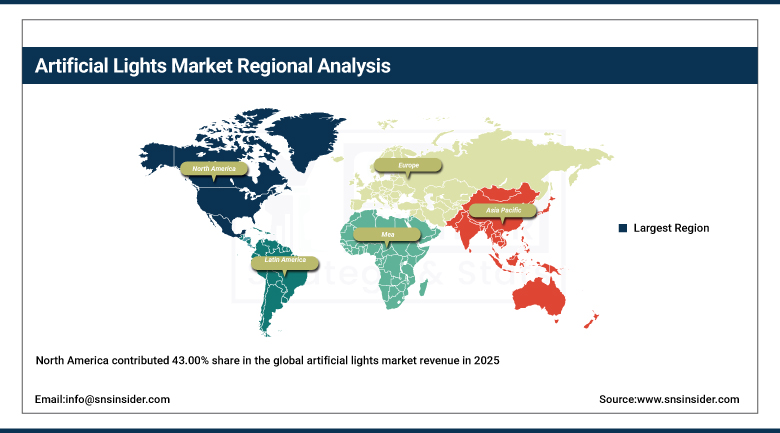
North America contributed 43.00% share in the global artificial lights market revenue in 2025 due to the extensive usage of LED technology, well-established commercial environment, strict energy efficiency norms, and constant up-gradation of the public lighting system. The United States and Canada keep investing in intelligent lighting in their commercial buildings, industrial plants, transportation system, hospitals, and municipal infrastructure. Usage of intelligent lighting systems, occupancy based control systems, and building automation systems via the Internet has made it easy for businesses to reduce their energy consumption, cost incurred for maintenance, and their carbon footprint.
In addition, regional development has been encouraged by the rise in investments in smart cities, digital infrastructure, and intelligent transportations, which need advanced outdoor lighting systems. Building managers are using AI-based lighting analytics and IoT enabled sensor to enhance efficiency and occupant comfort. Expansion in the manufacturing unit of EVs, logistics warehouse, and hyperscale data center has created a need for advanced industrial lighting systems. The DOE kept on making improvements in Solid State Lighting Research initiatives related to lighting efficiency, connected control systems, and intelligent building integration.
Get Customized Report as per Your Business Requirement - Enquiry Now
Europe Artificial Lights Market Insights
Europe continues to be among the technically advanced lighting markets owing to climate goals, stringent energy efficiency laws, and rapid transformation of existing lighting infrastructure. Some countries such as Germany, France, the UK, Italy, and the Netherlands have been engaging in LED retrofit, intelligent commercial buildings, green urban infrastructure, and intelligent lighting networks. The government-led programs for modernization of the lighting technology and stringent environmental policies have led to the adoption of energy-saving luminaires in both residential, industrial, and municipal uses in support of regional decarbization plans.
Innovations in the European lighting industry continue to drive the commercialization of smart lighting, human-centric lighting, OLED, and wireless lighting control. Commercial buildings have started installing lighting systems which use occupancy sensors, daylight harvesting, and prediction based energy management systems in order to enhance their performance. Increased investments in green building and intelligent infrastructure will drive the growth of the regional market throughout the forecast period. In 2025, several European cities have intensified LED street lighting upgrade projects as part of national energy transitions and carbon reduction programs.
Asia Pacific Artificial Lights Market Insights
The Asia Pacific is anticipated to hold the highest CAGR of 3.73% during 2026–2035 owing to high urbanization, rise in manufacturing operations, construction of smart cities, and constant infrastructural development in countries like China, India, Japan, South Korea, and Southeast Asian nations. Large scale housing constructions, industrial growth, commercial building constructions, and upgrading of transportation infrastructures continue to fuel huge demand for energy-saving lighting products. The adoption of LED lighting products and electricity saving strategies from the government policies boosts the regional market growth.
Furthermore, it is the leading manufacturer of lighting components, LEDs, drivers, semiconductor chips, and electronics assemblies in the world, thus creating several benefits for the global manufacturers. The increased use of horticulture lights, connectivity lighting systems, and industrial automation solutions will contribute to the market growth. The concepts of smart manufacturing and digital buildings are expected to generate opportunities for advanced lighting solutions. Several Asian manufacturers have expanded their capacity for manufacturing efficient LED chips and intelligent lighting components to meet the increasing global demand.
Middle East & Africa and Latin America Artificial Lights Market Insights
Middle East & Africa market is continuing to grow due to the government focus on smart cities developments, improvement of tourism facilities, construction of commercial real estate and utilities upgrading. The countries such as UAE, Saudi Arabia and South Africa are installing energy efficient street lighting, airports, hospitals, educational facilities and large-scale mixed-use developments. Increasing importance of sustainable development, reduced electricity usage and smart infrastructure development drives the use of connected LED lighting systems in both private and public sectors. In 2025, the UAE continued expanding its smart city infrastructure projects using smart LED street lighting systems.
In Latin America, the market shows stable growth due to the urban development, modernization of public infrastructure, commercial building activities and residential electrification. The Latin American countries, namely Brazil, Mexico, Chile and Colombia continue the implementation of energy efficient LED systems in place of traditional lighting to save electricity expenses and reduce the environmental impact. Long-term growth drivers include the energy conservation programs conducted by governments, industrial facilities' modernization and smart public lighting system installations. During 2025, several cities in Brazil increased the pace of implementation of LED public lighting projects using public-private partnerships.
Market Dynamics:
Growth Drivers: Increased transition to energy-efficient LED lighting and intelligent lighting systems.
The quick adoption of advanced LED technology over traditional lighting solutions such as incandescent lamps, fluorescent lamps, and HID lighting is considered to be one of the major growth drivers in the Artificial Lights Market. Many developed and emerging nations are still enforcing strong policies for the adoption of energy-efficient and environment-friendly lights through strict energy standards and regulations in place. LED lights offer better lighting performances along with increased operational life and cost-saving in terms of energy use and maintenance costs. Furthermore, growth in the construction of commercial properties, smart cities, industrial automation, and transport infrastructure is driving the demand for advanced lighting solutions.
Moreover, the advent of intelligent lighting solutions based on wireless communication, occupancy sensors, daylight harvesting, IoT connectivity, and AI-based energy-saving is revolutionizing lighting solutions by providing better lighting experiences as well as energy savings. Intelligent lighting systems based on connected lighting are increasingly being deployed to improve efficiency, reduce costs, and meet sustainability goals. The connection of lighting system with other building management system and predictive maintenance platforms is growing its adoption in offices, warehouses, hospitals, universities, and factories. The U.S. Department of Energy (DOE) continued its support towards advanced research of Solid-State Lighting technologies.
Restraints: Cost involved with initial installation and replacement of the advanced lighting infrastructure.
Although there exist favorable long-term economics of operations, the relatively high cost of upfront investment in advanced LED lighting systems, smart lighting control systems, wireless infrastructure, and building automation systems is considered a major market restraint. Complete lighting infrastructures in large commercial buildings, industries, municipalities, and public infrastructures are costly, which delays the process of purchasing, especially by cost-conscious entities and developing countries. Other additional costs related to installation, networking systems, software integration, commissioning, and personnel training may also result in delayed purchases from cost-conscious entities and underdeveloped countries.
Moreover, issues of incompatibility between old electrical infrastructure and next generation of lighting infrastructure could result in complexities and increased costs for implementation. The smaller companies and households might delay the upgrade process due to limited budgets. Hence, the manufacturers will continue to emphasize product cost, modularity, ease of installation, and financing to increase the use of such products. In 2025, many of the major global lighting manufacturers have introduced retrofit table LED lighting products.
Opportunities: Smart cities, controlled environment agriculture, AI-powered lighting management.
The development of smart city infrastructure and intelligent buildings has been resulting in significant long-term opportunities for the artificial lights market. Governments around the world have been spending a lot of money on installing connected street lights, adaptive traffic management, monitoring public safety, and constructing digital urban infrastructure in which the intelligent lights serve as the core component. Cloud-based lighting management, occupancy analytics, and adaptive lighting via sensors ensure higher efficiency and performance along with lower maintenance needs. Such features have been stimulating adoption in airports, transportation centers, schools and universities, hospitals, commercial campuses, and industries.
A very promising opportunity can be attributed to controlled environment agriculture, vertical farms, and precision horticulture where programmable LED lights ensure year-round crops regardless of the season and weather conditions. Adjustable spectrum lights help achieve higher photosynthesis efficiency and crop quality together with lower resource consumption. Innovations in OLED lights, Li-Fi technologies, human-centric lights, and lighting ecosystems are expected to create more revenue opportunities during the forecast period. Leading lighting manufacturers introduced advanced AI-driven lighting management systems capable of optimizing illumination according to occupancy and environmental parameters.
Recent Developments:
-
2026: Signify introduced new Philips smart lighting solutions with expanded AI-enabled automation, advanced energy management capabilities, and enhanced interoperability for commercial buildings and smart city applications. The launch strengthens connected lighting adoption across enterprise and municipal infrastructure.
-
2026: The U.S. Department of Energy (DOE) continued funding Solid-State Lighting (SSL) research initiatives focused on improving LED efficiency, intelligent lighting controls, and connected building technologies to accelerate nationwide energy conservation.
-
2025: Acuity Brands expanded its intelligent lighting and building management portfolio through new connected lighting technologies designed to improve operational efficiency, occupant experience, and sustainability across commercial facilities.
-
2025: Signify expanded its Interact connected lighting platform with enhanced cloud-based lighting management, predictive maintenance capabilities, and IoT-enabled smart infrastructure solutions supporting commercial and public sector customers.
Artificial Lights Companies are:
-
Signify N.V.
-
Zumtobel Group AG
-
Panasonic Holdings Corporation
-
Hubbell Incorporated
-
Current Lighting Solutions, LLC
-
Samsung Electronics Co., Ltd.
-
Nichia Corporation
-
Penguin Solutions, Inc.
-
Legrand S.A.
-
LEDVANCE GmbH
-
Fagerhult Group
-
Lutron Electronics Co., Inc.
-
Toshiba Lighting & Technology Corporation
-
Opple Lighting Co., Ltd.
-
Havells India Limited
-
Wipro Lighting
-
Syska LED Lights Pvt. Ltd.
-
Seoul Semiconductor Co., Ltd.
Artificial Lights Market Report Scope:
| Report Attributes | Details |
|---|---|
| Market Size in 2025 | USD 99.63 Billion |
| Market Size by 2035 | USD 136.07 Billion |
| CAGR | CAGR of 3.17% From 2026 to 2035 |
| Base Year | 2025 |
| Forecast Period | 2026-2035 |
| Historical Data | 2022-2024 |
| Report Scope & Coverage | Market Size, Segments Analysis, Competitive Landscape, Regional Analysis, DROC & SWOT Analysis, Forecast Outlook |
| Key Segments | • By Product Type (LED Lighting, Fluorescent Lighting, HID Lighting, Halogen Lighting, OLED Lighting, Smart & Specialty Lighting) • By Application (Residential, Commercial, Industrial, Outdoor & Street Lighting, Horticulture Lighting, Healthcare) • By End User (Commercial Buildings, Industrial Facilities, Government & Infrastructure, Agriculture, Others) |
| Regional Analysis/Coverage | North America (US, Canada), Europe (Germany, UK, France, Italy, Spain, Russia, Poland, Rest of Europe), Asia Pacific (China, India, Japan, South Korea, Australia, ASEAN Countries, Rest of Asia Pacific), Middle East & Africa (UAE, Saudi Arabia, Qatar, South Africa, Rest of Middle East & Africa), Latin America (Brazil, Argentina, Mexico, Colombia, Rest of Latin America). |
| Company Profiles | Signify N.V., Acuity Brands, Inc., Zumtobel Group AG, Panasonic Holdings Corporation, Hubbell Incorporated, Current Lighting Solutions, LLC, Eaton Corporation plc, Samsung Electronics Co., Ltd., Nichia Corporation, Penguin Solutions, Inc., Legrand S.A., LEDVANCE GmbH, Fagerhult Group, Lutron Electronics Co., Inc., Toshiba Lighting & Technology Corporation, Opple Lighting Co., Ltd., Havells India Limited, Wipro Lighting, Syska LED Lights Pvt. Ltd., Seoul Semiconductor Co., Ltd. |
Frequently Asked Questions
The Artificial Lights Market was valued at USD 99.63 Billion in 2025.
The market is projected to reach USD 136.07 Billion by 2035.
The market is anticipated to expand at a CAGR of 3.17% during the forecast period.
North America dominated the global Artificial Lights Market in 2025 with a 43.00% revenue share.
LED Lighting accounted for the largest revenue share of 61.00% in 2025.
