
Ferroelectric FET Market Report Scope & Overview:
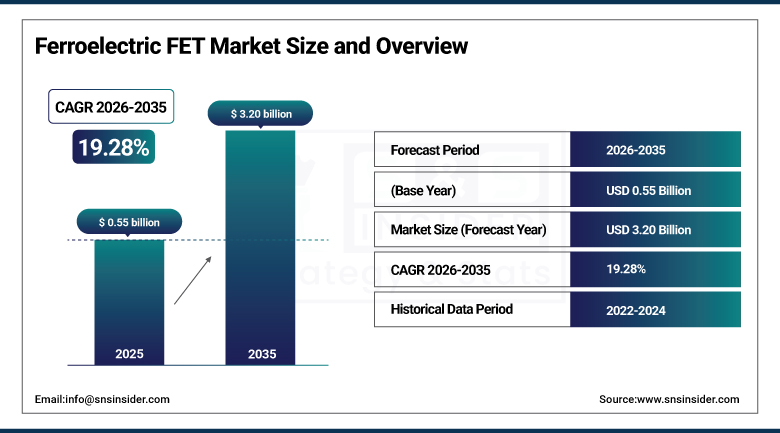
The Ferroelectric FET Market size was valued at USD 0.55 Billion in 2025 and is projected to reach USD 3.20 Billion by 2035, expanding at a CAGR of 19.28% during the forecast period 2026–2035.
There is significant momentum in the market due to the search by semiconductor manufacturers for new non-volatile memory technologies that can provide low power usage, fast switching capabilities, and increased endurance compared to the traditional Flash memory. FeFETs utilizing hafnium oxide ferroelectric materials are gaining significant traction for the embedded memory, artificial intelligence hardware, and edge computing applications owing to their CMOS compatibility and capability to store data non-volatilely. Increasing investments in advanced semiconductor process technology, edge AI devices, and energy-efficient computing architecture have been driving the development of FeFET technology.
Fast technological development in the neuromorphic computing industry, in-memory computing architectures, and AI accelerators has also been driving the FeFET technology trend. Utilizing FeFET in embedded non-volatile memory allows to minimize latency, decrease energy usage, and simplify memory architecture, hence, making them suitable for use in automotive electronics, industrial IoT, and next-generation microcontrollers. The growing investment in advanced logic nodes below 22 nm, government-sponsored semiconductor manufacturing projects, and partnerships between foundries, research organizations, and semiconductor companies have been contributing to the large-scale commercialization of the technology.
To Get more information Ferroelectric FET Market - Request Free Sample Report
Ferroelectric FET Market Trends:
-
Increasing commercialization of embedded ferroelectric non-volatile memory technologies.
-
Rising integration of FeFETs into edge AI and intelligent IoT processors.
-
Growing adoption of sub-14 nm semiconductor manufacturing technologies.
-
Expansion of neuromorphic computing using ferroelectric memory architectures.
-
Increasing investments in CMOS-compatible ferroelectric semiconductor fabrication.
U.S. Ferroelectric FET Market Size Outlook:
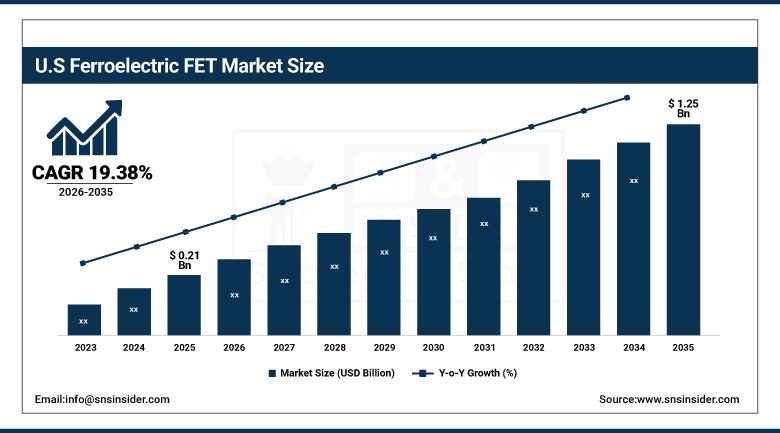
The U.S. Ferroelectric FET Market was valued at USD 0.21 billion in 2025 and is expected to reach approximately USD 1.25 billion by 2035, expanding at a CAGR of 19.38% during 2026–2035.
The United States is set to maintain its dominance in the North America ferroelectric FET market on account of its dominance in the innovation of semiconductors, robust semiconductor fabrication capabilities, and substantial investment in artificial intelligence hardware. There is growing activity by major manufacturers of integrated devices, semiconductor equipment, and research institutions on the development of FeFET technology for embedded memory, automobiles, and AI accelerators. The development of semiconductor funding programs by the federal government, expanding fab activities, and advanced process nodes commercialization are helping enhance manufacturing capability and adoption of ferroelectric transistors in industries.
The growing innovation in memory structures, neuromorphic computing, and edge computing technologies will help the country retain its market leadership during the forecast period. Semiconductor companies have started using FeFET technology for the development of energy-efficient embedded systems meant for applications like industrial automation, automobiles, and smart consumer electronics. In April 2025, Global Foundries and the Department of Commerce made efforts to enhance domestic semiconductor manufacturing capabilities and next-generation memory technologies backed by CHIPS Act funding program.
Ferroelectric FET Market Segment Analysis:
-
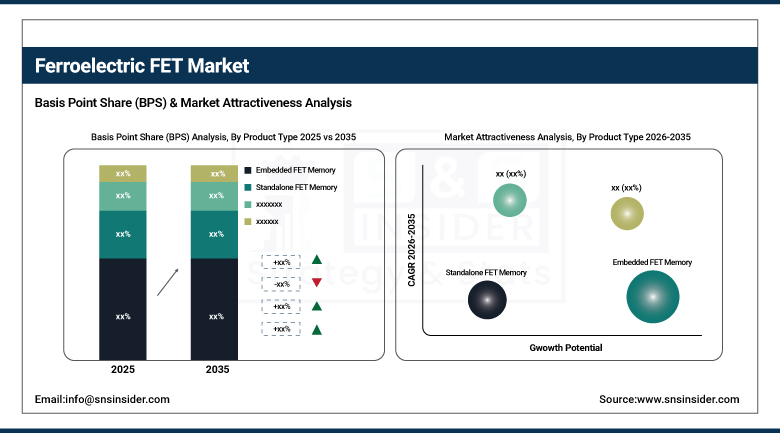
By Product Type, embedded FET memory dominated the market with 42.00% share in 2025, while neuromorphic computing chips are projected to witness the fastest growth with 20.54% CAGR during the forecast period.
-
By Technology Node, 28 nm & above dominated the market with 44.00% share in 2025, while below 14 nm is projected to witness the fastest growth with 24.40% CAGR during the forecast period.
-
By Application, edge AI dominated the market with 28.00% share in 2025, while automotive electronics are projected to witness the fastest growth with 21.83% CAGR during the forecast period.
-
By End User, semiconductor manufacturers dominated the market with 39.00% share in 2025, while automotive OEMs & tier-1 suppliers are projected to witness the fastest growth with 21.23% CAGR during the forecast period.
By Product Type, embedded FET Memory dominated, while neuromorphic computing chips grows fastest.
The market share of embedded FET memory was estimated to be 42.00% in the year 2025, owing to the rising commercialization of embedded non-volatile memory for microcontrollers, edge processors, and AI integrated semiconductor devices. As compared to the conventional flash memory, the embedded FeFET memory provides fast programming, lower write energy, and increased endurance without changing the CMOS fabrication process. This has led to the inclusion of embedded FeFET memory in SoCs designed by semiconductor companies for use in automotive, industrial, and smart consumer electronics sectors, resulting in the domination of this segment.
Neuromorphic computing chips segment is expected to register the fastest 20.54% CAGR during the period 2026–2035. Rising demands for the brain-inspired computing systems capable of performing AI processing operations with ultra-low energy consumption will drive the growth of FeFET based synaptic memory chips. The analog switch functionality, fast-latency, and in-memory computing capabilities make FeFET memories well-suited for neuromorphic processing applications employed in robotics, automation, and intelligent sensing applications. In the year 2025, teams from imec and other academia have achieved additional success in the area of FeFET based neuromorphic memory arrays.
By Technology Node, 28 nm & above dominated, while below 14 nm grows fastest.
The 28 nm & above category has accounted for the leading revenue share of 44.00% in 2025 as a result of its commercial maturity and broad availability across current semiconductor fabrication plants. The majority of initial FeFET implementations have been designed on mature process nodes in order to make the design process less complex, increase yield rates, and expedite the industrial validation process. These process nodes are appealing for embedded memory in automotive controllers, industrial automation systems, and IoT devices as reliable and economical products with long lifecycles remain an important purchase factor for them.
The below 14 nm category is projected to achieve the fastest 24.40% CAGR over the forecast period. Ongoing investments in advanced semiconductor fabrication, AI accelerators, and HPC technologies are pushing the development towards smaller process nodes in which FeFET technology can offer higher memory density and reduced power consumption. Various foundries have already started looking into the integration of ferroelectric hafnium oxide into advanced Fin FET and gate-all-around transistors in order to make the future embedded memory possible. In 2025, multiple collaborations in semiconductor research sector have announced successful implementation of FeFET devices in advanced below 14 nm logic processes.
By Application, edge AI dominated, while automotive electronics grows fastest.
The edge AI constituted 28.00% of the worldwide ferroelectric FET market in 2025 due to increased demand for real-time AI inference from centralized cloud infrastructure to intelligent edge devices. FeFETs help in developing low-power embedded memory which offers faster data access capabilities and thus is highly beneficial for AI-powered camera devices, wearable electronic devices, industrial sensors, and intelligent consumer devices. With growing demand for energy-efficient AI hardware that operates under tight power limitations, there has been an increase in the use of FeFETs in edge computing platforms in multiple semiconductor products.
Automotive electronics is anticipated to hold the fastest CAGR of 21.83% during the period up to 2035. Electric cars, ADAS, software-defined cars, and autonomous driving features have created the need for robust, endurance embedded memory. The FeFET devices are characterized by low power usage and high endurance features along with compatibility with the semiconductor manufacturing process of the automobiles. During 2025, the leading semiconductor manufacturers in the automotive industry increased investment in AI-powered automotive processors using the next-generation embedded memory technology.
Regional Analysis:
|
Region |
Major Country |
Share within Region, 2025 (%) |
|---|---|---|
|
North America |
United States |
94.00% |
|
Europe |
Germany |
30.00% |
|
Asia Pacific |
China |
23.00% |
|
Middle East & Africa |
UAE |
3.00% |
|
Latin America |
Brazil |
3.00% |
North America Ferroelectric FET Market Insights
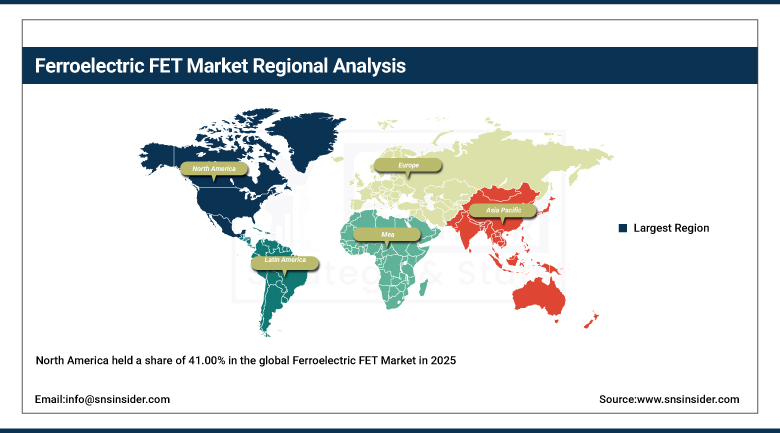
North America held a share of 41.00% in the global Ferroelectric FET Market in 2025 on account of its well-developed research abilities of semiconductors, state-of-the-art fabrication facilities, and significant financial commitment towards AI, high-performance computing, and embedded memory. North America is home to a number of major semiconductor players along with leading equipment vendors and research institutes that are developing FeFET technology in order to implement it for the design of embedded memory of AI processors, industrial automation, automotive electronics, and edge computing solutions. Continued growth in the semiconductor manufacturing industry backed by government programs and expansion of domestic fabrication plants is driving the adoption of the technology even further in advanced logic applications.
North America is experiencing an increase in funding towards novel memory architectures, neuromorphic computing, and low-power semiconductors. Increased collaboration between foundries, equipment makers, and universities is allowing faster innovation in the field of CMOS compatible ferroelectric memory technologies ready for mass production. Increasing demand for AI accelerators, smart IoT devices, and innovative automotive electronics will help the region maintain its leadership through the forecast period. Intel revealed in February 2026 plans for further investment in advanced semiconductor process technologies and AI manufacturing capacity.
Get Customized Report as per Your Business Requirement - Enquiry Now
Europe Ferroelectric FET Market Insights
Europe is another important market where the use of FeFET technology can be witnessed due to the presence of highly developed semiconductors research ecosystem, strong automotive electronics industry, and investments in energy-efficient computing. Countries like Germany, France, the Netherlands, Belgium, and Italy are increasingly undertaking research projects related to non-volatile memory, AI processors and semiconductor materials. Leading semiconductor manufacturers and research institutes in Europe are also exploring the potential to integrate ferroelectric hafnium oxide in CMOS-based processes for improving memory efficiency with lower power consumption.
Introduction of European Chips Act and increase in investment in domestic semiconductor production will help in boosting the commercialization of advanced memory technologies during the coming years. Growing demand for industrial automation, smart manufacturing, autonomous mobility, and intelligent sensor systems will also boost the demand for FeFET based embedded memory solutions. In 2025, imec expanded its research collaboration programs with semiconductor industry in Europe in relation to advanced memory technologies, AI hardware and transistor architecture.
Asia Pacific Ferroelectric FET Market Insights
Asia Pacific Ferroelectric FET Market is expected to hold a higher CAGR of 20.45% during the period from 2026–2035. The rapidly growing production capacity of semiconductors, investments in AI chips, and increased use of consumer electronics are fueling market growth in countries such as China, Japan, South Korea, Taiwan, and India. The region serves as the manufacturing center of semiconductor production, providing the means to quickly introduce embedded non-volatile memory solutions due to foundries' availability and high-level packaging technology.
There is an emerging trend of government support for self-sufficiency in semiconductors, development of wafer fabrication plants, and investments in automotive and IoT electronics. The increasing implementation of smartphones with AI capability, wearables, robots, and intelligent industrial devices is another factor that drives the need for low-power embedded memory solutions. In 2025, TSMC made significant advances in investment in advanced process technology for AI processors and next-generation embedded memory technology.
Middle East & Africa and Latin America Ferroelectric FET Market Insights
The Middle East & Africa region market is slowly growing due to government investments in digital infrastructure, smart manufacturing projects, and development of semiconductors' ecosystem. Nations such as the UAE, Saudi Arabia, and Israel are enhancing their research efforts in artificial intelligence, industrial automation, and electronics, providing an opportunity for the future of embedded memory technology. Increased deployment of solutions related to Industry 4.0, as well as intelligent edge devices, will promote gradual adoption of FeFET semiconductor components. In 2025, the UAE enhanced its national program in AI and advanced technology aimed at semiconductor research and innovation.
The Latin America market is driven by increased adoption of industrial automation, connected consumer electronics, and automotive manufacturing in Brazil, Mexico, and Argentina. Increased investments in smart factories, IoT infrastructure, and electronics manufacturing are slowly increasing the need for energy-efficient semiconductor technologies. However, the presence of large-scale semiconductor fabrication is rather small; however, continuous growth in electronics manufacturing and AI-based industrial systems will create commercialization opportunities in the future. In 2025, Brazil enhanced its semiconductor innovation programs through increased public-private technology partnerships related to advance electronics manufacturing and digital industrialization.
Market Dynamics:
Growth Drivers: Increasing deployment of AI edge computing and non-volatile memory solutions.
Increasing adoption of Artificial intelligence at the edge is likely to be one of the prominent growth enablers for the ferroelectric FET market in the coming years. For the functioning of edge AI hardware, non-volatile memory technologies that offer extremely fast performance, ultra-low power consumption, and instantaneous retention of information without continuous power source are required. This requirement can be met with the help of FeFET memory technology due to its inherent capability of providing non-volatile memory along with CMOS integration facility. With an increase in the optimization efforts by semiconductor companies for on-device AI inference, there is likely to be a surge in the demand for embedded memory solutions in the FeFET architecture in the coming years.
Demand is further supplemented with growing investments in semiconductor process innovations, edge computing solutions, and power efficient electronics. Automobile electronics, wearable devices, industry automation, and smart consumer goods are incorporating embedded AI functionalities in increasing numbers. Intel announced further extension to its AI semiconductor roadmap and advanced process technology developments for future low-power computing and embedded AI solutions.
Restraints: Fabrication complexities in making high-performance FeFETs.
Although the technology has much commercial promise, advanced FeFET technology still faces manufacturing difficulties related to process integration, device variability, and reliability. The precise manufacture of ferroelectric materials, interfaces, polarization retention, and endurance of the devices is very difficult. Variability in the properties of ferroelectric materials and retention could hamper the yield and thus make commercialization slower than existing non-volatile memories like embedded Flash.
Moreover, qualification of the semiconductor chips for automotive, industrial, and critical missions requires extensive reliability testing prior to mass production. This needs optimizing the compatibility of the ferroelectric material and transistor architecture under 14 nm dimensions with production economics. Semiconductor researchers from imec made advances in the endurance and retention properties of FeFETs through engineering of ferroelectric materials.
Opportunities: Development of automotive AI processors and neuromorphic computing platforms.
With more widespread use of software-defined vehicles, self-driving capabilities, and industrial automation with AI technologies, there are numerous opportunities in the long term perspective for producers of FeFET. Automotive electronic control units are increasingly reliant on AI processors integrated into them that have memory systems with high capacity, fast write capability, low power consumption and high endurance rate. FeFET technology has all the necessary potential to cope with such requirements providing the possibility to develop compact semiconductors to work with huge amount of sensory data in real time.
There are also expectations about significant demand growth connected with further electrification of automobiles and advancement of advanced driver assistance systems. Other than automotive industry, neuromorphic computing is considered as one of the most attractive opportunities for use of ferroelectric transistors in commercial purposes. Analog weights storage makes it possible for FeFET devices to perform efficient energy-consuming operations of AI inference for robotics and cognitive computing systems.
Recent Developments:
-
2026: Intel expanded its advanced semiconductor manufacturing roadmap with continued investments in AI-optimized process technologies and next-generation embedded memory research.
-
2026: Global Foundries announced continued investments in advanced semiconductor manufacturing and embedded memory innovation to support AI, automotive, and industrial applications.
-
2025: Infineon Technologies strengthened its embedded memory and AI semiconductor portfolio through continued development of energy-efficient microcontroller technologies for automotive and industrial markets.
-
2025: TSMC highlighted continued progress in advanced logic process technologies supporting next-generation AI processors and embedded memory integration during its technology symposium.
Ferroelectric FET Companies are:
-
Infineon Technologies AG
-
TSMC
-
Samsung Electronics Co., Ltd.
-
Intel Corporation
-
SK hynix Inc.
-
Kioxia Holdings Corporation
-
Applied Materials, Inc.
-
imec
-
CEA-Leti
-
Fraunhofer IPMS
-
Ferroelectric Memory Company
-
Fujitsu Limited
-
IBM Corporation
-
Everspin Technologies
-
Analog Devices, Inc.
-
Synopsys, Inc.
-
Cadence Design Systems, Inc.
-
Tower Semiconductor Ltd.
Ferroelectric FET Market Report Scope:
| Report Attributes | Details |
|---|---|
| Market Size in 2025 | USD 0.55 Billion |
| Market Size by 2035 | USD 3.20 Billion |
| CAGR | CAGR of 19.28% From 2026 to 2035 |
| Base Year | 2025 |
| Forecast Period | 2026-2035 |
| Historical Data | 2022-2024 |
| Report Scope & Coverage | Market Size, Segments Analysis, Competitive Landscape, Regional Analysis, DROC & SWOT Analysis, Forecast Outlook |
| Key Segments | • By Product Type (Embedded FET Memory, Standalone FET Memory, Neuromorphic Computing Chips, AI Accelerator Arrays, Others) • By Technology Node (28 nm & Above, 22–14 nm, Below 14 nm) • By Application (Edge AI, Embedded Memory, Automotive Electronics, Industrial IoT, Neuromorphic Computing, Others) • By End User (Semiconductor Manufacturers, Consumer Electronics OEMs, Automotive OEMs & Tier-1 Suppliers, Industrial Equipment Manufacturers, Research Institutions) |
| Regional Analysis/Coverage | North America (US, Canada), Europe (Germany, UK, France, Italy, Spain, Russia, Poland, Rest of Europe), Asia Pacific (China, India, Japan, South Korea, Australia, ASEAN Countries, Rest of Asia Pacific), Middle East & Africa (UAE, Saudi Arabia, Qatar, South Africa, Rest of Middle East & Africa), Latin America (Brazil, Argentina, Mexico, Colombia, Rest of Latin America). |
| Company Profiles | Infineon Technologies AG, GlobalFoundries Inc., TSMC, Samsung Electronics Co., Ltd., Intel Corporation, SK hynix Inc., Micron Technology, Inc., Kioxia Holdings Corporation, Applied Materials, Inc., imec, CEA-Leti, Fraunhofer IPMS, Ferroelectric Memory Company, Fujitsu Limited, IBM Corporation, Everspin Technologies, Analog Devices, Inc., Synopsys, Inc., Cadence Design Systems, Inc., Tower Semiconductor Ltd. |
Frequently Asked Questions
The Ferroelectric FET Market was valued at USD 0.55 Billion in 2025.
The market is projected to reach USD 3.20 Billion by 2035.
The market is anticipated to expand at a CAGR of 19.28% during the forecast period.
North America dominated the global Ferroelectric FET Market in 2025, accounting for 41.00% of total market revenue.
Embedded FET Memory accounted for the largest revenue share of 42.00% in 2025.
