
Level Transmitter Market Report Scope & Overview:
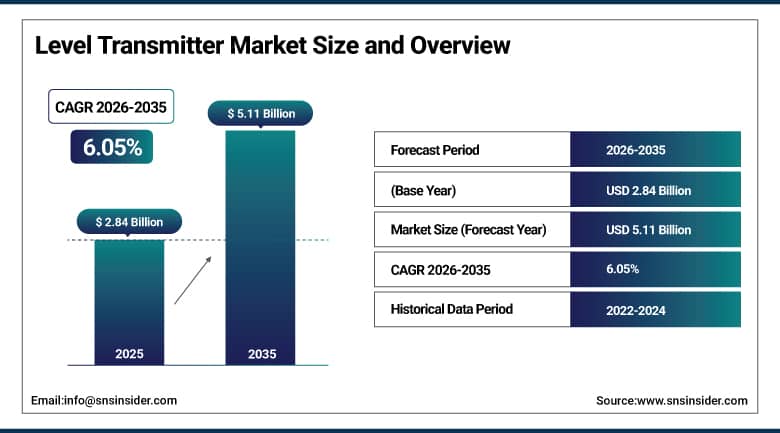
The Level Transmitter Market size was valued at USD 2.84 Billion in 2025 and is projected to reach USD 5.11 Billion by 2035, expanding at a CAGR of 6.05% during the forecast period 2026–2035.
Growth in the industry is being driven by increasing automation in measurement of fluids, solids, and interfaces in process industries that require precision measurement in order to control inventories, processes, safeguard their equipment and ensure safety during operations. Increased investments in industrial upgrades have prompted manufacturers to upgrade their systems to include continuous electronic measurements rather than manual methods of measuring levels. Market is also growing as a result of increased installations of radar, ultrasonic and networked transmitters in processing plants, storage tanks, utility plants and industrial assets that are located remotely.
Development in technology is also increasingly moving level measurement from being purely instrumental to becoming connected and diagnostic in nature. Contemporary transmitters employ advanced sensing and communication technologies alongside remote configuring and diagnostics to enhance the reliability of measurements while at the same time minimizing field visits and maintenance requirements. In October 2025, Emerson introduced the Rosemount 3408 Wireless Level Transmitter which according to the company is the world's first native Wireless HART non-contacting radar level transmitter to enable automatic measurement of levels of liquids and solids in hard-to-reach locations.
To Get More Information On Level Transmitter Market - Request Free Sample Report
Level Transmitter Market Trends
-
Increasing adoption of radar-based continuous level measurement.
-
Growing deployment of wireless and remotely configurable transmitters.
-
Rising automation of water and wastewater measurement systems.
-
Increasing demand for real-time diagnostics and predictive maintenance.
-
Expansion of level monitoring across difficult-to-access industrial assets.
U.S. Level Transmitter Market Size Outlook
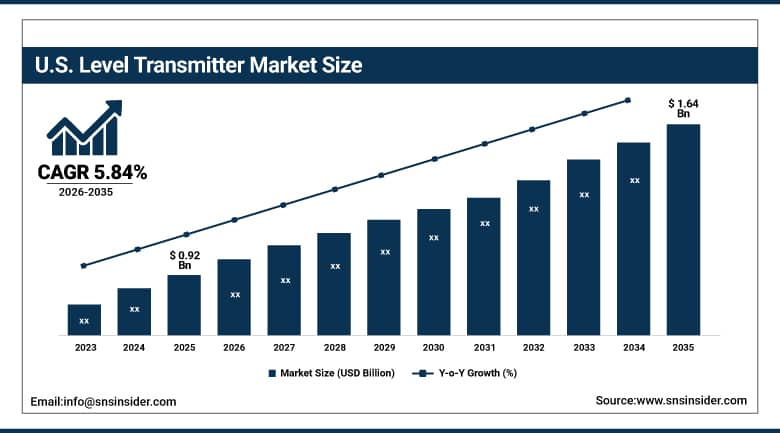
The U.S. Level Transmitter Market was valued at USD 0.92 billion in 2025 and is expected to reach approximately USD 1.64 billion by 2035, expanding at a CAGR of 5.84% during 2026–2035.
The U.S. continues to be the leading player within the continent, providing 90.00% of the North American market in 2025, based on the ME sheet. Growth is expected due to well-developed process automation systems, oil and gas industry infrastructure, chemical industry, water infrastructure upgrade, and replacement of traditional measuring devices with digitally connected process instrumentation. More and more industrial companies tend to focus on continuous measuring and diagnostic technologies to enhance asset integrity and minimize unscheduled maintenance works.
In addition to this, U.S. demand for instrumentation technology and equipment is expected to grow due to efforts from industrial providers of products and services aimed at local customer support, technological innovation, and development of digital instrumentation solutions. Thus, in 2026, the corporation Endress+Hauser registered growth in demand in the USA, along with further investment in buildings, plants, IT systems, and software. The total sum of the investments of the group amounted to EUR 370.8 million in 2025. In June 2026, the corporation also declared expansion of its presence in the USA, which once again confirms investment in customer proximity and service infrastructure.
Level Transmitter Market Segment Analysis
-
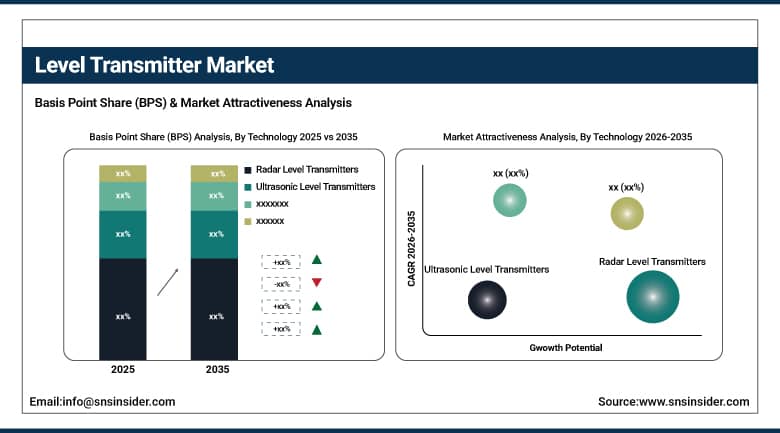
By Technology, radar level transmitters dominated the market with 31.00% share in 2025, while ultrasonic level transmitters are projected to witness the fastest growth with 7.44% CAGR during the forecast period.
-
By Application, liquid level measurement dominated the market with 44.00% share in 2025, while solid & bulk material measurement is projected to witness the fastest growth with 7.70% CAGR during the forecast period.
-
By End-User Industry, oil & gas / petrochemicals dominated the market with 24.00% share in 2025, while water & wastewater is projected to witness the fastest growth with 7.62% CAGR during the forecast period.
By Technology, radar level transmitters dominated, while ultrasonic level transmitters grows fastest.
The share of radar level transmitters in the level transmitter market was 31.00% in 2025; they comprised the largest technology segment. The reason for the high adoption of these systems is their non-contact measurement capacity, effective performance under difficult process conditions, and applicability in tanks, silos, storage vessels, and continuous process applications. High-frequency radar can ensure accurate measurement while minimizing the use of mechanical elements exposed to the process medium. The launch of new products also highlights the relevance of the technological solutions.
Ultrasonic level transmitters are projected to exhibit the highest CAGR of 7.44% during 2026-2035. The increasing popularity of non-contact measurement in water treatment facilities, utilities, storage applications, and processes in which the contact with the measuring medium is not preferable contribute to the growth. Ultrasonic systems are easy to install and can offer continuous measurement without mechanical interactions with the material. Growing automation of water facilities and the necessity of remote monitoring is expected to increase the number of applications. Manufacturers' product lines often place ultrasonic measurement along with radar and other types of digital sensors, providing users with an opportunity to choose equipment based on medium characteristics, geometry of the vessel, installation conditions, and measurement needs.
By Application, liquid level measurement dominated, while solid & bulk material measurement grows fastest.
Liquid level measurement was the most dominant application market segment, accounting for 44.00% of the level transmitter market share in 2025. Liquid measurement is vital in oil and gas storage, chemical processing, pharmaceuticals manufacture, food and beverages production, water treatment, and power generation. Accurate continuous measurement allows operators to monitor the volumes of the processes, avoid overflow, protect pumps and containers from damages, optimize inventories, and provide stable operating conditions. The need for tanks, vessels, reservoirs, and process equipment in the industries provides a wide base of installed level transmitters, whereas the modernization efforts promote the replacement of analog measuring instruments and gauges with continuous measurement solutions.
Solid & bulk material measurement is forecasted to register the highest growth rate of 7.70% CAGR between 2026 and 2035. Growth is fueled by the growing automation of mining, metals industry, cement, chemical, food processing, agricultural bulk material handling, and other industries dealing with powder, granule, aggregate, and solid material storage and processing. Continuous measuring in silos, bins, hoppers, and other storage facilities helps to avoid overfilling, lack of material, production stoppages, and ineffective inventory management. Technologies such as radar and ultrasonic are being considered more often for those applications due to their ability to perform continuous measurements without frequent manual checks. The opportunities for business are additionally created by novel transmitter designs allowing measuring liquids and solids.
By End-User Industry, oil & gas / petrochemicals dominated, while water & wastewater grows fastest.
In 2025, oil & gas / petrochemicals captured 24.00% share of the level transmitter market and was hence the dominant end user segment. The level transmitters find usage in various applications like storage tanks of crude oil and refined products, separators, process vessels, blending equipment, and petrochemicals plants. Measurement accuracy is commercially important due to the impact of inaccurate level measurements on process continuity, inventories, equipment safety, and process safety. The large installed base of process instrumentation in the sector leads to opportunities in terms of replacement as well as upgrades to the modern technologies from the traditional measurement techniques. The segment will also benefit from the increasing adoption of remote and wireless measuring technology in challenging industrial environments.
Water & wastewater segment is expected to be the fastest growing one at a CAGR of 7.62% during the forecast period. The factors responsible for growth include increasing infrastructural development needs, scarcity of water resources, need to increase the capacity of treatment facilities, and increasing focus on efficiency. The level transmitters provide automation of pump control, storage capacity, and help in avoiding overflows besides optimizing the process. Geographically scattered municipal and industrial water and wastewater facilities make connected measuring equipment more appealing. The example of US infrastructure needs shows the scope of the market opportunity. According to EPA's, the needs relating to distribution/transmission were USD 422.9 billion, treatment was USD 107 billion, and storage was USD 56.1 billion.
Regional Analysis:
|
Region |
Major Country |
Share within Region, 2025 (%) |
|---|---|---|
|
North America |
United States |
90.00% |
|
Europe |
Germany |
27.00% |
|
Asia Pacific |
China |
25.00% |
|
Middle East & Africa |
UAE |
7.00% |
|
Latin America |
Brazil |
5.00% |
North America Level Transmitter Market Insights
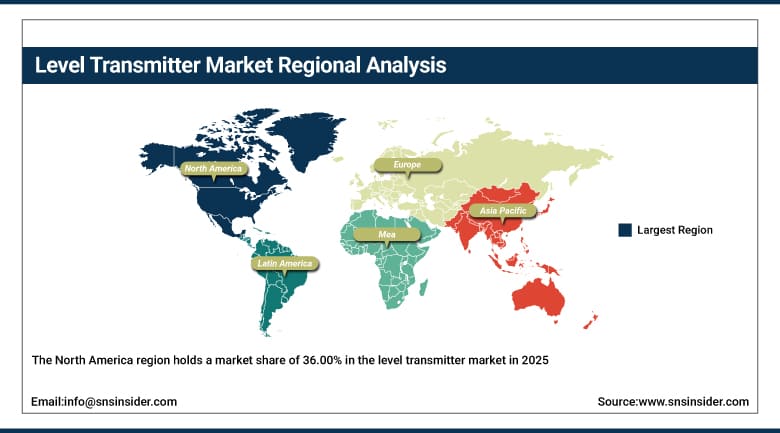
The North America region holds a market share of 36.00% in the level transmitter market in 2025, continuing to hold the top regional spot due to matured process automation systems, substantial processing capabilities for oil and gas, well-established chemical manufacturing processes, highly developed water treatment plants, and digital instrumentation. The United States accounts for 90.00% of the North American market due to its highly developed industry and investments made towards process control systems. Increasing demand is driven by replacement of old measuring devices, modernization of industries, remote monitoring of assets, and installation of radar and wireless transmitters.
Increased opportunities for suppliers of level measurement devices in the US are being created due to infrastructure investment in the country. According to the Environmental Protection Agency (EPA), the Infrastructure Investment and Jobs Act offers more than USD 50 billion for drinking water, wastewater, and storm water infrastructure, which is the biggest federal investment in water infrastructure in US history. In July 2026, the EPA also brought together the states and water systems to fast-track infrastructure projects.
Get Customized Report as Per Your Business Requirement - Enquiry Now
Europe Level Transmitter Market Insights
The Europe region possesses an advanced process-manufacturing industry including chemicals, pharmaceuticals, food and beverages, energy, and specialized manufacturing industry, which makes continuous demands for precise level measurements. Industries have become more and more motivated to modernize their instrumentation systems for better process efficiency, minimal maintenance needs, and connectivity in production. Concerns about environmental impact and efficiency are promoting the need for investments in water treatment, energy efficiency, and automatic process measurement systems.
Demand from Europe is additionally driven by the presence of strong instrumentation companies and advanced engineering competencies in process automation. Large number of leading suppliers offering broad radar, ultrasonic, differential pressure, and capacitance product lines makes it possible for industries to choose instrumentation based on process parameters. Development of digitalized measurement equipment is additionally helping to achieve better predictive maintenance and remote diagnostics options especially in large process plants, where decreasing field interventions may create operational cost benefits.
Asia Pacific Level Transmitter Market Insights
Asia Pacific is expected to witness the highest regional CAGR at 7.01% during the forecast period of 2026-2035. The industrial developments taking place in countries such as China, India, Japan, South Korea, and Southeast Asia are driving the need for process measurements in chemicals & petrochemicals, pharmaceuticals, power generation, water treatment, food processing, and mining industry. Modern facilities have been using process measurement technologies right from the time of their construction, and existing facilities can be retrofitted with the new technology due to outdated measurement systems.
In addition, increased investments in industrial automation and infrastructure are also driving the regional growth. The development in water treatment capacity, urbanization, manufacturing localization, and industrial projects are generating new process measurement points in tanks, vessels, silos, and water treatment systems. The technologies of radar and ultrasonic measurement are likely to benefit as they are capable of continuous non-contact measurement and can be seamlessly integrated into modern automation infrastructure.
Middle East & Africa and Latin America Level Transmitter Market Insights
Middle East & Africa has a clear correlation with oil and gas, petrochemicals, desalination, water treatment, power generation, mining, and industrial infrastructure. The need for constant liquid level measurement in the processes of storage, separation, refining, and petrochemical operations makes it necessary for the region to have level transmitters. At the same time, the problem of water shortage and increased number of desalination plants open up new markets for transmitters in reservoirs, treatment facilities, pumping stations, and water storage facilities. Industrial diversification in the region creates another long-term market potential, apart from the hydrocarbons. There is investment in chemicals, manufacturing, mining, utilities, and water infrastructure that will result in new measurement needs in green field and brownfield developments
Latin America has demands driven by oil and gas, mining, chemicals, food and beverage, water treatment, and power generation industries, mainly in Brazil, Mexico, Argentina, Chile, and Colombia. Level transmitters are increasingly becoming important in storage tanks, process vessels, water systems, and bulk materials handling processes where measurement helps in minimizing material losses and improving operation control. The modernization of industries in the region also helps in providing replacement demand for instrumentation. There is also demand in the region created through infrastructure development and resource intensive industries. Large oil and gas industry, mining operations, and the growing water infrastructure in Brazil creates demand for rugged measurement technology.
Market Dynamics
Growth Drivers: Rising application of industrial automation and continuous level measurement solutions.
Rising application of industrial automation is one of the significant drivers of the Level Transmitter Market as industrial processes require continuous and consistent measurement for effective production, inventory management, equipment protection, and safety. Using radar, ultrasonic, differential pressure, and capacitance transmitters, operators can measure automatically instead of manually and help process control systems respond to varying vessel conditions.
The commercial value of measuring the accurate levels is quite significant in industries like oil & gas, chemicals, water treatment, and power plants, as inaccuracy of level measurement results in production inefficiencies, overflow, equipment damage, and unnecessary maintenance work. The trend towards connected instrumentation is contributing further to the growth in demand for the product. In October 2025, Emerson launched Rosemount 3408 Wireless Level Transmitter that offers non-contact radar measurement along with native Wireless HART connectivity.
Restraints: High initial costs of using advanced instruments for measurement.
High initial costs are some of the challenges that limit the usage of advanced level transmitters, especially in small industrial plants and utilities, which operate under constrained budgets. In addition to the cost of the actual transmitter, radar and digital instruments might require special connection in the process system, configuration equipment, communication equipment, and skills. Upgrading can also entail engineering study, downtime scheduling, calibration, start-up, and interfacing with an existing DCS. The costs involved make operators postpone modernization if old mechanical or legacy measuring systems work. Wireless technology can alleviate some of the installation costs by reducing cabling needs, but it poses other challenges.
Opportunities: Smart water infrastructure & real-time operational monitoring.
Smart water infrastructure is generating a new opportunity for the development of level transmitters market. The utilities are now taking advantage of monitoring data for making decisions based on real-time information on flow changes, equipment performance, and severe weather conditions. The level measurement technology can be incorporated into overall water management system and help optimize automatic pumping, water storage management, prevention of overflow, and fast reaction on abnormal operation conditions. Level transmitters become essential component of the data-driven water infrastructure. The information provided by the agency in March 2026 illustrates the use of technological developments and monitoring information for real-time or near-real-time operational decision-making.
Recent Developments
-
2026: Endress+Hauser expanded its U.S. presence through new facilities in Greenwood, Indiana, and Edgmont, Pennsylvania. The company stated that its U.S. operations provide measurement and automation technologies, including level measurement, with the new facilities strengthening customer support and collaboration.
-
2026: The U.S. EPA convened states, water systems, and small communities to accelerate drinking-water, wastewater, and storm water infrastructure investments. The initiative focuses on reducing implementation barriers and improving delivery of federally supported water infrastructure projects.
-
2026: EPA announced USD 30 million through its Real Water Technical Assistance Initiative to support small and rural water systems. The program is intended to strengthen technical capacity and assist communities in meeting Safe Drinking Water Act and Clean Water Act requirements, supporting continued modernization of water infrastructure.
-
2025: Emerson launched the Rosemount 3408 Wireless Level Transmitter, a native Wireless HART non-contacting radar transmitter using 80 GHz FMCW technology. The product is designed to measure liquids and solids in remote locations while reducing cabling requirements and supporting continuous automated monitoring.
Level Transmitter Companies are:
-
Emerson Electric Co.
-
Siemens AG
-
Honeywell International Inc.
-
ABB Ltd.
-
Yokogawa Electric Corporation
-
KROHNE Group
-
Schneider Electric SE
-
Pepperl+Fuchs SE
-
AMETEK Inc.
-
WIKA Alexander Wiegand SE & Co. KG
-
Magnetrol International
-
Dwyer Instruments, Inc.
-
Baumer Group
-
Fuji Electric Co., Ltd.
-
Rockwell Automation, Inc.
-
SICK AG
-
Nivelco Process Control Co.
-
Monitor Technologies LLC
Level Transmitter Market Report Scope:
| Report Attributes | Details |
|---|---|
| Market Size in 2025 | USD 2.84 Billion |
| Market Size by 2035 | USD 5.11 Billion |
| CAGR | CAGR of 6.05% From 2026 to 2035 |
| Base Year | 2025 |
| Forecast Period | 2026-2035 |
| Historical Data | 2022-2024 |
| Report Scope & Coverage | Market Size, Segments Analysis, Competitive Landscape, Regional Analysis, DROC & SWOT Analysis, Forecast Outlook |
| Key Segments | • By Technology (Radar Level Transmitters, Differential Pressure & Hydrostatic, Ultrasonic Level Transmitters, Capacitance / RF Level Transmitters, Others) • By Application (Liquid Level Measurement, Solid & Bulk Material Measurement, Interface Level Measurement, Slurry & Difficult Media Measurement, Others) • By End-User Industry (Oil & Gas / Petrochemicals, Chemicals & Pharmaceuticals, Water & Wastewater, Food & Beverage, Power & Mining) |
| Regional Analysis/Coverage | North America (US, Canada), Europe (Germany, UK, France, Italy, Spain, Russia, Poland, Rest of Europe), Asia Pacific (China, India, Japan, South Korea, Australia, ASEAN Countries, Rest of Asia Pacific), Middle East & Africa (UAE, Saudi Arabia, Qatar, South Africa, Rest of Middle East & Africa), Latin America (Brazil, Argentina, Mexico, Colombia, Rest of Latin America). |
| Company Profiles | Emerson Electric Co., Endress+Hauser Group, Siemens AG, Honeywell International Inc., ABB Ltd., Yokogawa Electric Corporation, VEGA Grieshaber KG, KROHNE Group, Schneider Electric SE, Pepperl+Fuchs SE, AMETEK Inc., WIKA Alexander Wiegand SE & Co. KG, Magnetrol International, Dwyer Instruments, Inc., Baumer Group, Fuji Electric Co., Ltd., Rockwell Automation, Inc., SICK AG, Nivelco Process Control Co., Monitor Technologies LLC |
Frequently Asked Questions
The market is projected to reach USD 5.11 Billion by 2035.
North America dominated the market with a 36.00% regional share in 2025.
Radar Level Transmitters held the largest share at 31.00% in 2025.
