
Dispatchable Renewables Market Report Scope & Overview:
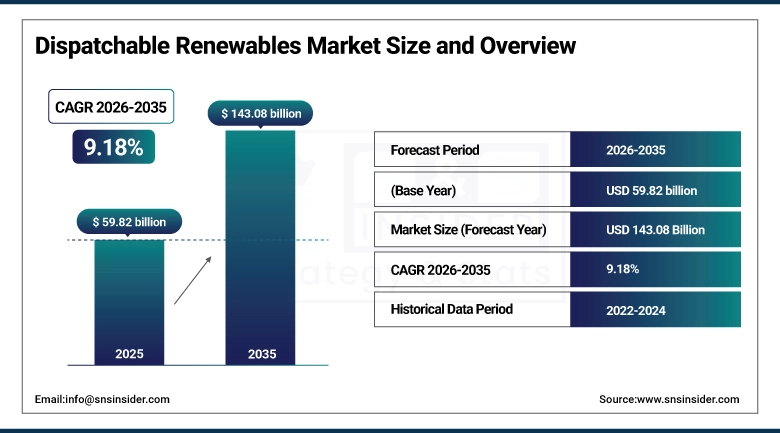
The Dispatchable Renewables Market Size was valued at USD 59.82 billion in 2025 and is expected to reach USD 143.08 billion by 2035, growing at a CAGR of 9.18% from 2026-2035.
The Dispatchable Renewables Market will experience steady growth because of the growing requirement for flexible power generation to increase renewable energy penetration. Growing spending on smart grids, energy storage technologies, and hybrid systems is helping with its adoption. The government's clean energy transition initiatives, coupled with higher industrial and rural electrification rates, are driving its growth further. Improved technology in biomass, hydroelectric, and geothermal power generation is also supporting growth.
In the United States, hydropower and pumped storage systems remain key assets for grid stability and peak-load management, with long-term performance and reliability data continuously monitored by the U.S. Department of Energy, underscoring their role in balancing variable renewable output.
Globally, the International Energy Agency (IEA) projects that renewables will contribute over 90% of total power capacity expansion through 2027–2030, driven by strong policy frameworks and accelerating clean energy deployment.
To Get more information on Dispatchable Renewables Market - Request Free Sample Report
Dispatchable Renewables Market Trends
-
Rising demand for reliable and flexible renewable energy sources is driving the dispatchable renewables market.
-
Growing integration of energy storage with renewables to ensure consistent power supply is boosting market growth.
-
Expansion of grid stabilization needs alongside intermittent sources like solar and wind is fueling deployment.
-
Increasing focus on technologies such as hydropower, biomass, geothermal, and concentrated solar power is shaping adoption trends.
-
Advancements in energy storage systems, hybrid power plants, and smart grid technologies are enhancing efficiency.
-
Rising government policies supporting clean energy transition and decarbonization are supporting market expansion.
-
Collaborations between utilities, renewable developers, and technology providers are accelerating innovation and global adoption.
U.S. Dispatchable Renewables Market Size Outlook:
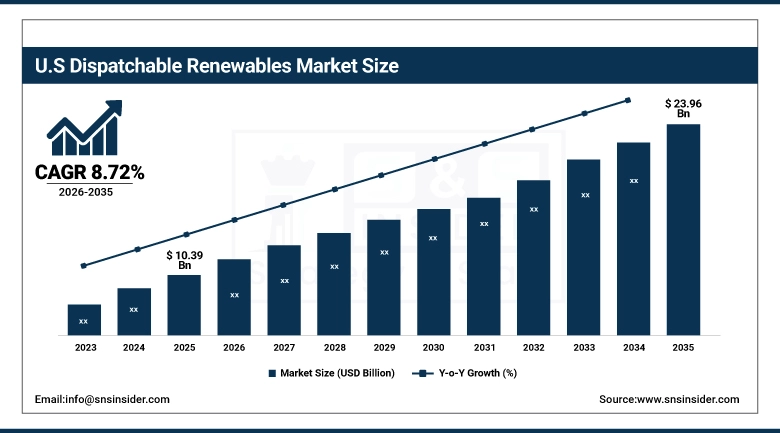
The U.S. Dispatchable Renewables Market was valued at USD 10.39 billion in 2025 and is expected to reach USD 23.96 billion by 2035, growing at a CAGR of 8.72% from 2026-2035. The U.S. Dispatchable Renewables Market is expanding as a result of the rising emphasis on grid stability and renewable energy integration. The growth in investments in hydro power plants, biomass, and geothermal energy, among other factors, is leading to continuous market growth.
Dispatchable Renewables Market Growth Drivers:
-
Growing investments in grid modernization and energy storage integration supporting deployment of controllable renewable energy technologies globally
Increased funding towards grid modernization and energy infrastructure is playing a crucial role in the deployment of dispatchable renewable energy technology. Both governments and private stakeholders are focusing on building sophisticated grids that can accommodate different forms of energy production yet remain stable. Dispatchable renewables are increasingly being combined with energy storage systems to ensure greater flexibility. Policies and financial incentives are driving the utilities industry to invest in their aging infrastructures and introduce dispatchable renewable energy resources into the energy mix. Moreover, the increased use of smart grid technology and digitalization helps with load forecasting and balancing.
Supporting this trend, the International Energy Agency (IEA) reports that global grid investment must double from around USD 300 billion today to over USD 600 billion annually by 2030 to achieve clean energy targets and enable effective renewable integration.
In parallel, the U.S. Department of Energy (DOE) highlights that installed battery storage capacity in the United States surpassed 15 GW in 2024, reflecting rapid growth driven by rising grid flexibility requirements.
Dispatchable Renewables Market Restraints:
-
Environmental and regulatory concerns associated with large-scale projects creating barriers to expansion and delaying approvals in multiple regions
The environmental and regulatory issues that arise can present severe constraints on the growth of dispatchable renewable energy sources. The larger hydroelectric and biomass projects often come under criticism because of their effects on wildlife, the water supply, and land use. Compliance with regulations results in extended approval processes and added uncertainties associated with project implementation. Issues related to public resistance to displacement, the loss of species, and emissions from the biomass plants contribute to additional complexities during project planning and execution. Moreover, variations in policies across different areas can also cause uncertainties among investors.
Dispatchable Renewables Market Opportunities:
-
Rising demand for hybrid renewable energy systems integrating storage and dispatchable sources to enhance grid flexibility and efficiency worldwide
The growing need for hybrid energy systems creates substantial potential for growth in dispatchable renewables. The addition of dispatchable energy sources like hydroelectricity or biomass along with intermittent renewable sources and energy storage increases the flexibility and reliability of the entire system. Utility companies are rapidly incorporating the hybrid concept to maximize energy production while minimizing their reliance on traditional fossil fuels. Hybrid energy systems ensure that there is effective load balancing and increase efficiency while limiting curtailment of renewable energy. With the development of sophisticated energy management systems, integrating hybrid energy systems becomes easier.
Hybrid Renewable Energy Systems with Dispatchable Integration
|
Hybrid System / Project |
Details & Dispatchable Role |
|
NextEra Energy – Solar + Battery Hybrid (USA) |
Combines utility-scale solar generation with battery storage. Solar produces daytime electricity, while batteries store excess energy and dispatch it during evening peak demand periods, reducing reliance on fossil fuel peaker plants and improving grid flexibility. |
|
Noor Energy 1 – Solar + CSP + Storage (UAE) |
Developed by Dubai Electricity and Water Authority, this project integrates photovoltaic solar, concentrated solar power (CSP), and thermal energy storage. Molten salt storage enables electricity generation after sunset, making it a fully dispatchable renewable system. |
|
Hydropower + Pumped Storage Systems (Global) |
The World Bank identifies pumped hydro as the largest form of grid-scale energy storage. It stores energy by moving water between reservoirs and provides fast dispatchable power during peak demand, stabilizing renewable-heavy grids. |
|
Hornsdale Wind + Battery Hybrid (Australia) |
Managed under coordination with Australian Energy Market Operator, this system combines wind generation with large-scale battery storage. It delivers fast frequency response, grid stability, and dispatchable energy during demand peaks. |
|
Biomass + Combined Heat & Power (CHP) Systems (Europe) |
According to the European Commission, biomass CHP plants provide continuous dispatchable electricity and heat co-generation, supporting baseload renewable supply and reducing fossil dependency. |
Dispatchable Renewables Market Segment Highlights
-
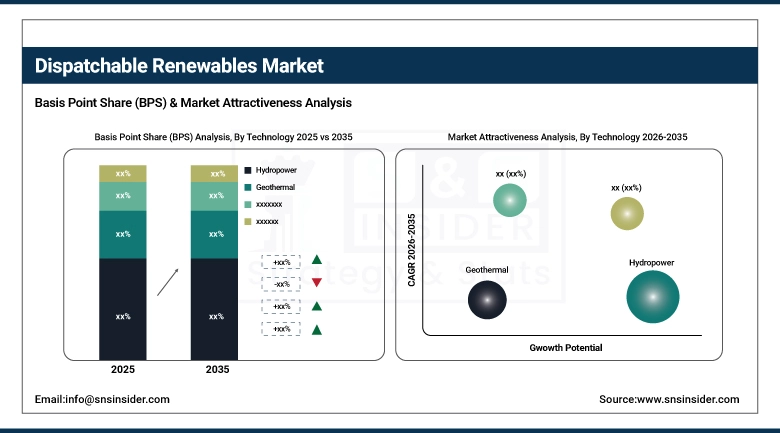
By Technology, Hydropower dominated the Dispatchable Renewables Market with ~54% share in 2025; Biomass fastest growing (CAGR).
-
By Capacity, Above 50 MW dominated the Dispatchable Renewables Market with ~48% share in 2025; 10 MW – 50 MW fastest growing (CAGR).
-
By End Use, Utilities dominated the Dispatchable Renewables Market with ~52% share in 2025; Commercial fastest growing (CAGR).
-
By Application, Grid Stabilization dominated the Dispatchable Renewables Market with ~34% share in 2025; Off-Grid Power Supply fastest growing (CAGR).
By Technology, Hydropower segment dominates the Dispatchable Renewables Market, Biomass segment expected to grow fastest
The Dispatchable Renewables Market was mainly dominated by hydropower due to its infrastructure, efficiency, and capability of offering stable and predictable power production. Its capacity to generate energy using reservoirs and the fast response time are critical factors for ensuring grid stability. Additionally, its longevity and low cost make it a valuable and cost-effective renewable energy source for both local and international markets.
Biomass is projected to witness the highest growth rate owing to its ability to produce a constant supply of power using organic wastes and crop residues. The growing emphasis on sustainable methods of converting wastes into usable forms of energy and the development of technology is expected to make biomass more efficient and hence, popular as a renewable energy resource.
By Capacity, Above 50 MW segment dominates the Dispatchable Renewables Market, 10 MW–50 MW segment expected to grow fastest
Above 50 MW capacity projects dominated the market because of their high generation capacities, thus allowing utility-based generation. They have economies of scale, meaning that they can produce electricity at relatively low costs. Besides, they can also help ensure grid stability and satisfy large demands for energy in industries and cities.
The 10 MW - 50 MW project category will witness the highest growth because of increasing demands for intermediate-scale energy sources. Projects in this category need lower investments than those of larger capacity. They can also be implemented within a shorter period of time. More acceptance in industries and regional grids is the driving factor behind their rapid penetration.
By End Use, Utilities segment dominates the Dispatchable Renewables Market, Commercial segment expected to grow fastest
Utility companies led the industry as they were responsible for generating electricity in bulk quantities. Their operations were based on reliable and predictable energy sources. The use of dispatchable renewables was beneficial for utility companies to ensure stable electricity transmission and peak load management. The rapid developments taking place in grid modernization and renewable energy transition made the presence of utility companies more dominant in the use of dispatchable renewables.
The commercial category will witness the highest growth owing to the rising demand for dependable and sustainable sources of energy for commercial establishments, data centers, and other business establishments. There is an increased emphasis on lowering carbon footprints and energy costs by generating renewable energy either within the premises or under contract arrangements.
By Application, Grid Stabilization segment dominates the Dispatchable Renewables Market, Off-grid Power Supply segment expected to grow fastest
Grid stabilization led in the market because it is vital to have a steady frequency and voltage in the system. Dispatchable renewables help in balancing the supply-demand equation that results from having various forms of energy supply. Being able to offer fast power generation is very important in terms of reliability, which makes them an important part of the modern energy structure.
The off-grid power supply segment would experience the highest growth because of increasing electrification initiatives in underserved and remote areas. Dispatchable renewables are reliable sources of energy that do not depend on the grid to operate. Investments in rural electrification and energy needs of mining and agriculture operations would contribute greatly to this trend.
Dispatchable Renewables Market Regional Analysis
Asia Pacific Dispatchable Renewables Market Insights
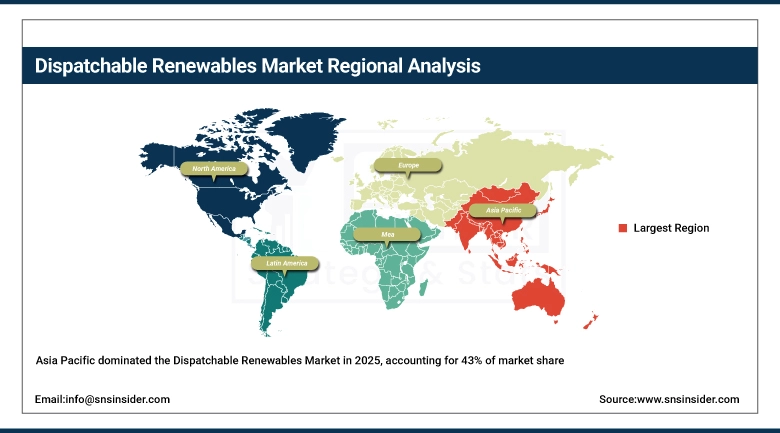
The Asia Pacific region accounted for the largest revenue share of around 43% in the Dispatchable Renewables Market in 2025 owing to significant investments in the generation of hydropower, biomass, and geothermal power plants. Growing industrialization coupled with increasing electricity consumption has led to the requirement for a secure source of energy supply. Additionally, government policies promoting a clean energy transition and infrastructure development have fueled the use of dispatchable renewable energy solutions in this region.
Get Customized Report as per Your Business Requirement - Enquiry Now
North America Dispatchable Renewables Market Insights
North America is one of the key markets supported by high-level infrastructure of energy generation and utilization of reliable renewable energy sources. This continent has abundant hydro power potential, along with expanding use of biomass and geothermal resources. Growing interest in the development of resilient grids and utilizing intermittent sources of renewable energy results in increased demand for flexible energy systems. Efficient regulatory environment and advances in technologies also facilitate the growth of dispatchable renewable energy sources in North America.
Europe Dispatchable Renewables Market Insights
Europe is an established and continuously developing geographical area within the Dispatchable Renewables Market, driven by effective policy instruments and decarbonization initiatives. Europe focuses on integrating renewable power sources, like biomass, hydroelectricity, and geothermal power, in order to counterbalance the increased presence of solar and wind power. Europe's advanced grid systems, international energy trading, and energy storage systems contribute to making dispatchable renewable sources more crucial for achieving a reliable energy grid.
Middle East & Africa and Latin America Dispatchable Renewables Market Insights
Middle East & Africa and Latin America markets are growing continuously due to an increasing emphasis on flexibility in energy supply systems. The deployment of hydropower, biomass, and geothermal energy systems is facilitating energy diversification and grid stabilization. Growth in electrification programs and infrastructural development, combined with favorable governmental policies, is also contributing to their growth.
Dispatchable Renewables Market Competitive Landscape:
Siemens Energy
Siemens Energy is a Germany-based global energy technology company (founded in 2020) specializing in power generation, transmission, and industrial energy solutions. The company focuses on enabling the energy transition through renewable integration, grid stabilization technologies, hydrogen-ready systems, and flexible power infrastructure. Its portfolio spans gas turbines, grid technologies, offshore wind support, and digital energy solutions, making it a key player in delivering reliable, dispatchable, and low-carbon energy systems worldwide.
-
2026: Siemens Energy was selected to supply transformers for modernization of Romania’s Iron Gate 1 hydropower plant, improving reliability and extending lifecycle of a major dispatchable renewable asset supporting grid stability and flexible electricity generation.
-
2025: Siemens Energy highlighted hybrid power plant capabilities combining renewables with flexible generation and hydrogen-ready systems, enabling dispatchable low-carbon energy solutions that stabilize grids and support integration of intermittent renewable sources.
-
2024: Siemens Energy supported offshore wind infrastructure at Inch Cape project, delivering substations enabling grid integration and dispatch optimization, ensuring renewable electricity delivery with improved reliability and controllability for large-scale power systems.
Dispatchable Renewables Companies are:
-
Siemens Energy
-
ANDRITZ Hydro
-
GE Renewable Energy
-
China Three Gorges Corporation
-
Statkraft
-
ENGIE
-
Xcel Energy
-
Babcock & Wilcox Enterprises
-
ABB Ltd.
-
EDF Renewables
-
Iberdrola S.A.
-
NextEra Energy
-
Ormat Technologies
-
Voith Group
-
GE Vernova
-
Brookfield Renewable
-
Exowatt
-
TotalEnergies
Dispatchable Renewables Market Report Scope
| Report Attributes | Details |
|---|---|
| Market Size in 2025 | USD 59.82 Billion |
| Market Size by 2035 | USD 143.08 Billion |
| CAGR | CAGR of 9.18% From 2026 to 2035 |
| Base Year | 2025 |
| Forecast Period | 2026-2035 |
| Historical Data | 2022-2024 |
| Report Scope & Coverage | Market Size, Segments Analysis, Competitive Landscape, Regional Analysis, DROC & SWOT Analysis, Forecast Outlook |
| Key Segments | • By Technology (Concentrated Solar Power, Biomass, Geothermal, Hydropower, Others) • By End Use (Utilities, Industrial, Commercial, Residential, Others) • By Application (Grid Stabilization, Peak Power Generation, Off-Grid Power Supply, Backup Power, Others) • By Capacity (Up to 10 MW, 10 MW – 50 MW, Above 50 MW) |
| Regional Analysis/Coverage | North America (US, Canada), Europe (Germany, UK, France, Italy, Spain, Russia, Poland, Rest of Europe), Asia Pacific (China, India, Japan, South Korea, Australia, ASEAN Countries, Rest of Asia Pacific), Middle East & Africa (UAE, Saudi Arabia, Qatar, South Africa, Rest of Middle East & Africa), Latin America (Brazil, Argentina, Mexico, Colombia, Rest of Latin America). |
| Company Profiles | Siemens Energy, Voith Hydro, ANDRITZ Hydro, GE Renewable Energy, China Three Gorges Corporation, Statkraft, Enel Green Power, ENGIE, Xcel Energy, Babcock & Wilcox Enterprises, ABB Ltd., EDF Renewables, Iberdrola S.A., NextEra Energy, Ormat Technologies, Voith Group, GE Vernova, Brookfield Renewable, Exowatt, TotalEnergies. |
Frequently Asked Questions
Asia Pacific dominated the Dispatchable Renewables Market in 2025
The Hydropower segment dominated the Dispatchable Renewables Market in 2025.
Growing investments in grid modernization and energy storage integration supporting deployment of controllable renewable energy technologies globally.
The Dispatchable Renewables Market was valued at USD 59.82 billion in 2025.
The Dispatchable Renewables Market is expected to grow at a CAGR of 9.18% from 2026 to 2035.
