
Firmware Signing Platform Market Report Scope & Overview:
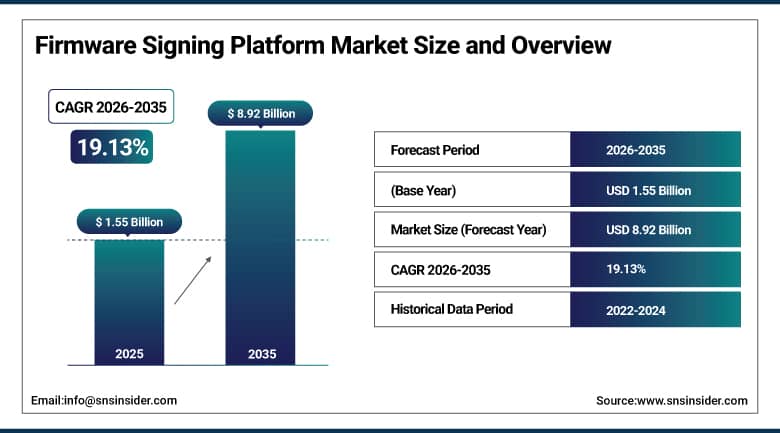
The Firmware Signing Platform Market was valued at USD 1.55 Billion in 2025 and is expected to reach USD 8.92 Billion by 2035, growing at a CAGR of 19.13% from 2026 to 2035.
Firmware signing has become genuinely foundational to how connected devices establish trust, and the market is rapidly growing on the back of increasing demand for secure device boot processes, rising IoT and industrial automation adoption, and stringent cybersecurity regulation. These platforms ensure firmware authenticity, preventing unauthorized modifications and enhancing system integrity across everything from consumer electronics to critical infrastructure.
Enterprises, OEMs, and critical infrastructure sectors are investing in robust signing solutions, key management, and integrity monitoring to protect connected devices and industrial systems, and growing digital transformation, coupled with the sheer proliferation of connected devices, keeps fueling market expansion. Continuous innovation, government cybersecurity initiatives, and rising awareness of firmware-level threats are expected to sustain steady growth across the category well through the forecast period.
To Get More Information On Firmware Signing Platform Market - Request Free Sample Report
Firmware Signing Platform Market Trends
-
Rising demand for secure device boot processes keeps pushing OEMs and enterprises toward more robust firmware signing infrastructure.
-
Increasing IoT and industrial automation adoption continues expanding the addressable market for firmware authenticity solutions.
-
Stringent cybersecurity regulation across critical infrastructure sectors keeps accelerating investment in signing solutions, key management, and integrity monitoring.
-
Growing digital transformation, coupled with the proliferation of connected devices, keeps fueling steady market expansion across every major industry vertical.
-
Rising awareness of firmware-level threats, including supply chain compromises, continues driving adoption of automated, cloud-integrated signing workflows.
The U.S. Firmware Signing Platform Market Outlook
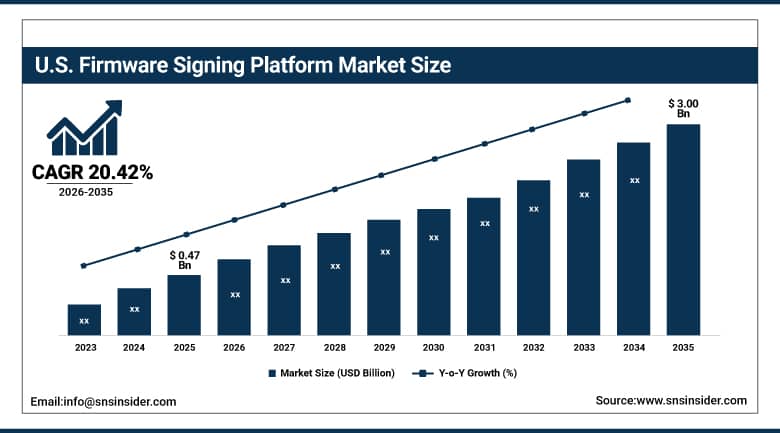
The U.S. Firmware Signing Platform Market is estimated to be USD 0.47 Billion in 2025 and is projected to reach USD 3.00 Billion by 2035, growing at a CAGR of 20.42% during 2026–2035.
The growth in the market in the U.S. is fueled by increased demand for secure authenticated update services in IoT, automotive, medical, and industrial segments. The companies and OEMs operating in the U.S. have been among the earliest adopters of firmware signing architecture. This is especially true for the critical infrastructure, automotive, and IoT segments, where the need for regulatory compliance is increasing. The region is favored due to the presence of advanced technology adoption, IT infrastructure, and regulatory compliance. However, early adoption of secure firmware solutions, increase in cybersecurity needs, and integration with AI-based platforms continue to make the U.S. the leading and the fastest growing market for this segment globally.
American Megatrends Inc. partnered with Ampere Computing to implement scalable and automated firmware management across multi-vendor server platforms, aiming to advance secure, heterogeneous firmware management and orchestration across multi-vendor, multi-generation server infrastructure while streamlining the firmware lifecycle from development through deployment.
Firmware Signing Platform Market Segment Analysis
-
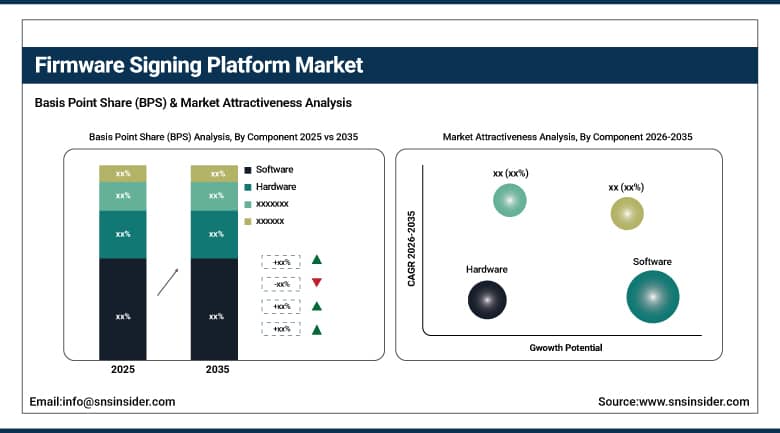
By Component, Software dominated with a 58.63% share in 2025 and is also the fastest-growing component at a CAGR of 20.05%.
-
By Deployment Mode, Cloud dominated with a 47.13% share in 2025 and is also the fastest-growing deployment mode at a CAGR of 22.69%.
-
By Organization Size, Large Enterprises dominated with a 57.25% share in 2025, while Small and Medium Enterprises is the fastest-growing organization-size segment at a CAGR of 20.62%.
-
By Application, Industrial Control Systems dominated with a 21.38% share in 2025, while Healthcare Devices is the fastest-growing application at a CAGR of 20.85%.
By Component, Software leads and grows fastest
The software segment emerged to be the leader of the market, with a market share of 58.63% in 2025, owing to the extensive usage of the same in enterprises, its association with AI technology, and its deployment in cloud computing. Scalability, intelligence, and security of software make it the most desired option for businesses for their digital needs, which have made it the leading component by a good margin.
The software segment is also the fastest-growing component at a CAGR of 20.05%. This is an abnormal leadership combination owing to the increased demand for automated and scalable platforms that increase operational efficiency and enterprise innovation. With the shift in the firmware signing process from the manual, hardware-centric model to an automated software-driven one, this has been the key to the growing prominence of the software component.
By Deployment Mode, Cloud leads and grows fastest
In 2025, Cloud continues to dominate the segment in terms of market shares (47.13%) due to high scalability, flexibility, and possibility of performing remote and real-time operations. Enterprises opt for the cloud-based signing infrastructure because cloud enables organizations to perform key management, certificate management, and signing process management in a centralized manner despite the distributed device fleets that do not require maintenance of any on-premise infrastructure.
At the same time, cloud-based deployment mode continues to enjoy the highest CAGR (22.69%). The high growth rate of cloud-based deployment mode can be explained by the high demand for a secure, flexible, and efficient platform. The increasing trend of moving IT infrastructure to the cloud and integration expectations of firmware signing solutions into the already established cloud-based development and deployment process are the factors behind the dominance of cloud-based deployment mode.
By Organization Size, Large Enterprises lead, SMEs grow fastest
Large enterprises continue to dominate the market, accounting for a 57.25% share, due to their extensive IT infrastructure, resource capabilities, and early adoption of advanced technologies. These organizations typically manage the largest device fleets and face the most stringent regulatory compliance obligations, giving them both the resources and the operational necessity to invest heavily in comprehensive firmware signing infrastructure.
Small and Medium Enterprises are expected to grow fastest through 2035, at a CAGR of 20.62%, as cloud-based, more accessible signing platforms continue lowering the barrier to entry that used to keep sophisticated firmware security out of reach for smaller organizations. As more SMEs enter IoT and connected device manufacturing, that expanding customer base with genuine but previously unaddressed security needs is what's driving this organization-size category's rapid growth.
By Application, Industrial Control Systems lead, Healthcare Devices grow fastest
Industrial Control Systems dominated the application segment in 2025, at a 21.38% share, reflecting the critical infrastructure protection requirements that keep pushing manufacturers of industrial equipment toward comprehensive firmware authenticity solutions. That combination of high stakes and regulatory pressure has kept industrial control systems the largest single application category, even as the overall application mix remains genuinely diverse across several substantial categories.
Healthcare Devices are the fastest-growing segment, at a CAGR of 20.85% globally, fueled by rising adoption of AI-enabled, connected, and real-time monitoring solutions that enhance patient care, efficiency, and operational safety. As medical device manufacturers increasingly build connected, software-updatable devices, the need to guarantee that only verified, untampered firmware ever reaches a device that could directly affect patient safety is what's pushing healthcare devices' growth rate ahead of every other application category.
Regional Analysis
|
Region |
Major Country |
Share within Region, 2025 (%) |
|---|---|---|
|
North America |
United States |
81.35% |
|
Europe |
Germany |
24.20% |
|
Asia Pacific |
China |
32.60% |
|
Latin America |
Brazil |
36.40% |
|
Middle East & Africa |
UAE |
25.10% |
North America Firmware Signing Platform Market Insights
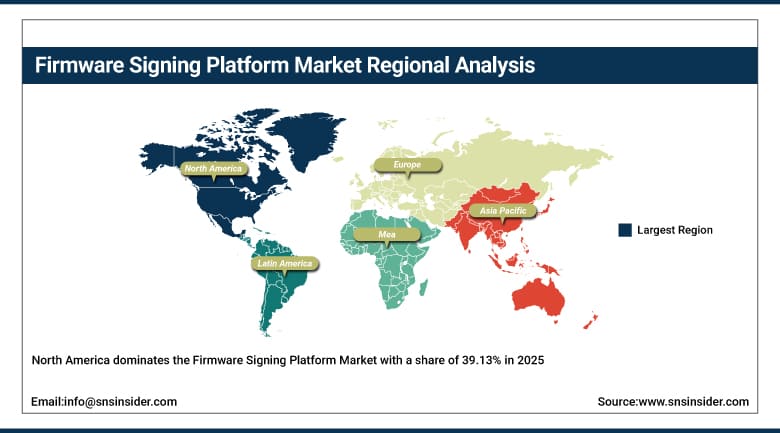
North America dominates the Firmware Signing Platform Market with a share of 39.13% in 2025, growing at a CAGR of around 16.99%. This region enjoys the advantage of advanced technological penetration, strong IT infrastructure, and high compliance with regulations due to the early adoption of secure firmware, increasing needs for cybersecurity, and AI integration, making North America the leading region and one of the fastest-growing regions globally as per the regional assessment done by SNS Insider.
The United States is responsible for about 81.35% of revenues in the region due to strong IT infrastructure, advanced technology adoption, and strict compliance with regulations in critical infrastructure, automobile, and IoT sectors. Canada also provides additional regional demand due to the growth of the cybersecurity and connected device market in the country, ensuring that North America continues to dominate the market throughout the forecast period.
Get Customized Report as Per Your Business Requirement - Enquiry Now
Europe Firmware Signing Platform Market Insights
Europe held a 24.50% share of the Firmware Signing Platform Market in 2025 at a CAGR of about 17.19%, representing a stable and mature market. The region's strong tradition of data protection regulation and its leadership in implementing comprehensive device security frameworks, including the EU Cyber Resilience Act and NIS2 Directive, keep creating direct, enforceable obligations for device manufacturers to implement verifiable firmware security.
Germany leads regional demand at roughly 24.20% of European revenue, supported by its strong industrial and automotive manufacturing base. The UK and France contribute substantial additional demand, and continued EU-level regulatory tightening around device security should keep European demand for firmware signing platforms climbing steadily through the forecast period.
Asia Pacific Firmware Signing Platform Market Insights
Asia Pacific is the fastest-growing region in the Firmware Signing Platform Market with a share of 23.75% in 2025 growing at a CAGR of around 24.57% over the forecast period, thus likely to surpass all the other regions in terms of absolute share over the forecast period. Key drivers of the growth include high rates of industrialization, growing adoption of IoT, and investments in digital infrastructure.
China is the leading market within the region, having about 32.60% share of revenue of the region, owing to China being the largest center for electronics manufacturing and investments in IoT infrastructure. Japan, South Korea, and India offer significant additional demand due to the adoption of security in product design process of local manufacturers to meet requirements in the export markets, making Asia Pacific the region growing fastest compared to others in the report.
MEA & Latin America Firmware Signing Platform Market Insights
In 2025, the market share in South America was 6.75%, with a CAGR of 15.39%. This was due to consistent growth because of an increase in investments towards digitalization. The Middle East & Africa had a market share of 5.88% in 2025, with a CAGR of 17.10%. This was because of consistent growth but relatively stable market share for the global market.
In Latin America, Brazil is the highest market leader with increasing demands in the region because of technology development and industrialization. In the Middle East & Africa, the UAE was the highest market leader with 25.10% of regional revenue because of consistent investments and cybersecurity policies.
Market Dynamics
Growth Drivers: Rising cybersecurity threats and IoT proliferation
The need for better security of the device through guaranteeing that only authorized software is run on the devices is a key driver in the adoption of the firmware signing technology. This is because signature technologies are increasingly being used in order to address concerns about firmware corruption, chip vulnerabilities, and advanced cyber attacks. The adoption of the platform is also driven by compliance regulations within the critical infrastructure, automotive, and Internet of Things industries where adoption of sophisticated firmware signing platforms that protect against cyber threats, preserve IP, and safeguard the device's trust is being encouraged.
The exponential growth of interconnected devices in industries like automotive, health care, manufacturing, and consumer electronics is further reinforcing this driver since the Internet of Things environment poses greater risks of firmware-based cyberattacks.
Restraints: Integration complexity and evolving security threats
Adoption of firmware signing platforms is hampered by a number of factors. Frequent updates are required due to growing security concerns, which increases operational complexity and expenses. Regional regulatory pressures make compliance difficult and cause implementation delays, and deployment is further constrained by high integration complexity with a variety of hardware and older systems, particularly in industrial and healthcare environments running legacy device architectures.
The global shortage of skilled cryptography and embedded security professionals constrains both vendor capacity and customer adoption rates. Rapidly evolving attack methodologies, including supply chain compromises targeting signing infrastructure itself, require continuous platform innovation and create ongoing investment pressure that smaller vendors and resource-constrained customers alike can find genuinely difficult to sustain.
Opportunities: Zero-trust architecture and healthcare device security
The leading vendors working within the firm ware signing platforms market place a premium on the use of advanced technology, such as zero-trust architecture, to increase device security, guarantee firm ware integrity, and block any attempts of unauthorized access. Zero trust architecture does not automatically trust any access requests and constantly authenticates any user or device, and vendors capable of implementing the security model to their firm ware signing platforms will gain considerable market traction as more organizations opt against perimeter-based security models.
The increased use of AI-driven, interconnected, and real-time systems used in medical devices represents another significant opportunity for players working in the market, as the need for guaranteeing the authenticity of firm ware in medical devices that have a direct impact on patient safety is becoming increasingly relevant. Vendors capable of providing a truly reliable and compliant firm ware signing infrastructure to the unique requirements of medical devices will benefit greatly from this trend.
Recent Developments:
-
2023: American Megatrends Inc. partnered with Ampere Computing to implement scalable and automated firmware management across multi-vendor server platforms, advancing secure firmware orchestration.
-
2025: Multiple major cloud and cybersecurity providers expanded firmware validation frameworks embedded across desktop, mobile, and cloud infrastructure ecosystems.
Firmware Signing Platform Market key players are:
-
DigiCert, Inc.
-
Thales Group
-
Microsoft Corporation
-
Infineon Technologies AG
-
NXP Semiconductors N.V.
-
Entrust Corporation
-
Keyfactor, Inc.
-
Amazon Web Services, Inc.
-
Apple Inc.
-
Google LLC
-
Cisco Systems, Inc.
-
Intel Corporation
-
Broadcom Inc.
-
Hewlett Packard Enterprise Company
-
Texas Instruments Incorporated
-
Nuvoton Technology Corporation
-
Rambus Inc.
-
Fortanix, Inc.
-
Futurex, Inc.
-
Wind River Systems, Inc.
Firmware Signing Platform Market Report Scope:
| Report Attributes | Details |
|---|---|
| Market Size in 2025 | USD 1.55 Billion |
| Market Size by 2035 | USD 8.92 Billion |
| CAGR | CAGR of 19.13% From 2026 to 2035 |
| Base Year | 2025 |
| Forecast Period | 2026-2035 |
| Historical Data | 2022-2024 |
| Report Scope & Coverage | Market Size, Segments Analysis, Competitive Landscape, Regional Analysis, DROC & SWOT Analysis, Forecast Outlook |
| Key Segments | • by Component (Software, Hardware, Services) • by Deployment Mode (Cloud, On-Premises) • by Organization Size (Large Enterprises, Small and Medium Enterprises) • by Application (Industrial Control Systems, Healthcare Devices, Automotive, Consumer Electronics, IoT Devices) |
| Regional Analysis/Coverage | North America (US, Canada, Mexico), Europe (Eastern Europe [Poland, Romania, Hungary, Turkey, Rest of Eastern Europe] Western Europe] Germany, France, UK, Italy, Spain, Netherlands, Switzerland, Austria, Rest of Western Europe]), Asia Pacific (China, India, Japan, South Korea, Vietnam, Singapore, Australia, Rest of Asia Pacific), Middle East & Africa (Middle East [UAE, Egypt, Saudi Arabia, Qatar, Rest of Middle East], Africa [Nigeria, South Africa, Rest of Africa], Latin America (Brazil, Argentina, Colombia, Rest of Latin America) |
| Company Profiles | DigiCert, Inc., Thales Group, Microsoft Corporation, Infineon Technologies AG, NXP Semiconductors N.V., Entrust Corporation, Keyfactor, Inc., Amazon Web Services, Inc., Apple Inc., Google LLC, Cisco Systems, Inc., Intel Corporation, Broadcom Inc., Hewlett Packard Enterprise Company, Texas Instruments Incorporated, Nuvoton Technology Corporation, Rambus Inc., Fortanix, Inc., Futurex, Inc., Wind River Systems, Inc. |

Frequently Asked Questions
The Firmware Signing Platform Market is expected to grow at a CAGR of 19.13% from 2026 to 2035.
The Firmware Signing Platform Market was valued at USD 1.55 Billion in 2025.
The major growth factor is increasing demand for secure device boot processes, rising IoT and industrial automation adoption, and stringent cybersecurity regulation.
The Software segment dominated the Firmware Signing Platform Market with a 58.63% share by component in 2025.
North America dominated the Firmware Signing Platform Market in 2025 with a 39.13% share of total global market revenue.
