
Furfural Derivatives Market Report Scope & Overview:
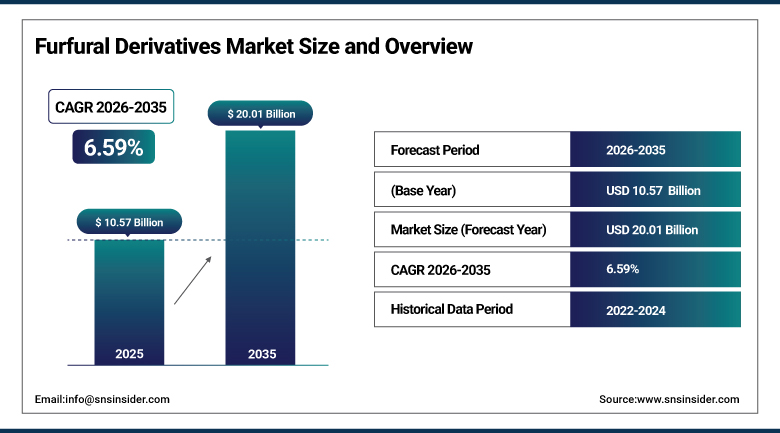
The Furfural Derivatives Market was valued at USD 10.57 Billion in 2025 and is expected to reach USD 20.01 Billion by 2035, growing at a CAGR of 6.59% from 2026-2035.
The Furfural Derivatives Market is expected to be fuelled by the rising need for bio-based chemicals and sustainable replacements for petroleum-based chemicals. Furfural derivatives have numerous applications in the making of solvents, resins, medicines, agrochemicals, and speciality chemicals. The rise in environmental concerns, coupled with an increased focus on renewable sources, is motivating the producers to develop furfural-based substitutes from agricultural waste materials like corn cobs, bagasse of sugar cane, and rice hulls. The rising requirement for bio-based solvents and furan compounds is likely to drive the Furfural Derivatives Market forward. Advancements in biomass conversion technology and investments in green chemistry manufacturing will make it possible.
⮞In August 2026, the Instituto Azucarero Dominicano reported that Central Romana Corporation produced 25,845 metric tons of furfural in the 2024-25 harvest. This output shows how sugar mill residues feed the global supply chain for furan derivatives.
To Get more information Furfural Derivatives Market - Request Free Sample Report
Furfural Derivatives Market Trends
-
Bio-based and biomass-balanced solvent grades are replacing fossil-derived supply in regulated end uses.
-
Foundries are shifting to furan resins with lower free furfuryl alcohol content as labeling rules tighten.
-
Furoic acid and related intermediates are moving toward pharmaceutical-grade purity specifications.
-
Producers are integrating upstream with sugar mills and corn processors to secure residue feedstock.
-
Furan chemistry is extending into FDCA and renewable polymer value chains.
U.S. Furfural Derivatives Market Outlook
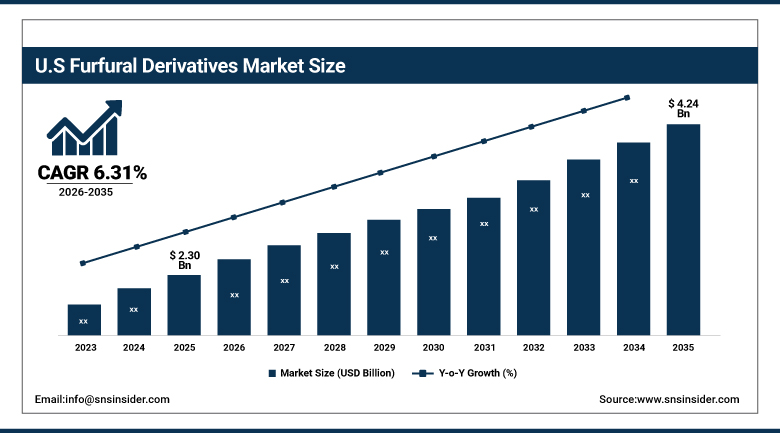
The U.S. Furfural Derivatives Market was valued at USD 2.30 Billion in 2025 and is expected to reach USD 4.24 Billion by 2035, growing at a CAGR of 6.31% from 2026-2035.
The U.S. Furfural Derivatives Market is anchored by foundry resin consumption, specialty solvent demand and a rising preference for certified biobased inputs. Cast parts for vehicles, pumps and construction equipment rely on furan no-bake binders that cure at ambient temperature and allow efficient sand reclamation. Pharmaceutical and agricultural formulators use tetrahydrofurfuryl alcohol and 2-methyltetrahydrofuran as renewable solvents. Federal procurement preferences and corporate sustainability targets reward products with verified biobased content. Buyers also weigh supply security because commercial furfural production is concentrated in a few residue-rich regions overseas. These factors support steady growth in local derivative upgrading and formulation. Local formulators also see rising interest in renewable carriers.
As of June 2026, the USDA BioPreferred Program reported that approximately 9,000 biobased products in more than 200 product categories had received certification. This certified base gives furfural-derived solvents and resins a recognized route to federal purchasing visibility.
Furfural Derivatives Market Segment Analysis
-
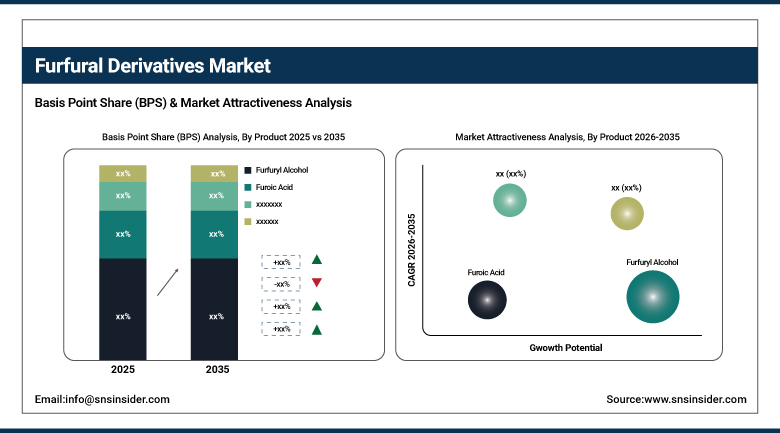
By Product, the Furfuryl Alcohol segment dominated the Furfural Derivatives Market with approximately 51.10% share in 2025, while the 2-Methyltetrahydrofuran segment is the fastest growing with a CAGR of approximately 7.69%.
-
By Raw Material, the Corncob segment dominated the Furfural Derivatives Market with approximately 49.45% share in 2025, while the Bagasse segment is the fastest growing with a CAGR of approximately 7.49%.
-
By Application, the Resins and Foundry Binders segment dominated the Furfural Derivatives Market with approximately 54.20% share in 2025, while the Agrochemicals segment is the fastest growing with a CAGR of approximately 7.64%.
-
By End-Use Industry, the Chemicals segment dominated the Furfural Derivatives Market with approximately 59.24% share in 2025, while the Pharmaceuticals segment is the fastest growing with a CAGR of approximately 7.39%.
By Product, Furfuryl Alcohol Dominates the Furfural Derivatives Market and 2-Methyltetrahydrofuran Grows Fastest
The furfuryl alcohol segment dominates the Furfural Derivatives Market due to its wide usage in the manufacture of foundry resins, corrosion-resistant products, and specialty chemicals. The properties of this product enhance the thermal stability, chemical resistance, and mechanical strength that make it useful in metal casting and industry. In addition, the increase in demand from foundries, construction, and chemical manufacture leads to steady consumption of furfuryl alcohol. Moreover, the developed methods of production and compatibility with many kinds of resins make this product dominant in the market.
The 2-methyltetrahydrofuran segment is expected to grow rapidly due to growing demand for renewable solvents and replacement of traditional petroleum-based chemicals. Favorable solvent properties, lower boiling point, and use in the synthesis of drugs and specialty chemicals make this product suitable. Increasing demand for bio-solvents encourages manufacturers to produce the furfural derivatives in different industries. In addition, there are opportunities for the use of 2-methyltetrahydrofuran in the studies of batteries and chemical reactions.
⮞A March 2025 data sheet from International Furan Chemicals states that the TransFurans plant near Antwerp produces over 40,000 MT of furfuryl alcohol annually. The company describes it as the world's largest furfural hydrogenation plant.
By Raw Material, Corncob Dominates the Furfural Derivatives Market and Bagasse Grows Fastest
The corncob segment dominates the Furfural Derivatives Market owing to the agricultural raw material that consists of hemicellulose and can be used to produce furfural. Reliable collection infrastructure in the corn-growing regions is established. The corncobs can also be considered agricultural waste, and, thus, producers are able to use available sources of biomass, instead of growing purpose-specific raw materials. Also, the conversion experience and established conversion technologies add value to the adoption of the corncobs. Suitability of the corncobs to production of furfural adds weight to their role in providing raw material to downstream chemical producers.
The bagasse segment is expected to grow rapidly due to increasing research and development activities of the chemical manufacturers in exploring agriculture waste in order to develop renewable chemicals. The bagasse, which is a by-product of the sugarcane, is a good source of biomass in the countries that produce sugar and it consists of hemicellulose suitable to be converted to furfural. Processing of bagasse in the furfural manufacturing is beneficial for the creation of new values of sugar industry by-products.
⮞In January 2026, the USDA Economic Research Service raised its estimate of the 2025/26 U.S. corn crop to 17.00 billion bushels. A crop of that size enlarges the cob residue pool and supports feedstock pricing for corn-based furfural processors worldwide.
By Application, Resins and Foundry Binders Dominates the Furfural Derivatives Market and Agrochemicals Grows Fastest
The resins and foundry binders segment dominates the Furfural Derivatives Market owing to the use of large quantities of furfuryl alcohol to manufacture furan based resins for metal casting. The binders act as a good binding agent and provide strength and dimensional stability thus help to produce metal components. The demand from various foundries used in the manufacturing of automobiles, machinery, construction, and industrial equipments creates a consistent demand from the industry. Additionally, the furan resins have chemical resistance making them useful for some special industrial use. Existing foundry process, metal casting and good performance of the binders support the dominance of the segment.
The agrochemicals segment is expected to grow rapidly driven by the growing demand for the use of chemical solutions to increase crop productivity in addition to controlling pests, disease and weed infestations in agriculture. The derivatives will be of great importance where they will be used as intermediates in manufacturing some agrochemical compounds. The increasing demand for crop protection products as well as advancement in green chemical manufacture processes have opened up the area of bio-based derivatives in this field.
⮞The Institute of Indian Foundrymen stated in February 2026 that India's foundry industry produced 15.86 million metric tonnes in 2024-25 across nearly 5,000 units. That output reflects a large base of sand casting plants consuming furan resin systems.
By End-Use Industry, Chemicals and Materials Dominates the Furfural Derivatives Market and Pharmaceuticals Grows Fastest
The chemicals and materials segment dominates the Furfural Derivatives Market because furfural and its derivatives serve as furfural derivatives are used as intermediates in the manufacture of resins, solvents, specialty chemicals, and industrial material chemicals. Furfuryl alcohol, for instance, acts as an essential derivative in the manufacture of furan resins. Other derivatives play an important role in the chemical synthesis processes and in some industrial uses. Customers in the foundries, construction materials, and industrial manufacturing sectors act as key downstream customers. The availability of processing facilities and flexibility in the furfural derivatives further ensure the usability in commercial processes. The numerous applications create demand among the chemicals and materials players.
The pharmaceuticals segment is expected to grow rapidly due to the usage of furfural derivatives in chemical industries and pharmaceutical sector as intermediates to the synthesis of some specific active ingredients and specialty compounds. Such functional chemical structures provide great chances for manufacturing of molecules required in the process. High spending on drug discovery, specialty chemical synthesis, and pharmaceutical production can provide enough demand for such compounds based on furans. Moreover, increased focus on renewable raw materials is contributing to the bio-based intermediate research. Pharmaceutical market depends largely on the performance of compounds, purity requirements, etc.
⮞In April 2026, the International Organization of Motor Vehicle Manufacturers (OICA) reported that global vehicle production rose from 92.70 million units in 2024 to 96.40 million in 2025. Higher vehicle output lifts casting demand and with it the use of furan binders across the chemicals and materials chain.
Regional Insights
|
Region |
Major Country |
Share within Region, 2025 (%) |
|---|---|---|
|
Asia Pacific |
China |
66.67 |
|
North America |
United States |
91.43 |
|
Europe |
Germany |
33.33 |
|
Latin America |
Dominican Republic |
38.62 |
|
Middle East & Africa |
South Africa |
52.76 |
North America Furfural Derivatives Market Insights
North America represented 23.83% of 2025 revenue with the United States and Canada as the only contributing countries. Foundries in the Midwest and Ontario supply cast components to automakers and heavy equipment builders and consume furan no-bake binders in volume. Specialty solvent users in pharmaceutical and agricultural formulation add a second demand line. Because commercial furfural production sits overseas, sourcing agreements with offshore suppliers are central to regional resin and solvent makers. Distribution networks for specialty chemicals are mature and well integrated, which helps new grades reach buyers quickly.
Regulatory scrutiny shapes how suppliers operate across the region. Environmental and health agencies review volatile furan compounds, and resin and solvent producers respond with emission controls, exposure monitoring and customer stewardship programs. These obligations raise compliance cost but also favor suppliers with documented safety data and consistent quality. Demand for lower-emission binder systems in foundries and for renewable solvents in drug manufacturing therefore rewards formulators that can demonstrate responsible handling. Customers increasingly request this documentation during supplier audits and often make it a condition of long term supply agreements.
⮞In March 2023, Environment and Climate Change Canada and Health Canada published a proposed risk characterization of outdoor air exposure to furfuryl alcohol and tetrahydrofuran, citing facility air releases of about 641 tonnes of furfuryl alcohol in 2019. Scrutiny of this kind guides product stewardship programs among resin and solvent suppliers.
Europe Furfural Derivatives Market Insights
Europe is projected to expand at a CAGR of 7.33% from 2026 to 2035, the fastest pace among the regions. Belgium anchors the regional chain. TransFurans Chemicals has operated a furfuryl alcohol plant at Geel since 1972 and depends on imported furfural, with Belgium receiving 24,685.80 metric tons of the Dominican Republic's 26,685.90 metric tons of furfural exports in 2023. That trade lane links Caribbean sugar residues directly to European resin and solvent supply. Strong policy backing also supports faster adoption of renewable chemicals by regional converters and brand owners.
Germany hosts the region's largest foundry and automotive supply base and sustains demand for furan no-bake resins and renewable solvents. Chemical groups in the Netherlands, France and Germany also invest in bio-based platform molecules that fit climate and circular economy goals. Pharmaceutical process chemists across the region favor 2-methyltetrahydrofuran and tetrahydrofurfuryl alcohol as replacements for chlorinated solvents, which keeps specialty grade volumes rising even where heavy industry demand is flat. Research institutes add momentum through pilot projects in biomass conversion and green solvent development.
⮞In November 2025, the European Commission adopted a new bioeconomy strategy that aims to boost demand for bio-based content in products through targets in relevant legislation. Such targets would widen the market for furan-based solvents and resins in the region.
Asia Pacific Furfural Derivatives Market Insights
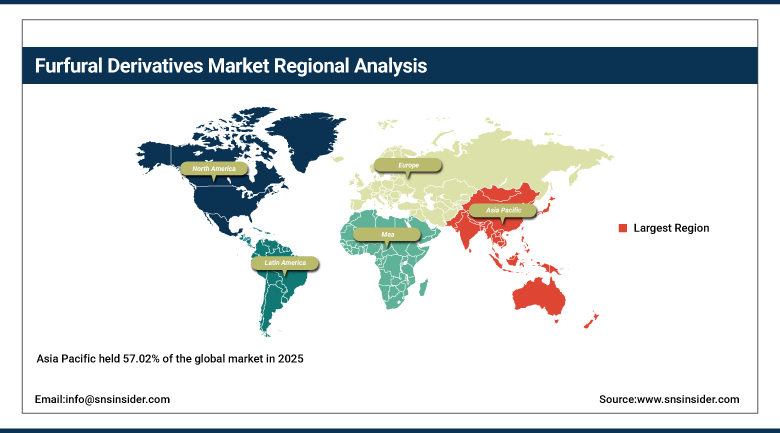
Asia Pacific held 57.02% of the global market in 2025 because China concentrates the largest volume of furfural and furfuryl alcohol output. Xingtai Chunlei Furfuryl Alcohol lists annual capacity of 30,000 tonnes of furfural, 25,000 tonnes of furfuryl alcohol and 5,000 tonnes of furan resin at its Hebei base. Northern corn belts supply cob residue at low cost, and local resin makers sell into a vast casting industry. Cost leadership gives Chinese exporters a strong position in global furfuryl alcohol trade. Rising consumption in neighboring markets adds a second growth path for regional producers.
Japan adds a technology-led layer to regional demand. Kao Corporation has made KAO LIGHTNER furan binders for casting sand at its Wakayama plant since 1974 and later opened Chinese production sites in 2002, 2012 and 2015. India contributes a growing mill-based supply chain as sugar and ethanol producers look at furfural recovery from bagasse. Southeast Asian foundries and agrochemical formulators broaden the buyer base further and keep regional demand for higher purity grades rising. Local standards for casting quality favor suppliers with proven technical service.
⮞In December 2025, the National Bureau of Statistics of China reported a record grain output of 714.88 million tonnes for 2025. Large grain harvests generate the corn residue that Chinese furfural plants convert into feedstock.
Get Customized Report as per Your Business Requirement - Enquiry Now
MEA & Latin America Furfural Derivatives Market Insights
Latin America links Caribbean raw material strength with Argentine downstream processing and Mexican manufacturing demand. Central Romana Corporation built its Dominican furfural plant in 1955 and expanded it in 1973 to reach installed capacity of up to 90 million pounds per year. Silvateam produces furfuryl alcohol in Argentina at 98.50% purity through high-pressure catalytic hydrogenation. Mexico adds foundry and automotive consumption that draws on both regional and imported furan derivatives. Together these assets give the region a flexible export position toward both Europe and North America.
In the Middle East and Africa, South Africa leads regional supply. Illovo Sugar makes furfural and furfuryl alcohol at Sezela alongside its sugar operations, and the main use of its furfuryl alcohol is resin binding of foundry sand. Mill-based integration lets the producer convert bagasse into higher value chemicals. Other markets in the region import resins and solvents and offer long-run potential as casting and agrochemical use grow. Government interest in agro-industrial diversification may support new projects over time and improve local value capture from cane and grain residues.
⮞The South African Sugar Association reported in August 2026 that 16,809,086 tons of cane were crushed in the 2025/2026 season. That cane volume defines the bagasse base for mill-integrated furfural production in the
Market Dynamics
Growth Drivers: Expanding Sugar and Ethanol Output Is Widening the Residue Feedstock Base for Furfural Derivatives
Producers and brand owners are moving away from fossil-derived intermediates, and furfural offers a route that starts from residues rather than crude oil. Tetrahydrofurfuryl alcohol and 2-methyltetrahydrofuran already substitute for hazardous solvents in pharmaceutical and crop protection formulations. Corporate emission targets and procurement rules reward products with renewable carbon content. Each of these shifts opens purchasing channels for furan-based chemistry that did not exist a decade ago and lifts volumes beyond traditional resin outlets. Rising investor attention to bio-based chemistry further supports capacity planning and helps producers fund purity upgrades.
Foundry demand provides a stable base. Furan no-bake binders deliver fast cure and strong mold strength, and casting plants adopt them to meet air quality limits and productivity goals. Feedstock availability reinforces the trend because sugar mills and corn processors produce residues at predictable volumes. Integrated operators that convert those residues on site secure lower input costs and can price derivatives competitively against phenolic and urethane systems. Steady casting demand from vehicles and machinery cushions the market in weaker cycles and supports long term supply contracts.
⮞The Indian Sugar and Bio-energy Manufacturers Association estimated in November 2025 that India's sugar production would reach 34.35 million tonnes in 2025-26. Greater cane crushing translates into additional bagasse available for furfural processors.
Restraints: Seasonal Residue Supply and Strict Labeling Rules Are Raising Input and Compliance Costs for Producers
Furfural supply depends on seasonal harvests and agricultural residue logistics. Weather shocks alter corncob and bagasse availability and price, and collection from scattered farms adds transport cost. The process is energy intensive and lacks the scale economies of petrochemical plants, so producers outside China face a persistent cost gap against Chinese exporters. Margin pressure follows whenever feedstock prices rise faster than derivative prices, which discourages new capacity in higher cost regions. Storage of bulky residues adds working capital needs as well and exposes inventories to moisture loss and spoilage.
Health and environmental rules add a second layer of cost. Furfuryl alcohol and tetrahydrofuran face toxicity review in several jurisdictions, and resin makers must manage worker exposure and emissions. Reformulation toward lower free monomer content requires testing and customer requalification, which takes time and capital. Smaller producers in developing economies also lack technical skills and awareness of advanced derivatives, so growth in value-added grades remains uneven across regions. Compliance costs weigh most on smaller regional producers, which may slow consolidation of fragmented supply.
⮞ASK Chemicals noted in a July 2022 press article that resins containing more than 40 wt % of free furfuryl alcohol must be labelled as toxic. Such labeling pushes foundry resin makers toward reformulation and adds development cost.
Opportunities: Bioeconomy Policies in India and Europe Are Opening New Demand for Furan Platform Chemicals
Furandicarboxylic acid and polyethylene furanoate offer the most visible new outlet because they extend furan chemistry into packaging polymers. Developers are moving the technology toward industrial scale and will need dependable furan-based building blocks. 2-Methylfuran also attracts interest as a renewable fuel additive that blends with gasoline. Producers able to supply consistent purity grades are positioned to join these value chains as volumes build. Partnerships between polymer developers and furan suppliers could accelerate adoption of these materials and secure long term offtake for new plants.
Policy programs that favor biomanufacturing create room for new furfural capacity near feedstock. Integrated biorefineries can combine furfural, ethanol and lignin streams to improve plant economics. Pharmaceutical-grade furoic acid and high purity solvents offer premium pricing for producers able to meet quality standards. North America and Europe are also exploring local production of green chemicals to reduce import dependence, which favors investors willing to commit early. Early movers can also secure long term feedstock contracts with mills and shape the standards that later entrants must follow.
⮞In August 2024, the Indian Cabinet approved the BioE3 Policy of the Department of Biotechnology, which lists high value bio-based chemicals among its priority sectors. This direction supports new furfural-based capacity and derivative production in the country.
Recent Developments
-
October 2026, Monument Chemical moved to expand its global supply of bio-based tetrahydrofurfuryl alcohol and 2-methyltetrahydrofuran after Minasolve agreed to cease U.S. production of both solvents. The step keeps a furfural-based solvent producer active in North America and Europe and protects supply for pharmaceutical and agricultural customers.
-
September 2026, Avantium completed commissioning of the purification unit at its FDCA flagship plant in Delfzijl, with all major process units now commissioned. Ramp-up to full design capacity is expected about 24 months after start-up. The plant brings a furan-based polymer building block closer to commercial supply.
-
May 2024, BASF announced that its biomass-balanced tetrahydrofuran had been certified at the Ludwigshafen and Geismar sites. The certification offers customers a lower-carbon solvent and monomer option that competes directly with bio-based furan derivative routes.
-
February 2023, the U.S. Department of Commerce International Trade Administration published the continuation of the antidumping duty order on furfuryl alcohol from China. The decision keeps duties in place and continues to influence sourcing choices among U.S. resin makers.
Furfural Derivatives Companies are:
-
TransFurans Chemicals
-
Central Romana Corporation
-
Illovo Sugar
-
Xingtai Chunlei Furfuryl Alcohol
-
ASK Chemicals
Furfural Derivatives Market Report Scope:
| Report Attributes | Details |
|---|---|
| Market Size in 2025 | USD 10.57 Billion |
| Market Size by 2035 | USD 20.01 Billion |
| CAGR | CAGR of 6.59% From 2026 to 2035 |
| Base Year | 2025 |
| Forecast Period | 2026-2035 |
| Historical Data | 2022-2024 |
| Report Scope & Coverage | Market Size, Segments Analysis, Competitive Landscape, Regional Analysis, DROC & SWOT Analysis, Forecast Outlook |
| Key Segments | • By Product (Furfuryl Alcohol, Furoic Acid, Tetrahydrofuran, 2-Methyltetrahydrofuran, 2-Methylfuran, and Others) • By Raw Material (Corncob, Bagasse, Rice Husk, and Others) • By Application (Resins and Foundry Binders, Solvents, Agrochemicals, Flavors and Fragrances, Fuel Additives, and Others) • By End-Use Industry (Chemicals, Automotive, Pharmaceuticals, Paints and Coatings, Agriculture, Food and Beverages, and Others) |
| Regional Analysis/Coverage | North America (US, Canada), Europe (Germany, UK, France, Italy, Spain, Russia, Poland, Rest of Europe), Asia Pacific (China, India, Japan, South Korea, Australia, ASEAN Countries, Rest of Asia Pacific), Middle East & Africa (UAE, Saudi Arabia, Qatar, South Africa, Rest of Middle East & Africa), Latin America (Brazil, Argentina, Mexico, Colombia, Rest of Latin America). |
| Company Profiles | TransFurans Chemicals, Central Romana Corporation, Silvateam, Illovo Sugar, Monument Chemical, Xingtai Chunlei Furfuryl Alcohol, ASK Chemicals |

Frequently Asked Questions
The key players in the Furfural Derivatives Market include TransFurans Chemicals, Central Romana Corporation, Silvateam, Illovo Sugar, Monument Chemical, among others.
Key opportunities include furandicarboxylic acid and bio-based polymer value chains, 2-methylfuran as a renewable fuel additive, pharmaceutical-grade furoic acid and solvents, and integrated biorefineries supported by bioeconomy policies in India and Europe.
The major growth factor is the shift from petrochemical intermediates to bio-based furan chemistry. Stable foundry resin demand and rising availability of sugar and corn residues reinforce this shift and support steady volume growth across regions.
The Furfuryl Alcohol segment dominated the Furfural Derivatives Market with approximately 51.10% share in 2025. Its position reflects the central role of furan resins in foundry binders and composites, supported by long qualification cycles with metal casters.
Asia Pacific dominated the Furfural Derivatives Market in 2025 with a 57.02% share. The lead is attributed to large-scale Chinese furfural and furfuryl alcohol production, low-cost corn residue feedstock and a vast casting industry.
